The frontiers of bureacracy and the frontier bureaucrat
With people like Phyllis Shaffley against it, you can’t help sort of supporting something like The Kansas City Smart Port project. Basically, this is just a giant truck stop and train yard … shipping containers unloaded at Lazaro Cardenas would be driven straight through to Kansas City before stopping for customs and re-deployment through the United States and Canada.
OK, there are some serious corporatist concerns… the port facilities in Lazaro Cardenas are run by the Chinese and these ships will – presumably – be unloading Chinese goods, the manufacturer of which undercuts both U.S. and Mexican businesses… and unloading at Lazaro Cardenas will cut into traffic at Long Beach, the biggest U.S. Pacific commercial port. And, this probably has something to do with the Trans-Texas Corrodor (the proposed ten-lane and two-traintrack route through Texas which, if the feeder goes through the Big Bend means moving … well… basically most of the towns around here – we are where we are because it’s where the passes are, and where the trains can get through the mountains). You know, the kind of stuff we lefy types worry about.
But what’s really got the right-wing loon’s panties in a twist is that the Kansas City SmartPort would include a Mexican Customs Station… according to them, one more step in the Mexification of ‘Murica.
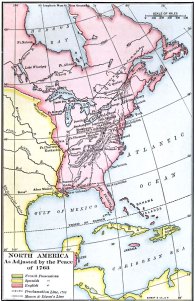 It wouldn’t be the first time the Mexicans were in Missouri. Which had something to do with the successor to the Austrian Crown, which led to the War of Austrian Succession, which somehow led to the Seven Years War, somehow involving Britain and Prussian… and France and Portugal and Saxony, and Spain and the Netherlands all squabbling over colonies around the planet. What we know as the French and Indian Wars was one part of a global stuggle for markets and access to raw materials. Winston Churchill later called it the real “FIRST World War”. It all came to an end in 1763, with the Treaty of Paris, which – among many other things — took Louisiana (at the time extending into today’s Alberta) away from France, turning over everything east of the Mississippi to the British, and the rest to Spain. That put what’s now Missouri in the middle of an overly large Nueva España.
After the American Revolution, the United States of course, controlled the former British territories east of the Mississippi, which added a player to the game. A few new United States citizens, for one reason or another, preferred to move into the Spanish territory (usually involving legal problems). And Missouri was a long, long way from Mexico City… which itself is a long, long way from Spain.
The chief legal and adminstrative officer in the area, as Missouri (and a lot of other states) today, combined the role of judge and administrator. Being a lawyer isn’t strictly a requirement for the elected position, and the royally appointed Syndics weren’t always lawyers either. Especially on the frontier.
Still, even for a rough and ready place like Missouri, a 65 year old bankrupt Protestant who barely spoke Spanish (and could barely read his native English) was an unlikely choice. But, we’re told, the Syndic did an excellent job, rendering opinions based as much on his knowledge of the frontier as on strict adherence to Spanish law. And – because of the communication problems with Spain — if Viceroys were told by the King “do what is prudent”, then the Viceroy could put up with a “prudent” Syndic up in the wild north.
Prudent meant being resourceful. A frontier bureacrat had to be resourceful. The Syndic was, supplementing his income by farming and hunting… and was a tough old geezer. He might not have read up on the nuances of the law, and he supplemented his income by collecting bear skins. His judgements were based on his long experiences with frontiermen and life in the rough backcountry, and, though he was known to be fair, probably the last guy you’d want to deal with if you faced a minor smuggling charge was somebody who once killed a grizzley armed with just a hunting knife.
 Given the huge distances and primitive communications of the time, it took a while to discover that Spain had been taken over by Napoleon. And Napoleon didn’t bother to tell his brother, who he’d made King of Spain, that he’d taken back Louisiana (including Missouri). He certainly didn’t tell the frontier Syndic, who was being paid in land, but hadn’t received clear title as yet.
When Napoleon did finally decide Lousiana was his, he didn’t bother telling the Syndic either… though he sold the whole place to the United States in 1804. While his property claims were worked out, the old guy was out of a job and spend his time hunting. He was known for it anyway… he was in his late 70s, still waiting for his land claims, when he went exploring along the Yellowstone River. He was in his 80s by the time his property claims were worked out, but he had to sell most of his land off immediately to settle old debts.
The travails of a minor Mexican bureaucrat wouldn’t be that important, but it is worth remembering that Mexican bureaucrats in Missouri are nothing new… and Mexican bureaucrats aren’t always forgettable. Walt Disney’s version of American History usually leaves out something… and one thing he never had Fess Parker do was play Daniel Boone, Mexican Syndic.

Dan’l Boone (1734-1820)
American Frontiersman, Mexican Bureaucrat
He kilt a b’ar … or ten or twenty


 mexfiles.net