It pays to advertise…
While today is the official holiday, tomorrow (20 November) is Revolution Day, commemorating Francisco I. Madero’s “invasion” of Juarez…
Madero was a bit of an odd duck (he dabbled in spiritualism and wrote pseudo-Hindu philosophical essays) and would have made a fine character out of a 19th century novel… but, in staging his revolt, relied on post-modern techniques like “media spin” and corporate sponsorship.
A friend at ThornTree wanted a “sample” of what I’m putting in Gods, Gachupines and Gringos … and so… here’s a sample.
The wonderful photos are from the University of Texas at San Antonio Institute of Texas Cultures collection. I don’t have a web copy of the photo of Madero’s headquarters with the Bell Telephone logo, but there is one in the collections of the El Paso County Historical Society, reproduced on page 87 of David Dorado Romo’s absolutely wonderful “Ringside Seat to a Revolution (2005, Cinco Puntos Press, El Paso).
The railroads had been Díaz’ most important contribution to pulling México into the modern age. While the trains were designed to take products out of the country and still left one region isolated from another, most parts of the country were—for the first time—within a day or two of Mexico City. The viceroys had been able to “hear, but not obey” the king of Spain. With trains able to carry soldiers even to isolated state capitals, governors heard and obeyed Porfirio Díaz. But Porfirio needed the railway workers. They were essential to the Mexican economy, and they knew it. Even if the foreign workers were better paid than Mexicans, the Mexican railway worker was still better paid than most other workers. The railways attracted the skilled and ambitious. Most could read. Brakemen, engineers, baggage handlers and tracklayers knew each other and had contacts throughout the republic. Even without a union, they had been able to obtain some benefits. And they weren’t shy about sharing their organizing skills and insights with other workers.
The railway workers knew México—and often a good part of the United States, as well. Díaz might have an army, but the army couldn’t go anywhere without the railroad. Francisco I. Madero—the little rich boy with the squeaky voice—had the railroad men.
Díaz canceled the elections and for the first time in many years ignored the democratic facade he had so carefully maintained. Madero, operating from relative safety in the United States, continued writing. The railway workers—helped by the railway unions in the United States—smuggled in Madero’s articles, along with other revolutionary propaganda and guns. México was set for another rebellion. Madero took out advertisements in Spanish-language newspapers along the border, announcing that the Revolution would start 20 November 1910. The railway workers sent the information south (amazingly, Mexican newspapers reported on this strange advertising campaign—and even reprinted the advertisements—as news, of course). And…much as it goes against the Mexican stereotype, the Revolution started on schedule.
On the appointed day, Madero—who with his wife had spent a busy week attending parties in El Paso while arranging for press coverage for the revolution and telephone service for his “Provisional Capital” (a storage shed sitting on the Mexican side of the border, behind an El Paso smelting plant)—crossed the border and posed for the cameras. He’d managed to talk the Bell Telephone Company into running a line across the border in return for hanging up a sign on the “Provisional Capital” that advertised the phone company and would be seen in the news photos.
Madero was by no means the first revolutionary to seek corporate sponsors but was probably the first to trade off advertising for technical support. The reporters asked their questions and took their photos, and the Revolution was on.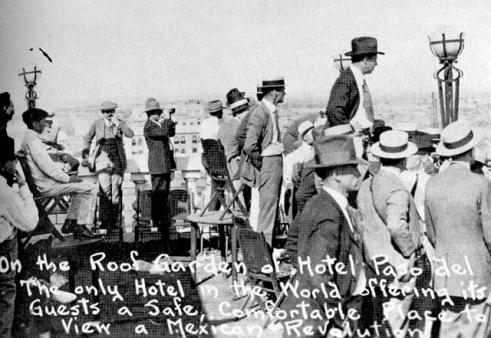
The reporters did the job Madero expected. Other than a short battle in Ciudad Juárez (there were a few casualties in El Paso, Texas—people don’t get to watch a foreign revolution from their rooftops every day, and a few stray bullets crossed the border) With advance publicity, enterprising photographers had stationed themselves throughout Juárez. Colliers’ Magazine—at great expense—hired an airplane hoping to scoop the competition.)

Madero didn’t have much of a revolution. There were “spontaneous” uprisings throughout México on 20 November, but they went nowhere. However, the news photographs of the Battle of Juárez, made it look important — and, sometimes looking good (or bad) is more important than being good (or bad). Porfirio, seeing the photos, knew his time was up, and made arrangements to sail into exile. Interim president de la Barra’s first official act was to schedule new elections. He spent the rest of his six-month term cutting ribbons and dedicating monuments (with the Centennial celebration still under way, there were a lot of new monuments to dedicate) and filling key bureaucratic positions with Porfirio die-hards. Naturally, Francisco I. Madero won the election. José Pino Suarez, a newspaper editor, was vice president.


 mexfiles.net
Don Porfirio’s departure was not a foregone conclusion at the time. I’d add a sentence or two bridging Madero’s insurrection and Don Porfirio’s departure. Reportedly he uttered “They have unleashed a tiger” upon stepping down.
I’d also add how out of touch the foreign press was. I believe that on 20 November 1910, the foreign newspaper of record declared that a revolution in Mexico was nearly impossible.