Shaken… and stirred: 19 September 1985
One can almost pinpoint not only the date, but the minute, that the political and cultural reforms that changed Mexico from a “perfect dictatorship” to a post-modern state occurred. 7:19 A.M, 19 September 1985.
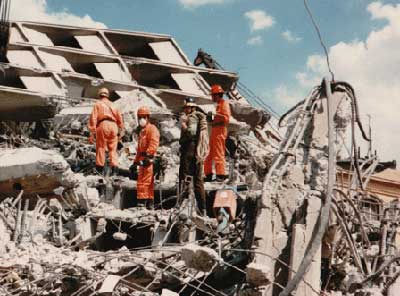 The epicenter of the 8.1 Richter Scale earthquake was the Cocos Plate, off the Michoacan coast, and was felt as far as Los Angeles, Houston and Guatemala City, but the damage was most severe in Mexico City. In less than a minute, according to estimates from the Servicio sismológico nacional 40,000 were killed, 30,000 homes were destroyed and 400 large buildings collapsed. Within the Capital itself, the death toll was somewhere between the 4,200 later estimated by the BBC and 10,000.
The scale of the devastation was suspected, but at the time, not much was know. The day’s BBC News, reported only that:
Mexico City… was declared a disaster zone.
Telephone links were cut, and a communications tower burst into flames, leaving television broadcasts monitored in neighbouring Guatemala the only source of information.
Television reports said hundreds of people are trapped in rubble, and more than a third of all buildings have been damaged.
Clouds of dust hung over the city centre, and broken glass and chunks of cement littered the streets.
There was a strong smell of gas and the city government issued a radio appeal for people not to light matches.
Collapsed buildings
Several high-rise hotels collapsed entirely, as well as a section of the city’s huge medical centre. Many buildings were on fire. The underground system also failed, stranding hundreds of people.
Many people gathered on street corners, several weeping and some fainting. Others joined rescue workers digging through rubble in a frantic search for survivors.

1988 election protests in Mexico City (Center for Latin American Studies, U.C. Berkeley)
It was those digging through the rubble that changed the system. As with Hurricane Ike today, the government attempted to black out news coverage of what happened — and what the death toll might be — and this was the not so recent pre-internet era — but too many people discovered their hidden talent to at least witness the truth, and relay the information accurately. There was no way NOT to see that the Army was looting at worst, and guarding only the wealthy at best. There was no way NOT to notice that the buildings that collapsed tended to be the newest, government-financed constructions. There was no way NOT to notice that the Party and the De La Madrid administation was hapless and incompetent.
And everyone — like it or not — was in the streets. In 1968, those who took to the streets were led by students and intellectuals. The grievances that brought the people out were learned ones — things that required thinking them through, synthisizing the information — the lack of social justice, liberty, freedom of expression. In 1985, literally felt their grievances. And had no choice but to be in the streets.
Not that they openly rebelled. They were too busy trying to survive, and — just in surviving — transformed the political and social landscape. Mexico City, and Mexico itself, has always been a huge village society. While there are always tensions and those who just don’t fit in any village, things are worked out within the group. Which is what neighbors had to do, and basically turned their backs on the official channels.
My favorite story is of the unknown hero, el chamaco... the kid. The earthquake hit as students in the first school shift (schools in the Capital have morning and afternoon/evening shifts to handle what at that time was a huge population growth and a shortage of classroom space) were preparing to leave for school. El chamaco had a scout meeting after school and was prepared: at least he was in his scout uniform. The 14-year old was his block’s undisputed authority in the informal search, rescue, triage, emergency food distribution system that was patched together. And, so its said, did a more than credible job.
While there were great heroes — like el chamaco, the Mole Men of Tlatelolco, the Red Cross and the Fire Department — these were either the individuals whose unknown talents are only discoved in extraordinary circumstances, or apolitical civil institutions. The system was broken.
And the system never recovered. In the city especially, even as people began to recover some semblance of normalalcy, the had lost faith in the party and the bland, academic PRI leaderhip. Right then, at 7:19 AM on 19 September 1985, even if they didn’t know it at the time, Mexico City would become a stronghold of a new political party — the PRD — led by younger leaders who were jolted out of complacency by the system’s failures to deal with disaster and others who noticed the serious cracks in the system, and fled before it all came tumbling down around their ears.
Not being a citizen, I of course, am not a party member, nor am I claiming that party is perfect (or even better than any of the others). But it was the new PRD that transformed Mexico City mostly by paying attention to what the street level leaders were demanding, as well as paying attention to what a city needs… fire brigades, earthquake-proof buildings, a functional transit system. PAN, ironically, was the political beneficiary of the split in the PRI, somewhat plastering over the serious cracks in the edifice of national power, but not completely. A few institutions had to be completely remodeled, like the Army… which recovered its honor though competent disaster relief and taking on the task of protecting the people and the natural resources in times of disaster, and some are still shaky… like the police.
This country may have its problems but — as the 19 September earthquake painfully demonstrated, Mexico can weather disasters, and can creatively solve its problems… not perfectly, and not immediately, but it will muddle through, and at worst, fall back on the untapped resources of tradition.


 mexfiles.net