Ghost busters at the Summit of the Americas
The Summit of the Americas, coming up April 17 to 19 in Port-of-Spain Trinidad and Tobago on April 17th to 19th will be nothing but Cuba, Cuba, Cuba, according to the Economist. Which will not be present.
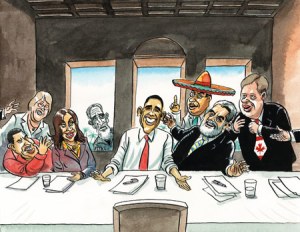
Peter Schrank in The Economist
The real ghosts in Port-of-Spain are not the Castro brothers… nobody believes in ghosts anymore, and no one pays any attention to the ghost-busters of Washington. What scares everyone, and won’t be talked about are the demons: guns, money and drugs.
When not talking about the Cubans behind their backs, a few other pertinent inter-American issues MIGHT get a hearing, but
… this will not include any commitment from the United States to lift its tariff on Brazilian ethanol. Many Latin Americans would like to rethink the “war on drugs”, which they see as failing. Instead, there may be talk of beefing up anti-drug aid to Central America and the Caribbean, because of evidence that Mexico’s crackdown on drug gangs is driving the trade to neighbouring countries.
In other words, the Summit of the Americas is a nice beach-side get-together in which Barack Obama — with admittedly better manners than the last White House resident — dictates what inter-American policies are, and are not, to be considered relevant.
Manuel Pérez-Rocha (Foreign Policy in Focus, via Upside Down World) has his hopes (and end to the Security and Prosperity Partnership, a renegotiation of NAFTA, more respect for indendent political action within the Americas). Quite rightly, he notes that the Security and Prosperity Partnership never did come together, but is more likely to be expanded under more salable names than ended:
…the SPP wasn’t going to perform as advertised to provide more security and prosperity to “North American” people. What better proof of this than the failed war on drugs in Mexico that took about 6,200 lives in 2008 alone? The SPP has failed also thanks to the opposition of a wide array of civil society groups in the three countries — Canada, the United States, and Mexico — that denounced its secret dealings.
This apparent victory of civil society groups hasn’t eliminated the need for skepticism, however. Wholesale change won’t happen without further struggle. Economic, corporate, and military interests remain largely the same, and militaristic and deregulation initiatives are well underway. First among them is the Mérida Initiative with which the United States is providing military hardware to Mexico. This program, while intended to fight drug traffic, is much more likely to exacerbate violence, since it doesn’t address structural problems like widespread corruption, deficiencies in Mexico’s police and judiciary system, arms smuggling from the U.S. into Mexico, or money laundering.
Those “civil society” groups frankly aren’t very effective, and haven’t altered the reality. There are a few groups working on single-nation issues (like immigration enforcement abuses in the United States, or civil rights in Mexico, or the labor violations of Canadian mine operators), but no coordinated, or even “apparent” victory of civil society groups.
While Latin America has changed, partially in response to the “with us or against us” rhetoric from the previous U.S. Administration, Obama’s non-confrontational style won’t change much. It seems the present U.S. Administration at least offering to make some changes (a few controls on gun exports to Mexico, for example), but nothing substantive.
The Obama Administration has been backing off on the gun issue lately, and even supported the G-20 in not taking any real action against money laundering (notice that none of the countries with substantial British and U.S. investments were even talked about — it wasn’t commonwealth countries like the Caymans, or British dependencies like Jersey, nor popular money laundering sites like Panama, that were singled out for corrective action… it was Uruguay and the Philippines).
If you don’t think all these are connected, think again. Al Giordino (Narco News) hit on the real reason the Washington would rather chase ghosts:
… a peaceful and democratic revolution has occurred in much of Latin America during this time period. Only two major powers in the region drag their feet: Colombia and Mexico, coincidentally the two nations where US-imposed drug policies have wreaked the most havoc, violence and criminal enrichment from the mouths of the poor.
And, purely by coincidence, Colombia and Mexico are the two nations where the U.S. is making a killing exporting firearms and sending laundered cash. And, also by coincidence, the two countries where a military solution to the narcotics export “problem” by rightist administrations. And, which have governments receptive to “Free trade” agreements with the United States.
About about all that… nobody is gonna say “boo”.


 mexfiles.net