Norman Borlaug, D.E.P. (25 de marzo de 1914 – 12 de septiembre de 2009)
To my knowledge, only two streets in the entire Republic of Mexico have ever been named for U.S. citizens during their lifetime. One is calle Neil Armstrong, a very small street in a fraccionamento in Mexico City where you’ll also find calle Apollo XII, calle Saturn, etc. The other — a major one — is calle Norman Borlaug –in Ciudad Obregon, Sonora.
Borlaug, like Armstrong, changed the way we see the world. They were icons at a time when we had faith in the ability of mankind to conquer the limits of nature though our technology and science. Both modest men, they preferred to fade into relative anonymity of academia. But where Armstrong’s fame rests on leaving earth, with the considerable assistance of high tech innovation, and billions of dollars in engineering development, and a huge investment by the military-industrial complex, Borlaug’s rests on a few wheat fields in Sonora and outside of Toluca.
Following on the land redistribution of the Lazaro Cardenas administration, Manuel Avila Camacho came into office in Mexico in 1940 with the goal of, among other things, increasing Mexican crop yields that would make the ejidos and small farms profitable. In the United States, the Roosevelt Administration, recognizing it would soon be involved in the world war, was looking to improve relations with Mexico, and to assure access to Mexican resources, including food crops. AND… the Vice-President of the United States was Iowa plant breeder and former Secretary of Agriculture, Henry Agard Wallace.
For cultural, political and historical reasons, the Mexican government could not — and would not — sign into a direct partnership with the United States government, but with support at the highest levels, the Rockefeller Foundation was encouraged to underwrite a Mexican agricultural research institute, with both U.S. and Mexican scientists and agronomists.
A native of a Norwegian agricultural settlement in Iowa, Borlaug was a first-hand observer of the collapse of agriculture in the 1930s, and the very real malnutrition that was found in the upper mid-west during the Great Depression. Despite the hard times, he Work on an off for government-sponsored conservation projects, while pursuing an education in forestry and plant pathology, and was just finishing his doctorate when the Second World War started. Like other scientists, he was drafted into “war research”, but developing a glue that would stand up in the jungles of the south Pacific was probably a misuse of his particular talents and knowledge.
He was transferred to the Mexican “Office of Special Research” in 1944, despite an offer to double his salary (DuPont liked his glue). While what he did in Mexico was what plant breeders and farmers have always done — cross bred varieties for desirable traits — his single minded search for wheat varieties that would give a higher yield and were resistant to common plant diseases, was undertaken in the same spirit as the space program in the United States: as a scientific and economic government priority with national defense implications.
The only really new scientific breakthrough Borlaug made was the realization that wheat seed did not need to “rest” after harvesting, and could be planted immediately. Although this meant transporting seed around the country (and Mexico is fortunate in having enough different climate zones to have several discrete growing seasons), it also meant developing entirely new varieties… one for every possible growing condition.
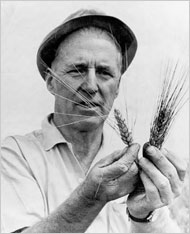
Borlaug with dwarf wheat, 1970 news photo
The results of Borlaug’s work was a doubling of the Mexican wheat harvest, and — though application of his research elsewhere — a massive increase in crop yields (and the food supply) around the planet. Coming as a result of the most destructive war the planet has endured, and at a time when the human population was skyrocketing, it was logical for Borlaug to be honored with a Nobel Peace Prize in 1970.
At the time, saving an estimated billion people from malnutrition seemed miraculous. Borlaug deserved his award. But, with the human population still growing exponentially, a billion people still face malnutrition around the planet. Borlaug has been accused of creating the conditions where the population would continue to grow, although he can’t be held responsible for the failure of governments to adequately address the issue. Nor, really, can he be blamed for those that profited from his scientific work, who have created “frankenfoods” and forced farmers into a situation where they grow single varieties of a crop that fits the needs of a corporate entity, not of the consumer.
It’s an old tragedy. Mexico gives the world food — corn, chocolate, beans, squash, tomatoes, etc. — and the world’s rulers seek not the benefit of all, but the benefit of the very few.


 mexfiles.net
Молодец конечно! Поддерживаю! 🙂
Ну, как сказать, понравилось конечно:) Хотя я все равно практически ничего не понял. 🙂