How are we doing?
The United Nations 2009 Human Development Report is on-line for those of a wonkish frame of mind.
As I’ve said before, Mexico is not a particularly poor country, it just looks that way being next to a very rich one. The “Human Development Index (HDI)
provides a composite measure of three dimensions of human development: living a long and healthy life (measured by life expectancy), being educated (measured by adult literacy and gross enrolment in education) and having a decent standard of living (measured by purchasing power parity, PPP, income).
With 1.0 being the highest possible number, and Norway at the top (at 0.971), Mexico comes in a respectable 0.854 … 53rd out of the 182 nations surveyed. Noting that intangibles like political rights are not included, Mexico ranks just below Uruguay, Cuba and the Bahamas in HDI, and well above supposedly “advanced” European nations like Bulgaria and Romania.
We’re generally healthy, with a long life expectancy (76 years), although five percent of Mexicans have a probability of not surviving to age 40. That’s the same percentage of Mexican babies who are underweight, and of Mexican homes do not have access to clean water, both of which may be a factor in the survival rate.
While the adult illiteracy rate is a little high (7.2 percent), it’s not particularly bad (especially in a country with 50 plus spoken languages), it’s not as bad as it looks. With the phenomenally high literacy rates in Europe, even in non-European Union countries like Russia, I’m surprised that Mexico has a higher literacy rate than at least one E.U. nation, Malta.
One place we are doing very well is in overcoming gender disparity.
The HDI measures average achievements in a country, but it does not incorporate the degree of gender imbalance in these achievements. The gender-related development index (GDI), introduced in Human Development Report 1995, measures achievements in the same dimensions using the same indicators as the HDI but captures inequalities in achievement between women and men. It is simply the HDI adjusted downward for gender inequality. The greater the gender disparity in basic human development, the lower is a country’s GDI relative to its HDI.
Mexico’s GDI value, 0.847 should be compared to its HDI value of 0.854. Its GDI value is 99.2% of its HDI value. Out of the 155 countries with both HDI and GDI values, 72 countries have a better ratio than Mexico’s.
And who comes just behind Mexico? Canada! The United States comes in way behind at #105. However, when it comes to gender empowerment (“the share of seats in parliament held by women; of female legislators, senior officials and managers; and of female professional and technical workers- and the gender disparity in earned income, reflecting economic independence”), the two NAFTA partners blow us away. At #39, we’re not so bad, though the United States comes in at #18, and Canada blows us away at #12.
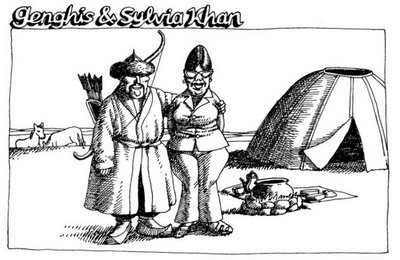
Although it lags far behind when it comes to gender empowerment, the most gender-equal country (at least by GDI) is Mongolia… Yes, we khan?


 mexfiles.net