What they’re saying in las Malvinas
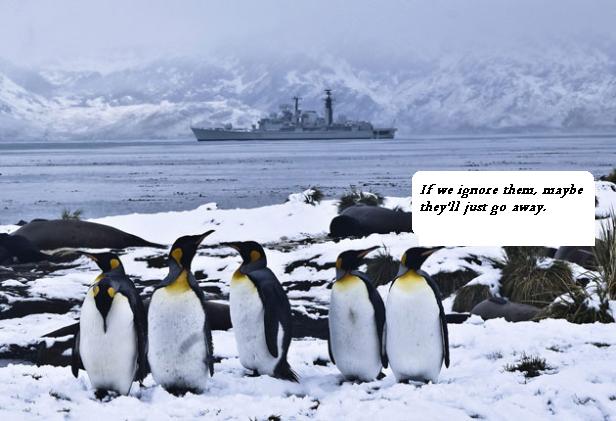
Britain feels it necessary to maintain 1,000 troops, a destroyer and £300m worth of Typhoon fighter aircraft on the islands to defend 3,000 people, 500,000 sheep and a claim that does not come out particularly well from historical scrutiny….
Like the “Treaty of Friendship, Navigation and Commerce” between Great Britain and the “United Provinces” (i.e., Argentina) in 1823, recognizing the transfer of the Malvinas from Spain (which had been recognized by Britain under the 1713 Treaty of Utrech) to the new country. Which of course, perfidious Albion forgot all about in 1832, when they suborned the Argentine naval personnel and occupied the islands. And, started thinking up rationales for why they were even there…and now spend something like 70 million pounds (no idea what that is in money anybody uses on this side of the Atlantic) to keep British politicians in office.


 mexfiles.net
Rich, that’s a pretty threadbare account of sovereignty claims, which are incredibly complex and the evidence available offers no true, certain and indisputable support to either side.
In my opinion, the status quo is objectionable only to those who want to pursue the issue for political means. Of all the British overseas territories that most certainly should be returned to A.N.Other, the Falkland Islands are at the very bottom of the list.
I feel far more for Spain, who have a chunk, albeit small, of their mainland under occupation.
Hardly threadbare, since the Malvinas were inhabited at the time of the British invasion. True, it was a penal colony, but the convicts were Argentine. A better analogy would be Belize, seized by the British from Guatemala, and — as British Honduras — not recognized by either Guatemala or Mexico until the 1990s. I remember when Mexican maps showed the area as “British occupied Guatemala” and there were no customs posts, or overland communications, and British Honduras had to be supplied from the West Indian Commonwealth countries.
Geography is destiny. Britain benefited in 1982 from the Argentine-Chilean conflict, which gave them an ally (and don’t forget Margaret Thatcher-Ronald Reagan and Augustin Pinochet had a mutual admiration society at the time) that no longer is relevant. With the new Latin American-Caribbean Union (about which I’ll have more to say) backing the Argentines, there isn’t much the British can do to supply the islands. You realize any major medical services on the Malvinas now require airlifting the patient to Chile via Uruguay. Chile and Uruguay now back the Argentines, and the U.S. no longer has any particular interest in the matter. And, the commonwealth nations don’t seem to have a problem with the Argentines either.
Even if oil is discovered, I can’t see the Malvinas surviving as the Falklands. The local population is aging and depends on Argentine, Brazilian and Uruguayan workers now. The only way a British presence would be maintained would be if it were an independent Commonwealth nation, like Belize… although that really wouldn’t change the geographic and demographic facts.
Extremely threadbare, and I’m surprised you’d argue for a second that a three sentence summary could be anything else.
You’re ignoring hundreds of years of prior sovereignty contests, declarations, agreements, treaties etc. As I said, it’s a complicated issue, and one which cannot be resolved on ‘past evidence’.
Geography is important. As is population. The population on the Falklands are pretty anti-Argentina, which I will come to again. I personally understand the Argentine’s claim, even if it is rather tenuous and pointless. But their current actions will do little more than prolong the islands current status as a British Overseas Territory.
Prior to the ’82 war, the British government was open to (or even engaged in) talks regards joint sovereignty. Which is the first step to a territorial handover. That’s a policy I am sure the British government would like to use elsewhere. Mr Chavez has told the Queen of England that empires are over. Someone should tell him there hasn’t been a King or Queen of England for hundreds of years, but regardless, the UK has been well aware of the fact for a long time and has been trying desperately to disentangle itself, politically at least, from the remnants.
But the difficulty is that you can’t undo history, only study it.
The Falkland Islands will, I am convinced, remain a UK territory for decades to come. Especially if oil is found there. For that status to change, Argentina needs to become the ‘best friend’ of the islanders, and demonstrate over a long period that a change of sovereignty is for the best.
They aren’t currently doing that. And having local friends won’t help much for the foreseeable.
I find it astounding that people publish these ramblings without looking at the facts. The Falklands were first discovered totally uninhabited by Human life by a Brit in 1690. Britain first laid claim and sovereignty to the Islands in 1765, before Argentina even existed. The Falklands are British, end of.
Interesting alternative history – the Malvinas were on Spanish maps before 1690. The French and Spanish both laid claim to the island around the same time, when the Argentines arrived plenty of people claimed the island belonged to them but no colony was set up. The British only set up a colony in response to the Argentine presence, a typical tactic of British imperialism.
@ Nolan. The first person to land on the Falklands may well have been British, about a hundred years earlier than Bouphos claims. Regardless, the British originally settled the Islands in the mid 1700’s, a long time before any Argentine colony or claim, as did the French and Spanish.
As I said previously, the history of sovereignty is a complicated issue without a perfect conclusion. And irrelevant to today’s dispute really, on two counts.
Firstly, possession is nine tenths of the law. The other tenth is having a big enough stick to either enforce or change the previous nine.
But more importantly, international law will almost unquestionably side with the will of the Falkland Islanders themselves. Who currently, and very passionately, do not want any sovereignty discussions to take place.