A rising tide sinks all boats?
While Edward Luce, writing in the Financial Times (registration required), is correct in noting that Mexico is probably much more important to the United States than any of the recent political discussion (or rather lack of discussion) by the presidential candidates would indicate, there might be a flaw in his argument.
Mexico is rapidly becoming as important to the US economy as China.
[…]
Much of this is driven by the rise in the cost of oil, which makes transport costs increasingly pricey for US companies to make goods for domestic consumption as far away as east Asia. And most of the rest is driven by Chinese wage inflation. In 2000, the average Chinese worker was paid 35 cents an hour versus $1.72 in Mexico, according to HSBC. Now the Mexican gets paid $2.11 an hour and the Chinese $1.63. Pretty soon Mexico will have the lower labour costs.
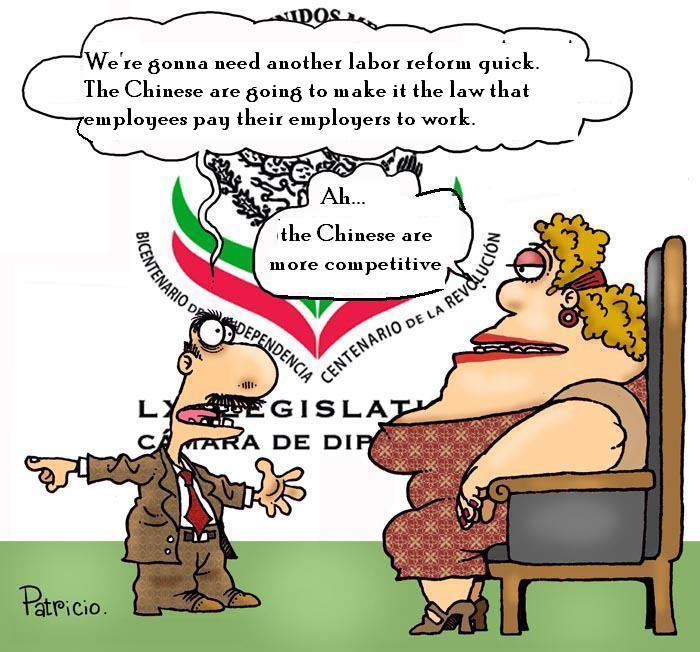 Exports account for just over 30 percent of the GDP in both countries, meaning close to 70 percent of economic activity depends on domestic spending. If wages go down, or rather, don’t rise, Mexicans won’t be able to spend as much, to the detriment of a much larger sector of their own economic system. And, while Mexico has a theoretical advantage over China, at least in transportation costs to the United States, U.S. wages are also trending downwards… meaning U.S. consumers are buying less… to the detriment of both their domestic and import economy. And the Mexicans, buying less, are going to buy less imported U.S. goods…
What’s troubling about this is that Mexico and China are even considered equivalent economies. While both depend on exports for about 30 percent of the GDP, the similarities end there. Mexico is a “high middle income” nation (with an GNI — personal purchasing power — of about 15000 US$ per person, compared to China’s 7500 US$ (both World Bank figures). Granted there are a lot more Chinese than there are Mexicans, but individuals with only half the income of Mexicans spend a lot less. Once they take care of the necessities, there isn’t much left over. It would take a large family pooling their money to buy even a small car. But even a childless Mexican couple, with both partners working, can afford the big ticket items… a car, a washing machine, a vacation.
Much of that is due to the Mexican domestic economy: the reason things like automobiles and washing machines are available is that they aren’t made just for export, but in the assumption that Mexicans themselves will buy the products, and they do.
IN THEORY, proposed changes in Mexican labor law will make employment and wages more “flexible”. We’re being told this will create more jobs, but whether it creates more wages and means more money in Mexican households rather than more hours of work and less to spend is not clear. As German economist (and Director of the Division on Globalization and Development Strategies of the United Nations Conference on Trade and Development) points out in the Real News Network interview below, that lowering wages to boost exports is counter-productive, and ends up meaning less money, and less economic activity for everyone: worldwide. IF lower wages (or wages competitive with China) are the norm, then Mexicans would have less to spend not just on domestic goods, but on U.S. imports as well. And, U.S. workers, having less to spend (their own wages being held down in the hope of boosting exports) would buy not just less Mexican goods, but less Chinese ones as well.
All to the bad and worse. But, what really is bothersome is the assumption that Mexico should emulate China (at least when it comes to wages). China has lower wages in good part because Chinese workers don’t have a Hell of a lot to say about wages, hours and working conditions. The social problems — not to mention environmental and public health concerns — that are bound to develop when a country doesn’t pay its workers enough to live a decent life are bound to affect China much sooner than a country where there is some social safety net, labor standards and the basic expectations for a decent life are already met for the most part. That is, lowering wages is likely to cause unrest in China as expectations rise, more than in Mexico where at least the minimum expectations for a decent life are met (for the most part). I doubt U.S. consumers concern themselves much with working and living conditions by their suppliers, but it does affect them in their pocketbooks.
Of course, I think that Mexico depends too much on exports… and specifically on exports to the United States. While I question whether consumption for its own sake is sustainable in the long run, there are still huge pockets of poverty in this country, and higher wages might cut into the exporters incomes, but strengthen the bulk of the economy, as the poor are able to “catch up” with the rest of the country, buying those washing machines and taking those vacations that put more money immediately into the economy than exports.


 mexfiles.net
Appreciating the time and effort you put into your site
and in depth information you present. It’s awesome to come across a blog every once in a while that isn’t the same out of date rehashed material.
Fantastic read! I’ve saved your site and I’m adding your RSS feeds to my
Google account.