Bernardo de Galvéz: the enemy of my enemy …
There is no doubt Bernardo de Gañvéz was a key — and until recently, overlooked — figure in the American Revolution, and he well deserves the honor bestowed upon him postumously (of the United States,Perhaps it was a combination of nepotism and geopolitics that led Bernado de Galvéz to be (long) postumously made an “honorary citizen” of the United States (a mere 228 years after his death). But one shouldn’t forget that his importance to the cause of US independence was precipitated more by his loyalty to the Crown of Spain than any love for the “American Way of Life”.
A professional soldier, Galvéz had fought Portuguese, Moroccans and even Apaches by the time he was in his early 20s. A bit of nepotism (his dad was Viceroy of New Spain) certainly didn’t hinder his colonial career, being appointed miliary commander of Nuevo Viscaya (today’s Sonora, Chihuahua, and Durango) at 24, then sent to serve in a joint Spanish-French unit where he picked up fluent French (useful later).
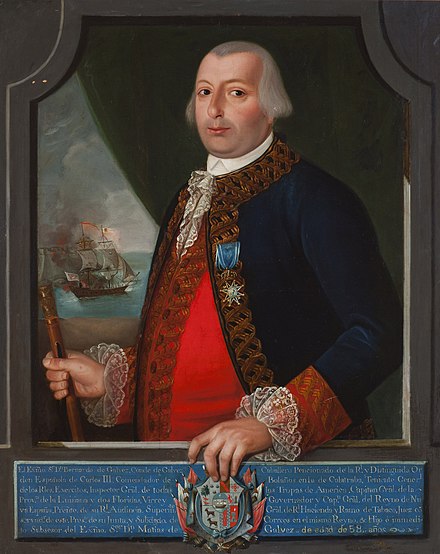
In 1777 (when he was 31) he got another career boost, as Governor of
Florida… not just today’s US state, but Alabama, Mississipi and parts
of Lousiana, and.. later as Governor of Spanish Luisiana — that massive
chunk of real estate in the center of North America, gifted to Spain by
the departing French in 1762 although it would largely remain French in
language and culture. In all his posts, he enjoyed excellent relations
with the colonial subects, attentive to their needs, even when they
conflicted with those of the “Metropol”.
In his dual role, and politically well connected, Galvéz (and his father in Mexico City) were paying close attention to the rebellion in British North America. How better to stick it to perfidious Albion than — like the royal family’s cousins in France, with its own reasons to weaken England — than to offer aid and assistance to the rebels? And not just token support.
Whereas in Mexico City, dad was raising funds to keep George Wasington’s army paid and fed (the only quid pro quo being Washington have his soldiers innoculated against smallpox, as Spanish soldiers were), though a “back door” from Luisiana, and from Florida into Georgia, Bernado was anxious to keep the rebellion supplied and avoiding British naval blockades.
Moreover, he served as overall commander in the first US overseas operation… a joint Spanish-US seizure of the Bahamas (a useful bargaining chip once independence was achieved), With the Spanish navy busy harrassing the British Navy around the world (an overlooked Spanish contribution to US independence, although of course the Spanish objective was to regain control of the Mallorcas –which they did — and Gibralter — which they didn’t), Galvez was also able to arrange for the Havana gold shipments to be diverted to Washington. just in time to keep his troops on the offensive as they closed in for the final showdown with Conwallis. (September 1781)
AND… a few months earlier (May 18, 1781), Galvéz personally commanded the Spanish attack on Pensacola, the center of British control over the Floridas. This eliminated any threat from the south (and given the strong military presense of the British in the Caribbean, as opposed to their weaker presence in Canada) was the final nail in the coffin for the British forces still in the field.
However, how committed he was to the Ameican cause, and its rather limited definition of the right to “life, liberty, and the pursuit of happiness” and how much his actions were just those of a good soldieer, or as a geopolitical thinker we’ll never know. He would become Viceroy of New Spain at 40.. in 1785, at only 39 (succeding his dad), but died of typhus the next year. Had he lived into Mexico’s independence here, he would have only been in his early 60s, and whether his duty to his sovereign, or his support for criollos would have swayed him, we’ll never know.
We do know, however, what he thought of his suport for the enemies of his enemies. The way following his defeat of the British at Pensacola, he told us what he really thought:
The Yankee is a hypocritical, false and truly rapacious being. The ideas of popular government, of democracy and free trade that it proclaims, have no other purpose than to ignore the rights of others, deceive the world with false promises and obtain personal advantage.
Mammon is the God of the New Phoenicia or New Carthage of America, a motley mixture of hypocritical puritans, lawless adventurers, audacious demagogues and merchants without conscience” (May 9, 1781).
Selser, “Cronología de las intervenciones extranjeras en América Latina. Tomo I (1776-1848)” Mexico: Cema, page 45 (2010).
Yanez, “The Role of Spain in the American Revolution” (Masters’ Thesis, United States Marine Corp Command and Staff College)


 mexfiles.net