Cruelty by design
Noam Chomsky on the U.S.-Mexican border
“How the U.S.-Mexico Border Is Cruel by Design”, Alternet (28 October 2013)
After the war of the 1840s the US-Mexican border remained fairly open. Basically the same people lived on the same sides of it, so people would cross to visit relatives or to engage in commerce, or something else. It was pretty much an open border until the early 1990’s. In 1994, the Clinton administration initiated the program of militarizing the border, and that was extended greatly under George W. Bush in the 2000s—largely under the guise of safety and defence from terrorism. The two key pieces of legislation were called “The Border Protection, Anti-terrorism, and Illegal Immigration Control Act of 2005” and the “Secure Fence Act of 2006″. That was interesting, and revealing, because the warnings from the security services were that the dangerous border, with regard the possible incursion of terrorists into the US, was the Canadian border. If you take a look, you can see why. The Canadian border is so porous that you and I can cross it in some forested areas. If you were worried about terrorism, you would fortify the Canadian border. Instead, they fortified the Mexican border where there is no threat of terrorism; it was, clearly, for other reasons.
Energy reform… pick one, some, or all of the below
Via Noel Mauer, the best simple overview of the proposed energy “reform” bills now before Congress:
Mexico’s three parties split three ways on constitutional reform.
The PRI wants a modest reform that will let Pemex sign joint ventures to develop offshore fields and possibly expand gas and tight oil production on land.
The PRD wants no constitutional reform, but wants to cut taxes on Pemex and turn it into a fully autonomous profit-driven corporation. (Or so they say.)
The PAN wants to throw open the Mexican hydrocarbon sector, making it look more like Brazil or Colombia. It also wants to reform the way the federal government profits from the sector, imposing a scheme that looks almost exactly like the Alaska Permanent Fund, only with the profits going to the government rather than to individuals.
Everyone needs to read this, as it is going to be THE key issue in Mexican politics over the next several years. I think Noel is right that what will emerge will be closest to the PRI proposal. PAN’s proposal is DOA, but PRI could garner PAN support in return for some of the changes in election law it is also seeking. I’d also expect that a good part of PRD’s proposal (which I don’t see as wishy-washy as Noel does) — turning PEMEX into an autonomous organ (like Universities are now… self-regulating, and able to make its own decisions, but with a guaranteed operating budget) … isn’t out of the realm of plausibility, will be adopted in part.
Even so, with the PEMEX (er.. Hyrdocarbon) “reforms” likely to impact everything from labor rights to tax issues to environmental concerns (hopefully, Texas oil experts are right, and fracking is not likely to be feasible here) to how the nation defines itself, expect massive public protests.
Now, go read his post.
,
¡Ah, Jalisco!
(via CNN Mexico)
Last Thursday (31 October) the Jalisco State Congress approved a Civil Union bill, under the name of a “Free Cohabitation Law”, a new legal entity that will permit same-sex couples to establish a legal relationship and thereby share rights like social security. It guarantees the right to claim pensions, inheritance, and social security benefits between partners of the same or opposite sex.
The bill passed 20-15, the PRI, PRD, and Greens voting in favor, PAN and Morena opposed.
Jalisco is one of a handful of states where legal cases were likely to reach the Supreme Court regarding the right to same-gender marriage. With passage of this law, any case arising from Jalisco (where there was at least one challenge to the existing “one man-one woman” marriage law) will be moot… and it lessens the chances of the Supreme Court ruling this year on a fifth challenge to similar laws in the several states, which have held back an expected constitutional change that would make same-gender marriages legal throughout the Republic.
Good as a half-way measure like the “Free Cohabitation” (and other new legal forms) are, they do not extend the same rights as marriage. They only apply within the state, and couples who leave the state, or who are applying for federal benefits granted to married couples are not protected by these state laws.
PAN, as the Catholic Party in all but name, naturally opposes any bill legalizing same-gender relationships. In Colima, where the state legislature created Civil Unions under the strange name of “Conjugal Bonds” Morena legislators voted against the bill because they wanted challenges to the state’s marriage law to go to the Supreme Court (which has broadly hinted… everything but formally announced… it would rule in favor of the overturning gender requirements in marriage contracts) and one assumes the same rationale applied to their vote against Jalisco’s “Free Cohabitation” bill.
Love (that dare not speak its name) among the ruins

“Aztec Warrior”, Lalo Ugalde
It was a bad decision on my part, but when I was finishing up the manuscript for what became Gods, Gachupines and Gringos, I unwisely let some English teacher unknown to me, have a copy of the manuscript for what I thought was a bit of polishing and grammar checking. Whether that foreign English teacher in Chihuahua thought his role was in all this, I have no idea, but he took it upon himself to attack my inclusion of homosexuals among the many diverse forms of humanity in what I saw as a much more culturally and ethnically diverse society than is popularly assumed. Multiculturalism, and cultural appropriation is nothing new, and the creation of new cultural norms is nothing new.
Starting off, as I did, by noting that both Spain and indigenous Mexico were both extremely diverse cultures, I mentioned indigenous homosexuality as an example of cultural diversity… and added that some cultures did (and still do) define gender differently than others (the Zapotec’s third gender being the best known example). Though I didn’t feel compelled to spell it out, there was — and still is — no single Mexican norm when it comes to sex… or anything else for that matter.
The Spanish … or, rather Castillian… conquerors — or at least the “one percenters” among the one percent of the population that ran Mexico after the conquest — often justified brutality with the excuse that they were fighting “sodomy”. Although 16th and 17th century Spaniards didn’t always exactly mean what we mean today by “sodomy” (which covered a number of sexual practices), the fact that they extended so much effort in “stamping out” sodomy means it was a common enough activity to merit notice, and — to that particular class of one percenters — to be put down by any means necessary.
 The one-percenters in any society, especially in colonial societies, tend to set the norms for that culture, at least as far as the outside world is concerned. It’s something of a mistake to speak of Cortés “conquering” Mexico… what he overthrew was the Aztecs — the one percenters of the Mexica people, who were the hegemonic power in Mesoamerica — and incorporated much of the existing political and social system into the new order of things.
“Aztec” was improperly applied by 18th century writers to the Nahuatl-speaking Mexica, and has, over time, been applied to all Nahautl speaking societies, when in fact, they were a minority of a minority. What we know about how the Aztecs lived and thought, is mostly though Spanish sources, or from post-conquest Aztec writers, most of whom had to some degree adapted themselves to Spanish social thinking. Our knowledge of the daily lives of the Mexica, let alone the myriad other indigenous peoples (especially when it comes to intimate matters like sexuality) is largely guesswork.
Given that the upper class Castillians and the Aztecs both had taboos on same-gender sexual activity, and the ruling classes have always held a monopoly on what is, and isn’t, recorded, it’s not surprising that we are often forced to make assumptions when speaking of the past. My “helpful” reader in Chihuahua was perhaps simply steeped in the “official story” (which generally makes no mention of sexuality. beyond the fact that somehow various historical figures sired or bore children. Or, more likely, he was reading into the past his own assumptions based on his own cultural values.
I realized why a person like that reader in Chihuahua might have a problem accepting the “normalcy” of indigenous sexual variation, after re-reading Gary Jennings’ celebrated 1980 novel Aztec, in which the villains are very much stereotypes… artistic, bitchy and treacherous … common to Americans in the 1970s when Jennings was conducting his extensive (and admirably exhaustive) research. Reading his 1984 novel about Marco Polo, The Journeyer, where there is another homosexual stereotyped villain (who, in addition to being unreliable, is a cross-dresser) and I began to wonder if Americans of a certain age weren’t imposing their own standards of sexuality on others.
Jennings’ research into the Aztec world (I know nothing about his preparation for writing The Journeyer) was amazingly in-depth (he claimed to have spent 17 years on research, and among other things, learned Nahuatl), and despite it’s pot-boiler “sex-violence-more sex” style his book remains justifiably popular among experts in pre-Conquest studies, and is recommended reading for students and those with a general interest in the subject.
Jennings had to make assumptions about the way people lived (as did I in writing “straight” … as in non-fiction… history), but in this instance, I wonder how accurate his assumptions were. Not that Mexica artists couldn’t be gay, but there is no evidence that gays were considered particularly artistic by the Aztecs (or by modern Mexicans for that matter[1]). And, although the villainous artists work for the ruling class, there is no any evidence that the Aztecs … with their own strictures on sodomy, either extended those strictures to their skilled workmen, that the barbaric penalties imposed on Aztecs for anal intercourse were meted out to the lower classes, or for that matter even enforced[2]. Or that artists were ceded the right to non-conformity (or even thought of themselves in terms of non-conformity).
In short, other than knowing that sexual relations between persons of the same gender were known even to the Aztecs, we have no idea how common it was, or how accepted it was by
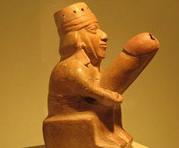
Xochipilli
general society. We DO know that the Mexica had a god of male homosexuality (Xochipilli) and that there were male prostitutes . One of Jenning’s artistic villains ends up as a pathetic male prostitute but we have no evidence that male prostitutes were considered vile. Female prostitutes were seen as performing an important public service by the Mexica, and for all we know, so were their male counterparts.
While the Aztec… and Spanish ruling class… attitudes towards sexuality in general, and male homosexuality in particular survive, they are rapidly giving way to what we assume are a more modern understanding of sexual variation. But, as we find so often when we make assumptions about Mexico, our assumptions are based on our own cultural biases. The new attitudes may not be so new, but simply a rediscovery of older, existing attitudes, or a new prominence given to long-existing beliefs that were too easily overlooked when we forget that culturally there is no one Mexico — there are, and always have been, many Mexicos coexisting at any one time.
[1] Although at the time Jennings was active, in the U.S., an interest in the arts was considered somewhat effeminate and by extension, gay, Mexicans have never seen artistic interest as particularly effeminate: quite the opposite — in post-Revolutionary Mexico — Salvador Novo and others were considered poseurs and not artists because they were effeminate, gay or both.
[2] In an era when anal intercourse was punished in Europe by burning people alive, the Aztec code called for the passive partner to be impaled, and the active partner to have his entrails pulled out through his anus.
Additional sources: my “inspiration” for this came from a very short piece on “Homosexualidad Prehispánica” posted on Mitofago.com.mx . Recommended by that site for more on pre-Conquest sexuality are:
Cobo, Bernabé, Historia del Nuevo Mundo.
Fernández de Oviedo, Gonzalo, Sumario de la Historia Natural de Indias
García, Gregorio, Origen de elos indios del Nuevo Mundo e Indias Occidentales
For English readers, I would add:
Soustelle, Jacques, Daily Life of the Aztecs (Patrick O’Brian, translator)
Landa, Fray Diego de, An Account of the Things of Yucatán (David Castletine, translator)
Whitecotton, Joseph W. The Zapotecs: Princes, Priest, and Peasants
My information on modern male sexuality comes from personal discussions with various Mexican researchers, including Dr. Leónardo Olivera (UNAM) whose doctoral dissertation surveyed the sexual habits of Mexican soldiers.
“Aztec Warrior” by Lalo Ugalde, via “Out in the 562” Other illustrations from mitofago.com.mx
Much as it might pain me as a knee-jerk lefty to say this, the Peña Nieto administration has done an excellent job in getting through the new tax bill. A few particulars I don’t care for… with the 16 percent value added tax (IVA, for its initials in Spanish) being applied to pet food, Yaquí ‘s food bowl is gonna include 16 percent table scraps… and there is still too much dependence on PEMEX income, overall, it’s a much more progressive taxation system than we expected.
Making the headlines outside Mexico (and inside too… just easier to write about)… are the junk food tax and the mining royalties. A snarky and not very informative article in today’s New York Times by David Toscana (“Mexico’s Soda Pop Tax“) suggests that the revenue raised is just going to be stolen by “corrupt” officials anyway, so why bother taxing something that everybody buys anyway…
The government stands to collect $1 billion every year from the soft-drink tax. It isn’t a huge fortune, but as we hear the hiss of a bottle being opened and we gaze down at our still broadening waistlines, we will wonder whether another politician is using our tax money to buy real estate in Florida, Texas or California.
So here’s an idea: now that we’ve taxed soda, let’s tax corruption. According to the Mexican employers’ association, the cost of corruption is 9 percent of our economic output ($1.2 trillion).
Cute… but one could ask why the U.S. doesn’t tax “campaign contributions” and other forms of legal corruption. And the assumption that because people have been drinking fizzy, sugary drinks in lieu of other sorts of beverages for several decades now (although Coca-Cola has been bottled in Mexico since the 1920s, it was mostly sold in areas with a concentration of U.S. workers… i.e., the oil camps… until after the Second World War), it’s not as if Mexican consumers haven’t changed their buying habits before,or that consumers anywhere don’t change their habits in response to costs (think tobacco products). And what does it really matter? If consumers pay more for soft drinks and junk food, the state earns more money… if only a fraction of consumers cut back their spending, the state SAVES money. As reported in The Guardian (“Mexico to tackle obesity with taxes on junk food and sugary drinks“:
… the government has taken the long view – that the potential economic harm from reduced junk food and soft drink sales now is insignificant compared with the damage in 10 years time if obesity continues at the current rate. The healthcare burden of diabetes and heart disease in Mexico is already huge and increasing. Some 9.2% of children in Mexico now have diabetes.the government has taken the long view – that the potential economic harm from reduced junk food and soft drink sales now is insignificant compared with the damage in 10 years time if obesity continues at the current rate. The healthcare burden of diabetes and heart disease in Mexico is already huge and increasing. Some 9.2% of children in Mexico now have diabetes.
Actually, the best thing about the Toscana article was the cartoon (by Dan Woodger) showing a soda-pop can driving out of Mexico with bags of cash. Not exactly what the New York Times, or Toscana meant to suggest, but the 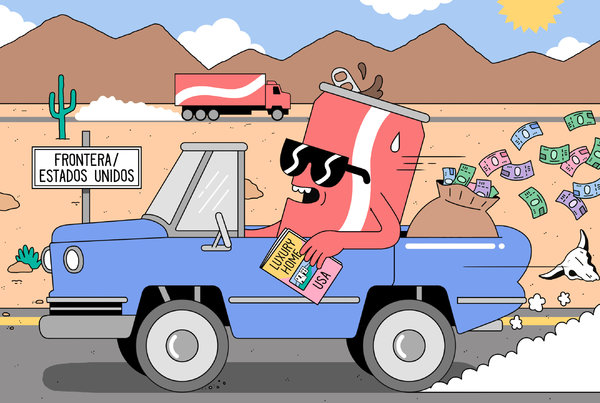 fact that the foreign-owned soft drink companies are extracting huge profits from this country’s consumers, and not to their benefit. Assuming Mexican consumers don’t change their habits… and it’s Mexican taxpayers who have to pick up the tab for the results of the soft-drink habit, why should the profits be driving back across the border in the first place?
Which does seem to be what the resistance to this particular feature of the tax bill was all about. Jarritos, Peñafiel, and Pascual and other national firms have always offered drinks in more traditionally Mexican flavors (tamarind, jamaica, etc.) and may be better positioned to adjust their formulas to meet consumer demands and tax regulations. As are snack companies like Bimbo. But, then, those are Mexican companies, not foreign multinationals.
The Wall Street Journal reported that out of concern for the landmark bill, Coca-Cola CEO Muhtar Kent recently called President Peña Nieto and Finance

Mister, you’re going to have to answer to the Coca-Cola Company
Minister Luis Videgaray, but Videgaray told him that Mexico would make decisions in its own interest. Galván Ochoa believes that Kent’s worries have more to do with Mexico setting a precedent for other countries to follow than the impact that it may have on Coca-Cola in Mexico.
Meanwhile, Daniel Servitje, Bimbo’s Managing Director, said that the company is studying ways to tweak their recipes of popular snacks, such as Gansito, which contains 392 calories per 100 grams, reported the Mexican daily Reforma. The proposed law will impose a 5% excise tax on products with 275 calories or more per 100 grams.
I am pleasantly surprised that Luis Videgaray seems to be in the mold of the “old” PRI at its best, telling foreign companies that Mexicans make the rules for Mexico, and the impact on the business affairs of even the Coca-Cola Company are irrelevant. Much the same message is being given to foreign mining concessionaires. Although a much higher royalty on mining — up to 7.5% on profits, plus 0.5% on revenue from precious metals — has been in the works since last April, it is only when it finally reached the Senate that the Canadian firms (and most mining companies in Mexico are Canadian) began making threats:
Last Monday, while the bill was being finalized in the Senate, Reuters quoted Rosalind Wilson, president of the Canadian Chamber of Commerce’s mining task force, as saying “What I’m hearing is not what I’d like to hear.”
… Wilson, whose group represents about 60 firms that dominate Mexico’s mining sector, said she was still holding out hope that lawmakers would reconsider and lower the planned royalty rate.
Mining companies threatened to cut investment in Mexico after the government proposed the royalty, arguing that lower metal prices, rising running costs and higher taxes reduce the country’s investment allure.
It’s not “allure” that gets metals out of the ground, and I’m not sure how seriously to take threats by people like Brad Cook of Endeavour Mining who, on the one hand, purrs over the mineral resources of “This place [that] has been mined for 450 years yet this little treasure box has been hiding less than 25 metres below ground,” and in the same Economist article is quoted as saying that if the royalty went into effect (and now it has), his company would be taking operations elsewhere. Um… yeah, there are other places in the world with various ores, and it may even be true that profits will be lower, but if people want the resources, they’re going to mine them. Seeing the traditional royalty (and the source of the term) was the twenty percent of all minerals owed to … royalty… specifically, the King of Spain, they should be thankful they’re getting off cheap. And, in the good old days of colonialism, they didn’t get to write off depreciation on their equipment, which they still get to do.
… AND, less talked about, but extremely progressive is a more equitable income tax, which eliminates some annoying minor taxes (like the one on bank deposits) which still has a very low top margin of 35 percent.
As I said, being a knee-jerk lefty, I’m supposed to look at the PRI and at the Peña Nieto administration with a jaundiced eye. Certainly, I question increased “defense spending” (up 300 percent) and “reforms” in education and energy policy that are a step backwards towards the neo-liberalism that plunged Mexico into a position of dependence on the U.S. and Canada. One can’t help think that both the strength of the left (despite it’s tendency to form a circular firing squad), as well as the traditional nationalist wing of the PRI… and perhaps a “soft response” to U.S. spying on Mexican officials, all played a part in the government for once doing things right.
¿Qué hora es?
The closer you are to the Equator the less the difference between the hours of daylight on July 21 and December 21. Here in Mazatlan it’s only an hour and twenty minutes difference, and most of Mexico lives even closer to the Equator, so changing our clocks twice a year never made much sense. Maybe in the far north, along the U.S. border it sort of does, but there it has more to do with not confusing the gringos who are likely miss their appointments with their cut-rate dentists, than anything else. The Baja always did observe Daylight Savings Time, but they’ve always kowtowed to the other California anyway, and kept their clocks on the time of the other California. Sonora — where businesses have to deal with Arizonans (more’s the pity) — they didn’t, because Arizona didn’t.
In 1996, most of the country adopted daylight savings time… following the international standard of moving clocks ahead the first Sunday in April, and turning back an hour the last Sunday in October. Except Mexico City, which held out until 2001… partly because then Jefe de Gobierno Andres Manuel López Obrador (an early riser if ever there was one) saw no reason to adjust his 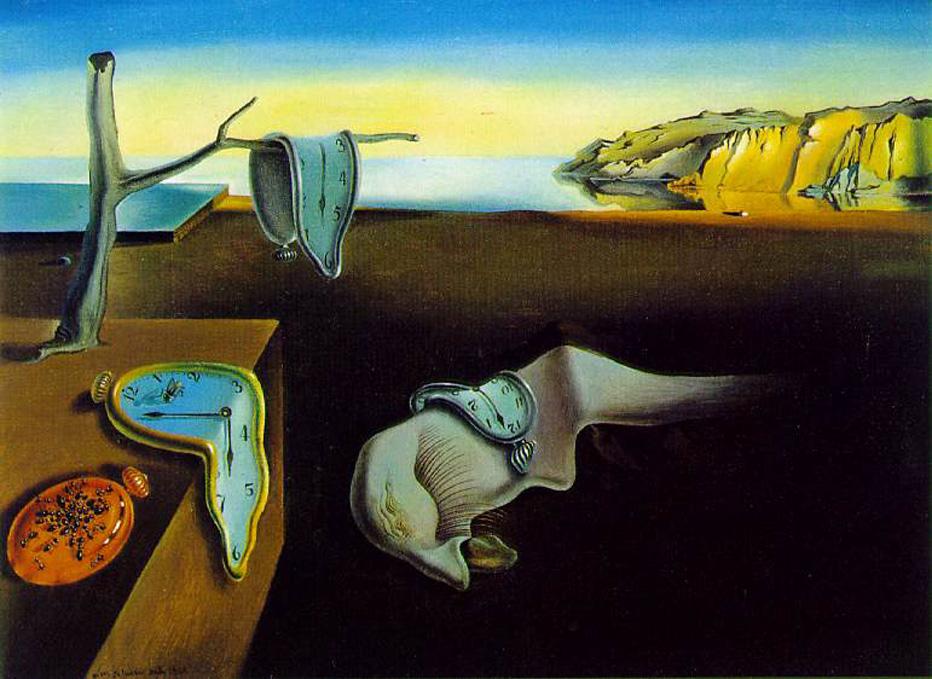 biological clock (or force reporters to change theirs) for his 5:30 AM daily press conference, or… as he playfully suggested… concern for the psychological well-being of the working class: working long hours and facing long commutes, Mexican workers are just too exhausted by the time they get home to do more than have a meal, maybe watch some TV, and go to sleep. But, early to bed and early to rise has a slightly different meaning in Mexico… A good night’s sleep and one is ready for “el manañero”, the early morning … er… fulfillment of one’s conjugal duties. Going to daylight savings time, López Obrador argued, would mean workers didn’t have the time to properly prepare themselves for the day, and well, who knows what might happen if some arbitrary intervention on behalf of the ruling classes and the gringos were to trample on the traditional values and simple pleasures of the Mexican working classes?
The López Obrador administration lost that one … the Supreme Court finally weighed in with a ruling that regardless of the benefits of some morning nookie, the Federal Government had the right to regulate time zones… and with the Mexican workers screwed out of potential screws, the U.S. decided to change the dates they spring forward and fall back… screwing up the whole screwy system.
When the United States arbitrarily changed the start and end dates for Daylight Savings Time in 2007, the Baja did too, and in 2009, a tier of northern border cities did, too. Sonora still doesn’t change their clocks at all, and although it is part of the State of Nayarit (which observes Daylight Savings Time), neither does the penal colony on Islas Marias (what for? Everybody there is doing time, so what difference does an hour make). Just to make things weirder, the Revillagigedo Archipelago, as part of the State of Colima keeps to Colima Time and despite less than an hour’s difference between the hours of daylight throughout the year, springs back and falls forward for no earthy reason other than that’s the way it’s done in Colima: except for the less than dozen sailors who make up the garrison on Isla Clarión, the western-most island in the Archipelago, live at UTC -8 (Pacific Standard Time) year round. Meaning, Mexico has three half the year, and four half the year. And frustrated workers in Mexico City.
The only reason I bring all this nonsense up is that while I remember to change the clocks around the house and most of my software packages can automatically follow the international standards (though for a time, there was a problem with software that presumed the weird U.S. way of doing things was the way everybody did it), WordPress doesn’t automatically change time at all… and I usually forget. I only thought of it earlier this evening (er, last night now), when somebody in the U.S. mentioned something about not forgetting to “fall back”. Which I did last week. And I fixed tonight… though I’m not sure why.
Centenarian of the day (of the dead)
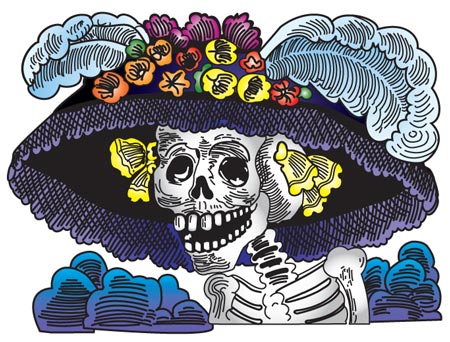
La Calavera Catrina is 100 years old today. Born dead, she was the brainchild of José Guadalupe Posada, who first made zinc etchings of the “elegant” lady first appeared in a 1913 broadside pamphlet. Largely overlooked at the time, Catrina did not become an immediately recognizable figure until the 1930s, when the government began a concerted effort to encourage the middle and upper classes to accept Mexican folk customs in part to wean them for both Catholic and U.S. cultural influence and Posada’s best known disciple, Diego Rivera, began to incorporate into his own art Posada’s satiric comments on the Europeanized Mexicans of the early 20th century.
Sheee’s baaaaak: Mary Anastasia O’Grady
Via Secret History: Reflections on Latin America:
Somebody let Wall Street Journal fiction writer Mary Anastasia O’Grady slip the leash this week and she’s arguing that Bolivia has become a narco-islamo-communist terror state. She tried before to argue that Nicaragua and Venezuela were harboring terrorists headed to the U.S. (all tosh) and now she’s put Bolivia in her rifle scope of malarkey. My guess is that O’Grady finally worked her way down as far as Bolivia with her Fisher Price “Nations of South America” floor puzzle and so decided to drop her discounted and tired theories on Bolivia. Look out, Chile, she’s coming for you next.

Tumbas por aqui, tumbas por alla
Fun kiddy song for Day of the Dead…
Neat, clean and dead
An old joke has it that Mexicans don’t make good hippies, because their moms won’t let them out of the house in wrinkled jeans. Despite adopting a more “relaxed fit” to sartorial standards in recent years, proper Mexicans still have the attitude that one should be not only neat and clean, but unsullied by wrinkles… a matter of respect and the preservation of dignidad… a value that transcends not just the introduction of wrinkle-free fabrics… but mortality.
Since at least 1947, patients and staff at Mexico City hospitals, notably Hospital Juárez, have spoken of a mysterious night nurse, who sometimes simply sits with patients who have been isolated or are in private rooms… occasionally assuring anxiety ridden patients that they will recover… , and sometimes simply walking the halls of less visited wards. While she doesn’t seem to provide any particular nursing function, dispensing drugs or physically assisting patients, at times she has been a life-saver… like the report she pressed a call button for a patient in distress, before simply vanishing. What all patients, and the hospital staffers who have seen the night visitor all agree on is that her uniform is out-of-date, but is immaculately pressed, without a wrinkle to be seen… something only Mexicans would notice when describing a person… and something only a Mexican ghost would consider important when out haunting.
The ghost is that of a young nurse of the 1930s named Eulia. At the time, a nursing career was considered more a “calling” than a job, and for the beautiful young Eulia, a vocation. As with nuns, her special  clothing marked her as one with a special role in society, with an utter devotion to a higher calling. Alas, like some nuns, Eulia’s devotion to her calling left her ill-prepared to deal with the more carnal instincts of man in the singular, rather than mankind in the plural. She’d fallen in love with a young doctor, but, with her well-known dedication to her calling, wanted to avoid any gossip about her affair, and … in an attempt to be the perfect nurse… made something of a fetish out of always appearing on duty in a perfectly turned out uniform.
Ghosts are usually tragic figures. Eulia’s doctor was, as you’d expect, a cad. Claiming he was going to a medical conference for two weeks, he left for Monterrey. Eulia pined for her swain, the pressure to maintain her own impossibly high standards beginning to crack when two weeks stretched to three… and three to four. She had a breakdown when another nurse… in complete innocence… mused about the intern and his new life in Monterrey… with his new wife.
Eulia … depending on the story, either fell into a lingering illness and died in Hospital Juárez… or hanged herself in the corridor (after, of course, making sure her uniform was in perfect condition). But… dedicated a nurse as she was, though unlucky in love, she still serves. And still keeps her uniform in tip-top condition…
… and making her the neatest ghost in Mexico — La Planchada: the Ironed Woman.
Whatever it is, I’m against it…
I’ve always said that protesting is the national sport, but here’s the ultimate protest. Protesting protests!
Merchants claiming that various sit-ins and occupations have damaged their businesses are demanding the Government “do something”… what I’m not sure.
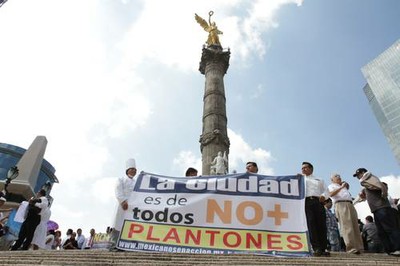
Photo: La Jornada/Roberto Garcia Ortiz


 mexfiles.net