Education and a step to the right?
A doff of the sombrero to Paul Imeson (Counterpunch, Independent (U.K.), etc.) for recommending what is, arguably, the best English-language explanation of our educational woes, the resistance to them, and the reasons for the resistance:
From the venerable U.S. quarterly magazine of culture and politics Dissent, comes Benjamin T. Smith’s “Teachers, Education Reform, and Mexico’s Left.”
… Drawing parallels between the school reforms and those of the petroleum industry and the fiscal system, [the political left] argue that the changes are steps on the way to a neoliberal apocalypse, the “elimination of social rights to education, housing, healthcare, and food.”
Without doubt, the teachers and their supporters have a point. The proposed reforms are ill thought out, disconcertingly vague, and have clearly been rushed through without proper consultation with either experts or broader society. The regulations fail to differentiate between professionalization and teaching evaluation. There is no national system for imposing a minimum level of teaching standards throughout the country. And as local governments remain in charge of interpreting and implementing the new rules, the control of teachers’ placements might simply pass to other, equally undemocratic powers. The reform of Article 67 of the Constitution, which encourages parents’ organizations to help pay for local schools, clearly opens the door to the kind of cheap privatization schemes that have served to ruin the U.S. education system.
At the same time, government and media treatment of the teachers has been brusque, dismissive, and at times abusive. On September 15 police violently removed strikers from Mexico City’s main square before the president’s Independence Day celebrations. And public discussion of the strike has disintegrated into ugly right-wing name-calling. Like the student radicals of an earlier age, teachers are regularly described as “ungrateful”, “lacking in respect,” even “savages” and “barbarians.” Beyond these immediate reforms and their political fallout, the overall standard of public education in Mexico is appalling (Mexico ranks last of the OECD countries in terms of education) and this is primarily due to chronic and sustained government underfunding. Evaluating teachers will not reverse inequality or generate social mobility.
Your homework for this week: READ THE ENTIRE ARTICLE. HERE.
We love the Dead!
I’d written several years ago a silly little guide to Mexico City cemeteries (“The Dead Tour”) which may even still be somewhat accurate, but for the meaning of it all, and to enhance the experience, one can’t have a better guide than “maesania “, a regular contributor to the Lonely Planet’s “Thorntree Message Board: Mexico”:
 People interested in experiencing the Day of the Dead in Mexico often ask about where to go for an authentic DoD experience. From photos, articles and trip reports they’ve seen and read, it’s a natural assumption that the deeper you go into rural, indigenous Mexico, the more real and authentic DoD celebrations will be. But my experience suggests otherwise.
You also see the real Day of the Dead in Mexico City. Even though the people are urban middle-class mestizos instead of Indian villagers, their DOD customs and celebrations are no less a deeply ingrained part of their culture: indeed, I find that aspect one of the fascinating things about Mexico City during the DOD period.
As an example, look carefully as you go around the city and you will catch glimpses: every workplace—every supermarket, office, school, museum, market, etc.—has its altar to the departed set up somewhere – principally by and for the benefit of the employees, not necessarily visitors.
There are also numerous mega-ofrendas—large-scale altar exhibits—set up for public view at various locations around the city. For example, there will be one outside each of the delegación (borough) city halls. In past years there has always been a giant one in the main Zócalo – I expect there’ll be one this year, too.
Universities as well – for example, the UNAM mega-ofrenda is located in the vast green space in the centre of campus called Las Islas. The combination of traditional elements with modern social and political commentary can make this one particularly interesting. The students who create these ofrendas draw on their social, political, and internal cultural experiences – the ofrendas are more than just art exhibits, but expressions of a culture that they have been living all their lives. The theme of this year’s mega-ofrenda at the UNAM is “50 years since Remedios Vara” paying homage to the famous surrealist painter who died 50 years ago.
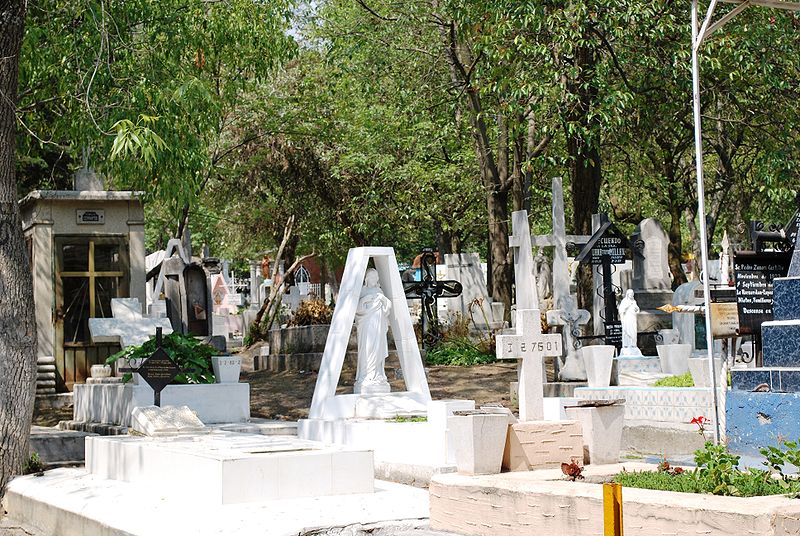
I can’t speak for all the cemeteries in Mexico City, so I’ll describe the one I visit, where my in-laws’ relatives are buried. On Nov. 2, the scent of Day of the Dead in 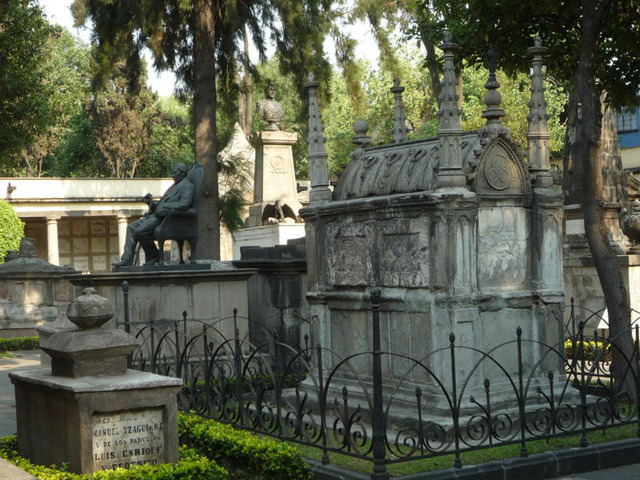 the cemetery is food, flowers, and incense. The sight is a shifting tapestry of colour: people and flowers—mostly gladiolas and giant marigolds. The sound is a murmur of thousands of voices of families conversing, punctuated by strains of mariachi bands here and there, and the cries of vendors weaving their way between the tombs. The pathways are choked with streams of people arriving and leaving. A visitor threading their way along the walkways would hardly be noticed among the crowds.
In summary, Day of the Dead in central and southern Mexico is different in the city vs. the countryside, but both are authentic experiences in their own way.
Big appetite?
I don’t know what was in them, but former Tabasco Governor Andres Granier ran up a tab of 937, 758 pesos and 20 centavos for… tacos. Well, at least the bills were paid to taco vendor Norma Alicia de la Cruz Gallegos. At about 30 pesos a taco (and that’d be high), we’re talking 31,259 tacos. Governor Granier was in office for 2192 days which would have meant he bought 142 tacos. os.
Clever money laundering scheme… who’d question the bill for tacos… unless your governor had fled the state with a couple of suitcases full of cash.
(Source: 24 Horas: Granier dejó deuda de casi un millón de pesos… en tacos)

Mariachi makes everything better… almost
You can’t keep a good song down. Lyrics, well… that’s another story.
Mariachi Sangre Azteca does Daft Punk:
Toot! Toot! — sweet!
THREE new passenger train projects Via Reuters:
Mexico’s government will tender three passenger train projects next year worth 97 billion pesos ($7.4 billion), two of which will service the capital’s sprawling metropolitan area, the country’s transport ministry said on Tuesday.
Project details will be published ahead of the contract tender in early 2014, the ministry said in a statement.
The new trains will connect the country’s capital with the cities of Toluca and Queretaro, in addition to a train traversing tourist destinations along Mexico’s southern Yucatan peninsula.
The 237-kilometer (147 mile) Mexico City-Queretaro route will cost about $3.3 billion.
The 47-mile route connecting Mexico City with Toluca, capital of the state of Mexico, will cost $2.9 billion, while the nearly 200-mile Yucatan route will cost $1.2 billion.
(If you’re wondering why the much longer Yucatan route is so much less expensive, it’s because the Yucatan Peninsula is flat… and less urbanized that the other two routes)

One irony in all this is that Mexico had decent passenger rail up until the neo-liberal “privatization” push of the 1990s. Seems selling off the rail lines (which promptly dropped passenger service) was centavo-wise and peso-foolish. I took the new Ferrocarriles Suburbanos from Buenvavista to Tulitlán (State of Mexico) recently… 45 pesos ($3.42 US$) … which would make it a reasonable commuting cost if one were to live there and commute to the city. Not that Tultitlán is a particularly charming place, and it appears some U.S. style “developments” are popping up on the edge of what is a very small city.
Another victim of privatization: Carlos IV
Miguel de la Grúa Talamanca, the Marqués de Branciforte, the fifty-second Viceroy of Neuva 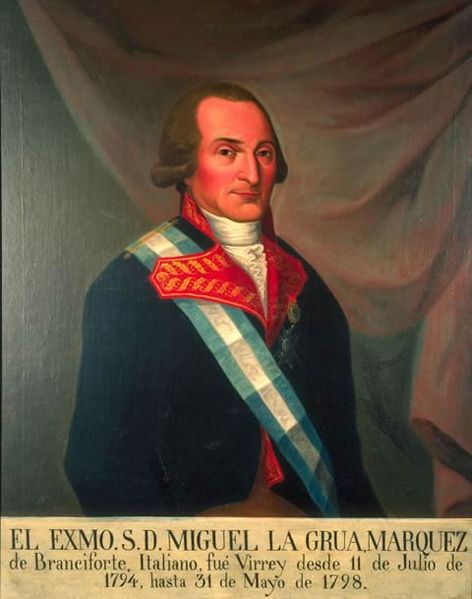 España, has two claims to fame as a ruler. His first was as the most corrupt chief-administrator this country has ever had (and that takes some doing). His second was commissioning one of the greatest pieces of sculpture ever produced. Alas, his greatest contribution to the culture appears to have been irretrievably damaged by those working in the spirit of his greatest vice.
If the Marqués had spent his life back in his hometown of Palermo, Sicily and probably being a founding father of the Mafia, but with the Kingdom of Sicily basically a subsidiary of Spain, there were much more opportunities abroad for a young, ambitious crook than merely extorting the local peasantry. Especially after he married the sister of the equally ambitious and amoral Manuel Godoy. The handsome Godoy, not fancying a career as an obscure army officer, was quite willing to … um… offer his services to the homely, and rather frustrated, Queen Maria Luisa.
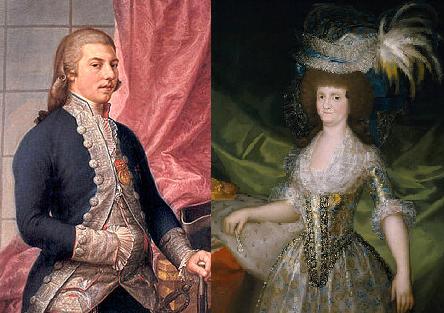
Godoy and Maria Luisa.
Queen Maria Luisa was saddled with a marriage to the son of one of the most intelligent and hard-working European monarchs in history, Carlos III of Spain. Alas, Carlos IV was one of the stupiest, and laziest of European rulers. He was happy enough to let Maria Luisa make the decisions and run the country. Maria Luisa was happy to let Manuel Godoy take over the work for her… and Manuel — having some sense of family values — happily obliged his brother-in-law Miguel de la Grúa’s wish for unlimited opportunities to steal.
Which Miguel did.
Arriving in Veracruz in 1794, Manuel spent a happy two years skimming the tax receipts, brow-beating the campesinos, and cheating the Indians. He just took a cut (whether legal or not) of any real estate transaction anywhere within the realm (which at the time included everything from what is now the Panamanian Border to the headwaters of the Missouri… Spain having acquired what was French Louisiana in 1762). Miguel, at one point, simply had a Veracruz brothel seized… mostly because he wanted ahem… some company for the evening… and he took a fancy to some of the furniture (which he later sold).
While his depredations of the lower classes might have been overlooked, he managed to basically, annoy even the rich Mexicans enough to the point where some began openly considering a radical departure from the mother country. But, before things reached such a point, some pesky honest bureaucrats had to stick their noses in… going so far as to complain to Madrid. Somehow word got through the Godoy-Maria Luisa filter and reached the ear of Carlos IV… who had a dim idea that the colonies should be sending back more money than they were… and wanted to know what the problem was.
Thinking fast, Miguel had a doozy of a rationale. It wasn’t that the money wasn’t being used, but that the monument being erected to the glorious Carlos IV by his grateful subjects in New Spain, destined to stand for all time in the at the center of Mexico City, was … well… rather pricey.
Which Carlos bought. It is true that some major public works had been undertaken, especially in Mexico City, but those were buildings, not statues. While the skill sets might have existed for Aztec style monumental art, no one in the Americas had ever produced a major sculptural work, although Mexico City’s sewer and drainage inspector, Manuel de Tolsá had been been to art school… and had studied sculpture back in Spain.
Viceroy Manuel, maybe carried away with his own fantasy, envisioned a marble statue, but Tolsá… who after all, did have to think about what was UNDER the city, realized it would be much too heavy. He proposed a “lost wax” bronze monument (which is hollow inside) … something he’d never tried before, but at least something a bit lighter than what he estimated as about 100 tons of stone (not to mention the problem of finding a suitable chunk of marble, transporting it and carving it).
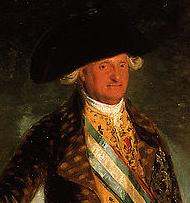
Carlos IV, from a portrait by Francisco Goya
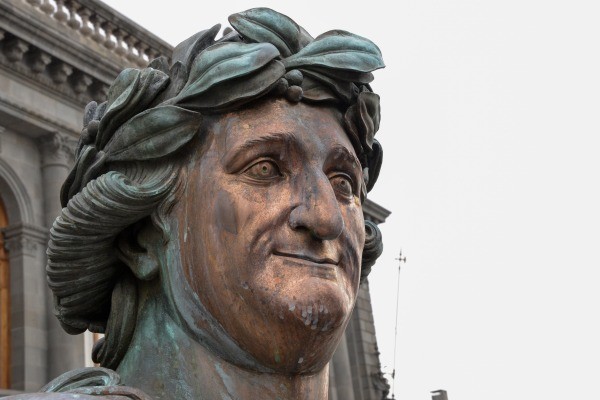
As it was, Tolsá’s design was, in some ways, a pastiche. Needing to find something heroic for Carlos to be doing, he is shown dressed as a Roman emperor, bearing… not a sword… but SOMETHING. That could be put off til later — it was something of a gamble, but there had to be something that Carlos could be credit with doing that, at a stretch, could be said to justify his grand monument. Based on heroic Imperial Roman statutary, Carlos’ goofy-looking and pudgy head would be attached to a “classical” body (from Tolsá’s own collection of copies of famous sculptures), mounted on a the only live model, and only “real” Mexican in the composition, Tambor, the horse.
While the statue may have been an absurd idea, it did fire Tolsá’s imagination… and his plans for the monumental bronze (at 5 meters long and 4.85 meters high, weighing in at just under 20 tons, it is one of the largest monumental bronzes ever completed, and the first in the Americas) was ambitious enough. But word of his commission led to other commissions, and Tolsá’s work as an architect (designing among many others, Mexico City’s Palacio de Minería, and Museo de San Carlos, as well as the Hospicio Cabañasin Guadalaja ) would delay the project for several years.
The crooked Viceroy, meanwhile… having stolen about all he could… returned to Spain in 1796. However, before he went, he proudly unveiled on the square in front of the viceregal palace (today’s National Palace) NOT the statute, but a wooden and stucco model of the statue on a marble base. The technical term for a statue’s base in Spanish is “zocalo”… which not too many people would have heard of before… but took the fancy of the public to such an extent Mexicans began applying the word to similar municipal squares everywhere.
With his other commissions, Tolsá’s masterwork would not be unveiled until 1803 … by which point, he’d found something worthwhile to put in Carlos’ hand that was at least heroic: his 1802 edict order smallpox vaccination being sent to the colonies.
I don’t know, maybe it makes sense that the crooked viceroy ended up commissioning a sewer inspector to build a monument to public health, but I don’t think that was the intention. Anyway, Alexander Humbold was dutifully impressed, considering it the second greatest sculpture in the world (he liked one of Marcus Aurelius he’d seen in Rome a little better).
The Mexican people… while they remembered the Zocalo… were of mixed feelings. While everyone admired Tambor the Horse, nobody particuarly liked Carlos IV, and few tears were 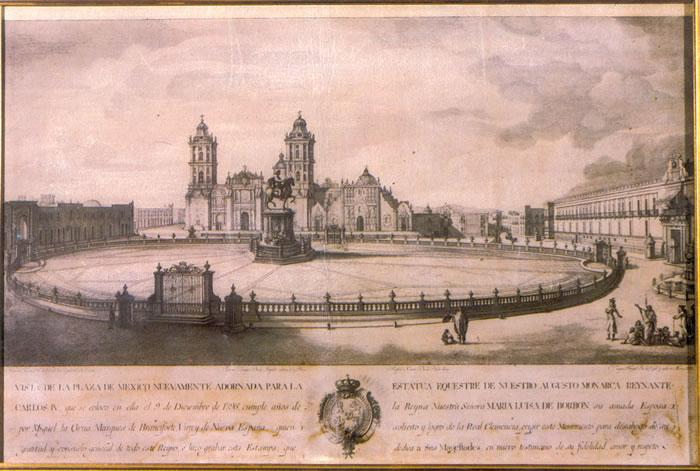 shed when he was forced to abdicate in 1808. To protect the work, Carlos had to be covered up during the Independence wars of 1810-20, after which there was some suggestion of knocking the head off and replacing it with Augustín Itubide, which went nowhere (mostly because Tolsá had died in 1808 and no one wanted to take on the job… and Iturbide’s short-lived Empire of Mexico had other priorities, like dealing with an empty national treasury. That empty treasury led the first president of the Republic, Guadalupe Victoria, to consider having it melted down for coinage, but he was talked out of it by pro-Spanish historian and cultural guru, Lucas Alemán. However, Alemán did understand that not everyone wanted to be reminded of Carlos IV (as pro-Spanish as he was, even Alemán was at most a lukewarm defender of his reign), and the 20 ton statue was moved a few blocks away to what is now the courtyard of the National Prepatoria. In 1852, it was hauled up the road to what is now the corner of Reforma and Bucarelli… serving as the first of the Reforma monuments that line the avenue.
In 1979, being somewhat overwhelmed architonically by the large new buildings in what had become an important commercial center, the Caballito was again moved (and replaced by a Alexander Calder Sebastian abstract horse… that — perhaps in honor of Tolsà’s day job with the city — doubles as a sewage gas escape pipe) to its present location… now named “Plaza Tolsá”, site of the National Museum of Art.
With the exception of the honest Guadalupe Victoria, El Caballito de Tolsá has always been treated with respect by Mexican leaders, even the outright crooks who almost measured up in venality to Miguel de la Grúa Talamanca. Santa Anna, Huerta, Carlos Salinas… they had nothing but respect for Tambor the horse and his goofy looking rider. But… this is the age of neo-liberalism, and where crooked viceroys and venal caudillos feared to tread.
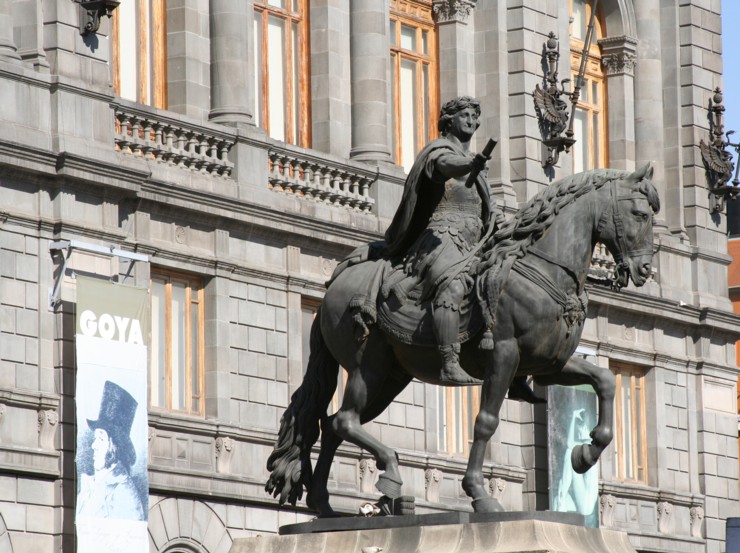
Pre-“restoration”
Having starved the Instituto Nacional de Antropología e Historia, which oversees the nation’s substantial cultural treasures, and having put it under the “guidance” of political hacks (much as Ronald Reagan put the U.S. National Endowment for the Arts and Humanities under similar control), important preservation work has been “privatized” and major cultural sites have been seen as opportunities for short-term profit (one thinks of the Elton John concert at Chichen Itza… which had to be ritually cleansed by the Mayans after its pollution by the trash-bearing crowd… or the probably permanent damage caused to the same site by installing fixtures for a “sound and light show”). Although not in any major danger, El Cabilitto de Tolsá has been sitting outdoors for the last two centuries, and bronze does discolor. What should have been a simple job for the professionals at INAH was let out to a private firm, which used nitric acid in a much too strong concentration (and overcharged for the job, it seems), causing damage to about a third of the entire work, horribly discoloring it (the gray patina was never considered particularly ugly, although it would have been a site to see it new and shiny again) and… this being a venal and ugly age… an untold financial loss.
Sources:
Carlos Franco-Paredes, Lorena Lammoglia, and José Ignacio Santos-Preciado: The Spanish Royal Philanthropic Expedition to Bring Smallpox Vaccination to the New World and Asia in the 19th Century Clin Infect Dis. (2005) 41 (9): 1285-1289. doi: 10.1086/496930
Manuel Tolsá, Obra escultórica, UNAM: Faculdad de Ingeniería, División de Educación Continua y a Distancia.
Marcial Fernández, “El Caballito de Tolsá” El Economista, 29 Septiembre, 2013
SDPNoticias: Los daños irreversibles a “El Caballito” de Tolsá”, 09 de octubre de 2013
On-line encyclopedias…
Leave no bad policy behind
With growing recognition in the United States of the damages caused by over-reliance on testing, the “No Child Left Behind” policies of the Bush Junior’s Adminstration (which were designed to leave children behind) and the privatization of public education, what to do with the toxic waste of wrong-headed ideologies and “think tank” research? As with other unwanted and dangerous U.S. products, the answer seems to be to ship it to Mexico.
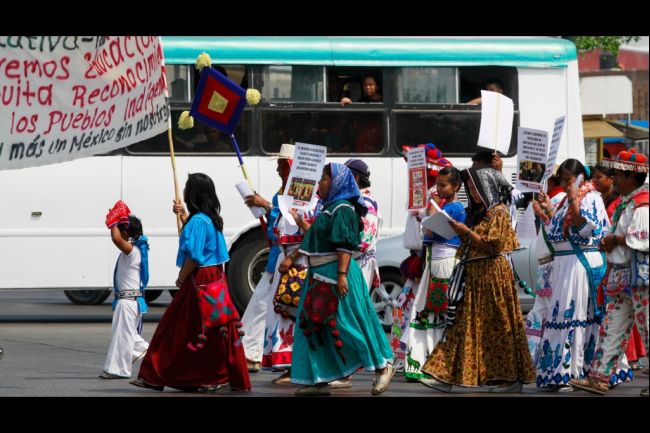
Wixarikas teachers protest, Guadalajara, May 2013. Photo by Hector Guerrero/AFP
Eva Hershow, “Profiting from Education Reform in Mexico” (Texas Tribune, 7-Oct-2013)
… the Mexican education system is clumsily following the path to privatized education and standardized testing blazed by its powerful northern neighbor. According to researchers from Mexico’s National Pedagogic University and Iberoamerican University, Lucía Rivera and Carlos Muñoz Izquierdo, Mexican schools are increasingly competing for federal money in an educational system dictated by private interests, a practice clearly established in the United States.
“Education reforms in Mexico have essentially been a business proposal,” said Hugo Aboites, a Harvard-educated professor at the Mexican Autonomous University. “It is a proposal aimed to promote economic development.”
In Mexico, education reform’s biggest cheerleader has been a group called Mexicans First. Described by its members as a diverse, independent citizen’s initiative, Mexicans First is comprised of some of the top brands and corporations in Mexico: Televisa, Palacio de Hierro, Modelo Group—manufacturers of Modelo, Corona, Pacifico, Negra Modelo beers—as well as dairy giant Lala, Aeromexico, Cinépolis, Bimbo and Santander.
Two months after Peña Nieto was elected, Mexicans First published a document entitled “The Time is Now: 2012-2014 Goals.” Among the many recommendations, the report called for curtailing the power of SNTE. Indeed, the union was once a close political ally of the PRI, the political party which ruled Mexico for 71 years, until 2000, but has recently returned to power with Peña Nieto’s election. The PRI, through the union, has long-controlled the sale and inheritance of some teaching jobs. Yet shortly after Peña Nieto took office in December, he orchestrated the removal of long-time SNTE leader Elba Esther Gordillo, who was accused of embezzlement of funds and jailed in February. The report also called for more teacher evaluations and test-based accountability as well as greater autonomy of the governmental National Institute for the Evaluation of Education (INEE), the body that oversees testing and evaluations. In April, a member of Mexicans First, sociologist and OECD advisor Sylvia Schmelkes, was installed as head of the INEE.
“The report published by Mexicans First, together with OECD proposals, essentially wrote these reforms,” said Aboites. “These businesses want our children and students to be good capital for our growing capitalist country. Bimbo and Televisa. This is the government’s agenda.”
I’m surprised no one (including myself) didn’t remember that when the U.S. started talking about “testing teachers” it was only as a prelude to testing students… creating “results driven education”… the results being, not an educated person, but someone who was trained to respond (in Pavlovian fashion) to provided stimuli… in other words, learn to take orders and give a fixed response. At the same time, the same people pushing the “No Child Left Behind” testing programs were generally the same ones pushing “reforms” like “Charter Schools” (private institutions with their own — generally corporately developed — curricula, paid for largely by private funds… and exempt from the union requirements and labor regulations of the public schools).
That teachers opposed testing here — and were portrayed in public as intransigent and anti-education — should have reminded us of similar attempts to block these “reforms” in the U.S. before they began destroying public education. Which they very nearly have succeeded in doing in the U.S.
I would recommend reading Eva Hershow’s article in full, and educational historian Diane Ravitch’s Reign Of Error: The Hoax of the Privatization Movement and the Danger to America’s Public Schools if one truly believes in educational reform. Ravitch was a former cheerleader for U.S. “reforms” (which are, with a few tweaks, what is being rammed through here), had to reverse her thinking… and U.S. schools are starting to work to undo the damage. Of course, with education in the U.S. controlled mostly at the local and state level, any protests before, and any counter-reforms now are merely local in scope, and never — as they are here — pressing national issues. A shame, since, in both the United States and Mexico, those who care about education, are likely to agree with Ravitch that
… public school education is about knowledge, about learning, about developing character, and about creating citizens for our society. It’s about helping to inspire independent thinkers, not just honing job skills or preparing people for college. Public school education is essential to our democracy, and its aim, since the founding of this country, has been to educate citizens who will help carry democracy into the future.
“… and your horns fall off”
Chiapas Catholics have always had to do things a bit differently.
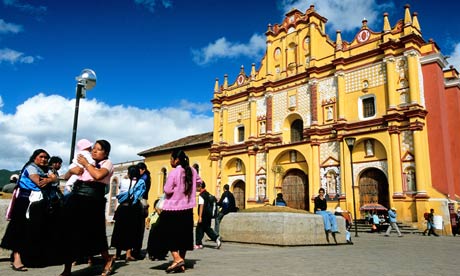
Photo: The Guardian
After having decided fifty years ago that the rites of the Church should be in the national language, Mexico’s fifty plus national languages has been one more rock in the shoe of the rather slow moving Vatican bureaucracy. In the Diocese of San Crisobal (Chiapas), the about two-thirds of the faithful are indigenous, and speak any one of five different languages. The two main languages being Tzotzil and Tzeltal, the late Bishop Samuel Ruiz had permitted priests to offer a partially translated Mass in the two Mayan languages, but much of the service required ad hoc translations and paraphrasing, which was often inadequate or misleading.
Oh well… it only took the Catholic Church about 1900 years to get all the various sacramentals into more widely spoken languages like English and Spanish, so coming up with the proper way of saying things, and preventing well-meaning but monolingual Spanish-speaking priests from saying “I baptize thee, and your horns fall off” rather than the more conventional “I baptize thee in the name of the Father, Son and Holy Ghost” in only seven years is something of an accomplishment.
(Jornada: Aprueba papa Francisco fórmulas en tzotzil y tzeltal para sacramentos)
Let the sun shine… let the sun shine…
Via Bloomberg:
Mexico, poised to allow foreign oil extraction for the first time in 75 years, is finding its abundant natural resources also appeal to investors in a much cleaner energy: sunshine.
First Solar Inc. (FSLR) of the U.S. has bought its first projects in Mexico, while more than a dozen other developers including Germany’s Saferay GmbH and Spain’s Grupotec Tecnologia Solar SL own licenses there. Local investor Gauss Energia opened Latin America’s largest photovoltaic plant in the country last month.
The project “will open the way for the development of the photovoltaic sector,” Gauss Chief Executive Officer Hector Olea said in an e-mail. “There have been multiple announcements but very little real development work so far even though the regulatory system is sound and conducive to bankable projects.”
Mexico, a top 10 oil producer, plans to generate 35 percent of its power from clean sources by 2026, up from less than 15 percent now, to curb emissions and diversify its energy mix. A global surplus of solar panels has made them cheaper, while the costly oil-fired plants common in areas such as Durango, Sonora and southern Baja California make solar a competitive option.
(Sorry about the dearth of recent posts… I could have used a longer vacation, but there are work projects that need caught up, and pressing matters that have to be taken care of as well).
Never forgive, never forget
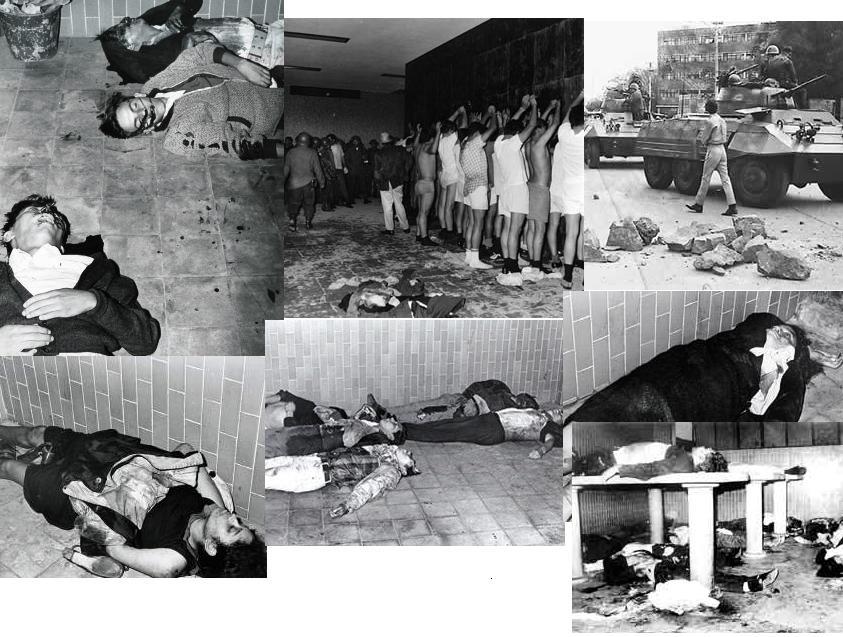
Photomontage: Javiersoriano.com
Latino Rebels has links to an excellent collection of English-language readings on the Tlatelolco Massacre and the event of 1968 here:
¿No pasaran?
Palacio de Bellas Artes, in anticipation of the 45th anniversary of the Tlatelolco Massacre.
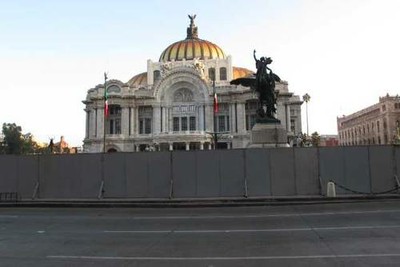
What is the government so afraid of, that it doesn’t trust the people to mourn their own history, and to celebrate democracy?
Older is better?
Quite a shock to realize how effective birth control has been in Mexico… while the 2010 census showed that 6 percent of Mexicans were age 65 and older, by 2016, the percentage of Mexicans of the “third age” (our euphemism for “old”) will be 15 percent.
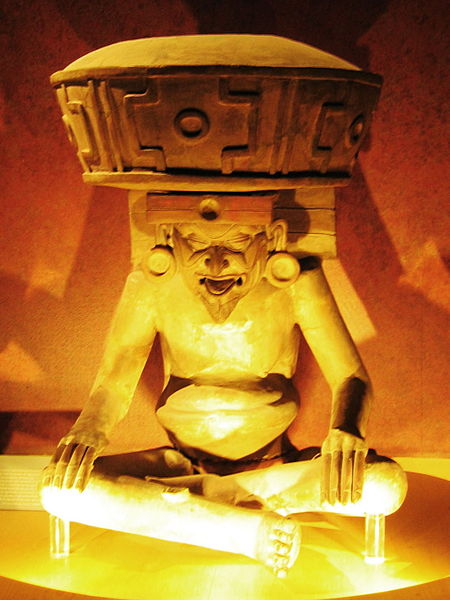
Huehueteotl, god of old age (Museo Nacional de Antropología)
Although the first effective oral contraceptives were developed in Mexico in the 1950s, it wasn’t until the late 1960s and early 1970s that access to birth control became a priority for Mexican health officials. Despite the stereotype of Mexico as a “Catholic country”, there has been little or no objection to making birth control (including the “morning after pill”) widely available. Rather cautiously, but still radical for the time, the Mexican Constitution was amended in the early 70s to guarantee the rights of families “to determine the number of its own members”.
In good part because of birth control and comprehensive pre-natal care, Mexican women saw a dramatic rise in their life expectancy and more Mexicans than ever are living past the age of 65. And having less children. I am not sure whether this is good or bad for the economy … overall, it is probably good (less mouths to feed, less resources to use, and more job openings for the underemployed better-educated young adults of today).


 mexfiles.net