Strangers in a strange land
Moses and Jesús: The Prophetic Fight for Immigrant Rights
Like coals to Newcastle… cocaine to Miami
What a problem! Costa Rican authorities have seized too much cocaine to handle… so:
A curious cargo airlift operation recently took place at the Daniel Oduber Quiros International Airport (LIR), in the northern province of Guanacaste. According to a news report by Alvaro Sanchez from online news daily CRHoy, nearly 24 tons of cocaine were loaded onto a United States Air Force transport aircraft. The destination of the controversial payload? Miami, a city that once held the infamous title of “Cocaine Capital of the World.”
The public affairs office of the Organization of Judicial Investigations (OIJ in Spanish) in Costa Rica explained to CRHoy that the 23 tons and 780 kilograms of powder cocaine hydrochloride were the result of two years of interdiction work by the National Coast Guard Service, the OIJ, the Border Police, and Fuerza Publica (the national police force in Costa Rica). This does not include seizures made by the U.S. Coast Guard and U.S. Navy as part of the Joint Patrol Agreement between Costa Rica and the U.S.
Um, yeah… the U.S. Air Force is destroying the payload. Or so we’re told.
Swift move?
The athletic shoe company, Nike, mostly known when it comes to exploiting poor people around the world for their labor, has expanded into cultural expropriation of … their feet?
Next weekend, with great fanfare no doubt, the U.S. multinational, will sponsor a race in Guachochi, Chihuahua, to present to the market (at prices no one in Guachochi is likely to be able to afford) a new running shoe based on… poor people’s feet?
The Tarahumara (Rarimuri) people… some of the poorest in Mexico… have survived mostly because they can run. Not only is their environment one in which what food there is is “fast food” (like jackrabbits and deer), and their traditional religious ritual involved running games, they’ve had to move quick to avoid being exploited by the Aztecs, the Spanish, the mining companies, the Revolutionary armies, etc. over the centuries.
I can’t imagine what Nike is thinking of… Tarahumara as often as not run barefoot. When they do opt for footware (mostly to avoid cactus thorns and little sharp rocks), they don’t use running shoes… not anything that exploited workers in Vietnam, Indonesia, etc. couldn’t afford on their own:

THIS requires corporate capitalism?
Not exactly the Marlboro man
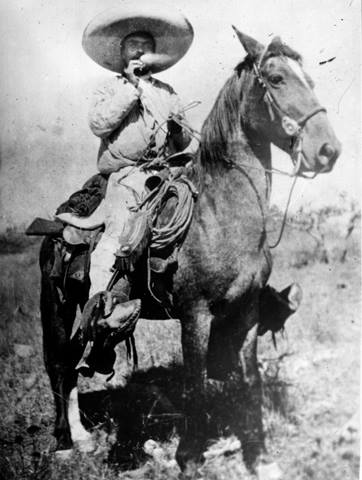
OK, so he’s not likely to be held up as a “role model for youths” in the United States. Emiliano Zapata, born 8 August 1879.
‘Splain this
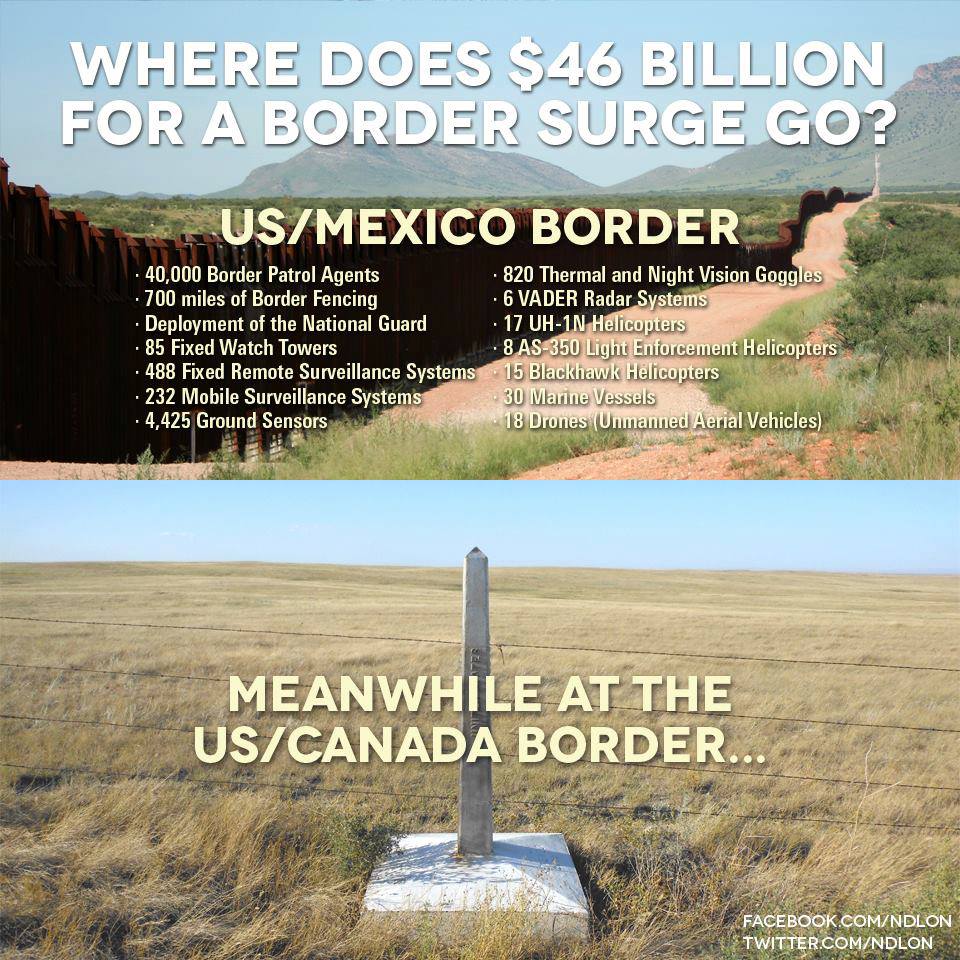
The poor will always be with us, just not with the US
I’m rather bemused by my fellow gringos who, with recent changes in the immigration laws here, pay somewhat more for their visas. It’s apparently quite an imposition that the 180 day visitors visa has gone up to something on the order of 30 USD.
Jack Donoghy — not known for throwing fits — is, shall we say, understandably upset that three of the workers from his parish church in Honduras were denied a visa to enter the United States for a short stay with a “sister parish” in Iowa. Despite assurances from the Iowa parish that they would be assume financial resposnibility for their guests, and despite having already paid the 160 dollar NON-REFUNDABLE interview fees (which also required a trip from Copan to Tegucigalpa) AND even support from Iowa Senator Charles Grassley, the visa requests were denied.
Why? The individuals don’t have a lot of money in their bank accounts (come to think of It, If Iwasn’t already a U.S. citizen, I probably couldn’t get a visa on my middle-class Mexican income).
I know that this happens everyday and has happened twice here to two other persons who were to be sponsored by Catholic institutions in the US.
I know that this is only the tip of the iceberg that is the unjust immigration system in the US….
There are poor people but a parish in the US, which is in solidarity with the parish here, promised to pay all the expenses – and has already put out more than $800 for this.
I don’t think that is the fault of the interviewer. According to the two men they were treated respectfully.
But what the US government looks for in these interviews is the almighty dollar. Solidarity does not mean much.
Money matters, not solidarity.
I think this reveals some of the problem with US migration policy. It’s based on fear, fear of the other, of the different. There is also the fear to “our way of life.”
Security matters – but security in terms of money and what money can buy.
What fresh Hell is this?
From THOSE PEOPLE responsible for convincing the educationally challenged of the world that some corn-based napkin holder in some way resembled a taco comes what Eater.com calls “the latest in breakfast hybrid technology.” Which is sort of like Dr. Frankenstien calling his monster the latest in zombie-hybrid technology, I guess.
Whatever this thing is, keep it out of Mexico. Taco Bell tried (to great hilarity) to foist their bizarre creations on Mexico back in 2007, opening a store in Monterrey — which sometimes takes a perverse pride in being “like the United States” (meaning: overpriced, pretentious and where one is likely to die of multiple gunshot wounds) — but even they could stomach those things.

Conservatives never change
It’s nothing serious, but having to be on some drugs the last week, I’ve mostly been sitting home reading. Looking for something lengthy, I worked my way through David McCullough’s 1977 The Path Between The Seas: The Creation of the Panama Canal 1870 -1914. Leaving aside McCullough’s defense of the United States government’s massive intrusion into the internal affairs of foreign states and the chicanery involved in creating the “independent” Republic of Panama, what stands out is the scale of the U.S. government investment. The United States government ended up paying more to build the Canal than they spent for the Louisiana Purchase, the Mexican War “indemnity”, the Gadsten Puchase and the Alaska Purchase (as well as the cash shelled out to annex Hawai’i) combined.
“Private enterprise” spectacularly failed — even with massive government assistance. What got the Canal going was a commitment by the U.S. government to invest in not just land and

Damn commie… paying a living wage and providing for the health, safety and recreation of the workers.
machinery (leading in itself to huge technical and industrial advances for U.S. industry), but in human resources. We have all benefited from the “socialist” investment in public health that made it possible to live in the tropics with the expectation that we would NOT be exposed regularly to malaria or yellow fever or plague, and — for a short time — the Republican administration of William Howard Taft created what might be considered almost a “workers’ paradise” (at least for the Americans… the West Indian workers had second-class conditions and terrible housing, but still enjoyed much better benefits and working conditions than most workers would have expected at the time.
That the Panama Canal would pay for itself — not only indirectly in the huge advances in technology and medicine and lower shipping costs — but directly though user fees was obvious to everyone. Which still didn’t prevent conservatives from complaining about government spending, even when it was for their own good.
To some visitors it seemed that perhaps everyone was having too good a time, that a little too much was being done at government expense. Others worried more over what the future effect might be of so efficient and apparently so successful a demonstration of socialism. In the largest of all modern enterprises, reporters were writing, not one man at the top, no one at any level, was working for profit. Visiting bankers and business people when home to report that the government-run Panama Railroad was a “model of efficiency and economy in every department.” No railroad in the United States was better equipped with safety devices. No private contractor in the world was feeding laborers so well as the I.C.C. [Inter-oceanic Canal Commission] In every phase of employer-employee relations the I.C.C. was more liberal than any private concern of the day, as several publications had already emphasized. The government ran the Tivoli Hotel, very well and at a profit. The steamship line between new York and Colón, also government-run, was earning a profit of some $150,000 a year.
What were to be the consequences when the canal workers, spoiled by such paternalism, came home again?
When these well paid, lightly worked, well and cheaply fed men return to their native land [warned a New York banker], they will form a powerful addition to the Socialist party . . . By their votes and the enormous following they can rally to their standard, they will force the government to take over the public utilities, if not all the large corporations, of the country. They will force the adoption of government standards of work, wages and cost of living as exemplified in the work on the Canal.
Do not disturb
Some people HATE to be interrupted.
On 17 July of this year, gunmen attacked Diana Marroquín — the blonde — while she was campaigning for the Hidalgo State Legislature on the Citizen’s Movement ticket. Marroquín had tried for a place on the PRD ballot, but state party leaders opposed her candidacy ostensibly not because Marroquín is a transgender, but because she was too much of an “outsider” … in other words, because she’s a transgender. And not part of the machine.

Hold your own damn press conference, bitch!
The PRD candidate was the brunette, Isabel Godínez Granjero, from a family well-established in the local political scene. In other words, very much part of the machine. Her brother was recently arrested for being the gunman who attacked Marroquín, whose campaign for the anti-establishment Citizen’s Movement was the victim of dirty trick at best, and violence at worst. by not their political opponents, PAN and PRI, as much as their supposed allies, the PRD.
Following Guillermo Godínez’s arrest for the attack, and based on evidence that other establishment political figures were involved, Marroquín called a press conference to discuss the issue. Isabel Godínez crashed the conference, and… well… shall we just say, it was one of those situations not covered in Roberts’ Rules of Order?
Maximiliano’s coalition of the unwilling
Latin Americans owe their independence to military leaders who took advantage of the power vacuum created when Napoleon Bonaparte occupied Spain. But, the Americas were not to only place where a military strongman was able to carve out an independent state in the name of resisting French hegemony over their empire.
In 1798, still a General in the army of the French Republic, Napoleon seized Egypt (for complicated reasons having to do countering British trade in India), a badly administered “vice royalty” of the Ottoman Empire. Napoleon went to great lengths to show respect the local beliefs, and proclaim “we are true Muslims too,” and managed for a short time to implement a French administration.
Although Napoleon’s withdrawal from Egypt would have more to do with the situation in Europe  than with Egyptian resistance, as in Mexico, local clerics fomented uprisings against what they claimed were “foreign atheists” and were joined by intellectuals and elites who recognized that their Egyptian interests outweighed their loyalty to the imperial power.
With the French withdrawal in 1801, the Ottomans sent a force to re-occupy Egypt, led by an Albanian commander, Mohammad Ali. Much like Agustín Itubide, the Mexican royalist general who struck a deal with the Republican leaders Guadalupe Victoria and Vicente Guerrero, Ali struck a deal with the various insurgents and anti-Ottoman forces within Egypt, seizing control of the local government himself. Although technically only the viceroy (khedive), Egypt under Mohammad Ali became an independent country with it’s own army and foreign policy. And even its own imperial ambitions, taking control of the Sudan in 1821.
Like Iturbide, Ali was an admirer of the man who made it all possible… Napoleon Bonaparte. The French were welcome foreign advisers and Egyptian policy was pro-French. Unlike Iturbide, Mohammed Ali was able to establish a dynasty. Under Said the First, when the French were given concessions to build the Suez Canal, Egyptian-French relations were particularly close… so much so, that when Napoleon III decided to invade Mexico in 1862, Said offered to send Egyptian troops.
Although the French had at the time the best army in the world, they were powerless against the Mexican’s secret weapon… one the Mexicans themselves didn’t quite understand. As the French learned from their attempted invasion in 1838, the Mexicans could decimate a foreign invader by bottling them up in Veracruz, and letting the secret weapon — yellow fever — do the dirty work. At the time, the link between mosquitoes and yellow fever weren’t know (and wouldn’t be until the early 20th century), but it was noticed that the people in yellow fever regions tended to be dark skinned, so — based on the racial assumptions of the time — it seemed logical for the French to send the darkest skinned guys they could find.
SO… the Egyptians “contributed” 500 Sudanese soldiers to the glorious enterprise, of putting the former viceroy of Austrian Italy on the throne of Mexico. Having only 400 Sudanese troops available when the call came to embark for Mexico, the Egyptian officers didn’t panic… they simply went out in the streets and “recruited” another 100 guys that might look presentable in uniform. They didn’t have any musical instruments with them, but the force included 22 “boy musician’s apprentices”. Less the boys, who were disembarked at Martinique and eventually sent back to Egypt (one hopes to get their flutes and drums and horns), the “undisciplined, insolent and filthy” (in the words of General Forey) soldiers of the “Egyptian Battalion” landed in Veracruz on 24 February 1863.
Where their commander, Yabritallah Effendi, promptly died of yellow fever, along with a number of the soldiers. And the unit started to fall apart. With “86 dead, 15 sick and the rest very tired… living in isolation with a bad reputation among the people” (quoting from General Forey), the French realized they had to do something. French officers and Algerian translators were brought in to shape them up, and the Sudanese were fairly well regarded by the French, if only for their brutality against civilians in response to guerrilla attacks. They were mostly used for garrison duty and guarding railways in the Port of Veracruz and the east coastal lowlands,
And, that lover of the exotica, the Emperor Maximiliano, thought they made a showy honor guard.
Back of the bus… er… boat. The Egyptians were the last of the French Expeditionary forces to be evacuated from Mexico in 1867. Despite that “bad reputation among the people” some of the Sudanese must have found something they liked in Mexico. Of the 326 of them that were still alive, only 200 sailed for home.
(Mexico Armado; Louis Napoleon’s African Allies; miscellaneous sources)
Staying the hand of God
Way to go, USA! You’ve managed to piss off the entire world… or the 96 percent of the human race that doesn’t care if Diego Maradona is a commie or not. Yeah, Fidel and the late Hugo Chavez like futbol, but so does God’s mouthpiece, and neither God’s mouthpiece, nor Walt Disney, nor the U.S. State Department would even consider staying the Hand of God.
Maradona wanted to take a family trip to the Florida theme park with his girlfriend, his two daughters and his grandson, but was denied entry to the U.S., for unexplained reasons, according to the British tabloid. Previous drug arrests and his well-publicised friendships with Fidel Castro and Hugo Chavez certainly don’t help matters.

I expect “Voice O God” agrees with me.
…
“[Maradona’s] relationship with the U.S. has never been good. His friendships with Fidel Castro and Hugo Chavez and other enemies of the US stopped him being given permission before.
That’s so Mickey Mouse, it’s Goofy.
Rita Hayworth, Chicana heroine?
One of those “while looking for something totally unrelated” factoidal posts for which we can thank the internet…
Probably the first pro-Chicano Hollywood film had to be the 1936 “B western” Rebellion from Crescent Pictures Corporation (which stopped making films in 1939). The only synopsis I could find is from an old “tripod” website, celebrating the works of its star, Rita Hayworth:
Rebellion is set in California, 1850. At the time, California was a newly acquired land of the United States. A treaty was signed to protect the

Rita Hayworth, before she was Rita Hayworth
Mexicans living in the area, but it is not being upheld. When American bandits murder the father of Paula Castillo (Rita Cansino), she heads to Washington to petition for law enforcement to be sent to protect her people and their land from the thieving outlaws. In response to her plea, the president sends Captain John Carroll (Tom Keene).
Once in California, the first thing he does is dismiss a self-made court set up by a criminal named Harris (William Royle) and his gang. When Paula’s brother, Ricardo Castillo (Duncan Renaldo) is killed, both Paula and John begin taking more serious action. Soon Harris’ gang kicks Paula out of her own home. The captain teams up with Ricardo’s band of patriots and they succeed in giving much of the land and homes back to their rightful owners.
Meanwhile, when Paula becomes influential in a campaign to make California a state, Harris’ bandits kidnap her. But John rescues her in short order and gets her home back. With the help of Ricardo’s friends, he forces out Harris’ gang, and so brings justice to California. Soon California achieves statehood. John is chosen to be it’s first senator, and he and Paula plan to be married.
Rita Hayworth was then known, and billed, under her real name, Rita Cansino. Although a native of Brooklyn, her father was a Spanish immigrant, so I guess she should at least be considered “Hispanic”. Which, other than the now forgotten Lita Cortez, in a minor role, were probably the only hispanics on the set. The main Chicano characters were played by future “Cisco Kid” Duncan Renaldo (a Romanian… although he started his film career as an illegal alien entering the United States from Brazil) and Gino Corrado , an Italian). In other words, about par for Hollywood when it came to casting Latinos in the movies… then and now.
Alas, for history, there was no Chicana leader, no Anglo champion of la Raza. The first California senators were John C. Frémont (with the accent mark) — not only the leader of those gringo invaders, but a guy who became very rich from stealing mining rights from the previous Mexican land-holders — and William Gwinn, who pushed through the bill in 1851 setting up the Public Lands Commission, which was used to deprive former Mexican citizens of their land and property rights.


 mexfiles.net