Build a 29,029 foot fence and…
Via Asian Trekking, at 4:35 am Nepal Time today (which would have been yesterday here), 33 year old Mexican alpinist David Liaño González became the first person ever to climb Mt. Everest from both the Tibet and Nepal side in the same season. On May 11, he reached the summit from Nepal (accompanied by Nepalese Sherpa Samden Bhote), and yesterday, from Tibet, with John Tsang and Pasang Dawa Sherpa arriving ten minutes later.
Apparently, this is a BFD in the alpinist world, but it just goes to show you that no matter how high the border barrier, for a Mexican it’s a challenge, not a deterrent.

Photo:SDPNoticias
Off we go, into the wild blue yonder…

Barbarians at the gate
Both north and south of us, the late-comers to the hemisphere have been destroying the national heritage for short term gain.
In Belize, the Noh Mul archeological site, although on on private property, as a “pre-Hispanic” site, is protected under Belizean law. It’s not exactly unknown, as Belizian photographer José Luis Zapata notes:
Nohmul, meaning “Great Mound,” is 20 meters above sea level and is situated on a low, limestone ridge east of the Rio Hondo between Orange Walk and Corozal. Nohmul lies among sugarcane fields and is actually the highest landmark in the Orange Walk/ Corozal area. It is about a mile from the Northern Highway between San Pablo and San Jose.
The site was first recorded in1897 by Thomas Gann. In 1908 and 1909, Gann returned to the site to dig what he thought were burial mounds containing polychrome vessels and human effigy figures. Gann continued excavating up to 1936 uncovering tombs and caches which yielded human bones, jade jewelry, shells, polychrome vessels, chultuns, flint and obsidian. Most of these finds were taken to the British Museum. Later on A. H. Anderson and H.J. Cook visited Nohmul to inspect damages to the site. In 1973, 74, and 78, Norman Hammond (then with Cambridge University) mapped the site. Hammond returned in 1982 to do a more intensive Nohmul Project which lasted until 1986.
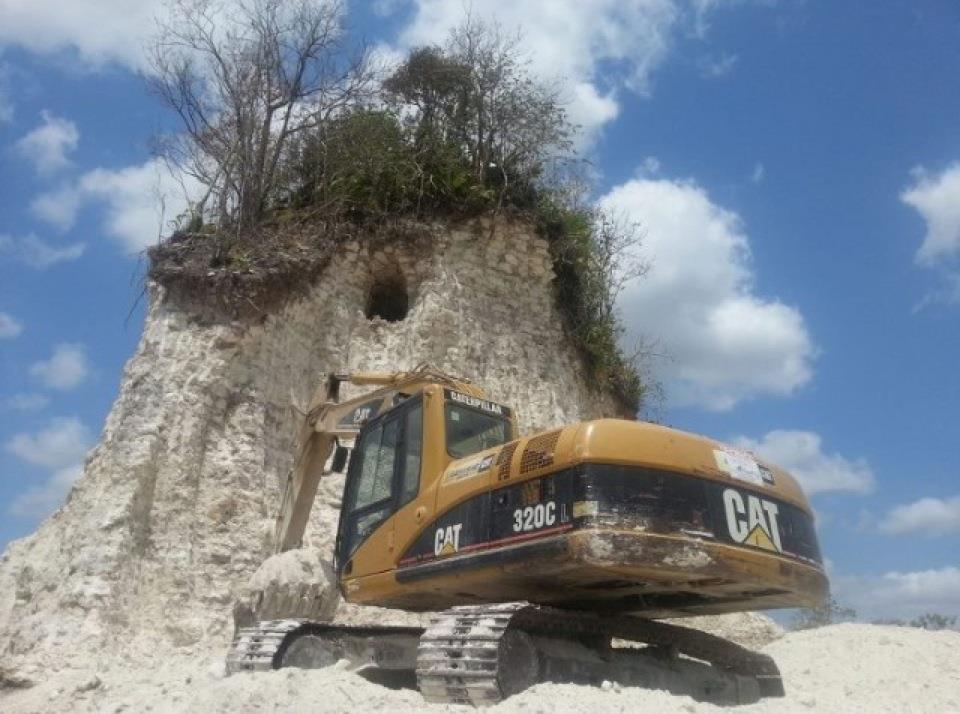 Despite being a known archeological site of importance, The 2300 year old central temple was bulldozed, and not by accident. Belize is mostly flat, and Although the mounds look like hills covered in plant growth rather than the clean pyramids we associate with Maya architecture, they are very well known as Maya structures. “It’s not like the construction companies innocently think they’re clawing away at a hill only to find a wealth of limestone bricking. It’s the bricks they’re targeting.” Which are used for paving roads… to Mayan sites, supposedly. Actually, for the benefit — no surprise here — a local politician:
The construction company in this case was identified. Archaeologists saw the name of D-Mar Construction on the equipment, a company owned by one Denny Grijalva, a United Democratic Party candidate for representative of his district, Orange Walk Central. Nohmul is in Orange Walk North. Interesting that the party platform includes rebuilding access roads to major tourist sites. It would seem counterproductive to build those roads using the major tourist sites. Then again, following election laws appears to be a sore point for Mr. Gijalva, so what’s a little cultural patrimony destruction?
In an almost parallel incident, the Barbarians to the north of us have also destroyed a “pre-Hispanic” (or, rather pre-Colombian) site, again with the overt connivance of local politicos.
City leaders in Oxford, Ala. have approved the destruction of a 1,500-year-old Native American ceremonial mound and are using the dirt as fill for a new Sam’s Club, a retail warehouse store operated by Wal-Mart. A University of Alabama archaeology report commissioned by the city found that the site was historically significant as the largest of several ancient stone and earthen mounds throughout the Choccolocco Valley. But Oxford Mayor Leon Smith — whose campaign has financial connections to firms involved in the $2.6 million no-bid project — insists the mound is not man-made and was used only to “send smoke signals.”

Leon Smith, like Denny Grivalda, stands to profit personally from the destruction, justifying their personal gain as a public benefit. A road, or a Sam’s Club parking lot perhaps serves some public good, but to what end? No, it’s not a case of “those who don’t know history…” but of refusing to acknowledge that history exists that should grieve us. These elected leaders see themselves as the arbiters of what is, and is not, the heritage of those they represent. In overriding and trodding under (literally) a sense of human continuity they seek to divorce their constituents from their community roots… putting those who elected them one step closer to simply being consumers and vendors of anyplace, anywhere… human sacrifices to the fetish of capital.
Sources: The History Blog: “Mayan temple in Belize bulldozed for road fill”
José Luis Zapata: “Nohmul Maya Temple Destroyed by Bulldozers in Belize”
Southern Studies: “Alabama city destroying ancient Indian mound for Sam’s Club”
Dan Whisenhunt, Anniston (Alabama) Star: “The Silent Partner: Oxford mayor has financial ties to Commercial Development Authority activities”
Let’s paint the town… mauve
National monuments in Mexico City are gaily lit this evening for International Day Against Homophobia.

Juan Rulfo
Literature is a lie… but it let us re-create reality.

U.S. taxpayer approved …
Usually U.S. embassies in Latin American countries spend all their time subverting the government. I suppose subverting good taste was a nice break in the routine.
eBooks… to each according to his need
Via Guerilla Comunicacional México links to free downloads of various anarchist, Trotskyite and Communist — and anti- — works. While the usual suspects (The Communist Manifesto, even a work by Stalin) are there, several — Ché Guevara on Guerrilla warefare, Trotsky on the Spanish Civil War, School of the Americas manual, etc.) of interest to scholars and students of Latin America, and Spain.
Anti-social media
Today’s El Debate has a story on a “virtual” kidnapping… the victim received death threats against his family, UNLESS he made himself scarce. The next day, his relations started getting calls telling them they’d kidnapped the guy, and would only release him after a ransom payment. So, the family turned to facebook and twitter to find the dude, which he was, sitting in a hotel room waiting by the phone for word he could go home.
I’m surprised only that the “virtual kidnappers” didn’t demand their ransom in bitcoins.
(Policías de Ahome rescatan a guasavense, vìctima de secuestro virtual)
Why are you here?
If there is one long piece about Mexico you should read this weekend, it’s Cat Rainford’s account in Sunday’s The Guardian of her two years as a malabrista in Mexico:
I ran away and joined the circus – in Mexico
…When travelling for long periods, it can be all too easy to fall in with other foreign travellers and stumble around in a closed group, insulating each other with a shared familiarity. You can strike out alone and try to figure out a country piece by piece, but you always feel like a stranger and feel increasingly disjointed yourself in the process.
I had done plenty of both over the previous months of travelling in Mexico. Trico and his friends were something different: escapists too, in a way, but also idealists, on a mission to explore the beautiful side of their troubled country and to give something back in the only way they knew. More than anything, it was this attitude that made me go with them.
[…]
… For a while we performed outside restaurants along the coast of Nayarit, sleeping on beaches under trees crawling with giant iguanas. When business was good, we’d treat ourselves to nights in guesthouses. When it wasn’t, we’d sleep in tents, shop doorways or plazas.
Any reluctance on my part was met with the admonishment not to be a fresa. Literally meaning “strawberry”, the word “fresa” is used in Mexican slang to denote anyone spoiled or soft. Of all the wide and imaginative range of Mexican insults this, for them, was the worst. It was acceptable to be a large goat (cabrón) or even, on occasion, a pubic hair (pendejo), but to be a strawberry was unforgiveable.
As the months went on, I became integrated. I learned to fire dance and juggle. I learned the etiquette of the traffic intersections, which dictated that a performer must defer to the windscreen washers, though not to the peanut or sweet sellers.
Ah, heck. The whole thing is wonderful, and captures the “real Mexico” more than burying your nose in any guidebook as you wander around the country ever would.
Our backwards neighbors
Belize, the former British Honduras was known in Mexico (officially anyway) as “British Occupied Guatemala” and wasn’t recognized as a separate state until the 1990s. It is still hard to recognize that it is a neighbor of Mexico.
It’s neighbors, Mexico, Guatemala and Honduras have not had laws against sodomy since the 19th century, and both Mexican and Guatemala have banned discrimination based on sexual preference. Same-gender marriage is legal in Quintana Roo, the Mexican state bordering Belize, and should become legal in all of Mexico sometime in the next year [The Mexican Supreme Court has overturned laws limiting marriage to opposite gender couples in a two states, and will rule the same way in future cases, but has yet to reach the threshhold of cases needed to make a definitive ruling that applies nation-wide].

Photo: Amandala
Ironically, maybe given its legacy as an outlaw state (founded by pirates and slavers) what is called “buggery” was merely classified as a public nuisance before World War Two, when then “British Honduras” updated its criminal code, adding, in Section 53, a ten year prison sentence for “every person who has carnal intercourse against the order of nature with any person …”.
A legal challenge to Section 53 is now before the Belizian Supreme Court, brought by Caleb Orozco of the United Belize Advocacy Movement. While opposed by all the churches in Belize, Orozco’s most active opponent is a Texas missionary, Pastor Scott Stirm of something called Belize Action.
Pastor Strim is quoted by Amandala (“Belize’s leading newspaper”) as saying:
We believe in respect, we believe in human rights; homosexuals already have human rights — they’re humans. If those rights are not being enforced, if police are not enforcing the proper laws, if there is any kind of bias, then there are proper procedures for dealing with that. But changing section 53 is not the answer to what they claim is a problem.
Did I add that there is no anti-discrimination law in Belize?
Deputy Solicitor General Nigel Hawke defended the law before the court. The strength of his argument was on the central point that the rights Orozco is claiming do not exist in the Belize constitution. According to Hawke, nowhere in the written text of the constitution does it name a right to privacy, human dignity and sexual orientation. He submitted further that the court does not have the jurisdiction to imply, impute or impose these supposed rights into the constitution because it would be giving itself legislative powers, which violate the doctrine of the separation of powers.
Beyond Strim and his minion’s references to Orozco as the Antichrist, Orozco has received death threats and supporters of United Belize Advocacy, as well as those who are, or perceived to be, gay have been harrassed and/or attacked in recent weeks. But it hasn’t only been the Evangelicals. A Catholic priest, Ian Taylor, told the country’s Channel 5:
Globally it has been determined by states that violence against homosexuals is highest within the homosexual communities itself. First of all the victim syndrome that they tend to portray is actually within the community itself – they are aggressive against each other, and less from those who are considered heterosexual.
The case was heard Tuesday, and a ruling is expected sometime today. Should Section 53 be upheld (and there’s every assumption it will be), the case could be appealed to Belize’s court of appeal – one rung above its supreme court, and beyond that – with permission – to the Caribbean Court of Justice (CCJ) in Trinidad and Tobago.
In all the Americas, only Belize, along with a handful of other Caribbean states (Antigua and Barbuda, Barbados, Dominica, Jamaica, Saint Kitts and Nevis, Saint Vincent and the Grenadines) and one South American country, Guyana, … all heirs of the British Empire… still criminalize same-gender sexual relations.
Sources: Amdala, The Guardian, 7 News Belize, United Belize Advocacy Movment
And all they will call you will be retiree…
While Mexico has never particularly solicited immigrants, immigration has played an important role in Mexican history and culture (I wrote a book about this ya’ know!) and, as in other nations, it has become a political football in the last few years.
Mexico had a hodge-podge of different immigrant categories, which have been simplified under reforms implemented this year. Basically what had been about a dozen different categories were reduced to three: tourists, temporary residents and permanent residents. People like myself (an “assimilated immigrant” under the old classification) who work here, and those that are already living here aren’t particularly affected by all this (other than some higher fees, offset by renewals being multi-year, rather than annual) but this has caused a major freak-out on MexConnect, a website mostly for U.S. and Canadian “rentistas” (non-working foreign residents) and part-time residents… the endless vacation crowd.
Mexico … like a few other (most Latin American) countries, allowed foreign to receive a yearly residency permit if they have sufficient income to support themselves and not be a burden on society. Until reforms went into effect this year, for a non-working temporary resident that was based on proof that one received 250 times the salario minimo (daily minimum wage) based on a recent bank statement: about 1350 US$. Under the new regulations, a rentista must show either an income of 400 times the salario minimo (about 2000 US$) OR not DEPOSITS, but an “Average Monthly Balance amounts equivalent to twenty thousand days of the general minimum wage in the District Federal for the previous twelve months”, or about $108,000 US$. For permanent residents of the non-working variety, the income requirements are about 2500 US$ monthly income, or about 125,000 US$ in bank balances.
Although in reality most immigrants to Mexico are NOT well-heeled gringos (or even gringos) retirees and U.S./Canadian winter residents are a fairly large percentage of the foreign population in this country: about a quarter of all foreign residents hold U.S. or Canadian nationality, and almost half of them (slightly under, and slightly over 44 percent respectively) claim to be pensioners. Whether it’s discriminatory to some percentage of that 12.5 percent of foreign residents to up the figures, I can’t say. Like the other 87.5 percent of immigrants the “rentistas” are in one sense or another looking for a better life for themselves. But whether they make life better for their new country is a question that isn’t much asked.
Which led me to consider posting on MexConnect the following response to one astute rentista’s post (the “mcm” — quoted in italic — I mention in the body of my response) that I thought it better to publish here.
Honestly, I’m not sure why the Mexican government would WANT to encourage retirees who can’t meet the current income requirements to move to Mexico. Mexican social services are already stretched very thin, and low income retirees without family or social support would be a potential further drain on the system.
Naturalization is not a way to avoid the income requirements — you must be a Resident Permanente in order to apply for citizenship, and thus must have met some sort of income requirement already. And, once you ARE a Residente Permanente, you don’t have to verify your income annually, so there’s no incentive to become a citizen for that reason.
HURRAH… saves me from opening up this can of worms. Rentistas may be the majority on this site of foreign residents of Mexico, but are NOT by any means the majority of foreign residents in Mexico… not even of U.S. residents in Mexico.
While “mcm” is mistaken in assuming one must meet income requirement before becoming a Residente Permanente (most foreigners aren’t rentistas, and are workers, or business owners or dependents of citizens who qualify for other reasons), but I think it goes further than just a consideration of social services costs.
Not to say that the “one-percenters” don’t want to screw the rest of us (or rather, don’t care about the rest of us enough to even worry about screwing us), but there are excellent reasons for raising the income requirements for “rentistas”.
Retirees bring in capital, but it’s mostly just “trickle down” when it comes to creating wealth. Sure, they create some economic benefits in certain sectors of the economy in some regions (housing, leisure activities, etc.), but it’s more just a short-term stimulus than anything. What retirees do not create in any meaningful way is WEALTH. Most countries prefer younger immigrants… those of working age… for a good reason: they’ll be creating wealth (or at least increasing productivity) for a number of years, whereas retirees? Not much. While some retirees are “job creators”… if they’re creating sustainable businesses that pay enough to benefit to the nation, one assumes they’ve got substantial resources to invest in the first place.
Otherwise, and one hesitates to say it… in our search for paradise, we’re parasites. Besides the social services, there is the water, roads, electricity, etc. that we all use, but some of us have been paying for for years and will be paying for for several more years to come. These are things the retirees paid for at home perhaps (and are usually still paying), but not putting in their fair share here.
Countries look at immigrants in terms of their own interests, and national interest is going to favor those who will be a value-added resident, the value coming in either labor, capital or some economic intangible like intellectual or artistic talent. Although no longer nearly as likely to use Marxist terminology, “rentista” is just the Spanish equivalent of “rentier“, the French term used by economic and political theorists to describe those who “live by ‘clipping coupons”, who take no part in any enterprise whatever, whose profession is idleness”*.
And, while the rich will always be with us, rising expectations among Mexicans themselves means both more middle-class Mexicans can afford to live the lifestyle to which the retirees hope to become accustomed… and more importantly… fewer and fewer Mexicans willing to see their children’s futures dependent on the whimsy of privileged outsiders.
I don’t sense that Mexican resent foreign residents any more than any other nationality. Other countries have seen a backlash against poor foreigners. Not that I expect mobs to attack old gringos, but that the rentista barely getting by and only here because it’s cheaper than elsewhere is in the same economic and social class as a lot of the native-born population, and — if that foreigner expects to be treated as someone special simply because of their foreign nationality, they’re going to breed resentment (and do). Rich people can get away with exotic customs, and weird obnoxious habits, but like everything else, the price of eccentricity has gone up.
* Some astute reader may recognize the quote as coming from Lenin’s “Imperialism, the Highest Stage of Capitalism” (which I’ll cheerfully fess up to having cribbed from a Wikipedia article). Though I have no objection to people earning a return on their investments, that money represents investments in foreign countries, or based on pensions earned elsewhere that do not particularly represent any investment (in money or labor) here, and can’t be said to create wealth, or enterprise, but are spent on “idleness”.
Ah, rats!
A plethora of stories in yesterday’s Mexican media (El Universal, Jornada, Televisa) on a Zacatecan specialty… rat soup.

Photo by Pablo Ramos/La Jornada
While fried rat is served up in some of the finest cantinas of Fresnillos, Caldo de rata is also a traditional home-cooked Zacatecan specialty… served up with a medley of local vegetables (cauliflower, broccoli, carrots, calabaza, chayote) and lightly flavored with cilatro.
Although the story can be (and is) spun as a comment on hunger in the north, caldo de rata is also being praised as a traditional dish that provides a highly nutritious meal… and, for cantina snackers, a smart alternative to potato chips or tacos.
The rats themselves are not street rats, but “Ratas del campo”… packrats (specifically, the White-Throated Woodrat, Neotoma albigula) which itself has a pretty healthy diet of nopales. While there is some danger that packrats are being over-hunted (usually by boys with slingshots) for the twenty or so pesos each rat brings in the market, which could change if foodies catch on to this latest trend in low fat dining.
¡Buen provecho!


 mexfiles.net