A long overdue reform that is beginning to make its way through the Chamber of Deputies is a raise in the mining tax, and charging a royalty on mineral exploitation. A bill presented to the Chamber of Deputies would replace the practically symbolic per-hectare user fee with a five percent royalty on profits, as well as raising the income tax on profits somewhere above the present 30 percent.
While there is, as expected, the usual noise from some mining operators that higher taxes would mean they would invest less in Mexico, it’s not to be taken seriously, since they’ll have to operate where the mines are, and just can’t go looking for the lowest bidder. And, given the recognition that Mexican taxes are well below regional averages for Latin America, operators have expected taxes to go up, and would prefer to have the matter settled sooner than later.
In the Senate, the leftist PRD and rightist PAN both oppose the PRI-backed proposal now in the lower house. The two opposition parties have slightly different demands on how the royalty revenues would be shared out between municipal, state, and federal governments and there are issues like mining safety, environmental protection, and workers’ rights that might be included — along with some raise in the tax or royalty rate — that will probably emerge sometime later this year.
(Reuters)
Let us reason together
AFP, via Guerrilla Comunicacional México (which has an AK-47 on their masthead and the motto: “Don’t believe the mass media, do your own research and draw your own conclusions”). My translation:
In May, for the first time ever, a Vatican-organized forum will be held in Mexico to promote dialogue between Catholic Church leaders and atheist and non-believers intellectuals.

Gianfranco Ravasi
The initiative for the “Atrium of the Gentiles” conference came from now Pope Emeritus Benedict XIV and Italian Cardinal Gianfranco Ravasi, president of the Pontifical Council for Culture.
The project was inspired by the space reserved in the ancient Temple of Jerusalem, set aside for meeting with non-believers.
The forum, will be held the 6th to 9th of May in several sites in Mexico, including the UNAM campus, considered the most prestigious and most secular university in Latin America.
“Until now there has never been a Cardinal, or even the Archbishop of Mexico on that campus, ” Ravasi, who will attend the discussions, commented on Friday.
Mexico was specifically chosen for this conference being one of the most Catholic countries in the world, but also one with a strongly anti-clerical tradition, marked by a religious war in the 1920s… something that will be discussed at a round-table with secular intellectuals.
Cardinal Ravasi will be a participant in another discussion, on “Secularism and transcendence”. Eduardo Gonzales di Pierro, Carlos Pereda Failache, Julio Hubbard, Hugo Hiriat and Carlos Ornelas are also scheduled for various talks, as will the atheist philosopher Guillermo Hurtado, who was invited by Benedict XVI to to an inter-relgious meeting held in Assisi, Italy, in October 2011.
In Monterrey and Puebla, Cardinal Ravasi will give talks on the value of education in “a society marked by drug violence, that every year kills thousands in Mexico”.
In Puebla, the Italian Cardinal will be receiving an honorary doctorate from PUASP after presentation of his thesis “Rethinking the university from the perspective of dialogue, faith and culture.”
Ravasi, 70, a Bible scholar, is considered a brilliant intellectual, known to send out tweets in Latin. A film and literature buff, he was considered among the “papables” at the March conclave to elect Benedict’s successor.
Dialogue with non-believers is expected to be a theme in the papacy of Argentine Pope Francis, who announced at the start of her reign that he wants to push the church out to the “existential peripheries” and to abandon its “self-referencial” positions.
The Vatican said that after the Mexican conference, it will be looking at holding similar forums in other Latin American nations.
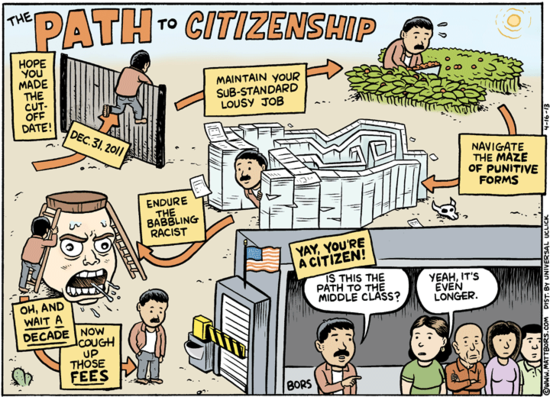
Path to citizenship
via Presente.org:
David Alfaro Siqueiros catches a buzz
Proof, if it is needed, that even great artists are sometimes … uh… dopes. From D. Anthony White, Siqueros: Biography of a Revolutionary Artist (2008):
One day Diego [Rivera] entertained the other artists with a lengthy discourse on the merits of marijuana, in which he proclaimed that the great art of the past was done under the influence of drugs.  When some of the artists endorsed the idea of using marijuana to enhance their creative talents, they requested an expert to instruct them in the use of the magical drug prescribed by Rivera. Two days later Diego introduced “Chema,” who proceeded to tell them that “Doña Juanita” was Mexico’s most important contribution to the world and that the decadence of the colonial period was the result of the Spaniards’ prohibition of the drug.
Although Orozco scoffed at the notion, others responded enthusiastically and agreed to launch a movement to change Mexico’s laws against the use of marijuana and to adopt the practice of smoking marijuana before painting. When Siqueiros and an assistant took a few puffs before painting one day, however, the lights failed and, when they reached for a cord, they received a shock and fell off the scaffold. Fortunately, they landed on a pile of sand, but it took them several weeks to recover. After that, both Siqueiros and Rivera agreed that, since they were already “marijuanos,” thy had consumed more than enough to stimulated their creativity.
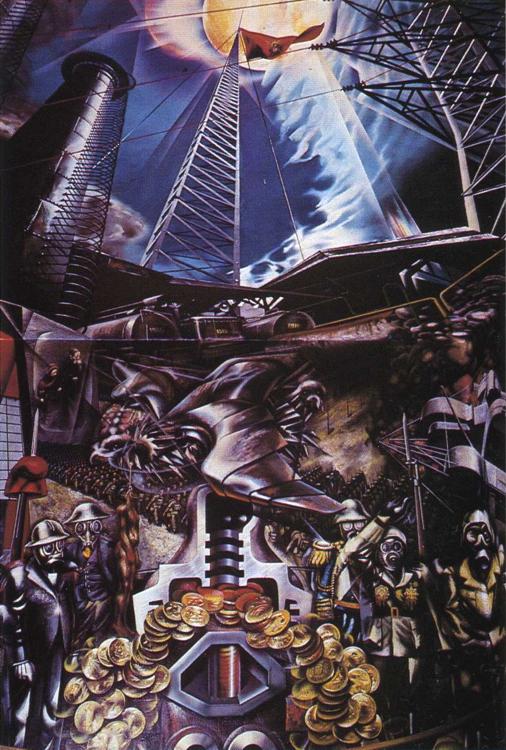
Portrait of the Bourgeoisie, 1939
Of course Rivera was full of it… marijuana being native to the central Asia, and only introduced to the Americas after the Conquest. And, whether the incident actually occurred, given that both Rivera and Siqueiros had a known propensity for being constitutionally incapable of not embellishing a good story (White accepts, apparently as truth, Rivera’s claims to have supplemented his diet while living in Paris with trips to the morgue), it is still very funny, and the book is a joy to read: even in writing about the now pointless manifestos (and sometimes bullets) that the Mexican intellectuals of the post-Revolutionary period flung at each other, White weaves an interesting, engaging narrative.
Siqueiros’ life story is fascinating. Despite his upbringing by a father more Catholic than the Pope, he was a committed Communist, and more than likely a soviet agent. Somehow, he managed to simultaneously be an ardent Mexican nationalist and enough a critic of his country to regularly be sent into exile… or prison. In and out of the country and in and out of jail (sometimes “in jail” but “out” — with the warden’s permission, the Chilean consul in Mexico City, Pablo Neruda, used to spirit Siqueiros out for a night of cantina hopping), he managed to maintain the loyalty and affection of three wives and a mistress.
All the more amazing is that the active, committed political career was in the service of… art. And what art! If he was high on anything, it was perhaps on paint fumes… Siqueiros, broke through the false dichotomy of art and technology… being the first to realize that industrial paints and sprayers were applicable to more than mere commercial products. As an artist, a revolutionary, a Mexican nationalist (and, yes, as a Communist theorist), a seminal figure of the 20th century, and one whose biography must be read.
Rita Pomade said just about everything I would in her own review posted 9 December 2008 on MexConnect. Alas, including this:
My one disappointment in the book is that it’s poorly edited. Various points are repeated and should have been edited out to sustain the flow. Spelling is not always correct. At times Siqueiros is referred to as David and at times as Siqueiros but with no reason for the switch. His brother is referred to as Jose and later as Chucho, but if you don’t have a Mexican background you wouldn’t know they were the same person. It’s too bad. This is a great read, rich in history and insights, and it deserved better.
As a erratic speller with a sometimes wandering sentence structure (and sometimes wandering off into the unknown), I’m well aware of the need for editors.
Dr. White did himself a disservice in allowing the release of outstanding piece of scholarship and excellent writing through a “print on demand” publisher. Perhaps “publisher” should be the word in quotes… the book appearing as if (and probably in reality was) produced directly from word processing test. The excellent cover design invites us to enjoy a book on visual art… and then assaults us with a nearly unreadable typeface (a narrow san serif — Century Gothic, I think) that might be suitable for on-line publication, or a blog post, but is off-putting in a 480 page book. A book about an artist should, if nothing else, not be an ugly read.

Women of Chilpancingo. 1960
Considering the subject was one open to using technology for aesthetic ends and of collaborating with others, Siqueros: Biography of a Revolutionary Artist, like several of the artist’s intriguing (and now lost, or never completed) works is imperfect, but still worthy of our consideration. Publishing through Amazon’s “booksurge.com”, the book suffers by being only available through a single corporate outlet (Amazon.com). There is something ironic about having to go to a U.S. corporation to buy a book on a Mexican nationalist and Communist who struggled mightily (and successfully) to bring art to the masses. But, Siquieros himself often failed in the execution of his works, and some of his best work meant for public display has ended up in private hands, so consider yourself lucky if you happen to stumble across a reference to D. Anthony White’s Siqueros: Biography of a Revolutionary Artist — and you don’t outright recoil from an unfortunate brush with the capitalist Yaquí imperialist bourgeoisie — I would go ahead and order D. Anthony White’s Siqueros: Biography of a Revolutionary Artist.
¡Que pendejo!
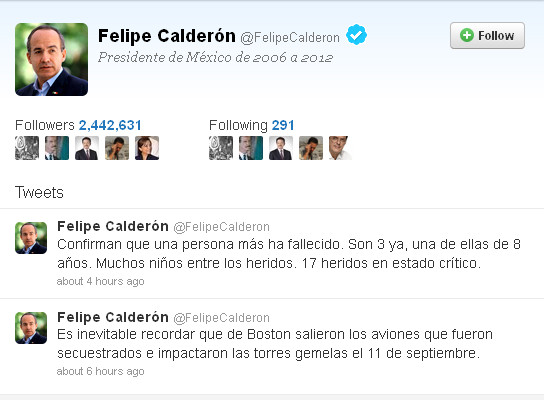
Not that he IS President of Mexico anymore, but as the guy who unleashed the “war on drugs” on the civilian populace in this country, he should be a little more discrete in what he says about terrorism.
Over-achiever

Francisco Guerrero was a contemporary of a well-known British practitioner of a new and different endeavor we have come to see as a part of the urban, modern experience. Any guesses as to what modern practice it was that Francisco excelled at?
Two to tango
Mostly because one is expected to post a cat photo now and again…
Discontented migrants, employers and cows
Is anyone at all happy with the proposed U.S. immigration policy? It appears from an article in the 12 April New York Times that not even the cows are contented:
The struggles of the dairy industry in western and central New York, one of the nation’s leading dairy regions, have become an unlikely focus of the national debate over immigration policy. Delegations of local farmers, including Mr. True, have made trips to Washington to lobby for an expansion of the guest-worker program for agriculture, or the creation of a new one, to help ensure a reliable supply of labor.
Dairy farmers are generally not able to hire foreign workers through the existing guest-worker program for agriculture because it is only for seasonal workers, and milk production is year-round.
itemprop=”articleBody”>A bipartisan group of senators negotiating a comprehensive immigration reform bill have struggled with the details of an agricultural workers program. Late Friday, however, they announced they had reached an agreement over terms of the program. Officials involved in the talks said the dairy industry’s concerns were addressed in the deal.
Still, the farmers said they were preparing for a lengthy fight in Congress before the proposals become reality.
Kirk Semple, “Focus on Dairy Farmers in Immigration Debate” NYT 14-04-2013)
Consuela Crow (Mexmigration Blog) on the proposals for U.S. immigration “reform” that may be nothing more than a recycled Bracero program.
We are in the midst of a sustained cycle of neo-nativist sentiment and a social climate in which the immigrant has become one of the most hated and dreaded others. This climate also continues to shape and constrain debates on “meaningful” immigration reform. There are loud and intensifying calls to further reinforce our borders with more fencing, surveillance equipment, boots on the ground, and drones in the skies.
Anti-immigrant groups throughout the country to hold a commitment  to a ‘Latino Threat Narrative’ with the usual telluric proclamations about protecting and defending our country, our economy, our freedom – all of which are seen is at risk or in shambles because the “illegals” are invading and violating our borders. In the worst manifestation of this threat narrative, the right-wing blogosphere is teeming with websites that compare the Mexican to “cockroaches” and “over-breeding vermin” that are “stealing” that which is the most sacred of all American birthrights, “our jobs”.
At the same time, there is another narrative emerging that does not view the Mexican as a threat. This neoliberal narrative sees the Mexican as a source of “cheap,” “acquiescent,” “reliable,” and “productive” – if a bit “quirky” – labor. The emergence of this narrative occurs like clockwork and is starting just as the broad outline of a new and expanded guest worker program begins to take shape as part of the debate over comprehensive immigration reform.
Mexican Workers for Dummies (8 April 2013)
Open Letter
So, Mr. Obama… the U.S. is best buds with the People’s Republic of China, but your government threatens to prosecute citizens for visiting Cuba? Mr. Jay-Z would like a word with you…
Anchors aweigh!
Naval training ship, ARM Cuauhtémoc, set sail for Europe today. For the first time in Mexican naval history, the training ship’s crew includes two women cadets.

Barbie-rians

| Mattel’s The Mexico BARBIE© | The Beltrán-Leyva Cartel BARBIE |
| Has a Chihuahua | Took over the narcotics trade IN Chihuahua |
| Accessories include luggage cart | Accessories to his crimes included MS-13 and Mexican Mafia[1]. |
| Has a passport , so maybe can be legally in the U.S. | Is a U.S. citizen[2] |
| Supposedly looks Mexican | Name comes from having gringo looks[3]. |
| U.S. Corporate product | Yup. |
[2] Born in Laredo, Texas 11 August 1973
Master of my domain…
Sorry for the interruption in service.
When I switched to the “mexfiles.net” domain name, I had paid several years in advance, but the email address I’d used back then was one that was “improved” to the point of being useless… and as far as I knew, there were no longer any mail going there except for junk and spam.
The domain had expired on 9 April, and I didn’t even notice until the next day, but had more pressing business that had to be taken care of, and didn’t figure out what the problem was until this afternoon.
Mexfiles.net should be active for the next couple of years now. That is, assuming everything still works five years from now as it does today… an always risky proposition.
BTW, how does one legacy a website? What happens when the registered owner dies? Not that I’m planning on that in the near future, but it crosses my mind that with so much publication now ONLY on the internet, a lot of original documents will be lost, or at least the references will no longer be valid. I’ve already found that in a number of reference works, and it’s only going to get worse.


 mexfiles.net