Coming Home
Sinaloans may like to brag about having the most beautiful women in Mexico, but one of the most famous daughters of Sinaloa achieved her fame… both during her lifetime and afterwards… as “the world’s ugliest woman”.
Julia Pastrana, born in 1834, somewhere in the Sierra Madres

Francis Buckland, son of the famed paleontologist William Buckland, arranged for some photographs of her to be taken and tried to raise some interest among the doctors of England during Julia’s visit there in 1857. (http://scienceblogs.com/laelaps/2008/04/21/the-nondescript-and-darwins-th/)
… was believed to have been born […] with hypertrichosis, a condition whereby one is covered with excessive long, straight hair. Julia also had enlarged jowls, a bulbous nose and grotesquely formed teeth. She was four and a half feet tall. As a child she spent time in a Mexican orphanage before becoming a ward of the governor of Sinaloa, Mexico, a period of her life she would refer to as ‘privileged’. Others document her position as one of a ‘servant girl’. In any case, Julia was a positive human being whose peers wondered as to whether she was in fact human.
1854 dates her entrance into the performance world, an arena which she was said to have appreciated and enjoyed being part of. ‘The Marvelous Hybrid or Bear Woman’ was what the banner read at the Gothic Hall on Broadway, NY, NY. Onlookers would gawp at her extraordinary features, but as the performance went on they began to admire her for her elegance and talent, for she was talented. She was an accomplished dancer and had a repertoire of operatic arias under her belt which she would perform to thunderous applause. Media tycoons and scientific minds alike were in attendance and reviews included phrases such as ‘harmonious voice’ as well as ‘terrifically hideous’.
(‘Bear Woman’: The Bearded Lady of Mexico)
Although her celebrity was as a horrible looking woman with a lovely voice, those who met her were more taken with her un-freakish and charming personality… happy to relate her travels in the three languages she spoke fluently (Spanish, English and Yaquí), a good cook who enjoyed sewing and knitting. Alas, her husband, Theodore Lent, was something of a money-grubbing cad. And more than a bit of a ghoul:
…From 1856 on, Theodore Lent was her impresario and soon also husband. They toured the USA, Europe, and Russia. Julia Pastrana was displayed for audiences who paid to see “The Ape Woman” or “The Indescribable” sing and dance. On several occasions, she was also examined and described by researchers.
In 1860, Julia Pastrana died a few days after having given birth to her and Theodore Lent’s son. The child also passed away soon after being born. Theodore Lent sold the bodies of his wife and son to the University of Moscow, where they were embalmed, before he bought them back and continued touring with the two bodies for display. Theodore Lent married another woman, Marie Bartel, who had a condition similar to Julia Pastrana’s, and included her in the display as Julia Pastrana’s little sister, under the name of Zenora. Some time after his death, Marie Bartel sold the bodies of Julia Pastrana and her son (both bodies had been on loan for a certain period), and they were displayed in a series of different cities in the following years.
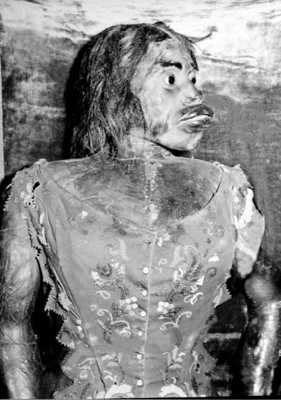
Somewhere in the course of her travels, Julia lost her beard.
In 1921, the two embalmed bodies were bought by Haakon Lund, manager of the biggest funfair in Norway at the time. Julia Pastrana and her son were then displayed periodically up till the 1950s. When Lund’s funfair put them on display again in 1970, there were strong reactions in the newspapers. A USA tour followed, before another display in Norway in 1973. The remains were then rented out to a Swedish funfair, which led to a ban on the display by the Swedish authorities. The remains were put in storage in Groruddalen in Oslo in 1976, and during a burglary performed by adolescents, the arm was torn off the embalmed remains of Julia Pastrana. The police took her remains with them, while the remains of her son, reportedly badly damaged, were seemingly discarded.
The two quoted paragraphs above are from the official statement by the The Norwegian National Committee for the Evaluation of Research on Human Remains, 4 June, 2012 as part of recent negotiations between the Kingdom of Norway and the United Mexican Republic on behalf of the University of Oslo (which had ended up with what was left of Julia’s corpse, for display in a proposed medical museum) and the Autonomous University of Sinaloa… the latter then turning to the Sinaloan State Department of Culture, which has made arrangements with the Roman Catholic Parish of San Felipe y Santiago in Sinaloa, Sinaloa: the Norwegian National Committee… having duly considered the matter, concluding that there is no reason Julia should be denied a Catholic funeral and burial in her homeland.
The viewing having gone on much longer than really necessary, I am pretty certain this will be a closed casket service.
Maybe I need a break

Not all history makes the record books, even in baseball
 Do you know who this is? A REAL baseball aficianado would of course recognize Ramon Bragaña. The right-hander pitched from 1928 to 1948 for several teams in the Cuban winter league, and from 1940 to 1951, he was also the star pitcher for los Azules de Veracruz. His career in Cuba (including setting the record for the most consecutive scoreless innings: 39 and 2/rds, during the 1941-42 season) and in Mexico (as the winning pitcher of 179 games during his career) led to his induction in both nation’s Baseball Hall of Fame (Cuba in 1960, Mexico in 1964). Bragaña also pitched for the New York Cubans and the Buckeyes in the Negro Baseball League, but if remembered in the United States, it’s not so much for no-hitters as for having pitched to a batter who hit a home run off his pitch at an exhibition game between the Azules and the Mexico City Diablos Rojos played at Parque Delta in Mexico City on 30 May 1946… a seminal event in baseball history that didn’t count.

Why?
Answer after the jump
¡Los hijos de la noche!
While made in the United States, it is one of the classic versions of a story often told in Latin America… in which soulless, amoral being — mistakenly referred to as “person” — transfers the operational centers to a new untapped country with the assistance of misguided elites (who in search of immediate profits ignore the documented dangers and evil intentions of their prospective investors) and then proceed to suck the life out of their hosts.
Conoco? Some Canadian mining outfit? Well… actually, I was thinking of the the Spanish-language version of Carl Lammele Junior’s “Dracula” — which besides being one of the earliest Spanish-language “talkies” (the first Spanish-language film made in the United States) is in some ways better than the version with Bela Lugosi as that human resource investor seeking to maximize his profits and lower costs by moving operations from Transylvania to England.
More “atmospheric”, the Spanish version was filmed at night on the same sets, and using some of the same footage (Bela Lugosi is in the Spanish version, although you only see him from the back), which no doubt put the cast into the proper “vampiric” frame of mind. The slightly different script (by Baltasar Fernández Cué) is conscious of the “over-the-top” style of Spanish dramatics… certainly the script gives more reign to Pablo Álvarez Rubio to chew up the scenery as the barking mad Renfield than would be possible for Dwight Frye in the English-language version.
 Oaxaca native Lupita Tovar (“Eva Seward”) — now a centenarian — in an interview about making the Spanish-language Dracula said she and her fellow cast members saw themselves in competition with their English-language counterparts, working not only to make the film better, but also, to make it sexier. Tovar and fellow Mexican Carmen Guerrero (“Lucia”) — who in the silent films had carved out a niche as seductive latinas — chose their own costumes, much more revealing than those worn by Helen Chandler and Frances Dade (“Mina” and “Lucy”) … in good part, because they could, and as . Tovar explained, because unlike the United States, there are not a lot of puritans among Latin American film-goers.
 Certainly Ms. Guerrero was more … er… a vamp.. than Ms. Dade. Spaniard Carlos Villar certainly doesn’t have the accent Bela Lugosi brought to his Count Dracula (in reality, the Hungarian actor barely spoke English when he made the film, and learned most of his lines phonetically), but Villar’s Conde Drácula — in the way of Spanish dramatics (i.e., over-stated) — able to deliver the line “Mí casa es su casa” as if it were a death threat (well… it was!), has a menacing charm all his own.
Happy Hallowe-en!
Hallowe’en. No. Día de los muertos. Si.
Here in Sinaloa, the State Department of Education nixed Halloween — no candy, no costumes, no ghost stories in the public schools. Despite its religious overtones, the customs and meaning of the Day of the Dead are considered part of the national heritage, and the the Department of Education decided schools can have activities this week in anticipation of the second of November, which will be a school holiday. Halloween, although widely celebrated, had no cultural value, according to the State. It’s perhaps the first “official” mention of what is becoming something of a unnoticed political and social movement here in Mexico.
 Anti-Hallowe’en activity in the United States is something we usually associate with the political right wing, usually on the grounds that it is anti-Christian in some way, or a revival of “pagan” custom.
In Mexico, and in the Central American States that were once part of the Mexican Empire or of New Spain (the “no Halloween” logo at the left is from Honduras), the arguments against Hallowe’en celebrations are coming from both the left and the right. On the right, while some of the more conservative Catholic Church hierarchy, like the heresiarchs of evangelical sects north of the border — who seem unmoved by the sight of children begging, or selling candy — issue annual anathemas against those who would dress their little darlings as witches, ghosts, or Spider-man and send them forth to beg for candy for issuing an open invitation to… SATAN. Apparently, Old Scratch has a fashion code when it comes to possession. Either that or beggary is a mortal sin, the near occasion of which is best avoided by violating child labor laws. What’s ironic in all that is that by pushing Day of the Dead over Halloween, the Churchmen (the Mexican Catholic variety, not the Evangelical Gringos) is filled with uncomfortable reminders of Mexico’s indigenous, “pagan” past. It is, however, unlike Halloween, a time to reflect on the recently dead, and offer prayers for their souls. And, does, at least, fall within the Liturgical Calendar.
 On the left, I suppose the argument might also be that Halloween is an open invitation to not just Satan, but “The Great Satan” … to use the inimitable terminology of a famous scary dead guy in a black cape … Ayatollah Khomeini.
Yeah, I know the Iranian cleric is kind of a weird reference to use (but isn’t Halloween an occasion for weirdness?). Then again, the Ayatollah was a leader (or the figurehead, anyway) of a movement that united anti-imperialists, nationalists, Marxists and traditionalists. Which is pretty much what the Mexican and Central American left see themselves as.
And, they see Halloween, not so much as a harmless children’s festival… or as an invitation to revel in disguised Satanic rituals … but as U.S. cultural imperialism… and an attempt — conscious or otherwise — to undermine traditional values, mores and activities with something more dependent on commercially-sponsored activity, meaning one that exacerbates class differences (rich kids get better costumes, and nobody wants home-made candy).
Day of the Dead, beyond its traditional Pre-Colombian customs (the food and liquor offered to the recently departed) and Catholic overlay (the day of celebration being moved from about the middle of August to the second of November to coincide with All Soul’s Day, and “Christianizing” the ancestral shrines as ofrendas) has a political dimension — something sometimes attempted at Halloween with masked Obamas and Romneys out to “scare” the grown-ups this year — but Day of the Dead has for at least the last two centuries.
With the turn of the last century’s great lithographer and cartoonist José  Guadalupe Posada having defined the “look” of the traditional calvara as political and social satire, the modern “tradition” especially on the Left has been to mark the holiday by mocking not so much Death herself, but politicians “killing” some favored policy or program, or a policy or program that was “killed” or about to die, thanks to some politican. Displays that present Elba Esther Gordillo into a ghoulish schoolma’rm, or a mocking memorial to PEMEX (perhaps being sucked by foreign “vampires”) will be popular this year, along with skeletal Peña Nietos and dead Democracies.
And, perhaps more importantly, Halloween is — as so many in Mexico view the United States — seen as a holiday without a purpose. It doesn’t serve to mock Death, or to treat Death as a fact of life, but only to provide cheap thrills, and empty calories.
Caballos de los muertos
Whoooooooooooooooooah!

Photo by Roxanne Chavez of the Alpine Daily Planet… the best daily in the largest city in the largest county in the contiguous 48-states.
Universal Health Care, not “Obamacare”
Angela Kocherga of KENS-5 (San Antonio) as you’d expect from a U.S. television reporter to do, files a story from Mexico that I suppose could be said to have something to do with drugs and U.S. citizens coming to grief… but only sorta.
One thing Ms. Kocherga says that might be unintentionally misleading is in saying that employees get their insurance through their company. Well… yeah, but unlike the U.S., where if an employer even offers health insurance, it’s bought from another company, then somehow applied to your taxes as an offset. Here, the insurance is through the Mexican Institute of Social Security, and the employer payment is just a payroll tax.
Seguro Popular covers everyone else — to put it in U.S. terms, it’s just expanded Medicare. Between the two government programs, 95 percent of Mexicans have health insurance.
IMSS covers more and can be self-paid (a 60 year old male pays about 250 dollars a year), but is not always an option for foreign residents, since IMSS has won’t cover those with certain pre-existing conditions and age restrictions. Seguro Popular is very basic health insurance, but still puts U.S. insurance to shame.
Her parents are brown
“Her parents are brown…” was the rationale a facebook user had for assuming a child he saw selling candy on a Guadalajara street had been kidnapped, and for eventually having the mother jailed, until the child’s grandmother was able to provide a birth certificate.
 What one British newspaper called an “uproar in Mexico…over ‘racist’ profiling” has mostly been confined to twitter and facebook (although a report on the story was reported by Carlos Loret de Mola on his nightly news broadcast). It was less an uproar, than the low-level rumbling that has been heard since colonial days about assumptions based on appearance and color.
Admittedly, I hadn’t heard any of the uproar until I noticed mention of it until it showed up in the English-speaking press (all the stories being basically the same text) and at first assumed — given that this happened in Guadalajara, in the ritzy part of town (ironically enough, at the corner of “calle Niños Obrero”— Child Labor Street) — that the unnamed facebook user was some foreigner. If I had a peso for every foreigner who assumed a blonde Mexican was either rich or not “really” Mexican, I’d probably have a much, much healthier bank account. And could be living in the ritzy part of Guadalajara myself.
However, Union Jalisco reports that the “uproar” (such as it was) began with a post by a Mexican who claims he simply noticed this child beggar because of her hair coloring, and that the “parents” were brown… which complicates my own easy assumptions.
The fellow claimed he had only the best of intentions in posting the photo.. and in contacting several state welfare agencies, as well as the State prosecutor. Perhaps. But he jumped to a few conclusions, the first being that the “parents” were “moreno” (brown) when there was only one parent. Of course, it could be the fellow never studied basic genetics (or just skipped biology, even though he’s connected with the University of Guadalajara), but a recessive trait like blond hair can come from either parent’s own DNA, and who knows what the genetic background of the parents’ (plural) parents’ were, or their parents. Not something you can just tell by looking at one parent out your car window.
Most commentators on the post noticed that in singling out this child as possibly exploited and in need of intervention he was overlooking the obvious: that if state intervention is called for when children are begging on the streets, there are a heck of a lot of kids (most of whom are non-blonds) equally in need of attention. Quite a few chided him also for missing a bigger problem, that economically disadvantaged single mothers — whether their kids are blond or not — aren’t being provided the resources they need to provide for their families.
But what the foreign press harped on what the accusations of “racism”. I know a lot of people are uncomfortable with that term, and in a way it is inaccurate. As I posted on The Unbearable Whiteness of Being (in Mexico) several years ago the fact that we associate blonds with the rich has less to do with ethnicity than with the skewered perceptions we get from pop culture:
… Fantasy stories about the idle rich are popular in any culture. Soap operas are set in the wealthier neighborhoods of Mexico City, areas that do have a lot of descendants of Europeans. […] I’d point out that I’ve seen blond, blue-eyed beggars and pelados, as well as ordinary working people – but no one writes TV shows about them.
The clue to what really set off condemnation of the post is perhaps “Se equivoco la cigueña“, a wildly popular Maria la India comedy of the 1990s. Maria la India takes charge of a rich blond child (played by a seven year old Eleazar Gómez, who grew up to be a dark-haired telenovela stud-muffin) to prevent his exploitation, raising the boy as best she can among the poor and the brown.
Only slightly disguised by the slapstick is the subversive message that the people with the superior moral and ethical values are the poor, and one can’t “read” cultural values into one’s appearance. Something that goes both ways, my favorite example being rather gross. I was on the metro on one of those rare days when it wasn’t crowded, in a car with a drunk who shit his pants. Nobody was more grossed out than the well-dressed gent with a face that could have graced an Aztec frieze. He berated the blue-eyed, blond-haired drunk with the words SUCIO INDIO! (filthy Indian!) … “Indio” being pejorative for indigenous, and used more in the sense that a U.S. English speaker might have used “nigger” in the not so distant past less to describe an African-American as to describe something done improperly.
Racist? Yes it is. And, in that sense, yes, the “uproar” over the presumption that a blond child could not possibly be the child of a beggar is racist. But more, classist and … worst of all… elitist.
(There is an excellent commentary by youtube VLOGger “Macakiux” here — in Spanish).
Shelf deporting?
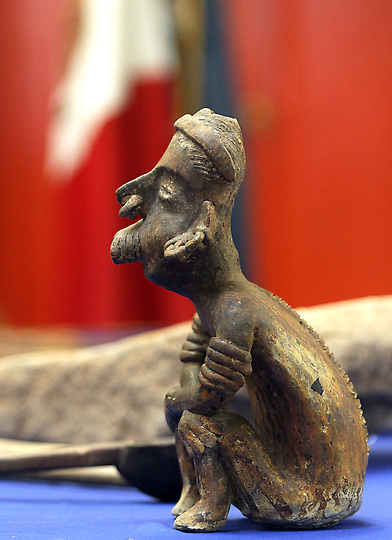
Photo by Mark Lambie/El Paso Times
It appears that sleepy Fort Stockton, far, far, far West Texas was the center of a sophisticated smuggling ring, the bulk of the 4000 Pr-Colombian artifacts stolen from over the last few years from Mexican museums and archeological sites having turned up there. Geeze, I guess down at the Presidio border crossing, no one thought to look for anything other than drugs … although occasionally they do catch someone carrying in a live chicken.
“This is going to get big really, really fast,”
There have been several recent incidents of Mexican citizens being shot by U.S. law enforcement officers firing across the border which are putting a strain on U.S.-Mexican relations (something just not reported north of the border outside of the immigration-focused media). Usually, the story from the U.S. is that the Mexicans (mostly teenagers) were throwing rocks. This latest… and I need to stress we don’t know even if the people killed were Mexicans, or even foreigners, at least didn’t cross any international boundaries. Which doesn’t make it sound any less hinkey.
The McAllen (Texas) Monitor is reporting that “A Texas Department of Public Safety sharpshooter opened fire on an evading vehicle loaded with suspected illegal immigrants, leaving at least two people dead,” along the border near LaJoya, Texas.
From what was in the updated website post (at 10:48 PM, U.S. Central Time last night) game wardens “tried to pull over a vehicle suspected of smuggling immigrants Thursday afternoon,” and a state police helicopter was called in to aid in the pursuit. The State Police (Department of Public Safety) opened fire on the truck, and the only thing being said is that two people are dead.
Everyone is apparently trying to keep a tight lid on this. The head of the department, Steve McCraw only said “of course I’m aware of the situation,” and then added he was out of state, and had nothing else to say.
One unnamed law enforcement officer was quoted in the Monitor as saying “This is going to get big really, really fast…You have a law enforcement official shooting at an unarmed alien. This is not an excuse for deadly force.”
At least, unlike several other recent incidents, the killings were inside the United States.
Chinese take-out
It’s not often you hear somebody say something good about the forces of law and order in the State of Chihuahua and you also get to write a really bad headline.
Manuel Quezada Barrón, El Diario (Chihuahua)
Chihuahua.– Mario Dueñas, President of Canirac (the National Restaurant Industry Association) and Ignacio Manjarrez, President of Coparmex (the Confederation of Mexican Employers) both welcomed the arrest of the gang of kidnappers who targeted Chinese restaurateurs, saying that in addition to providing security to those entrepreneurs it also sends a message that Chihuahua pursues and punishes the crime of kidnapping and extortion.

Power to … or v… The People?
THAT BLOWS!
Oaaaaaxaca…. where the wind come’s whippin’ down the Isthmus… has a long history of Mexican concessions being given to foreign private-public investment projects without considering the needs, or wants, of the region’s residents. At least twice in the 19th century, foreign investors sought their government’s assistance in obtaining “concessions” in the Isthmus of Tehuantepec from the Federal Government (I plan to write on one of the most ambitious of them — the Interoceanic Railway — later this week).
The latest of these schemes is financed by the Dutch government pension fund, PGGM; the Mitsubishi Corporation; and the Australian investment fund Macquarie.
 What has always made the Isthmus of Tehuantepec such a tempting target for developers is the same thing any real estate investor is looking for: location, location, location. In the 19th century, a flat stretch of land, separating the Atlantic and Pacific Oceans by a mere 200 Kms was the draw. Later on, it was the soil, year round growing climate and access to ports and — in our energy-conscious era, it’s the winds that blow constantly across the only gap in the mountain ranges that cross the entire spine of the Americas .
With the backing of the Interamerican Development Bank , the Dutch-Japanese-Australian 396MW Mareña wind farm supposedly signed contracts with Huave residents of San Dionisio del Mar before they began installing the huge turbines. Not so, say the Huaves.
The San Dionisio commune, which represents farmers from the Huave indigenous group, claims that a land-use contract signed in 2004 involved “deception and disinformation”, and that the number of turbines the consortium plans to install has been raised from an original 40 to 132.
“The dynamic of eviction, abuse, lies and contempt for indigenous people on the part of the company Mareña Renovables has become clearer and clearer,” it says.
Mareña Renovables says it wants to continue its dialogue with all stakeholders in the wind farm, saying it “is committed to managing this project with a view to sustainability and having regard to the interests of all stakeholders, including local communities”.
While back in the 19th century, the concerns of local communities were of little or no concern, today the locals are considered “stakeholders” — i.e, they have an economic interest … but then again, how much money does a Huave farmer have, when he’s up against a Dutch pension fund or Mitsubichi Corporation? And, while the Huaves can block a highway or two, the other guys can call out their mercenaries.
The the project […] has a 20-year contract with Femsa, a Mexican Coca-Cola bottler, and Heineken.[ ..]
The protestors claim the aforementioned groups are “forming paramilitary shock troops and preparing them to invade the ancestral lands of the Mexican indigenous Ikojts/Huave people in order to build by force Latin America’s largest wind farm.”
The protestors claim the aforementioned groups are “forming paramilitary shock troops and preparing them to invade the ancestral lands of the Mexican indigenous Ikojts/Huave people in order to build by force Latin America’s largest wind farm.”
It also needs to be pointed out that several wind-farm projects, mostly being developed by the Spanish energy giant Repsol, are also springing up in the Isthmus, and also being found by local communities.
THE SHOCK OF THE NEW
Speaking softly and carrying a big stake, the developers of the Mareña Wind-Farm claim that the dissent is based in local politics. They’ll tell you they received a permit for the project from the municipal PRD administration, but the commune objecting to the development is a PRI stronghold, and the leftists are either pocketing the money or repressing the PRI supporters.
In Morelia, where newly-installed PRD administration (replacing several years of PAN government) had to send in several hundred state police officers to take control of Huexca (Yecapixtla Municipio) where the “Frente de Pueblos en Defensa de la Tierra y el Agua en Morelos” had blocked access to construction on two new thermoelectrical plants. The community is mostly opposed to the Proyecto Integral Morelos, a concession granted by the outgoing federal administration of Felipe Calderón to four Spanish-owned companies: OHL, Abengoa, Enargas and Elecnor.
I am not really surprised that the left is seen as the bullies in some of these situations, the conflict in Mexico being — as it has been for centuries — having less to do with “left” v “right” as with tradition v modernity. Since the 2006 election, Andres Manuel Lopez Obrador — to name one of the more prominent leftists — has been pushing for more energy self-sufficiency within Mexico, and for more industrialization in the south. On the other hand, Vicente Fox, back in 2001, had proposed a neo-liberal development plan for Oaxaca and the Central American Republics, which would involve more foreign investments in areas like energy and resource extraction. I would put less “blame” — if there is to be “blame” — for these conflicts on any particular political party than on the top-down imposition of “development” on people who are seen only in narrow economic terms.
SOURCES:
Dutch wind farm in trouble in Mexico Louise Dunn, Radio Netherlands
Anti-wind protestors claim invasions of paramilitaries, Wind Concerns Ontario
Protesters block work at Latin America’s biggest wind farm, ReCharge
Primera represión de Graco Ramírez,Arturo Rodríguez García, Proceso


 mexfiles.net