Billions served
This week marks the 43rd anniversary of the Mexico City Metro… now only the fourth largest metro system in the world (Moscow, New York and Paris move more people per year), but is one of the most labor efficient.
For a system that handles 1.6 billion passengers per year, it runs pretty well on a mere work force of 16,500 personnel.
The chart (from this morning’s Milenio) shows the number of employees added for the newest addition to the system, line 12, and the total work force that keeps the city that never takes a siesta moving.

Now for something completely different
Banda de Gaitas de Batallion de San Patricio.
Lost and found
Miscellaneous items I’d bookmarked in the last week.
Lost Soul?
From the Argentine general interest on-line magazine, Puercospin.
Nueva Jerusalén is an implausible place. There is a tall building at the entrance to it called simply “The Tower”. No one seems to know wht it is. Inside it is empty, just a just a staircase that runs up and down. The windows have no frames or glass. Suddenly a boy appears at the window, using binoculars. The Tower is a mix between a panopticon and oriental pagoda. But perhaps it is not the weirdest thing you can find. That would be the man from the United States: a big man with white hair who appears to be ill. Body trembling, his eyes dancing and unable to speak, although able to sputter Spanish words like “culero” or “maricón” to denote that it is a reactionary. He is able to say that he has 17 different names.
You do run across crazed gringos around Mexico now and again … He’s probably one of the undetermined number of U.S. citizens who go missing every year in Mexico, normally by their own choice. Although… if Nueva Jerusalén had internet service, I’d venture a guess at his identity.
Found bodies…
Workers have discovered hundreds of bones belonging to Ice Age animals, including mammoths, mastodons and glyptodons, while digging to build a wastewater treatment plant north of Mexico City.
The bones could be between 10,000 and 12,000 years old and may include a human tooth from the late Pleistocene period, Mexico’s National Institute of Anthropology and History said Thursday.
Tusks, skulls, jawbones, horns, ribs, vertebrae and shells were discovered 20 meters (65 feet) deep in Atotonilco de Tula, a town in the state of Hidalgo, as workers built a drain, the institute said.
These remains belong to a range of species including mastodons, mammoths, camels, horses, deer and glyptodons…
Lost home
At least 500 Mennonite have fled the state of Durango, driven out of their homes by the severe drought that hit the region over the past 20 months.
Enrique Peter Klassen, governor of the Mennonite colonies in Nuevo Ideal and Santiago Papasquiaro, said […] many of those who were selling their animals before leaving decided to stay in Canada, others went to work in the state of Chihuahua.
Although the rains have returned to Durango and rainfall have been regular, they have not been sufficient to improve conditions and, Klassen said, “there was only rain in parts of parts of Nuevo Ideal”.
Finding a refuge
The Independent (Great Britain):
Ecuador has freed a Belarusian former police inspector who allegedly faced the death penalty in his homeland after uncovering government corruption there.
Judge Carlos Ramirez, of the National Court of Justice, in Quito, rejected the extradition request for Aliaksandr Barankov, which accused him of fraud and extortion. The reasons for the ruling have yet to be made public.
…
His case had come under the international spotlight after the decision by Ecuador’s president, Rafael Correa, to grant asylum to Julian Assange after the Wikileaks founder sought refuge in the country’s London embassy. One similarity in both cases was the claim that each faced execution if extradited.
Another similarity:
Mr Barankov claims to have uncovered an oil-smuggling ring involving members of Mr Lukashenko’s family and inner circle. He has won the support of democracy activists in Belarus.
If you’re going to blow a whistle, I guess it’s best to book a flight to Quito in advance.
Found a job
Notimex (via SDP Noticias)
Marcelo Ebrard, former head of the Federal District government ,was named vice president of Socialist International…
In a statement, the Democratic Revolution Party (PRD) described the appointment as “a triumph and a recognition Ebrard’s management”.
Socialist International President, former Greek president, George Papandreou, who was appointed president of the organization said: “[Ebrard’s] win is arecognition of the successful plans for development in in Mexico City and the great expansion of human rights, and of economic and political benefits for important sectors of the population. “
Deja vu all over again… or, “First as farce, then as…”
In the spring of 2008, there was a weird — and largely inexplicable — series of organized assaults on “emos” … followers of a musical trend snarkily (and all too accurately) defined in the “Urban Dictionary” as a:
Genre of softcore punk music that integrates unenthusiastic melodramatic 17 year olds who dont smile, high pitched overwrought lyrics and inaudible guitar rifts with tight wool sweaters, tighter jeans, itchy scarfs (even in the summer), ripped chucks with favorite bands signature, black square rimmed glasses, and ebony greasy unwashed hair that is required to cover at least 3/5 ths of the face at an angle.
In other words, a peer group for morose teenagers. That emos define themselves as exquisitely sensitive and adopted a gender neutral clothing style was initially overlooked. Early media reports claimed the emos were being attacked by punks.
The late Marxist writer John Ross chalked the whole things up to the class struggle: assuming the emos are children of the bourgeois, while the punks see themselves as heirs to the working class. While punk rock tends to have political overtones — specifically anarchism — its adherents are not necessarily of working class origins, nor are the punkers known for organized violence (they are anarchists, after all… but organized enough to put out a manifesto defending the Emos ).
Sergay, the largest circulation GLBT publication in Mexico, reported that while there were some punks in the mob that attacked emos at Insurgentes Metro Station in the Zona Rosa, the attacks were:
… a well-organized “hunt” for emos … and gays. [Sergay] also reports that los punketos were joined by a porro (basically a futbol fan club, but sometimes a gang of “rowdies-for-hire”, as with English football fan clubs) representing the UNAM Pumas , and possibly Mexican skinheads.
And, as harassment of emos spread around the country, it became increasingly clear that neither musical style nor working class resentment was as much the rationale for violence as was the perception of homosexuality, or at least effeminacy. Russian-emigre Televisa VJ, Kristoff, was widely condemned for an anti-emo tirade, laced with references to gay stereotypes which called for violence against the teenager rebels without a cause(since removed from their website) . When television news crews interviewed supposed anti-emo youths, it was obvious they were NOT the working class punks, but more what Mexicans call “fresas”… upper class youths easily identifiable not just by their clothing, but by the pronounced different accent used by upper class kids (a humorous look at “fresa” speech here).
Specifically, it appeared the attackers were RIGHT-WING youth groups… something that didn’t start to sink in until April, when Francisco Mejía in Milenio, and others, began to notice the ties between the anti-emos and neo-fascists.
It appears John Ross was right… although not for the reasons he thought. The emos were the targets in a class struggle, but it wasn’t the working class against the bourgeois, but the self-styled “casta divina” against nonconformists.
I am only rehashing the now half-forgotten great emo pogram of 2008 to introduce what appears to be a repeat… or rather, an escalation, of the class struggle… this time the targets being “reggaetoneros”, fans of the Panamanian hip-hop reggae fusion reggaeton style of music.
Unlike the case with the emos, who were the victims of violence, and it appears that reggaetoneros have occasionally been troublemakers, or — much more likely to be idenified as working class kids, more likely to be blamed for violence — there are similarities between the two groups.
Both are seen as blurring traditional sexual roles. But where the mos went in for basic black, but the more working class reggeatoneros tend to be more colorful:
Mexican reggaetoneros of both sexes tend to tweeze their eyebrows and wear skin-tight, neon-colored pants, loud jewelry, thick-framed eyeglasses and bedazzled baseball caps worn sideways.
And their assailants are organized in much the same fashion:
reggaetoneros gathering at the Chabacano metro station were assaulted by a group of young men who had planned their attack on Facebook. Surveillance cameras caught more than a dozen young men kicking a prone reggaetonero and whipping him with their belts.
The Facebook page was one of at least a dozen launched in the last year that urges people to kill or beat up reggaetoneros. YouTube videos ridicule reggaeton music and the way its fans dress.
Many of the attackers are members of porros, descendants of informal student groups created by the government in the 1960s to quell student uprisings. Today, they have transformed themselves into youth gangs that operate out of high schools and universities, where authorities have limited powers to enter.
I admit I didn’t much pay attention to the original reports in the Mexican media, but as I recall, this started with reggaetoneros being accused of vandalism and rounded up by the police. The kids complained of police brutality, and of being targeted for their appearance, when it was only a couple of individuals who were involved in vandalism at a Metro station… Insurgentes, as a matter of fact, where we were initially told there had been fights between emos and punks, as it just so happens.
One got the sense from Mejía’s article back in the 23 April 2008 Milenio that the anit-emo attacks wee simply a “training exercise” for the right wing. The skinheads talked about attending meetings in Polanco (not the usual haunts of the working class) and elsewhere:
The skinheads meet daily for training, mostly on the east side of the city, for directed study of Hitler’s writings, the Cristero struggle in Mexico and other texts on “re-awaked National Socialism.” They hold the ideology of a “pure race.”
“Pure race” is of course nonsensical in Mexico, but need I point out, that the reggaetoneros, besides their “flaming” disregard for traditional gender display, are adopting a “racially impure” Afrro-Latino musical and cultural style? And, maybe it isn’t in the Cristero tradition, but Mercadian Friar and reggaeton star Fray Richard, might disagree that it’s anti-Catholic.
Why now, though? Mexico City just overwhelming returned a Social Democratic local government, and it may be that the far right feels isolated and needs a scapegoat to either focus its energies on (and give its base a social cause to unite them), or it wants to embarrass the incoming Mancera administration. With the capital — and its ruling party — expected to be the focus of resistance to the incoming conservative and pro-clerical PRI administration of Enrique Peña Nieto (not known for his support for sexual minorities or dissent), there would be an incentive for the far right to create mischief.
*****
Mexican Reggaeton appears to be a fairly minor musical style… the videos that I’ve reviewed are minimalist… maybe a picture of the CD cover, or the band members cutting in and out… about on par with the production values for Nahuatl Death Metal … as much an indication as any that reggaetoneros are not seen as a particularly important consumer group, meaning they’re both poor and not enough of an audience to warrant slick productions. But enough to give the right wing a focus for their antics.
“Tocate Toa”, Bape
And there he is …
Enrique Peña Nieto FINALLY appeared today, which still leaves me wondering why he was under wraps of late. Photo by Luís Cortés, El Universal.

Where’s Enrique?
I haven’t seen anything said about it, but it occurred to me today that I have not seen a single photograph… or image of any sort… of Enrique Peña Nieto since the beginning of this month.
While rumors that Peña Nieto has a serious illness have never been denied, or even commented on, by his staff, the story never got much traction in the press. Whether it is because of the general Mexican reticence to bring up personal matters (Peña Nieto was an exception to the rule — even mentioning a presidential candidate’s spouse, let alone their children, or knowing much about their personal lives is only accidental, and usually a matter of history, not campaign news) or because health issues would only complicate the already complicated reportage surrounding the legal issues surrounding his election, I can’t say.
 But, if you go back through the recent coverage, from about mid-July forward, you have “spokesmen” for Peña Nieto, or his lawyers… or party officials all appearing for the candidate, but almost no photographs of the supposed winner. Given that not only is he now an international figure, but within Mexico, more than just the President-Elect, he’s a telenovela diva’s husband… AND, his photogenic looks were said to have swayed a number of voters, it’s inexplicable that he is not seen in public. Other than “tweets”… supposedly from Peña Nieto himself… he’s been the invisible man.
I fully expect Peña Nieto will officially become President-Elect tomorrow. Given that it has taken this long to confirm his election, and that those rejecting his electoral legitimacy have a much broader base than those rejecting Felipe Calderón’s election did in 2006, Peña Nieto perhaps has good reasons to stay out of sight, but the longer he does so, the harder it is for him to project the image of a president.
And another champion

34 year old tapatío Arnulfo Castorena Vélez took the silver in the men’s 50-meter breaststroke at the under-reported paralympic games.
A star among the stars
Dra. Sylvia Torres Castilleja (known professionally as Sylvia Torres-Peimbert), one of the … er.. stars of Mexican science, has been elected president of the International Astronomical Union.
Although, as you’d expect in the land of the Aztecs and Mayans, astronomy has been one branch of science in which Mexicans have excelled, Dra. Torres-Peimbert is the first Mexican to head the IAU. And the first Mexican woman to obtain a PhD in Astronomy.
Now a UNAM professor, Torres-Peimbert is an expect not so much in stars, but in what lies between stars… interstellar medium… and is a known in the scientific community for her work in with satellites and deep-space research. It’s understandable that she coupled her name with that of her husband, astrophysicist Manuel Peimbert Sierra… I guess you could call that a marriage made in the heavens. No slouch himself, Peimbert calculated the relative mass of the universe when he was 33,

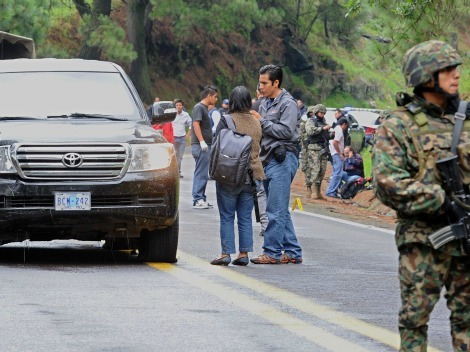
The news that didn’t fit the print: CIA “hit” in Tres Marias
If you want any evidence of how closed U.S. media is when it comes to Mexico, consider that I have to take the following AFP wire story not from any of my usual sources, but from Ahram, the Egyptian on-line English-language news service:
The US and Mexican governments have said little about the nature of their work since a shooting last week that wounded two Americans. This is a silence that has put a spotlight on the growing but often secretive US role in Mexico’s brutal drug war.
The Mexican left-wing opposition Democratic Revolution Party said it would summon government officials to a Senate hearing in order to clarify the murky role of the US Central Intelligence Agency in Mexico.
[…]
US officials told the [New York] Times on condition of anonymity there was no evidence so far the Americans, who have not been identified, were targeted because of their affiliation.
Mexico City Mayor Marcelo Ebrard, a member of the Democratic Revolutionary Party, had already raised questions about the CIA’s presence in Mexico on Tuesday.
“The Mexican government must give a complete report on what the CIA is doing here, with whom it is working and what is the extent of its work,” Ebrard said.
“Everything is in the dark,” he told reporters, adding that Mexico traditionally does not authorise CIA operations.
Calderon’s government has been forced in the past to defend the presence of US agents or the use of US drones over Mexican territory in the fight against drug cartels.
Analysts say the number of US security officials in Mexico has soared since Calderon launched an anti-drug offensive in 2006. More than 50,000 people have died since Mexican troops were deployed against the cartels.
But Calderon has refused to disclose the number of US law enforcement agents working in Mexico. Under Mexican law, foreign agents or soldiers are forbidden from taking part in operations or carrying weapons in the country.
“Of course many of these operations are taking place, and of course they are bypassing the legal framework in doing so,” Edgardo Buscaglia, a security expert and senior research scholar at New York’s Columbia University, told AFP.
…
While the US Drug Enforcement Administration (DEA) used to be the dominant force, the CIA, the US Defense Department and other American agencies have increased their presence, Buscaglia said.
“The expansion of the US presence within Mexican soil is unprecedented,” he said. “We are reaching levels — not in terms of soldiers but in terms of American intelligence — that are close to Afghanistan.”
On thing that I left out in my quotation from the full story was a reference to the New York Times “breaking” the story of CIA involvement. Most Mexican media knew this and published that information long before the Times got hold of it. As far as I can tell, it was Carlos Loret de la Mola who broke the story in El Universal. However, with Edgardo Buscaglia being identified as a “a security expert and senior research scholar at New York’s Columbia University” (which he is), rather than an adviser to the United Nations, the Mexican government, and THE expert on this issue, suggests to me this was a New York based report, which U.S. media have chosen not to run.
Things that have jumped out at me are that while U.S. biased reports stress “police corruption” and changes in police personnel, no mention is ever made that the Secretary of Public Security (who heads the Federal Police), Genaro García Luna, has been one of the few Calderón Administration cabinet officers that has been there since the beginning, despite allegations of illicit personal enrichment and incompetence. Calderón’s own open preference for using Marines (from the Secretariat of the Navy) in high-profile operations against organized crime figures, has been noticed. If “police corruption” really was a concern, one wonders why the top person has been kept on, and what is going on behind the scenes when there are two competing “law enforcement agencies”, one of which — the Navy — is operating in a constitutional gray area, if not a black hole.
Milenio Archive photo
The second thing — again, nothing not suspected or unreported in Mexico — is the presence of these U.S. agents operating outside the law. The “Afghanistanization” of the “war on (some) drug (exporters, but not the Sinaloan Cartel)” has been obvious for a long time. The two most recent U.S. Ambassadors here — Carlos Pascual and Anthony Wayne — were widely touted for having Afghanistan experience.
And, while there are those who defend the “intervention”, it has to be said that if these guys really were CIA, and not some bozos hired by the CIA they were not exactly the best advertisements for American power. Under the spell of Bush II-inspired “privatization” the CIA and other defense/national security operations have been contracting out to not always well-qualified or well-vetted — but politically supportive — sevice providers. That the U.S. pair needed a Spanish-language translator (the Mexican officer in the SUV that was fired on), not to mention that they didn’t have any visa that would allow them in the country (or at least give them some sort of legitimate cover, if just as tourists — c’mon, it’d only have cost them about 25 buck each ) — is sloppy at best.
The U.S. media is just saying the guys left the country… uh… yeah. They were illegal aliens. In theory, they can come back to give testimony, but somehow I don’t see that happening. The CIA wants to make this go away.
Here in Mexico, as elsewhere in Latin America, there is no love for the CIA, and a lot of people just want the CIA to go away. And I suspect — no, I know — there are those quietly cheering for whoever tried to pop the guys.
Money for nothin’ (but chickens aint’ free)
Patrick Ferguson, The [Mexico City] News:
MEXICO CITY – Mexico’s international reserves increased by $1.41 billion in the week ending on Aug. 24, reaching a record-setting $161.2 billion, reported the country’s central bank (Banxico) on Tuesday.
[…]
Mexico’s reserves have increased 13 percent, or $18.73 billion, this year. In the past, the reserves have helped Mexico control inflation. In June, the peso weakened to more than 14 pesos to the dollar. Although Mexico’s annualized inflation rate is currently at 4.45 percent, over Banxico’s target rate of 3 to 4 percent, Banxico is not expected to act. Banxico Governor Augstin Carstens has said that the recent increase in inflation is only temporary, and will die down after the bird flu dissipates.
One assumes it’s a good thing that there are healthy foreign reserves… and I’ll take Sr. Carstens’ word for it that the inflationary pressure is only temporary… and he’s paid very well (and does a very good job) of thinking in the long-range.
As Hank Williams (or was it John Maynard Keynes?) said, “In the long run we’ll all be dead” anyway, and without some relief in food prices a lot of us could be dead. Or, the “stability of the markets” might not mean a hell of a lot when there is instability in the streets.
I can see where egg and poultry prices would jump because of avian flu, but avian flu has only been a very recent factor, and food prices have been jumping since 2006. With the salario minimo kept artificially low (ideally, it would have the same purchasing power it did back in 2006) it’s no longer a matter of substituting one product for another, but of buying anything to eat at all.
And without some relief… even it it meant cutting into reserves and massively intervening in the food sector, this can’t go on much longer. While I’m hearing more and more stories of people only having beans and tortillas to eat, even those of us with relatively middle-class incomes are feeling a squeeze.

I’m talking about people who shop in supermarkets, but are buying less and less… and maybe eating less and less, too. What happens to the national productivity if middle-class people like myself put more of our working days into raising a few hens in the backyard? Egg prices are nuts: up to 60 pesos for three dozen here in Sinaloa — more than a salario minimo — which is what a family of four might go through in a week, especially if they can’t afford much else in the way of animal protein right now. And, seriously… what happens to the supermarkets and the suppliers and the banks and everyone else when are spending only on essentials?
Perhaps, as Trotsky pointed out, the comfortable seldom rebel… but these food prices are making people damned uncomfortable.
She’s partially right
Via Raw Story:

Arizona Governor Jan Brewer (R) angrily accused the Obama administration Monday of “race-baiting” in an effort to wrest Latino voters from the Republican party.
In an interview with Politico, Brewer said there was “no doubt” in her mind that Obama, through his campaign, was accusing her party of being “bigots.”
“It’s all the time, that we’re race-baiting,” she said. “It’s all the time, you know, that we’re bigots.”
Take out the comma and the last five words could be the Arizona Governor’s (and her Party’s) campaign slogan.
Leave them kids alone: Nuevo Jerusalén

Photo by Raúl Tinoco/El Universal
Two hundred Federal and State Police officers had to be dispatched to Nuevo Jerusalén, Turicato, Michoacán where leaders of the dominant sect in the community led a mob that destroyed the community’s public school, and where a sizable faction within the “theocratic commune” opposes public education.
Although the “Ermitas” of Nuevo Jerusalén are mostly members of indigenous groups, they not only families indigenous to the region, but a number of immigrants who joined the sect since its founding in 1973. This fact alone complicates matters, since it is hard to argue that the sects’ eccentric practices are an expression of the commune’s “traditional customs and usages” which — under Article 2 of the Federal Constitution — hampers the state from intervening in activities that would otherwise be violations of other constitutional rights — such as a free education.
That is, while the Ermitas are not unique in having an “unorthodox” faith (they are “end-timers” who worship the “Virgin of the Rosary”) or in enforcing strict adherence to gender-assigned roles and clothing, or even in turning their backs on the outside world, they are subject to the law.
The State of Michoacán has had to intervene in the community before. The sect was led by a patriarch, Papa Nabor, formerly a Catholic Priest from Lazaro Cardenas. Nabor had been the personal choice of the the Virgin of the Rosary according to Gabina Sanchez — later Mama Salome — whose visions of the Virig Virgin led to the sect’s founding. Mama Salome died in 1982, and the new matriarch, Mamá María de Jesús was rejected by about 200 of the faithful who backed a dissident matriarch, Mamá Margarita. The conflict over matriarchal succession turned violent, and the sect — at the time, still recognized as a parish within the Santa Iglesia Católica Apostólica, Ortodoxa, Antigua y Tradicional de México (Holy Apostolic Orthodox Ancient Traditional Catholic Church of Mexico) — faced a second schism by the aging Papa Nabor appointed Martín de Tours as his “auxiliary bishop” — and was henceforth excommunicated. Under Martín de Tours, who took over the leadership in something of a coup in 2006, the sect has become increasingly intolerant of dissent, and seen by its critics as “fanatical”.
Although the Mexican state really has no say in the internal affairs of sects, the activities permitted by “cults” (not a perjorative term, but simply the legal designation of a religious body) are subject to regulation under the Constitution, and have a special legal personality. They are required to be registered with the Federal Government, and — under pressure from both the Roman Catholic and the Apostolic, Orthodox etc. Churches — the Nuevo Jerusalén sectaries are not a recognized corporate body that can set its own internal policies and regulations.
Certainly, there are “legitimate” cults that have been accused of trying to enforce a theocracy, or enforce outmoded and (to our liberal thinking, absurd) gender-specific regulations in behavior and activities, and even the largest, and charges of sexual abuse are raised against conservative religious bodies all the time.
They may indeed as Aguachile — who has been following the school controversy for some time — be a “psychopathic” and “violent cultists, who destroy schools and pelt children with rocks, and have in the past been involved in rape and abuse scandals of their own brainwashed flock, ” (something undoubtedly true of any number of organizations, religious and otherwise) but the sect’s support for the PRI is probably not the only reason for the state’s reluctance to intervene. Lazaro Cardenas Batal, the PRD governor back in the mid-2000s, when Martín de Tours was moving the sect into direct conflict with the State over its aggressive refusal to abide by legal requirements (the sect rejects vaccinations and public schooling, in addition to the standard guarantees of equality of gender, etc.) and disputes over the new leadership and direction of the sect was also as hesitant to take action until the conflicts turned violent.
While the present issue is serious — just obtaining a public school has been a contentious issue within the community for several years and one that was under construction was destroyed by “radical” supporters of Martín de Tours, I can understand why the state has been reluctant to act. While it is easier — for the reasons over-explained above — for the state to force the Ermitas to follow the law — or at least allow those who want to send their children to school to do so, it also calls into question those exemptions for “officially recognized” minorities whose practices one may not approve of, or even find pernicious, but whose existence has been tolerated.
Padre Luís , a spokesman for the Nuevo Jerusalén Cathedral complains that
What happens is that those people [who favor opening a school] are using the school as a way to introduce to our community things that are banned, like fashion, immorality, vice, drugs and alcoholism
It also is a way of introducing the community things like freedom of thought, social equality and economic opportunity, but is the argument made by the Padre so different than that made by any “traditional values” supporter… whether we are talking about the reactionary right in the United States or indigenous communities fighting to preserve a way of life?
Of course, I want the kids in Nuevo Jerusalán to have a school… and I want them to attend. I don’t mean to play “Devil’s Advocate” (nor defend Martín de Tours and his minions). But, nothing is ever simple, and the struggle between tradition and modernity, communal and individual values, is one that has been a constant in Mexico since the Conquest and it is never easy to create change, nor is change without risk.
Sources: Contralinea; BBC News; CNN; El Univeral; La Jornada, Aguachile


 mexfiles.net