Give blood… bring rain
Equal opportunity sacrifices to Tlaloc.
Sembrando Vida (Sowing Life) and Jóvenes Construyendo El Futuro (Youth Building the Future) have proven to be two of the most successful, but under-reported, public assistance programs in Mexico… perhaps in the Americas. The first, Sembrando Vida, provides not just seed and fertilizer but direct payments (a minimal salary) for small farmers, and for land reclamation projects; while the latter, Jóvenes Construyendo — something like the US New Deal program, the WPA — hires young adults for public service jobs, providing stipends as well for apprenticeships, work-study programs, and internships. Some have criticized these as mere as “make work” projects, they are investments towards achieving long-range goals, meant to benefit not only their own nations (climate change abatement, food security, a better educated and higher earning work-force), but resolving a chronic complaint about our region from the United States. If people don’t HAVE to emigrate, they won’t… staying home, earning more, shopping at WalMart, ordering from Amazon, etc. etc. etc.
It’s not like people are just going to be sitting around and collecting a check for NOT emigrating, but rather — to use a mealy-mouthed term popular with the public relations crowd — they are “stakeholders” in their country’s development. And, at a low, low cost.
Since 2003, the United States government has spent over 335 BILLION (thousand million) dollars on immigration (or, rather preventing immigration) across the southern border. The Great Wall of Stupidity, had it been built, would have cost an estimated 21.6 billion, though, of course, Homeland Security has been spending… and spending… and spending funds just to keep up what wall was built, and still has no real plan to deal with central american migration.
Which leaves the question… given these programs are already working… why doesn’t the US … as promised… put up the measly 4 billion promised to expand these Mexican programs?
(Translation from Lidia Arista, “AMLO propone hacer masivo Sembrando Vida en Centroamérica”, Expansión, 6 march 2022)
President Andrés Manuel López Obrador proposed that the Sowing Life and Young People Building the Future programs be massively applied in the Central American Republics and asked the United States Congress and Government to deliver the 4,000 million dollars that Joe Biden offered in January 2021 to stop forced migration and promote development in Honduras, El Salvador and Guatemala.
“We are going to continue with these programs and [. . .] ensure that they benefit not tens of thousands, but hundreds of thousands, or millions, and for that we require that the Congress and the United States government approve the necessary resources. We are talking about 4,000 million dollars, which was what President Biden offered for the development of southeastern Mexico, Guatemala, Honduras, and El Salvador,” Mexican President Lopez Obrador said on the second day of his tour of Central America and the Caribbean.
In the three messages that he has offered after meeting with his counterparts from Guatemala, El Salvador and Honduras, the president has asked the United States to speed up the delivery of promised resources for Central America. “We need the United States to become clearly involved in solving a problem that affects it and to help finance these programs,” said the president after the meeting with Xiomara Castro.
The Mexican president said that as countries that send, transit and receive migrants, both Central America and Mexico and the United States must all contribute to resolving migration issues. “We [in Mexico] are transit territory and are aware of the risks and suffering this represents for many Honduran, Guatemalan, Salvadorans and for all citizens of other countries. That is why we have been insisting on the relevance of applying social programs like the ones we have been applying for three years in our country”, he said.
In a morning meeting with Salvadorian President, Nayib Bukele, Lopez Obrador agreed to double the current funding provided for the two programs to increase beneficiaries from 10,000 to 20,000. Honduran President, Xiomara Castro, spoke out in favor of dealing with migration from its causes, and announced that that her nation will host the Ministerial Conference on Migration to be held in the second half of this year. “Migration is a human right, it is not a crime,” she said.
None of which will be possible until Biden and co release the promised funds.
Oops… they (almost) did it again
“Former President Donald J. Trump asked Mark T. Esper, his defense secretary, about the possibility of launching missiles into Mexico to ‘destroy the drug labs’ and wipe out the cartels, maintaining that the United States’ involvement in a strike against its southern neighbor could be kept secret, Mr. Esper recounts in his upcoming memoir,” Maggie Haberman reported for The New York Times.
Raw Story
Maybe Cinco de Mayo … commemorating an unexpected Mexican victory over what at the time was considered the world’s best miliary… wasn’t the day for this to come to light, but hey… the US has indeed rained missiles down upon Mexico before.
ON 12 September 1967, a Pershing I missile, fired from the Black Mesa test site when “astray”, landing in Chihuahua, just south of Van Horn, Texas. At the time, other than a few more or less dismissive items in the newspapers (including the New York Times), the story was largely ignored, both in the U.S. and Mexican media, given that the missile was an unarmed test missile, the US (quietly) paid compensation and no one was unduly inconvenienced. HOWEVER, it might be noted that Pershing I was taken out of the US arsenal soon after, and all Pershings were later removed around the world in the late 1970s.
A much more serious… and nearly disastrous incident… occurred just three years later, when an Athena missile, in the early morning of 11 July 1970 had a systems failure… According to a later report by the Air Force Systems Command:
An inflight malfunction, fourth stage motor ignition on V123D, caused both stage four and the payload to fly off course; for ignition of the fourth stage occurred prior to mid-course guidance maneuvers and provided a range extension of approximately 400 (nautical miles) and subsequent impact in Mexico.”
While, again, the missile landed in a relatively isolated area, there was a HUGE problem. First, the Air Force couldn’t find it… not the US, not the Mexicans. The best anyone could figure at the time was that it was “somewhere” 150 miles south of Juarez.
Secondly, something no one wanted to think too much about, the missile included radioactive Cobalt-25 and was …somewhere. It wasn’t found, that somewhere turning out to be about the Durango-Cohuala border, the nearest population center being Torreon.
Cleanup took months. Not only the missile debris, but much of the topsoil having become while not glowing, at least radioactive enough to raise health concerns, had to be carted away by the US government (which also had to build a temporary railway to the site).
Once is an accident. Twice is happenstance… though it’s definitely noticed. A third time would have been enemy action… and whether Trump really suggested this, or whether or not anyone would have complied with that insane sounding plan (how would missile strikes NOT be seen as coming from the US?), Mexico should never take US good will at face value. Nor, consider itself an “ally” rather than a neighbor, of a nuclear power.
see also: 11 September 1967, New York Times (“Errant Army Missile Takes Mexican Trip”); Chicago Tribune (“US Missile Off-Course Hits Mexico”; White Sands Missile Range Museum (“In 1970, An Athena Missile Went Deep Into Mexico“)
Electrical, and electoral, power
With the narrow defeat (or… rather… narrowly not passed) … electrical system reform bill last Sunday (17 April), the pundit class is already weighing in on the future of power in this country… political power that is.
With overwhelming support from the ruling MORENA party and its coalition partners in the Chamber of Deputies, the bill, which would have only semi-nationalized the electrical generating system (only 53% would be state owned, as opposed to, say, the 75% in “free market” France) but with the opposition parties holding over a third of the delegations, and loathe to undo the “reforms” that were passed under the previous administration, it was always dubious that the administration would find the 53 votes it needed.
And, between party loyalty, intense lobbying by not just the foreign energy companies , and not so subtle threats to Mexican exports by U.S. Ambassador Ken Salazar, the bill was simply not going to pass.
Environmentalists also raised some legitimate objections… older CFE (the state system) generators are less “green” than those newer systems built by the foreign companies. Which did not mean they’d necessarily stay in operation, or wouldn’t be upgraded, and their concerns were worth looking at. However, there were also those AMLO dismissed as “pseudoenvironmentalists” who simply glommed on the green objections as a way to oppose the bill without appearing to side with the reactionaries who were being pilloried by the left for being sell-outs to foreign interests, or simply greed-heads. Given that the fallout from bribes paid to open PEMEX to competition is still in the news, nobody wants to be the target of some future investigation, or have their taxes too closely scrutinized should there be a reform.
Coupled with the low turnout for the recent referendum (also pushed by the administration) the failure to pass what was to be a jewel in the crown of the “Fourth Transformation” by re-nationalizing the electrical generation system (as it was in 1962) one would think… and, if a member of the opposition, hope… it means MORENA is in retreat, and the old “duoploy plus one” (PRI-PAN-PRD) is coming back.
Unlike the United States, where discussion of the “next” presidential election begins before the final vote count is even done, Mexico’s next presidential election is still a little over two years off, and it’s way too early to offer predictions. Which doesn’t mean people don’t.
What polls are out there show massive support for Morena. Even without a bespoke candidate, were the election today, they’d capture the Presidency by a(nother) landslide:
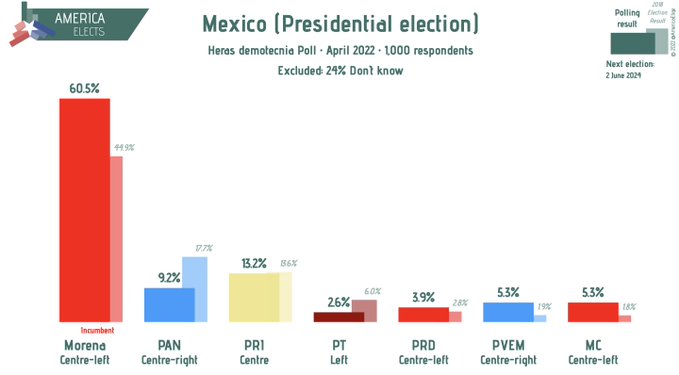
Even if … as endlessly discussed, PRI-PAN-PRD (“Priand”) had a coalition candidate… would not stand a chance. Even if the “centerist” Citizens Movement” (MC) and the Greens (PVEM), both seeming to be “rent-a-parties” with their own agendas (basically whatever benefits their leadership) joined the opposition, MORENA would still win. Which doesn’t mean they would also have a “supermajority” in a new legislature, given the proportional representation system used (200 of the 500 delegates are selected by their party, based on their relative showing in the general election) designed to prevent any one party from having more than 2/3rds the seats. Which, however, they could have with a coalition partner (say, MORENA and the Workers Party [PT] or Greens [PVEM]… the ruling party’s present coalition partners in the legistlature). However, they’ll be damned close, and have fewer opponents to win over.
And, by that time, quasi-nationalization may already be underway. On Monday, the day after the “defeat”, Lithium deposits were declared a mineral vital to national security. Passing a bill nationalizing lithium deposits only required a regulatory change, something only needing a majority of votes, and the bill was introduced and passed in the Chamber within a couple hours. Done.
Today, Tuesday (although by the time this is posted, probably Wednesday), the administration began whittling away at the foreign energy providers. Among the rationales for reform was a “loophole” in the existing system, whereby a business entity can generate power for its own use, selling the excess to CFE at a rate they set… i.e., higher than CFE can charge its regular customers, but forced to buy.
Notably, the administration was highlighting OXXO, the ubiquitous convenience store (and receiver of funds for banks, utility bills, on-line merchandise payments, etc. etc. etc.) pays less per store for heating, cooling a wall of beer coolers, lighting, computers, etc. than the average household. But… .even if the stores are franchises… they can legitimately claim to be part of the same group buying their electrical power together. Not so the 120 or so providers that put together what were basically buyers’ clubs of unrelated businesses and even individual home owners. At present, they are being “invited” to discuss their situation. Before the tax authorities, and/or federal prosecutor, steps in that is. Invited. Maybe to agree to a buy-out, like the government did with the few remaining private generating plants back in the 1960s?
At any rate, given this will be a multi-year process, and the presidential election is in two years, while one expects it will be a dominant issue for Morena, there are a few outside issues that could play a role. The most obvious is the European situation.
The war, or “special military operation” in Ukraine has led to massive shortages of fuel, specifically Russian natural gas, in Europe. With the US pressuring the Europeans to not buy from Russia, and Spain (whose private electrical generating system is raising prices beyond consumers’ ability to pay, and nationalization is more and more a possibility) being the main home of the private producers here in Mexico, might be forced to either raise rates here (making the case for nationalization even stronger) or have to sell to raise the cash needed to survive at home. Or… with the United States using the Russian boycott as a rationale for more liquid gas exports to Europe and elsewhere, cutting off Mexico’s access to a “cleaner” source than coal, there might be more support for the argument that the foreign companies, with their newer and “greener” technologies, need to stay on. Or… pressed to speed up the conversion to electric cars and transit systems, the price of lithium will go up, making those nationalized deposits here all the more viable (and subject to … ahem… interest by foreign “investors”).
“If present trends continue”… though they never do (not exactly, anyway)… Morena will control both the presidency and the legislature for the next several years, the Fourth Transformation will continue though at a slower pace, and some form of semi-nationalization of the electrical system will progress. And our light bills will still go up.
Rosario Ibarra de Piedra (24 Feb 1927 – 16 April 2022)
A Monterrey “housewife”, Rosario Ibarra de Piedra‘s public career didn’t begin until she was in her late 40s. Not that her’s was an entirely an Ozzie and Harriet (Monterrey version) family. Her husband was a Communist, although perhaps something he limited to his leadership of the University of Nuevo Leon Socialist Alumni Association, her son-in-law made something of an international splash in 1972 when he highjacked a Mexican plane to Cuba … ransomed for the release of three Communist political prisoners in Mexico, but was mostly a “stay-at-home” mom to her three sons.

When her eldest, Jésus, was first accused of belonging to a Communist organization — which was just the family tradition — and then snatched off the street in April 1975, she turned mama-bear: leading and pioneering the demands for answers to the still-chronic (if not worse) problems of “disappearances”) endlessly pushing for justice, not just for those disppeared for political expediency, but all victims of injustice.
In addition to founding, and running “Projeto Eurika!” (the first of many family organized and run organizations to mount searches for the disappeared, and to pressure authorities for answers), she had a second life as one of the more important figures in late 20th century Mexican politics.
Twice presidential candidate (in 1982 and 1988), with not a ghost of a chance of being elected, she used the bully-platform her campaign provided to not just push for answers to the disappearances, but to begin a long push-back against the growing neo-capitalist trend among the elites and political class.
A founding mother of the PRD (initially a dissident liberal-left movement within the ruling PRI) and later the PT (Workers’ Party) she also campaigned for women’s, indigenous, and LGBTQ+ rights, election reform, economic inclusion, and a long list of et ceteras.
Several times a Senator, most recently for MORENA, she was still an active and important voice on the Mexican left up until her death earlier today at the age of 95.
Were the conquistadores a bunch of pigs? Well… sorta
It’s not the stuff of epic painting, nor of our movie versions of the Conquest, but when those Spaniards came swashing and buckling though the continent, they were followed by (and depended upon) one animal more than anything else. Not the ferocious war dogs and not the horses… but their pigs.
Columbus’ second voyage (in 1493) introduced eight pigs to the Americas. It doesn’t sound like a lot of pork, but they weren’t brought over as dinner on the hoof (er… trotter). Pigs had been an integral part of Iberian cuisine since before the Romans (and some scholars claim the Iberian pig introduced the Romans to the “other white meat”) and Porky and Petunia and their six companions were prized for their ability to survive, and even thrive, on sea voyages (they’ll eat anything), breed quickly, and generally fend for themselves. These weren’t, after all, the pampered pigs of modern agro-business, but the tough Iberian pig (Sus mediterrenous), the ancestral breed , the medieval thug the porcine world.

The pigs Colombus brought with him to Cuba fared much better than the Spanish colonists, with an estimated 30,000 (probably an exaggerated estimate, but so it was said) by the time Las Casas (who’d been on that second voyage) was writing his Relaciones, both in captivity, and going over the wall. If anything, the feral pigs, were doing especially well, tearing up the landscape, feasting on the variety of tropical fruits on the island (and driving some to near extinction), free to roam a landscape without any natural predators… except whatever people had managed to elude the Conquistadores and weren’t eating the occasional ration of their more domestically inclined brethren.
Or… perhaps the pigs were preying on the remaining natives… pigs and humans, having been together (especially in Iberia) for millennia, were subject to many of the same diseases as humans… or humans to pig diseases (Swine Flu, anyone)? Las Casas laid the decimation of the native peoples in New Spain on the Spanish themselves. And, indirectly, it was… although the pigs may have been a more important vector than we realize.
While several of the contemporary accounts of the Conquest(s) and explorations of the “new world” mention pigs (and Pizarro was routinely described in his, and sometimes in our, time as a former swine-herder), modern accounts overlook how important they were: herds of pigs following every conquest, both as a source of fresh food, and as a breeding stock for any future settlement. But, other than De Soto’s ill-fated expedition (De Soto refused to allow his pigs to be eaten, which led to near mutiny), you scarcely find any mention of them. In Fernando Cervantes’ “Conquistadores: A New History of the Spanish Discovery and Conquest“… the latest major work on the subject (Viking Press, 2021), there are only four pages … all references to De Soto… mentioned in the index. And it’s for “piglets” not pigs.
Perhaps, as Benjamin Joseph Zadik, in the only English language work to delve into the subject at length (an MA thesis from 2000) suggests in his “The Iberian Pig in Spain and the Americas at the Time of Columbus” (Pomona College, 2000), the Conquistadores and early Iberian “settlers” (as if they were two different things) just took it for granted that they would bring pigs along, and wrote more about horses and cattle because they were status animals… and a Hell of a lot more trouble to import than pigs. And… I might add… historians have always been more likely to write about generals than quartermasters… the battles are much more colorful affairs to write about than it is to deal with mundane things like the supply train.
But, it was ham that sustained Cortés, pig fat that greased his war machine and served as ointment (“oink-ment”?) for wounds, and hog bristles that painted the heroic pictures. And spread the diseases further and further into the countryside as feral pigs roamed throughout the Americas.
Now read this!
. . . the silent and subordinate integration of the Mexican economy and security to the United States is advancing, under the guise of North American prosperity, but there is some resistance on the part of the Mexican government, and an important defense of strategic sectors such as energy. Given this situation, it is of enormous importance to understand Mexico’s foreign policy and specifically its proposals to the Community of Latin American and Caribbean States (CELAC).
Integration with the United States or Latin American Independence? (NACLA, David Barkin and Alberto Betancourt)
Was it worth it?
To absolutely no surprise, last Sunday’s referendum (consulta) had too low a turnout to be binding, and overwhelmingly showed support for AMLO finishing his presidential term. The major foreign media reports (AP and Reuters) make the same points, mostly that it was a sort of futile “ego trip”, costing a lot of money, and proving nothing.
Or.. did it?
Neither source, expect in its closing paragraphs, notes that the normal federal funding for elections was stinted… but neither notes that this was largely by design, the INE (Elections Institute) — controlled at present by representatives of the opposition parties (despite being, allegedly, a non-partisan independent body) — found rationale after rationale for underfunding the referenda. Underfunding to the point that only a third of the normal polling places were functioning, and several were changed from their usual sites to more obscure and hard to locate “alternative locales”.
Nor… as the pro-AMLO forces have maintained, that the INE, controlling its own budget, has been fighting to preserve the salaries of its commissioners (presently receiving more than the presidential salary) by claiming that, as an independent body, they cannot be subject to normal civil service rules.
NOR, do AP or Reuters not that the united opposition openly encouraged votes to stay away from the ballot box, being the “some say” of the articles who questioned the value of the exercise.
Though, of course, being underfunded, receiving messages that they shouldn’t bother to vote, and a good number of people understanding that AMLO … enjoying a 60% or more approval rating in every poll… was in no danger of being forced to resign.
SO… was there a point? Perhaps. As argued before, there is some value in bringing to light issues in presidential succession due to death or resignation (should it ever become necessary). It also shows up the “issues” with the INE, and the need for reform in the elector system.
It’s hard to say, though, that the “bragging rights” on the left (crowing that 90% of 20% of the electorate supports the president doesn’t really translate into an assumption that 90% of the population will support every initiative put forward by the administration), but it does show there is strong support for the president by those willing to turn out to vote … and that holding referendums — letting the people express their approval or disapproval of government initiatives — is a real possibility, and that there are legitimate alternative means to change or retain an administration without resort to the usual violent means so common to Latin America.
What if? Presidential succession and the consulta
Today’s “consulta”… the ballot issue being, first, should AMLO stay in office, and, secondly, if more than 50% of the voters say he should leave, is he obligated to do so… is — like all Mexican elections — only mandatory in theory. In practice, there is no fine or penalty for not voting, or for purposely nullifying one’s vote.
The statistical liklihood of AMLO being voted out are nil. As of 11:30 PM (4-10-2022) with about 10% of the vote counted, about 90% of voters are saying “stay”… although the second question, of whether a president should be obligated to step down if they lose a “consulta” is also passing at about the same lopsided percentage.
Still… given that this is more a “test run” for a new wrinkle in the already complicated Mexican political system, it raises some questions. Leaving aside whether regular citizen’s consultations on an administration half way through the six year term is a good, or bad, idea (I’ll get back to that), what happens if the President needs to be replaced?
It’s happened twice. Once really. When Alvaró Obregon was assassinated a few weeks before the start of his term, there was time for… as the Constitution mandates, for the Chamber of Deputies to sit as an Electoral College and pick a President to serve a short term until the next general election two years later. The cautious Emilio Portes Gil served out his eventful term (finishing negotiations to end the Cristero War, and dealing with the Wall Street collapse of 1929) and retired unscathed. For what was supposed to be a 1930-34 term, thanks to an (un) healthy assist from former president (and… man behind the scenes) Plutarco Elias Calles, Pascal Ortiz Rubio was elected.
Ortiz Rubio didn’t quite jump high enough when Calles’ said “jump”, so in 1932, read in the newspapers that he was resigning, “for health reasons”. Which might have been true, beyond the usual assumption that Calles’ and his gang was hazardous to his health. Poor Ortiz Rubio had been shot in the face the day of his inauguration (something covered up as much as possible... the would be assassin being a die-hard Cristero, at a time when Church and State had worked out an unsteady compromise to end the violence of the late 1920s) and probably had what we call today PTSD. Calles convinced the “Electoral College to appoint a yes-man (Abalardo Rodriguez) to finish out what should have been a normal term.
None of which provides too much guidance, other than having the Deputies elect a substitute President, for what would happen in the unlikely event that AMLO were to lose this “consulta”, or… in the still perhaps unlikely event that there will be enough voters in this “consulta” for it even to count and set a precedent: At least 40% of the entire electorate has to cast a ballot for the consulta to even count. As of 11:30, based on votes counted, it was only about 11% of the electorate (but it’s still early).
So… what would happen? If the president were to step down (voluntarily or by law), the President of the Chamber of Deputies (equivalent to the US Speaker of the House) becomes the “Interim President” and needs to convene the Chamber within 30 days.
Here’s where things could get very, very weird. The consulta results might be challenged by a president who was “asked” to leave. Or file an injunction (amparo) to prevent the votes from being certified. In which case, the Elections Tribunal would have to hold a hearing, and issue a ruling. Supposedly within 60 days… so… if that were to happen, would the President stay on, or would the “Interim President” at least temporarily take over?
And… just to confuse things more, when the President of the Chamber becomes interim president, is he or she still the one who calls the Chamber into session? AND… this consulta being held a week before the Chamber and Senate go into recess, can a special session be called, or, does it have to wait for the new legislative session to begin in September?
IF the 40% turnout is reached for the first question, and the 50% turnout on the second… AND the results are certified by the Election Tribunal, even if… as no one expects won’t happen, AMLO is sent packing, it’ll be a mess.
Given that any one of those three probably won’t, beyond wondering WTF was all this for (and I’ll get to that in a minute), there will need to be changes made to the process, something it seems only PRI Deputy Dulce María Sauri has been considering. Even with giving the Elections Tribunal final say, and shortening their time to make a ruling, still a mess.
So… why? Most commentators — those not of the AMLO can do no wrong stripe, anyway — see this mostly as an ego trip, or of a way to drive home the point to the opposition that there is no mandate to oppose his programs. But, a regular mid-term referendum on the president’s performance has a few advantages. Candidates would have to keep in mind what it is the people expect, and show progress, or deliver results, within a much shorter time-frame. This might lead to hastily conceived projects, or splashy initiatives that fall apart with a few years (or even months) after completion, but then again… it would serve as a corrective for administrations that appear to be going off the rails, and the head of which has lost the confidence of his or her people.
And, anyway… (looking again at the early returns)… if present trends continue, it’s an issue to be considered later. But not too much later.
Save the tortillas!
A friend up in North Carolina was complaining about some weird packaged tortillas she’d bought (Low-Carb Tortillas? … what’s the point, where’s the taste?) but for us in Mexico, where tortillas are a major part of the diet, commercial tortillas, and what they’re made of not just of consumer preference for low-carb, or gluten-free (hey, they’re corn anyway!), or tasteless… but literally a matter of life and death. And national identity.
Miguel Concha, in La Jornada (8 April 2022, page 13. . . my translation with a few additions n brackets for clarity)

Under the slogan “Save our tortillas!” the Alianza por Nuestra Tortilla, and Alianza por la Salud Alimentaria (Alliance for Our Tortilla, and Alliance for Food Health) have launched a campaign to encourage participation in the Public Consultation over a draft Official Mexican Standard PROY-NOM-187-SSAI/SE-2021, which regulates the production and sale of tortillas and other corn-based products .
It’s not a small thing: mass production of tortillas –fundamental to the Mexican diet — has led to deteriorating nutritional quality over those produced by traditional processes, like nixtamalization [in which the corn dough, masa, was mixed with alkaline, usually ground limestone, and rinsed… releasing amino acids and other nutrients]. Additionally, displacing traditional recipes with ultra-processed tortillas, made from industrial flours, contain additives, dyes or whiteners intended to imitate the natural characteristics and color of native corn tortillas.
But these are not the only issues. In 2019, the Association of Organic Consumers found that samples of Maseca brand corn flour collected in Mexico and the United States, contained unhealthy levels of glyphosate and transgenic corn [neither of which are supposed to be sold in Mexico]. Various consumer organizations and academic researchers have brought up their concerns and have presented their proposals to re-evaluate the regulations on industrial tortilla production, and on public policy to encourage the consumption of tortillas made from native nixtamalized corn.
This consultation serves as a platform for citizen participation improving the current draft Official Mexican Standard. The comments received will be reviewed by the working groups involved, in order to have a closer project and feasible proposals, in an effort to guarantee that food is derived from quality corn, safe and culturally appropriate.
What do the consumer groups hope for? They propose making a distinction between products derived from nixtamalized corn dough and processed flour, labeling them as such, as well as informing consumers of the other ingredients used in production, as well as the percentage of added ingredients, such as nopales and chiles, and the presence of additives.
In addition to giving the consumers better information on which to make purchases, it is meant to promote food production from native corn, in line with the already existing Federal Law for the Promotion and Protection of Native Corn.
With diabetes and hypertension, resulting [in part ] from a diet rich in ultra-processed products, regulating the way in which food is generated is a necessary measure. Especially when you take into account the socioeconomic conditions of a significant portion of the public for whom corn-based foods, such as tortillas, represent the main source of essential nutrients, both for the development of children and youth, as well as for adults and older adults.
This NOM-187 project does not solve problems such as supporting the local production of native corn by peasant communities, guaranteeing fair prices for producers or providing affordable food for all people. However, it supports the construction of an alternative food production model, close to the communities, that respects people’s human rights and a healthy environment. It is the task of the State to ensure that in the search to guarantee food sovereignty and health in the country, that the public demand that ultra-processed food companies comply with their responsibilities regarding respect the human rights of the population.
Salvador: where no news is fit to print
Try to bring up the best independent media site in Central America today, and this is what you get (original in Spanish):
No to Censorship.
For many years, in this space our readers have found critical journalism with a declared intention of understanding the political and social phenomena that determine the lives of Salvadorans and Central Americans.
Among them, we have also covered gangs, their origin and their excessive development in the north of Central America, how they subdued a huge part of the population and which politicians and governments they have had secret agreements for more than a decade. Without an independent press, citizens would never have known about these pacts. To continue explaining this, to continue revealing those pacts, is now a crime that can be punished with up to 15 years in prison in El Salvador.
The amendments to the Penal Code, approved this week by the Assembly of [President] Nayib Bukele, are a gag on freedom of the press and freedom of expression. But above all on the citizen’s right to be informed. What should Salvadorans know about gangs? Nothing, according to the regimen.
In a democracy it is not those in power that decide what is published and what is not. But this new law, at the express request of the President of the Republic, comes when democratic life has already been dismantled and the regime tries to hide its own negotiations with criminal groups and its corruption by all means. That is why today, in protest against this gag law, we have closed our front page. El Salvador paid a very high price to obtain our freedoms. We cannot allow them to be taken from us by a regime that seeks to keep citizens in the dark. Tomorrow you will find here what we have done and continue to do: journalism. Today we protest.
Cowboys v Nazis
One of several incidents that convinced me to start writing Mexican history (and, once being labeled “Mexican Pravda” for my trouble) was talking to a British teacher one day on the bus when I was still new to the City, who … in all honesty… told me the Mexicans had always hated the British, and that’s the reason they backed the Germans in WWII. Uh….
Yes, there were Nazi sympathizers in Mexico… quite a few, though outside of some urban intellectuals, support was more for a Francoist type of Fascism — upholding traditional religion and a reaction against the Revolution — than any ideological formulation based on some mythical “pure” bloodline (and… in one of the weirder attempts to justify Nazi ideology, José Vasconcellos made the “Cosmic Race” … the mixture of the then prevalent racial groups (white, black, red, yellow) … the “master race” over the Nazi sub-category of Aryan. But, as it was, with the Mexican state having been openly opposed to the Fascist states throughout the 1930s, the last gasp of the Cristeros (Saturnino Cedillo’s German-financed attempt at a coup in 1939) and the influx of often technically or intellectually gifted refugees from Nazi regimes, and the election of a more pro-western president in 1940 did not bode well for the likelihood of Mexico siding with the Germans, and putting its declared neutrality in doubt. After the United States entered the war in December 1941, it was only a matter of time until Mexico … among other things, the main foreign source for oil for both the United States and Great Britain… would be forced to openly take a side.
That oil was also a matter of great interest to Berlin. Either obtaining it, or at least keeping it from their enemy. And, with attacks on Mexican oil shipments in May 1942, Mexico had a constitutional mandate to declare war (the Mexican Constitution limits war powers to defensive actions).
However, although the post-Revolutionary state had been run by military men, going back to Alvaro Obregon, who openly mused that the with Juarez having overthown the Church, and the Revolution overthrowing the old elites, someone would nee to overthrow the military. Since Calles, the military’s power had been scaled back year by year (his Secretary of War, Jesus Amaro, famous for being one of the few cabinet officers in history– anywhere — to continually complain his department’s budget was too large, and needed more cuts!), and whether Mexico was prepared for war was a genuine concern.
Uncovering a Nazi spy network, and a few incidents of sabotage, gave credence to the sense that Mexico, might indeed, be a target for attack and attempted occupation.
Even the remaining Cristeros, although politically Fascist, changed their tune… where their leader, Carlos Abascal, had been trying to sell the Cristero colony on the Baja Peninsula as a potential auxillary force against gringo invaders, he was quick to suggest his “holy warriors” could fend off a potential Japanese landing.
Enter the cowboys
Anatolin Jimenez Gamas, never felt he had particularly received the rewards he was due for his service to the revolution as a lieutenant colonel in Pancho Villa’s cavalry from 1910 to 1915. He’d managed to get himself elected to the Chamber of Deputies a couple times, but other than that, his political role was reduced to being the president of the Association of Charros… a trade group and social club for horse fanciers.
But… perhaps each according to his ability… were the Nazis to attempt an occupation, somebody would need to be ready to fight them. The Army would probably be beaten but, given his own experience with Villa (having been wounded three times, and blown up a few railways back in the day), and that horse mounted cavalry was still a thing at the time (especially in the less mechanized armies like that in the Soviet Union and Poland), AND… nobody knew the back of the beyond better than cowboys, why not organize a cowboy guerilla unit?
Which, while a little dubious, President Avila Camacho authorized. 150,000 horsemen signed up, received training in sabotage and guerilla fighting, issued pistols and machetes… and sent home. By the time they were prepared for possible battle, organized into 250 resistance units throughout the entire republic, the prospect of a German or Japanese invasion was over, if there had ever been a threat to begin with.
That, and ironically, Jimenez had a heart attack in 1944, and was ordered by his doctor to stay off his horse. He retired, honorably as anyone who did their part, taking up the more sedate role of a book publisher.
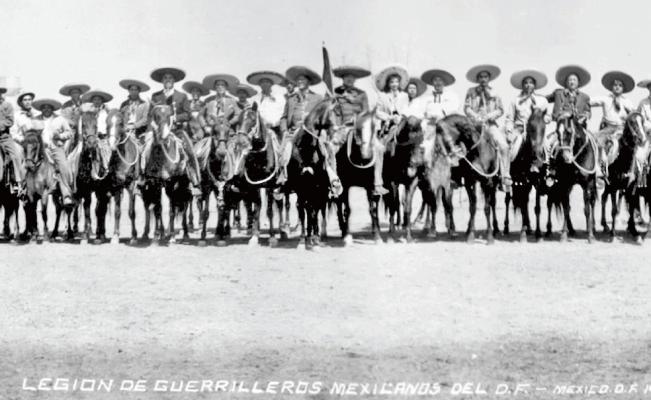
The short lived Legiòn de Guerrilleros Mexicanos may not have had the same impact on the war as Escuadron 281 .. the Mexican air unit that saw action in the Pacific, nor the importance to later history of the Braceros who kept the farms, factories and railroads in the United States functioning as their native workers went off to the front, or the Women Workers’ Corp that manned… or rather womaned… the overworked factories during the war, and formed the nucleus of the push for women’s suffrage and labor rights, the Legión has an honorable mention in Mexican military history… having stepped up … or, perhaps we should say saddled up… to do their part to defend the nation against outside aggression, and did it with style.
Sources:
Najar, Alberto, “El olviadado ejército charro creado para defender a México de los nazis” (BBC)
“La historia del ejército charro que se preparó para combatir a Hitler” México Disconocido
Matria (film). Fernando Llanos, director and producer. 2016.


 mexfiles.net