Miguel de la Madrid died this morning, was immediately cremated and has already received about as much in the ways of obsequies as the ex-President could have expected. The first of the Ivy-League presidents (de la Madrid, Salinas, Zedillo and Calderón), de la Madrid’s tenure (1982-1988) was the beginning of Mexico’s adherence to the U.S. inspired (and imposed) “Washington Consensus”. For the Washington Post, de la Madrid is something of a hero for forcing the massive sell-offs of government enterprises.
 Mexico’s foreign debt was indeed crushing when de la Madrid entered Los Pinos. The outgoing Lopez Portillo administration (in which de la Madrid had served as Secretarío de Hacienda — Treasury Secretary) had taken out massive loans to finance public works, often unnecessarily, counting on the huge Canterell oil field and the steep rise in oil prices, to cover the interest payments. Canterell was not nearly as large an oil field as initially believed, and the sudden drop in oil prices left the government on the hook for the massive loans to U.S. banks… who themselves would be in serious trouble were Mexico to default. That the banks had “encouraged” Mexican officials to take out massive loans after offering kickbacks of up to ten percent on the total amount borrowed, sort of makes it difficult to justify the Post’s claims that de la Madrid’s “saved his country from economic collapse.”
Whether that is true or not (perhaps Mexicans would be better off today if there hadn’t been privatization, or — at the very least — privatization without much
thought given to the true value of the state enterprises, or the buyer’s ability to provide services to the public) de la Madrid is better know for not saving his country from a very different collapse. The de la Madrid Administration’s response to the 17 September 1985 earthquake, the nation’s worst natural disaster, was matched in recent North American history only by George W. Bush’s response to Hurricane Katrina.

The Democratic Opening of 1985
That immediate relief and rescue operations mounted by the survivors of the quake themselves probably had more to do with the political change that eventually followed de la Madrid’s tenure than any other act (or, rather, non-act) by the political establishment. For de la Madrid to take credit for the “democratic opening” would be like Strom Thurmond taking credit for the Civil Rights Act of 1965 in the United States.
If that sounds harsh, it may be a bit unfair… de la Madrid claims he was misunderstood, or misunderstood the question, when asked if he had been involved in the highly irregular and dubiously legitimate election of his  successor, Carlos Salinas, who was losing to popular democratic rival, Cuauhtémoc Cárdenas, until an “unexplained” fire stopped the vote count and installed another Harvard educated economist at Los Pinos (with the inevitable financial mess that seems to follow Ivy-League economists when they enter Latin American politics).
His only seriously positive role was in his government’s brokering peace agreements in Central America, and in withstanding pressure from the Reagan Administration to back the reactionary  and murderous regimes imposed upon Mexico’s neighbors… and in keeping open Mexico to refugees from those conflicts.
About the most that can be said about the de la Madrid years is that there were no public scandals… no messy public fights with the first lady over presidential mistresses, as Lopez Portillo and Díaz Ordaz had to endure, or inconvenient siblings, like Carlos Salinas’ brother, Raul (and no dead ex-brother-in-laws to explain away). That de la Madrid had a gay son was widely known (and the subject of salacious gossip at the time), but with Mexicans much more reticent about prying into the private lives of others than in the United States, what attacks were launched against de la Madrid were political and not personal.
Out of office, de la Madrid was allowed to sink into obscurity. Even when he occasionally made eye-brow raising comments (such as calling Carlos Salinas a crook) or startling revelations (such as his own role in throwing the 1988 election) they were seen more as confirmation of widely held assumptions, and the former president’s very existence was more or less forgotten. Earlier false reports of his death (he had been in poor health for several years, and his death at age 77 was no shock) were taken in stride, meriting at most a brief mention in the Mexican press.
While the political class, and the professional politicians pay tribute to one of their own, and Time Magazine has an excellent obituary, perhaps the best and fairest comment on de la Madrid was made by one who might be considered the late President’s political antithesis: Andres Manuel Lopez Obrador.
The loss of any human being is lamentable. We should show respect for the dead… for any person, for any citizen, and for an ex-President of Mexico.
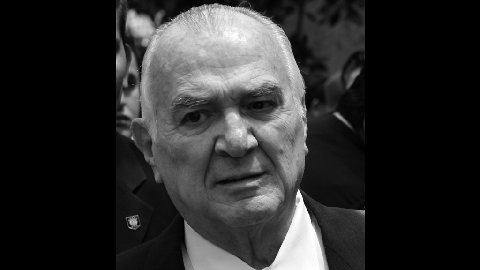
Moises Pablo / EPA
Bright ideas on the campaign trail
Whoops!
Josefina Váquez Mota has an interesting idea for “cleaning up” Mexico …saying in a speech “…vamos a fortalecer el lavado de dinero “: We are going to strengthen money laundering.
Yeah, I guess México could do more in the way of money laundering, and compete with the Caymans, Panama, Belize, the United States in that particular sector of the underground economy.
And they’re off!
As of midnight yesterday, the official Presidential campaign began…
Josefina Vásquez Mota promised life without parole for politicians involved in crime (should Felipe Calderón be worried? )…
AMLO promised to build five new refineries…
Enrique Peña Neito still can’t remember any books he’s read
And Gabriel Quadri walked out of a Veracruz restaurant and “forgot” to pay the tab.
Good times…
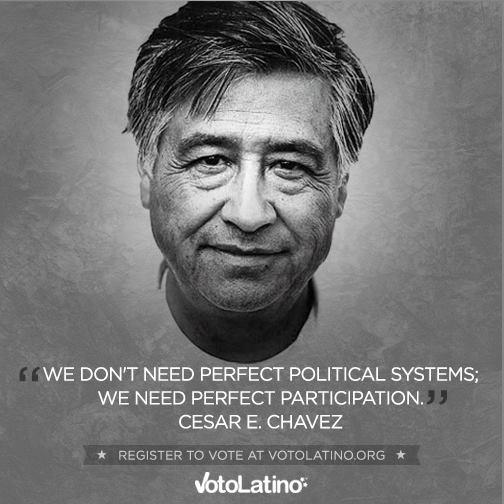
31 March 1927 – 23 April 1993
With the official start of the presidential election on this side of the border, and the interminable election season north of the border coming closer, a thought from today’s birthday boy:
The Table Dancer’s Tale: the real Mexico
Like Joanna van der Gracht de Rosado, whose “Magic Made in Mexico” Editorial Mazatlán published last year, Lupita Domínguez is a successful businesswoman, and keen observer of Mexican social customs and business culture who not only has a story worth telling, but a story she tells extremely well, and one worth reading.
The Canadian-born van der Gracht de Rosado’s had to carve our a business based on what skills she brought with her. The successful business she and her husband, Carlos, developed — Tecnología Turística Total — was a result not just of business acumen, but of a rare ability among expats to accept and learn to adjust to the Mexican way of things. Joanna initially self-published a book about her experiences, modestly focused on her own community, but… having recognized that there was a crying need for a more in-depth and comprehensive work, she’d completely rewritten and vastly expanded the original work, which, by sheer luck, came to our attention, and which we were honored to add to list of titles.
Lupita Domínguez, although a native-born Mexican, has also had to make adjustments in her outlook and assumptions if she was to succeed in her own career, as a service provider in the leisure industry.
Lupita Domínguez is an artist…a pole dancer. She has worked in various cities throughout México in the best—and sometimes not the best—table dance bars.
She learned English in Puerto Vallarta, México, and lived1 in the United States for a year to perfect her English and take a course in writing (and reading) as a follow-up to her first literary work.
Today, she combines her night job with a career in business administration and hopes to open her own bar in a Mexican port such as Manzanillo, Vallarta, Mazatlán, or Puerto Peñasco.
 That “first literary work”, like Joanna’s first book, was a self-published book. When Lupita, who was visiting family in Mazatlán stopped at our bookstore, to see if we might take a few copies for sale, we were immediately taken by her professionalism and seriousness. We mostly sell second-hand English-language “beach books”, but carry our own books, and a few local authors as well… but very few books in Spanish. Still, as a novelty, if nothing else, it seemed worth having a few copies of “Historías de Table Dance” available.
When I started to read “Historías” I had an “OH… MY… GOD!” reaction. This is not some lightweight entertainment, nor pure titillation, but a clear-eyed, no apologies look at some of the less flattering aspects of Mexican culture — gender roles, labor exploitation, sexual and physical abuse among them. And, in the midst of it all, love, tenderness, humor and solidarity.
Editorial Mazatlán, being Editorial Wisemaz’ imprint for “cultural studies”, was set up to publish just this kind of book. We took the unusual step of buying out Lupita’s contract (and the entire press run) from the original publisher. The printing and layout are not up to our standards, but the writing itself stands on its own as a original and valuable work. A primary source on the sex trade, one without the usual moralizing or theorizing normally found in such documents. But, as an English-language publisher, mostly distributing to the United States and Canada, we wanted to make this book available to English language readers. It deserved not just a good translator, but the right translator. After a lot of back and forth conversations with various translators I know about who might be up for this job, I realized I already knew the right person.
Sabina Becker, a well-known Canadian blogger, whose “News of the Restless” carries the slogan “Suck it, haters! Feminism rocks!” combines good humor, a dash of sexual innuendo and a goodly dose of righteous anger not only on sexual, class and labor issues, as well as Latin American politics. Having the good fortune to grow up in a multi-lingual household (she first learned Spanish from her mother’s old German language school texts) I couldn’t have found anyone better at ten time the rate we paid her (not that we had the budget for that). She has more than earned her quite reasonable fees and we’d be happy to recommend her to others needed quality translations in record time.
We’re still editing the translations, which is no reflection on Sabina, but part of the normal process… we normally go through five or six iterations with a text, and its unusual that on this work, we’ll only need two or three which I think is something of a record. With our book designer already at work, “The Table Dancer’s Tale” will be available for the general public by September. And, I should add, can be included (and SHOULD be included) on Fall Semester reading lists for courses in Latin American, Women’s or Labor Studies.
From the Introduction (copyright ©2011 Lupita Domínguez, English translation copyright ©2012 Sabina C. Becker)
In this book you will get to know the double standards of my beloved México, for though I love my country and am proud of my Mexican roots, I consider the all-pervasive culture of machismo and the double standards of México to be the true reason why so many young, beautiful, educated women end up with this kind of “easy job”.
How is it possible that our own mothers push us to work in the nightclubs? They, whose moral duty to their sons and DAUGHTERS is to give them love, protection, moral foundations and above all, to help them whenever they have problems, duck their heads and prefer to hide the problems just because of what people might say? Some of these women, whom the world by mistake gave the good luck of having children, dare to call their daughters whores—not prostitutes, but WHORES, which in México is the worst word we use when we want to offend, put down and insult a woman—when they live off them. Yes, week after week they go shopping with the money those daughters whom they call whores…and of whom they are ashamed…send them to buy food for those children and the good-for-nothing husband they have at home.
And, too, there are other “mothers” who prepare their daughters from an early age for this lucrative “work”. Stories of incest, in which the daughter, of course, is the one who is at fault. Abuses committed against girls by their brothers, which our mothers dare not report to the police out of shame about what they might say and because they might haul a beloved son off to jail. Fortunately, there are also stories with happy endings. Stories of girls who found love and the support of a partner in one of those so-called sin clubs. Enjoy, and please, mothers, support your daughters…love them…value them.
These double standards also include our “macho” Mexican men: fathers, brothers, uncles, buddies; who are all models of rectitude at home, but come nightfall, transform themselves, paying for dance after dance from us to show their friends what machos they are. Some even pay us to put our fingers in their anuses. Men who are brutes at home with their families but in the nightclub are the most splendid of gentlemen.
I have seen friends almost come to blows to pay the tab when they haven’t even gone home with their paychecks yet. Men who bring their sons to “debut” with the table dancers, while keeping their daughters at home to clean the house and wash and iron their brothers’ clothes. Because a good Mexican macho doesn’t wash clothes, doesn’t clean the house, doesn’t go grocery shopping…and doesn’t give good sex to his wife.
Ouch!
Gender bender
Like in a lot of countries, but not the United States, Mexican political parties have a mandated (or is that person-dated) gender quota. No more than 60 percent of the candidates for national office can be of the same gender. Not that it’s likely the majority will be female, so basically it comes down to meaning at least 40 percent have to be what Juanitajean would call “hooter toters”.
What complicates things is that Mexican legislative ballots include not only the candidate, but the “substitute” who steps into the job (should the candidate be elected, or appointed to a seat set aside for their party by proportional representation). The last legislative election, the Greens abided by the letter of the law, but not the spirit. Less an environmentalist party than the yuppie wing of the PRI (the “green” they seek being, it appears, yanquí dollars) , the Green female legislators all quit their first day in office, so their male substitutes could take their place.
It was a set-up of course, but the Greens were within the letter of the law. This year, maybe assuming that having a female presidential candidate was enough in the way of gender equity, the conservative PAN was arguing that by counting substitutes in their total candidate list, they met the required quota. That didn’t fly with the elections commission (IFE), and at the last minute, the party either “convinced” or simply stuck 44 male candidates from their candidate list. PAN and PRD (which was already in compliance) are running neck and neck in the polls for a distant second place finish in the elections right now, but wait… the PRI-Green ticket only is 20 percent female.
Given only 48 hours to correct the situation (or, possibly be disqualified), it looks like the two smaller parties in the leftist coalition (PT and Movimiento Ciudadano) … which also lacks gender equity are going to be able to meet the deadline, while PRI is going to appeal to the Elections Tribunal.
I rather doubt PRI will be stuck from the ballot (which would radically change everyone’s assumptions about this election), and legislative candidates normally don’t garner much interest (the legislative races being more a test of party organization than of anything to do with the candidates themselves), but this is another of those unexpected changes that could radically alter our presumptions about this race.
Although PRI has been seemingly united, like PAN and the leftist coalition, is a party of factions and “tribes” and competing interests. How much, behind the scenes horse-trading was done between these various factions that all cordially (and often not so cordially) hate each other is anyone’s guess. That PRI is stalling for time to find new candidates may mean that they are not as united as we think they are.
(UPDATE: As of Wednesday afternoon, PRI and the Greens came up with a new candidate list that meets the gender equity rules… so much for taking it to a higher court).
Oh, and for those who might be wondering: Diana Maroquín Bayardo did not make the ballot. She claims it was because discrimination against her status as a transgender, but her party’s selected candidate is female. Anyway, with only 48 hours to make changes, I don’t see any of the several parties stalwarts having the time (or inclination) to make the radical changes and sacrifices Maroquín did that would qualify them to overcome this particular hurdle to elective office.
I sold my soul to the company store…
Boy, you don’t see one of these very often any more…

…thankfully. Or do you?
It’s a 19th century Master Card: while it’s a little more indirect today, the whole point of labor management relations in 19th century Mexico was to keep workers in debt. This particular vale is for one load of firewood at the Hacienda Santa Cruz tienda del rey… meaning poor José Péon, probably received this in payment for working sunup to sundown, and — while he needed the firewood to cook his dinner, also needed to pick up beans and chiles at the tienda del rey… which, of course, he picked up on credit… at a “slight” markup to cover carrying costs … and then there was interest and compounded interest and… then as now “some restrictions may have applied”.
De-FeCal-ation
Jorge Zepada Patterson, one of Mexico’s best-respected, and best-informed “inside the Periferico” political analysts, muses in his Sunday column on Felipe Calderón’s fate after the transfer of power on December first of this year.
Zepeda points out that there is no question that Calderón could be facing very real criminal charges in international courts:
… there will be indictments connected to the 50 thousand dead and well documented disappearances of civilians. That is a fact. How these indictments are handled depends on the will of the incoming executive and judicial branches.
(my translation)
Zepeda points out that the Calderón Administration provided some support (mostly documentation) to Ernesto Zedillo, who faced merely civil charges in the United States over a single human rights violation charge (related to the Acteal Massacre). However, it would be difficult to tie Zedillo directly to the murders in Acteal (which seem to have been the work of local party militants, not necessarily under presidential control) and a Connecticut court wasn’t a likely venue to hear the case in the first place.
Zepeda thinks it is unlikely that Vásquez would pull something like the embarrassing Luís Echivierra’s successor, José López Portillo did — appointing the wannabe Secretary General of the United Nations to a slightly less visible position… as Mexican Ambassador to Fiji. On the other hand, given the likelihood that a Vásquez administration (assuming that’s even within the realm of possibility), would have to deal with a PRI dominated legislature, there wouldn’t be much the Presidenta would be able to do to support Calderón. Nor, given the fractures Calderón has caused in his own party over his obsession with the narcotics trafficking issue (notably the defection of Sinaloan senator and PAN staltwart, Manuel Clouthier) would it be politically possible for her to provide more than the informal support Calderón provided Zedillo.
Calderón might actually be better off if Enrique Peña Nieto becomes President. Whereas, Zepeda argues, a PAN president would need to keep the embarrassing FeCal under wraps (and as far away from Los Pinos as possible), PRI would want Calderón around as a bargaining chip, trading off protection for their former leader for legislative support of their own programs.
Should AMLO gain the presidency, Zepeda suggests Calderón not only have his bags packed, his passport handy and a visa for some other country in his pocket, but a bunch of lawyers on speed-dial.
I don’t believe that the Loving Republic’s Franciscan-style forgiveness is going to embrace the orchestrator and beneficiary “whatever happened, happened.”
(In other words, AMLO is going to get his revenge on the stolen 2006 election, or so Zepeda believes, despite AMLO’s statements this weekend that he would not be pursuing Calderón, and could live with him in the country).
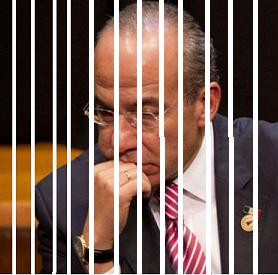 Among recent presidents, Diáz Ordaz, Echeverria, Carlos Salinas and Zedillo left the country after their term expired. Diáz Ordaz, at his own urging, accepting an appointment as Ambassador to Spain, side-stepping both personal difficulties over his presiding over the Tlatelolco Massacre and possible questions about Echeverria’s involvment. As it was, Diáz Ordaz was a very sick man, without long to live. Echeverria kept a low profile after his stint in Fiji. There were attempts to bring him into court during the Fox Administration, but the nascent truth commission that looked into the “dirty war” was never able to touch him, and was shut down before it ever really got off the ground. Given Echeverria’s advanced age (he is now 90 years old) he will never be called to answer questions about the “dirty war” of the 1970s, or his own role in the 1968 Tlatelolco Massacre, let alone stand in the docket.
One possibility, mentioned first by the Wall Street Journal, and considered plausible by Zepeda, is that Calderón — claiming that he is a target of narcos, will go to Brazil to work at a think-tank run by Brazilian ex-president Lula de Silva. This would put him far away, more or less protected by a foreign leader and “on ice” should the political climate change. Salinas hied himself to Cuba (and later Ireland), protected first by Fidel Castro, then by Irish banking secrecy laws (and quirky extradiction procedures) , where, under the radar, he was able to keep his hand in PRI politics, and make behind the scene deals, that probably will keep him out of court the rest of his life … unless of course, the unthinkable happens and AMLO is able to pull off an uncontested victory this time.
In that case, as Zepeda says about Calderón, but true also of Salinas, in the event of an AMLO presidency they are both “a la chingada“… fucked.
Pope-porri
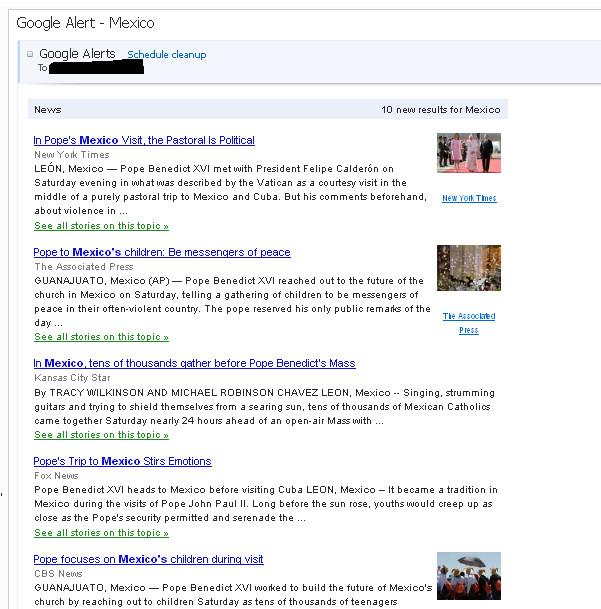 Despite what the foreign media are reporting (as my Google-search thingy might suggest), Mexico is not in the throes of Papamania by any means. Benedict’s visit has been on the front pages of the nation’s papers, but not top of the fold, nor has it dominated the news (except on television, and even there, it hasn’t been wall to wall, every channel coverage… my neighbors downstairs were watching cartoons). Nor is every church in the country Popified… going past Mazatlán’s cathedral this afternoon, there wasn’t any papal banner or indication that the head honcho was in the ‘hood, or that anything unusual was going on. I’ve been paying probably more attention to this visit than most, and have to say that the enthusiasm has been, if anything, underwhelming.
I wonder if foreign media (and many of our own foreign commentators on Mexico) haven’t presumed that because the country is about 80 to 85 percent Catholic, that means 80 to 85 percent of the people care one way or another about the Pope.
While even the Church had lower expectations for the welcome Benedict XVI would receive compared to that granted the “rock-star Pope,” John-Paul II, I think there may have been a huge miscalculation in how “Catholic” Mexico is on the part of the media and Curia.
The warm reception given to JPII may have been an anomaly… John-Paul having shown up just as two very important changes were taking place. First, the Mexican state was ready to relax the more onerous restrictions on religious observances and, second, as the Church was becoming more accepting of multi-cultural and multi-ethnic variations among the faithful.
Mexico’s Catholicism has always been described as “syncretic”: the mixture of folk religions and older faiths have fascinated outsiders for centuries. That seems to be more an accident of history than anything: the Americas coming into the Catholic fold late in the history of Christianity (which, after all, had blended in everything from Iranian Mithraism and Roman and Greek philosophy to various Germanic and Celtic folk-beliefs into a body of customs and practices) did not fit easily into the pan-Euopean assumptions about how Catholicism worked when the Council of Trent wrote the “standard operating manual” for the faithful.
Given the uncertainty of communications and travel until the mid 19th century, it’s not surprising the Mexican Church largely went its own way. Rome was even further from Mexico than Madrid, and Mexican elites didn’t always pay attention (or give much thought) to what the colonial masters said. When they did, it was usually because it matched their own interests. The Church was never able to enforce the new rules in the Americas. Not only was much of Mexico was beyond their easy reach, and the lower clergy who might, or might not regularly visit isolated communities, included many whose own understanding of their faith included those syncretic, and idiosyncratic Mexican folk beliefs.
At any rate, until the late 20th century, communications between headquarters and the regional offices here wasn’t always that clear, and what the Pope said — or who he was — didn’t always register. It was only in the late 20th century, with the reforms of the Vatican Council that Mexican Catholicism was accepted into the mainstream, and communications and transportation made Papal pronouncements — and visits — relevant. John-Paul II’s rock star status here, while due in good part to his own personal charisma, had a lot to do with just the fact that a more conservative government which needed clerical support had come to power (from Salinas onward) and the Papacy was seen as a bulkward against leftist trends within Catholicism that threatened the new elites of the neo-liberal age. The biggest supporters of John Paul were not the clergy, nor the state, but Televisa, after all.
I don’t know how much the State of Guanajuato spent preparing for the Papal visit, but the state Secretary of Tourism was hoping the three day visit would bring 900 million pesos. However, while the big event — the papal Mass this afternoon in León’s Parque Bicentenial drew a crowd of 300,000 according to Reuters, and between 400 and 500 thousand according to other news reports (perhaps including people just hoping for a glimpse of Benedict), there’s no indication of how many of the faithful were staying in Guanajunto State, and how many just bused (or drove) in for the day. León is only a short drive from Guadalajara, and the old “Cristero region” extends far into Jalisco and Michoacán, both of which border León. Tracy Wilkinson of the Los Angeles Times was reporting on Friday that campgrounds for the expected throngs were “virtually empty” on Thursday, but were filling up Friday.
And, it might be added, that while a half million people is a very large crowd, the papal visit was being pushed by what is said to be the most powerful institution in Mexico (I mean Televisa, of course), which has created larger crowds for political events, although those were in Mexico City.
It also has to be noted that not everyone who came to see the Pope came to cheer him. Besides those seeking an audience for specific grievances against the Church (victims of Marcial Maciel’s Legoinaries of Christ prominent among them, but also women’s groups bringing attention to Guanajuato’s draconian anti-abortion laws, gay and lesbian organizations and various anti-clericals, anti-Catholics and Marxists) there were those who simply came because they had to be there… like PANAL presidential candidate Gabriel Quadri, who apparently sat through the Papal Mass twittering away…

I’m sure there are some who are concerned with recycling the water bottles left behind by the faithful (and are clean-up costs, as well as the value of the recycled plastic, factored into the 900 million the Pope is supposedly generating for the state economy?), but of course, the impact of a Papal visit isn’t measured in terms of economic activity or in numbers of “hits” his visit registers.
The polemical nature of the Pope’s visit, coming as it does just as the pro-clerical party is expected to be turned out of Los Pinos and the traditionally anti-clerical PRI is openly courting Catholic voters, coupled with lingering questions about the role of the Church in Mexican public life, makes what was said and done much more important than the number of people who saw or heard what occurred. That Felipe Calderón did not kiss the Pope’s ring might not be all that important (although it avoided a public relations gaffe that Vicente Fox was never able to live down) … whatever the Pope and Calderón spoke about privately on Friday is.
Supposedly the two discussed the “drug war”… but if one thinks the Pope may have been lobbying for changes in the Constitution that would allow denominations to own media outlets and openly participate in politics, you wouldn’t be alone in thinking that. As it was, the Pope’s public pronouncements… mostly condemning violence and materialism were bland enough that even Lopez Obrador was able to say… “see, he agrees with me.“
Thou shalt take the bus
Blessed are those who take public transportation.

Mexico City based photographer Keith Dannemiller caught this trompe-de-oeil in León last week. There was a poster on the side of a church behind the bus, but maybe it will convince at least some to take the bus rather than tie up traffic. You never know who you’ll encounter in your travels, and besides saving on gas, maybe there’s a plenary indulgence in it — a different kind of savings.
I’m sorry, so sorry

After wreaking havoc across Guadalajara … the Cartel de Jalisco Nueva Generacion (CJNG) has left messages across the city apologizing to local inhabitants.
“We ask forgiveness for the events of last Friday. It was just a reaction to the capture of our associate from the CJNG. We are dedicated to our own affairs, and caring for and maintaining the tranquility of the state of Jalisco,” read one of the “narcomantas” (narco messages).
Nice to see our criminal class has the good manners to admit when they’ve … uh… gone beyond the boundaries of acceptable social misbehavior. Ok, boys… just don’t let it happen again:
She fought the law, and the law won… for now
Joanna van der Gracht de Rosado (“Writing From Merida“) has a much better, and more succinct overview of the Florence Cassez affair than I could write, so I’ll just cut and paste from Joanna:
Florence Cassez…is a French citizen who has been convicted of taking part in kidnappings in Mexico with the Zodiacs… She has denied involvement in any crime.
But three of the Zodiacs’ victims who were liberated at the time of Cassez’ arrest: a mother, her child and another child testified that she was one of their captors. She was convicted and sentenced to 60 years.
Since her arrest in 2005 she has repeatedly demanded that she be repatriated to France on the grounds that her civil rights were violated by the Mexican authorities. (PGR) This is true, the authorities did everything wrong.
As things stand now, Cassez’ 60 year sentence has been upheld by the Supreme Court, but a new panel of judges will rehear the evidence.
Obviously, it was a huge error for the PGR to re-stage the police raid which nabbed Cassez and her fellow deliquents for the benefit of a television news crew (and for the propaganda value it had for the “tough on crime” administration) , and it should have been questioned by the court, but I can’t see that it changes the fact that Cassez was identified as a kidnapper, and that evidence tied her to a very serious crime — one, I might add, that many feel merits a restoration of capital punishment.
What does seem serious to me — and makes this a more than Franco-Mexican issue — is that Cassez was denied consular assistance at the time of her arrest. Mexico has been complaining about lack of consular assistance for its own citizens arrested in the United States. Despite international court rulings that held the United States at fault for such failure, the Federal government was unable (or unwilling) to stop executions of Mexicans denied consular assistance in Texas.
Joanna’s post (and the comments) are well worth reading. She is, quite naturally, on the side of the victims… seeing justice is not being done in reviewing Cassez’ case. I tend to agree that this is a slap in the face of people who were already traumatized by Cassez and her gang, but also realize that by accepting the need for review, Mexico is … in a roundabout way… seeking to preserve the moral high ground in demanding consular assistance for her own citizens abroad.
What makes this incident so maddening is that, unlike the Mexican cases in the U.S., where there was never a question of guilt, but only of adequate counsel (something consular assistance is supposed to assure, or at least make more likely), the French seem to suggest that Cassez is innocent, or that she deserves “special rights”… because… she’s “white”, or she’s a she, or because simply because she’s French, ergo not to be judged by mere Mexicans.
Are these political, racial or justice issues? All of the above. In a perverse way, this is the other side of the coin of the Treyvon Martin shooting in Florida. Despite the rather pathetic attempts to portray the killer, George Zimmerman as “Latino”, and therefore not personally racist, there is no one can seriously claim that politically important killing doesn’t have racial overtones, and the incident wouldn’t have occurred (nor would it have been international news) had Zimmerman not been seen as a member of a specially privileged class*.
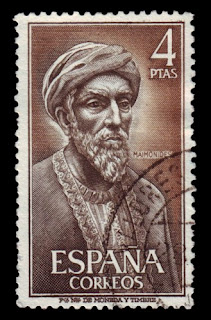 Much as I am fond of the quote I attribute (perhaps mistakenly) to the father of Hispanic legal thought, Moises Maimonidies, to the effect that it is better ten (or 99 or some other number) of guilty go free rather than one innocent suffer, perhaps I need to go with an authentic quote, from Guide to the Perplexed:
“You must accept the truth from whatever source it comes.”
The truth is that law cannot always provide justice. The apparent legality of Zimmerman’s shooting a kid armed with a bag of candy and an iced team, is really no different than Cassez’ claims that she should not be held responsible because of procedural errors. The truth, which we may not wish to accept, is that nowhere does the law NOT grant special rights to some and not others. It is not justice, but — in both affirming the original sentence and in re-opening the case, the Supreme Court is at least trying to create as balanced a decision as imperfect human beings can. imperfect humans.
* And note that, for purely legal reasons, I can’t do justice to Treyvon Martin and use the words one should use: like “murder”, “crime”, “injustice”.


 mexfiles.net