¡Yo soy el Juan Porciento!
With Presidential elections in both Mexico and the U.S. this year, why not…
In León there is no beer…
 EFE is reporting (via SDPNoticias) that the León, Guanajuato city government is banning liquor sales within two blocks of the route that will be taken by the Popemobile during Benedict XVI’s stay in the city 23-26 March.
I thought Pope Ben was a German, which makes it sound as if he’s unwelcome.
My lyrics, music provided by the great Flaco Jimenez…
In León there is no beer,
When Pope Ben comes here…
So best not get too near,
if you want to be drinking any beer.
Biden our time while we hope for change
Mexico is the United States’ closest Latin American neighbor and yet most U.S. citizens receive little reliable information about what is happening within the country. Instead, Mexico and Mexicans are often demonized in the U.S. press. The single biggest reason for this is the way that the entire binational relationship has been recast in terms of security over the past few years.
So wrote Laura Carlson back in 2009, when I commented that she “she still puts faith in the Obama Administration’s willingness to reorient its policies towards Mexico and Latin America (which I tend to doubt will happen).”
Her entire article, Perils of Plan Mexico: Going Beyond Security to Strengthen U.S.-Mexico Relations (still on the internet at ZNet) and perhaps my comments on Ms. Carlsen’s analysis of the U.S. proxy “war on (some) Mexican drugs” are unfortunately still a valid critique even in 2012. Perhaps more than ever.
The Bush announcement of the three-year Merida Initiative in October of 2007 extended U.S. military intervention in Mexico from this base. The plan is dubbed a “counter-terrorism, counter-narcotics, and border security initiative” although it’s the war on drugs that has received the most attention… what it does is ensure an expanding market for defense and security contracts, in an undeclared war that has no exit strategy in sight.
Now being into year five of that “three year plan” the only change I can see from the Obama Administration is that it wants to expand the “war” (or, perhaps the war profiteering opportunities for U.S. businesses) and is even less reluctant to intervene in Mexico and the Central American states for political ends than the previous administration.
I had some hope that this year’s U.S. election would give Mexico a chance to hold its own Presidential elections without Tio Sam looking on (and, who knows, maybe tipping the scales, as many think it did in 2006… “Plan Merida” being part of the political damage control). But, the Obama Administration, having either bought into the narrative of the right wing that Latin Americans somehow pose a danger to the U.S…. or believing that this is enough of a domestic political issue to warrant giving into the right-wing prescriptions, or maybe actually believing in the rightist narrative that the U.S. drug addiction problem is our problem (sort of like blaming ones alcoholism on a neighborhood liquor store), is not in the least interested in reorienting its policies towards Mexico and Latin America
.Rather, having found itself in a hole, is digging deeper… and sending Vice President Joe Biden to do the digging. As the perceptive Ms. Carlsen posted on Monday:
Vice President Joe Biden landed in Mexico City last night and he’s left little doubt about his mission—to lock in the regional drug war. His visit comes at a time of mounting calls to end prohibitionist laws and the drug war model.
Although Obama’s spokesman on Latin American affairs, Director for Western Hemisphere Affairs, Dan Restrepo, used the always popular word “dialog” for Biden’s discussions with Mexican presidential candidates, the imcumbent and the presidents of the Central American republics (including Honduran President Porfirio Lobo, who despite owing his position to the Obama Administration’s backing of the coup and the fraudulent election that put him into office questions the effectiveness of the “drug war”, and its aims).
But,
A dialogue on how to “be most effective in confronting transnational criminal organizations” must start from the recognition that the current U.S. strategy has increased violence, done nothing to reduce crime or illicit drug flows and had a devastating impact on “people’s daily lives and daily routines” in Mexico and Central America.
A real discussion on effective strategies has to include the option of legalization. The Obama administration seems determined to block that option, despite a growing number of calls for discussion on legalization that include former presidents of Brazil, Mexico and Colombia and current presidents Santos of Colombia and Perez Molina of Guatemala.
Biden is just the latest envoy in U.S. diplomatic offensive to bolster the drug war. On Feb. 27, Homeland Security Secretary Janet Napolitano was in Guatemala with the same message. “The United States does not view decriminalization as a viable way to deal with the narcotics problem,” she told Perez Molina.
There was no dialog. As Tim Johnson (McClatchy Newspapers) writes:
Vice President Joseph Biden said Monday that “there is no possibility” that Washington would heed a growing call by some Latin American presidents to move toward drug legalization.
Biden, on a two-day swing to Mexico and Central America, said a sour mood over violence from powerful narcotics mafias has led to a desire in some corners of Latin America to debate legalization.
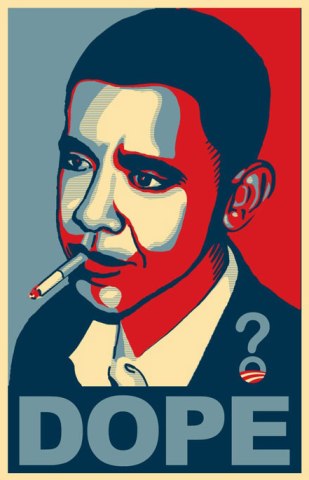 Never mind what Latin Americans want. I found it amusing that Biden fretted that legalization would, among other supposed ills, 2ould “even create bureaucracies for drug distribution.” Actually I think that’s a good idea… bureaucrats may take bribed or pad their budgets or steal office supplies, but seldom do they put out hits on their departmental rivals or get into firefights with the army and leave hapless civilians to be written off as “collateral damage.”
Honestly, I don’t care much about drug legalization one way or another… while it might reduce violence (peace through bureaucracy is as good a way as any though), what I note is the assumption that the big ideas that got Biden and Obama their jobs in the first place — “Hope” and “Change” — aren’t applicable south of the border.
El País, the generally conservative Spanish daily’s International Edition had the first results from a poll by Demotecnia. While pollster Maria de las Heras is only discussing presumably middle-class Mexicans, it’s clear that what is on those people’s minds is change… 74 percent of respondents say Mexico must change.
Nearly half see no change, no matter which of the major candidates is elected president (PANAL’s Gabriel Quadri, who realistically has no chance of winning more than a fraction of the presidential vote, was not included in the poll). Voters see PRI as most likely change (34%), and a third of those who believe PRI is the mostly likely to bring change, a third believe the change will be positive for the nation. Another third believes the PRD candidate is most likely to bring change, although only a quarter of them think the change would be positive overall. The PAN candidate’s numbers were not that far behind (26% and 30%).
With over half of respondents seeing the economic and security situation deteriorating over the next six months, change, and which of the candidates who best gives hope for change is likely to determine the outcome of the election. Although the voter nullification movement is likely to also affect the outcome (and perhaps those who don’t see change coming from the ballot box will have a larger effect on this election than has been assumed), what is more likely to short-circuit the hopes for change by Mexican voters is the same crew that came in to Washington four years ago (and more than probably will still be there for another four years), promising “hope” and “change:”
This would make a good Borges story
Wait a minute… this IS a Borges story!
Mystery shrouds an old greeting card tucked away in a dog-eared copy of Plato’s Republic that belongs to Toronto’s Agincourt District Library.
 Handwritten in Spanish, the card is addressed from famed Argentinean author Jorge Luis Borges and it appears to carry his signature and a cartoon doodle.
…
The note, dated June 14, 1978, says: “Thank you very much for your great welcome and reception. I wish you the very best success with your library and its marvellous collection of books,” according to Maria Figueredo, professor of Latin American literature at York University.
Signed “All the best,” the card’s signature matches a reproduced image of Borges’ signature in one of his books, claims Choquette. He adds that he found nothing in the library’s archives that mentions a visit from Borges to the Agincourt library. In 1978, the branch was located in nearby Agincourt Mall at Kennedy Rd. and Sheppard Ave. E. in Scarborough.
The question remains: Was Borges at Agincourt library?
Asi la vida: Expo Sexo 2012
Is it voyeurism?
Is it something like a ‘table dance’?
Is it a giant ‘sex shop’?
The public flocks to the Palacio de los Deportes in Mexico City, perhaps seeking an answer to these questions, but wanting to see everything.
There is not a single sign saying “do not touch”. On the contrary, one seems to be invited to do so.
SDPNoticias DEFINITELY NOT SAFE FOR WORK (unless you work in the sex trade, por supuesto) videoreport muses about the meaning of an event that we tend to think of as somehow alien to our perceptions of the “real Mexico”, but certainly part of real human life.
Good death
José Gil Olmos. La Santa Muerte: La Virgen de los olviadados (Debolsillo, 2010) 192 pp.
Santa Muerte — the Holy Death — is best known north of the border (and presented in the Mexican press as well) as the “Narco death cult”. I’ve always been somewhat fascinated by the Santa Muerte phenomenon. While I see nothing odd about having the White Lady in my office, admit that at least in part the fascination is a return  to early adolescence, when one is fascinated with Dracula movies, and Edgar Alan Poe (T.S. Eliot said “Poe appeals only to adolescents… the very bright ones”).
Of course, at my age, and given what I do for a living, my Santa Muerte could be passed off as just a souvenir, a memento of a mature interest in the syncretic belief systems common in Mexico. I have written on those beliefs (and on Santa Muerte) from time to time, and at one point considered translating Proceso reporter Gil Olmos’ book… which I’d still dearly love to see in an English edition. although I don’t think I’m the one to do the translation.
Or perhaps my little santito represents something more profound. To write intelligibly on Santa Muerte as a modern belief system means understanding not just the undeniable fact that Catholicism and Indigenous beliefs mixed in sometimes surprising ways, but understanding that besides the syncretic (and idiosyncratic) beliefs in this country, “mainstream” Catholicism is less a struggle between Liberation Theology and the reactionaries, but between the modernists and the 16th and 17th century beliefs implanted by our early missionaries. Especially Catholicism as presented by the Franciscans.

Memento mori over entry to Cuernavaca Cathedral
I’d been familiar with the early Franciscan churches here in Mexico, with skulls and crossbones iconography… always seeing them as a memento mori — remember you must die — i.e., a visual reminder that you are mortal, so stay humble, and nothing more. Which they are, but what I hadn’t considered was how obsessed those early Franciscan friars were with the nagging thought that the “discovery” of the Americas might be a sign of the impending Apocalypse. After all, popular belief had it, once the world was converted to Christianity, the conditions would be ripe for Christ’s return. And, at the same time the Franciscans were busily (and apparently, rather successfully) converting the heathens of the Americas, the Muslims and Jews of Spain were being forcibly converted (or at least driven out) and… Catholic missionaries had begun work in Asia. The crucifixion in Nagasaki of the Mexican Franciscan, San Felipe de Jesus, in 1597 was simply the price one paid to pave the way for the Second Coming. As would be the devastation of the Four Horsemen of the Apocalypse — Conquest, War, Famine and Death.
Obviously, Christianity came to the Americas through Conquest (on horseback, no less), and War. Famine and Death went hand in hand, as the native peoples died of exotic diseases like smallpox, and there weren’t enough farmers to feed the people. One can see how the Franciscans, coming from Spanish seminaries where the “end times” beliefs were especially strong, could be inured to the images of devastation, and even take comfort in them.
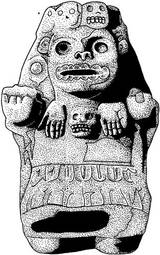 Of course, Europe having just come through the Black Plague, the image of Death was a common one in art… including sacred art, and found its place in the American churches, often built on the stones of temples that had been adorned with skulls and bones and Christian iconography recognizable to everyone as Mictecacihuatl, the Aztec goddess of death.
The Aztec Death, Mictecacihuatl, was a welcome — at any rate, unavoidable — presence. Mictecacihuatl was the hope of the future… she kept the bones that would be needed for a future rebuilding of the human race, and, as a goddess who had died (giving birth), represented a hope for a life beyond the grave. Jesus’ death, too, promised a new life, and held out a hope for resurrection… in the Christian mind, a personal one.
The European death, the Fourth Horseman of the Apocalypse, was not necessarily a figure to be feared either…. a harbinger of the “kinder, gentler” d eath of the Franciscan (and larger Catholic) tradition. The “good death” that Gil Olmos also sees in Santa Muerte… the hope for a “good death”. In the U.S., death (of humans — and even animals) generally takes place out of sight, out of mind. It’s rather sterile, and best not thought of, except in the abstract… here, it’s up front and real (one reason, perhaps, Mexicans mock death, and one reason the foreigners find some of the Church art so “creepy” if not gross (I was in Guadalajara Cathedral recently, where there is a representation of Jesus in the tomb… an obviously dead Jesus, which my friend found extremely disturbing).
The “rich countries” seem to have lost the belief in the “good death”… and cannot fathom the acceptance of the inevitable, assuming such acceptance is fatalistic or sinister. Santa Muerte and the older Catholicism saw death as nothing to be feared, being something we all have to face, although we hope it will be benign. Certainly, those in violent trades (like narcotics traffickers) who risk not dying in their beds, and being yanked painfully and suddenly from this life, are likely to find comfort in such an idea… but then, among those who simply recognize death as a likely companion to their daily life have the same hope.
The circular firing squad
Paul Imiso, “The Mexican Election and the Split on the Left” (Upside Down World, 2 March 2012).
AMLO’s “radicalism” was all in his fiery, anti-imperialist rhetoric; his actual policies were social democratic at worst. But given the way that such rhetoric ruffled feathers six years ago, his 2012 campaign looks set to be a far more cautious affair; courting the mainstream media, dropping the phrase “mafia of power” (used to describe the PAN-PRI hegemony) from his speeches, and making visits to the US and Spain to reassure investors that a “left-wing” Mexico would still be open for business.
Whatever one may think of AMLO’s style as a politician, he has  rarely changed his stance on key issues and often deliberately taken views that are unpopular. In 2006, he left office as Mexico City mayor with an 80% approval rating, and his record in tackling poverty, crime and inequality in the capital was praised by both Left and Right.
Yet although AMLO has fought for progressive governance in Mexico for nearly three decades – as a PRI dissident; as mayor of Mexico City; twice as presidential candidate – he has routinely failed to win the support of key figures on the Mexican Left.
I don’t completely agree with everything (I never do), but well worth reading.
Why is this good news?

Why is this headline NOT bad news?
The United States Constitution rather vaguely mentions that the Federal Government cannot favor any particular sectarian belief (Amendment 1), added in 1791, and in 1870 added that voting rights could not be denied on the basis of race, color, or previous condition of servitude (Amendment 15). The franchise was extended to women in 1920 (Amendment 19), but says nothing about other forms of discrimination. Of course, the U.S. Constitution is not so much a social document, as an outline of the Federal Government’s role, and a check on certain activities and the United States does have various anti-discrimination laws at various levels of government, some more inclusive than others.
The Canadian Charter of Rights and Freedoms, promulgated in 1982 does reflect more modern social thinking, spelling out that persons are “equal before and under the law without discrimination and, in particular, without discrimination based on race, national or ethnic origin, colour, religion, sex, age or mental or physical disability”
Mexico’s Constitution of 1917 was a social document, and — having been written originally as a blueprint for society as much as a political document, has been radically altered over the years. Ten years ago, Mexico rewrote Article I (which initially only mentioned that slavery was illegal in the Republic, something going back to the original Constitution of 1824) to include the following:
Discrimination based on ethnic or national origin, as well as discrimination based on gender, age, disability of any kind, social status, health condition, religious opinions, preference of any kind, civil state, or any other reason which affronts human dignity and works to deny or restrain an individual’s priviliges and immunities is prohibited.
Mexico’s record when it comes to protecting human rights is spotty at best, but what a magnificent and inclusive statement of those rights!
That there is still discrimination is not the focus of El Universal’s front-page story yesterday, but that the number of complaints to the Consejo Nacional para Prevenir la Discriminación (National Council for Prevention of Discrimination, CONAPRED) have skyrocketed. That the largest number of complaints are about discrimination based on “preference” (specially discrimination against GLBT individuals). Complaints about discrimination against the physically disabled nearly equal those filed alleging discrimination based on sexual preference, followed by allegations of discrimination based on health condition, gender, physical appearance, pregnancy, social condition (which could be either financial or marital status, although the latter is usually referred to as “civil state”), national origin, ethnicity and opinions.
But think about it. More complaints don’t mean more discrimination… but less tolerance for discrimination. One of the extremely bright spots in Mexican human rights is that the complaints are coming more and more from the lower social classes… as CONAPRED President Ricardo Bucio notes, especially with regard to GLBTs discrimination occurs more in the low socioeconomic status and lower educational level, and “as with violence, those who suffer the most are more likely to commit the acts themselves.” In addition, at least with respect to GLBT, the culprits are much more likely to be persons over 60… meaning that discrimination based on what the Constitution calls “preference” is less and less tolerated by the educated, the middle class and the not-yet-old.
Bucio cites several examples of what I would call self-justification when it comes to discrimination… storekeepers refusing entry to a person with a service dog (supposedly to prevent the dog from causing problems), or school administrators “suggesting” the different child should apply to another institution. Or, simply thoughtless… Bucio mentioning a case in which a single mother was not invited to the Parents’ Day activities at her child’s school.
Of course, Bucio sees a need for CONAPRED to have the power to sanction administratively or though the penal system those who discriminate, but the growing number of complaints (expected to double this year) means that affected citizens are becoming aware of the rights, and that affronts against human dignity are not something that can be brushed off as simply part of the “real Mexico”.
Greetings!
There were two drawing last week in Mexico City — one to pick a letter of the alphabet and one for a month of the year. “S” and December.
In something of a cross between a military draft and empaneling a jury, IFE (the elections commission, which is part of the federal judiciary), has to find the people who hand you a ballot, who check voter registration, hand out ballots, ink the voter’s thumbs, and count the ballots, somewhere… everywhere. That’s a lot of people, and depending on parties (as is done in the United States) might not be feasible in a multi-party state, where one party or another might not have any voters willing to identify themselves as members in any district, or — like in the U.S. — you have to hope the one poll-watcher you’ve depended on for the last thirty years doesn’t croak. And, given the track record of Mexican elections, depending on parties to safeguard electoral integrity isn’t all that smart. Nor is it in the U.S., but that’s another story.
So… while not a perfect system, IFE drafts a pool of poll-watchers… this time voters with a last name beginning with the letter S and a birthday in December, then IFE workers fan out to call on the pool to weed out those that can’t do the job (besides some minimal data entry skills and reading ability, being physically able to suit up and show up are about all that’s needed) … Uncle José is calling you.
3 de Marzo de 1938
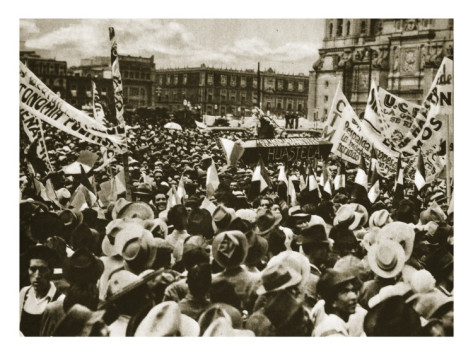
Celebrations in Mexico City following the Lazaro Cardenas’ nationalization of the oil companies.
Viva PEMEX… so what if it’s not run like an oil company should be or doesn’t get the return on investment that an oil company is said to require … it’s not an oil company, it’s a cash center for the state (and provides a lot of the basic services the state would otherwise have to provide directly, or which “private enterprise” would provide less equitably).
Come to think of it, no reason it HAS to export oil anyway.
Brain eating bugs!
Our greatest enemies were not the snakes or the heat and humidity. Our greatest enemies were the bugs! There seemed to be hundreds of varieties of them and they tormented me day and night. They crawled into my paint box and onto my palette. They got in the food and the water, into our hair and into our clothing. The cockroaches were the most revolting; they were clever and fast and hard to kill. The rhododores molested us during the day and covered or bodies with hundreds of little red craters. Their bites sapped our stamina, causing a newcomer such as Gary to become lethargic.
The chaquistes are the chiggers of the jungle. They started their daily torment at dusk and continued all night. They were almost invisible and managed to penetrate even the most closely-knit nets. Between the cockroaches and the chaquistes, there were the varieties of flies, spiders, caterpillars, worms and many other creatures.
The most dangerous was a fly called Mosca de Chicelero: its bite causes a deterioration of the flesh similar to leprosy. The worm, Cormollote, lived in the forest and falls on the traveler, burrows through the skull and into the brain, killing its victim. The tarantula and the scorpion were also present but we had only seen one of each. Some of the spiders were three inches around and as poisonous as the scorpion. Some of the caterpillars were poisonous; their bites caused great pain but are not fatal.
Oh what fun! Editorial Mazatlán has taken on the somewhat daunting task of publishing the Mexican and Central American journals of explorer and artist Dimitar Krustev, a Bulgarian artist who emigrated to the United States in the 1950s, and — fascinated by the indigenous peoples of the Americas — became one of the last of the great jungle explorers. In 1968 he became the first person known to have successfully navigated the Uscaminta River on the border of México and Guatemala from its headwaters in the Guatemalan Sierra Madres to the Gulf.
There is an overwhelming amount of material, and we’d be overjoyed to partner with a university anthropology department, or ambitious PhD student looking for a doctoral dissertation. For right now, our more modest goal is to get into print a small journal Dimitar kept of his adventures with a Lacondon Mayan community during the rainy season in 1969.
Being a visual artist, and not a writer (and having English as a second language), Dimitar’s self-published notes aren’t always in standard English. John Kirsch had the task of clearing them up enough to edit (and did an excellent job), so now I’m having a great time fact checking and straightening out some of the Bulgarian-flavored English phonetic spellings of Mayan words.
Mention of a missionary’s name had me calling the Wycliffe Bible Society this morning. Suprisingly enough, the person answering the phone knew the missionary (Phillip Baer, who wrote extensively on the Lacondon, while — in Dimitar’s view — undermining their society and culture) and I’ve been reading up on Latin American entomology. The “disease like leprosy is “Leishmaniasis”, carried by female mosquitoes of the genus Lutzomyia, but that was too easy to track down, having been mentioned recently in a Villahermosa newspaper.
But … oh what fun… the brain-eating bug was spelled right, but try finding out anything about the critter. I really had to bore through the internet, before I found the elusive Cormollote, buried in a short article in February 10, 1900 British Medical Journal written by Frederick C. Kayt, Assistant Colonial Surgeon of British Honduras (“A Case of ‘beef Worm’ (Dermatobia Noxialis) in the Orbit”). It wasn’t nearly as alarming… the critter having only eaten his way into an eyeball. And by the way, he’s not a bug, he’s the larva of Drmatobia noxialis, a kind of bot-fly. Which kind of redeems things: eyeball (and possibly brain)-eating maggots put Cormollote near the top in anybody’s list of gross jungle creepy-crawlies.
Writing footnotes and fact checking… before we start editing. What better way to spend the day when you live in a tropical sea-side town? Besides, the internet eats enough of my brain.

Jimi Hendrix Mexicano?
A kid’s gotta start somewhere… ¡Practica! ¡Practica! ¡Practica!


 mexfiles.net