That sucks!
 Reuters’ Andrew Quinn reports:
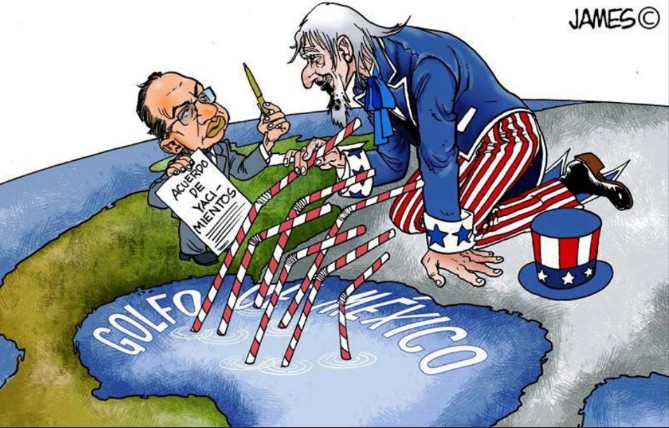
Mexico and the United States signed an agreement on Monday to help U.S. firms and Mexican oil monopoly Pemex exploit deep water oil resources in the Gulf of Mexico that straddle the countries’ maritime boundaries.
The deal, negotiated last year, will lift the moratorium on oil and gas exploration and production for 1.5 million acres in the Gulf and sets up legal guidelines for companies to jointly develop any trans-boundary reservoirs.
“These reservoirs could hold considerable reserves … but they don’t necessarily stop neatly at our maritime boundary. This could lead to disputes,” U.S. Secretary of State Hillary Clinton said at a ministerial meeting of Group of 20 nations in Los Cabos Mexico. “The agreement we are signing today will help prevent such disputes.”
Both the U.S. Senate and its Mexican counterpart have to approve the agreement before it goes into effect.
Interior Secretary Ken Salazar called the region an “area of high interest” to oil companies.
As you’d expect, at least some quarters (mostly on the left) are already comparing Calderón to Santa Ana… and not in a good way. The sense that Mexico’s mineral and other wealth is being given away at a fraction of its value has always resonated with both nationalists and leftists (not always overlapping categories). The cartoon at the top happened to come my way via a pro-AMLO facebook page … with unflattering comparisons between Calderón and Santa Ana among the more printable remarks posted about this agreement.
While I am dubious of the proposition that U.S. privately owned oil companies are the only (or the best) partners for PEMEX … or even if PEMEX necessarily needs foreign partners… or even if it is necessary for Mexico to sell oil to the United States (the existing reserves would more than meet domestic needs here, and allow for expanded manufacturing, although it would require a major overhaul of the existing tax system), there are good arguments to be made for resolving the questions of which country has the right to exploit these oil reserves in that “area of high interest”. And, being a country with a lot of oil and a crappy army, there’s every reason to avoid things that could “lead to disputes” with a country that has invaded here three times, and has occupied other oil rich nations under the rubric of “fighting terrorists”. Especially when the speaker, Mrs. Clinton, has used the term (“terrorist”) to describe those entrepreneurs who supply yet other commodities the United States uses in an appallingly larger percentage than the rest of the planet.
I am not yet ready to make any predictions about this agreement, but expect there will be resistance from the Mexican Senate, and — depending on which party seems most likely to accept the agreement with the least onerous restrictions on those U.S. based private corporations — more suspicion of U.S. political interference on behalf of that party in the upcoming election. The suspicion coming, of course, from those that will be making an issue of the agreement, i.e., the left.
Benito Juarez re-loaded
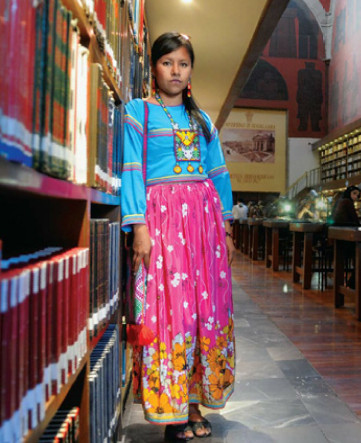
Aukwe, photo by Eduardo Loza, DR Emeequis
Threatened for centuries by outsiders, and presently by both Canadian mining operators, commercial agricultural farms and tourists, the Wixárika people (called Huicholes in Spanish and English, although the people themselves find the term insulting) have — as indigenous Americans find they have had to do so often before — adapted the superior opponent’s weapons and tactics to their own needs.
Through Proyecto Niuweme, forty of the most promising young Wixárikas have volunteered to go behind enemy lines, into a strange world where even food and water are considered commodities to be paid for with money,and where people live cheek by jowl, separated from the natural world. The forty are enrolled in the University of Guadalajara Law School.
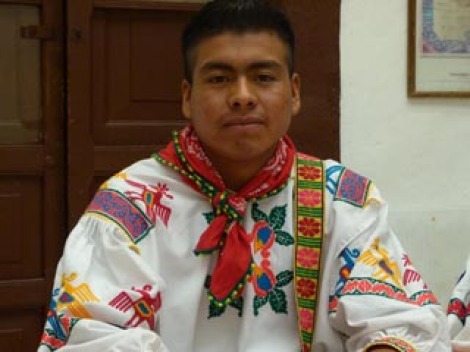
Photo: Maricarmen Rello, Milenio
Unlike Juarez, who had to sought to overcome his Zapotec lineage, Wixárika like Auke (aka Sofia Garcia Mijarz), have no intention of abandoning their traditions. For now, as Esiekame (Librado Benítez de la Cruz on legal documents) pointed out to Tataina Mallard of Eme-equis this creates some difficulties. Although the Proyecto Nieuweme students are among their people’s best and brightest (and, as far as the outside world is concerned, best educated), only the community’s authorities can speak on the magazine that only the community leaders are “authorized” to speak on behalf of the people as a whole, and the students are not leaders, nor do they have the age and traditional experience to become leaders… yet.
Juarez, having built his practice on resolving the petty disputes that lead to lawsuits in small towns, said “Among nations, as among neighbors, respect for the rights of others, is the way of peace.” For the 21st century Wixárika, neighbors and nations are difficult to define. The people, who accept all nature as sacred, make their home in a water-poor, mineral-rich desert environment. Surprising rich in desert plant life is threatened not only by the present drought, but the huge water demands associated with mining (the Wixárika territory in San Luis Potosí, especially around Real de Catorce, is home to several Canadian mining operations, notably First Majestic Silver) and commercial tomato farms… both major employers in a region where otherwise, Wizárika and other local inhabitants face chronic unemployment and hunger… forcing many to emigrate. Adding to their woes, tourism has brought in a horde of outsiders, whose demands for services (like flush toilets) and ignorance or indifference to local culture, creates further conflicts and ecological difficulties.

The Wixárika are most famous for their peyote quests… misunderstood by outsiders as a search for personal enlightenment which has led to overharvesting of the delicate desert plant, wide-spread destruction of the environment, and anger over outsiders taking sacred objects or mindlessly desecrating them. The Wixárika themselves see the quests (and the peyote use) as a community service… the religious and personal sacrifices a means of bringing enlightenment to the community.
In a different way, the Neumeme scholars are on a vision quest for the good of their people as well… one that may serve not only the Wizáriki but us all… resolving the conflicts between a way of life that has always depended on harmony between people and their environment with a materialist culture.
Mini-marachis!
The Mariachi Academy of New York
All told, there are some 120 children, most between the ages of seven and 17, enrolled at the decade-old music school in the Harlem neighborhood of northern Manhattan.
…
Ramon Ponce, the director of the school who also teaches guitar there, said he has a mission to spread the joy of mariachi in his adopted homeland.
“We wanted to bring the music of Mexico to the community here in New York,” he said, adding that he had decided to open the school after receiving accolades for his own touring mariachi troupe.
Vete a la chingada?
… or “Vete a ‘La Chingada’?
Alas, one doesn’t hear quote marks in spoken language. Andres Manuel López Obradór, speaking of his future should he lose the election , either said that he’s be fucked, or that he’ll probably spend some time with his family back in Tabasco.
Despite his puritanism, AMLO does have a wicked sense of humor, and swears as much as any other Mexican… which is to say, in the normal course of polite conversation. Joke names for family properties are normal. Alvaro Obregon, who made his fortune in garbanzos, named his farm “The Poor House” and the Lopez Obrador brothers own “Fucked Up Acres”. I think that his opponents are, in a backhanded way — confirming my sense that the leftist candidate is seen as a genuine threat, his every utterance being now newsworthy.
Count-down…
Taking the law against any campaign advertising until 90 days before the first of July national elections seriously, all the presidential candidates have suspended their facebook pages and their blogs… which is, when you think of it, kind of refreshing.
This hasn’t stopped the PARTIES from gearing up for the 90 days of what will be just like three our of every four years in the United States… round the clock political spin. Right now, the parties are arguing before the Federal Elections Commission (which is part of the judiciary, more an administrative law court than anything comparable to what’s in the U.S.) over the number of debates to be held. PRD is accusing the PRI of trying to hold the number to only two… maybe because their candidate has trouble remembering anything involving a higher number than that?
Transparency?
Los Cabos, an exclusive resort town in north-western Mexico, is to host Sunday and Monday the foreign ministers of the Group of 20 major economies (G20), ahead of the leaders’ summit that is scheduled to take place there in June.
When they gather in the Baja California peninsula, with the Pacific Ocean, the Sea of Cortez, the desert and lush golf courses as the backdrop, the foreign ministers are expected to discuss global affairs… with the current economic uncertainty as an omnipresent concern.
Nothing like meeting someplace with no pesky peasants in site, and no way for protesters to show up, to discuss the fate of the rest of us.
Hey gringo… get the hint?

Five plus years into his six year term, President Felipe Calderon, really, really, really means it this time. According to Mileno, Calderón expressed his outrage at the deaths caused by illicit weapons sales and is now asking the Obama administration to stop the “inhumane weapons trafficking into our country.”
At the same time, during his visit in Ciudad Juarez, Calderon also thanked the U.S. President’s for his police meant to reduce assault weapons sales, but said it was “somewhat inadequate.”
The Mexican President has requested that the the U.S. administration and congress do something to reduce drug use in their own country and stop financing Mexican cartels.
Think they’ll listen?
Lost in translation
If you have an hour to kill (er… an hour, three minutes and thirty-five seconds to kill), I suppose there are worse things to do than ponder what happens when you try to repackage low-brow Mexican entertainment for low-brow gringo consumption.
La Maldicion de la Momia Azteca has a few culturally redeeming moments (a very few)… some nice location shots of Mexico City and environs in the mid 1950s (if I’m not sorely mistaken, the location shots of Dr. Almada’s house is the present home of ex-President Miguel de la Madrid in Coyoacán), a masked hero of the pre-Santo era (more Zorro… or perhaps Scarlet Pimpernel than El Santo) and at least a nod to Mexican history.
All of which gets terribly mangled in the reworking for the U.S. market. The stylized acting that might work in a low budget, Mexican film (which this was), when coupled with bad dialog and the attempts to “Americanize” the characters (“Bobby” and “Jennie”?) turns what would be just a classic bit of Mexican kitsch into something so mind-bogglingly grotesque as to call into question how bad an auteur the contemporaneous Ed Wood really was.
By the way, this film does have a socially redeeming value… Francisco Franco himself personally saw that it was banned in Spain. That whole long dead guy stalking his reincarnated girl-friend made La Maldicion de la Momia Azteca a victim of el Cadillo’s attempts to dress up the frumpy old Spanish Inquisition in the oh-so-modern Fascist clothing. It seems that the whole dead guy stalking dead girlfriend’s reincarnated persona just wasn’t something strictly adhering to Catholic dogma, and … as far as Franco was concerned… made it very unSpanish, therefore unpatriotic… and just went to show how backwards the Mexicans were, and how fortunate Spain was to have gotten themselves tossed out of the country.
Franco is still dead (but then, in the movie, so is Popotla), but who knows… maybe watching “The Curse of the Aztec Mummy” still pisses him off.
Our Rick Santorum?
If Enrique Peña Nieto is Mexico’s answer to Rick Perry, is Josefina Vasquez Mota our Rick Santorum? The foreign press has largely simply assumed that being female, PAN’s selection of Vasquez Mota as the conservative standard bearer in 2012 is a step towards liberalization. However, as a few astute observers have noted in the English-language press, PAN is still largely the refuge of socially conservative, “traditional values” voters, and its candidates reflect views not necessary in line with those of most Mexicans, nor of women in general.
Luis Hernández Navarro, in The Guardian, U.K.:
Vázquez Mota also enjoyed the support of an important coalition of ultra-rightist forces, among them the notorious El Yunque (the anvil), a secret society who want to “defend the Catholic religion and fight against the forces of Satan, even through violence” and to “establish the kingdom of God on Earth”. Its members have infiltrated the federal government’s ranks since PAN’s Vicente Fox was elected president in 2000.
Throughout her campaign for her party’s nomination, Vázquez Mota managed to gain sympathy from those who would welcome a female president. However, her religious fundamentalism disappointed those who, without being PAN supporters, do not trust the leftist candidate Andrés Manuel López Obrador. On 31 January, the candidate told her party’s members that on election day: “We all should get up early. First to mass, and then to vote. I ask you to go to 8am mass and then to vote.” Many were disenchanted. Soledad Loaeza, author of the most important history of PAN, called it the “holy ghost vote”.
Randal C. Archibold, New York Times:
“She’s running explicitly as someone who affirms rather than challenges conventional gender stereotypes,” said Jocelyn H. Olcott, a Duke University history professor who studies the role of women in Mexican politics. “She’s being put forward as the nurturing, soothing, national caretaker who will put the house back in order.”
Ms. Vázquez Mota, she added, “certainly won’t support reproductive rights, and she’s unlikely to make issues like wage parity, social services and antidiscrimination major objectives for her administration.”
How that happen?

Size matters
Based on a study of 17,364 Mexicans the “average” adult Mexican male weights 74.8 Kg and stands 1.58 m tall; the “average” woman quite a bit lighter and shorter: 68.7 kilos and 1.58 m.
For any adult age cohort you plug these figures into in a Body-Mass Index calculator (like this one here), you end up with an “overweight” person. Using the “average” male numbers, at 18 they’re in the 81st percentile (weighing more than 81 percent of 18 year olds in general. If the average adult man is presumed to be 60, he’s only one percent heavier (at the 51st percentile).
Presumably, Mexico is having an obesity crisis and it’s obvious that there are a lot of overweight people, Like in other countries where a sedentary lifestyle has replaced the daily grind people have earned the luxury of having to work to lose weight, rather than work from dawn to dusk just to get enough caloric intake to maintain life. Or, to put it another way… does blogging make my butt look big?
So, is the stereotype especially bandied about by those outsiders who are considerably taller than 1.58 m (5 foot, 5 inches) and weigh less than 74.8 Kg (165 pounds) true? Are Mexican short and stout? There isn’t a lot of study on this, but it’s been known for years that Body-Mass Indexing has a built-in racial bias.
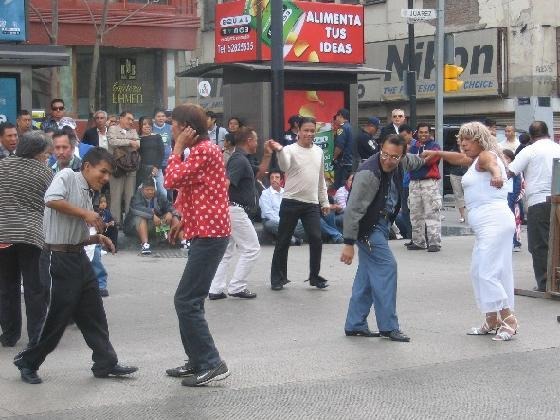
Photo by "Srheko", http://members.virtualtourist.com/m/tt/8a5b8/
Body-mass indexing and our conceptions of height-weight proportion are mostly based on what is normal for northern European. From a lecture outline on the University of Kent (Canterbury, UK) Social Ethnography website, I found these notes on body types:
Body build. Most of the variation in body build in humans can be reduced to linear build vs lateral build….
The extreme lateral stereotype would be found in some Asian and Native Americans. Eskimos, Japanese, Samoans, Apache, and many South American Indians exhibit lateral build…Laterally built people tend to have long and broad trunks, with wider chests, shoulders and hips.
Most Mexicans — those “average” Mexicans — being Native American in the DNA more than other North Americans, tend towards the lateral rather than the linear. Certainly it was an advantage to ancestors who lived at high altitudes where more space for lungs was an advantage (and whose descendants often as not still live at the same altitude). Which might just mean your average Mexican is… well… average.
All very interesting from a scientific standpoint (and maybe worthy of a discussion of aesthics and racism), but remember the researchers had their own biases. Not exactly who a group you”d expect to be on the cutting edge of science, the study was conducted for tthe Cámara Nacional de la Industria del Vestido (Conaive) … the rag trade association. Maybe in the near future, we’ll be hearing complaints from the average foreigner that he can’t find clothes that fit except in the specialty shops … all the “normal” clothes will be for short guys with 60 inch chests and those of us without an “average” build will just have to settle for what’s available in the odd racks. Or, instead of seeing Mayans with shirts hanging down around their knees, we’ll be wearing shirts barely covering our belly-buttons, but will nicely hide any spare tires we may have acquired.
Ladies first…
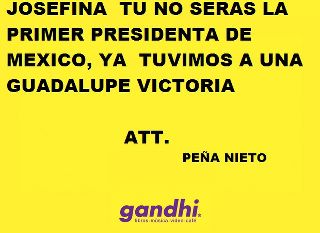
Josefina Vazquez Mota said her victory in the PAN primary was “historic” making her the “first woman” to run for the Presidency… well, at least from the right wing.

Rosario Ibarra de la Piedra, Partido Revolucionario de los Trabajadores (1982)
Marcela Lombardo Otero, Partido Popular Socialista (1994)
Cecilia Soto Gonzaléz, Partido del Trabajo (1994)
Patricia Mercado Castro, Partido Socialdemócrata (1996)
Ibarra ran as a Trotkyite, not so much to win as to raise questions about the fate of the “disappeared” including her son, Dr. Jesús Piedra Ibarra, a medical workers union leader, who was kidnapped by government agents in 1975 and never seen again. She is presently a Senator, and at the age of 85, still an important leader on the Mexican left and a human rights activist.
Marcela Lombardo is the daughter of Marxist philosopher, labor organizer and party founder Vicente Lombardo Toledano. Later a Federal Deputy, she now runs a think tank and foundation bearing her father’s name.
Cecilia Soto, initially a PARM activist, switched to the PT, and later … after serving as Ambassador to Brazil, became a PANista, and Calderón supporter.
Patricia Mercado bounced around from party to party, initially attempting to forge a feminist-gay-Protestant-indigenous-handicapped people’s coalition Mexico Possible… which pushed abortion rights,same-sex marriage and marijuana legalization… and annoying the Catholic Church. Mexico Possible did not receive enough votes to qualify as a party, so it was reorganized for the presidential election as the Social Democrats, which did. Although the party didn’t last very long, it brought national attention to social issues otherwise ignored, and gave some cover for incorporating them into at least the Mexico City PRD agenda.
And, of course, some might think of an earlier female presidenta:


 mexfiles.net