Pundits?
While some pundits will certainly overreact to the presence of any US security personnel in Mexico, what I find surprising is just how small this operation is. This article describes fewer than two dozen people assisting a fusion cell and perhaps another dozen serving as advisors for a police unit, all at the invitation and request of the Mexican government. That’s front page news?
Bloggings by Boz, 7 August 2011
Indeed it is, Boz… indeed it is.
Boz is a generally reliable guide to Washington establishment thinking on Latin America. I can’t read his mind, but I hope he is referring to the U.S. commentariti, and not us here in Mexico.
I don’t think I’m a “pundit”, though I’m happy to say some people read what I write from the perspective of a U.S. citizen living in Mexico. It’s not an over-reaction in the least to remember other small-scale “advisories”, going back to Viet-Nam. I know that is ancient history back north of the border, and I don’t see “fewer than two dozen Drug Enforcement Administration agents, C.I.A. officials and retired military personnel members from the Pentagon’s Northern Command” escalating into an army of occupation. But I see no indication that these people would be limited to working in a “fusion center”, nor that the number of such agents wouldn’t grow exponentially. And, the mention of “retired military” suggest “contractors” who, as we learned from the U.S. occupation of Iraq, are used to inflate the actual number of individuals involved in these kinds of actions belying publicly available figures.
As it is, throughout Latin America, there is a huge mistrust of U.S. “advisors,” not for what they do directly, but for what is done with their advice. Colombia may be “safe” (or at least Bogatá is) from open warfare by narcotics distributors, but the “advice” passed on about fighting them is used to kill union organizers, quash journalistic independence, and stamp out insurgency movements that had nothing to do with the stated U.S. objectives.
As a resident of Mexico, one notes that it’s not just the “pundits” who are making a stink about this. Congress wants answers, and — although they may be grand-standing in anticipation of next years Presidential elections — the government’s reaction (or non-reaction, saying they couldn’t talk about it) is not likely to make the issue go away.
Boring gangsters
The government, in its continuing quest to sell the its mano duro (hard hand) focus on anti-crime activity, may be slightly stretching the importance of some captures.
While kidnappers are no joke (and there are proposals to make kidnappers eligible for life imprisonment), and the fears generated by their violent methods are very real fears, not all kidnappers seem to be as efficient when it comes to sowing terror as others.
Mexican authorities detained five alleged members of a kidnapping and extortion ring in the Mexico City region that was known for leaving the heads of pigs outside homes and businesses as a warning.
It looks as if this gang was trying to keep the overhead low… since you can get a pig’s head in any market, on any day, anywhere in the country, and they’re hardly intimidating. Of course, maybe they threatened to bore their victims to death… while the published mug shots show the usual accourtrements of the criminal trade, I can’t muster up a lot of fear for a band of baddies led by a guy with the unimpressive moniker of “El Bla Bla”


Top, the not scary warnings (photo: Gavin Quirke) and bottom, a stupid pig.
As the crowbar flies
Patrick Corcoran’s “crowbar” award (for the best gratuitous mention of narcotics in any news story mentioning Mexico) has, like the U.S. war on its favored chemical and agricultural lifestyle enhancers, found its way into the Central American republics.
From the Latin American Herald-Tribune (Caracas):
GUATEMALA CITY – A total of 3,000 barrels of chemicals used to produce synthetic drugs were seized and three suspects arrested in a raid in Guatemala, the National Civilian Police, or PNC, said.
The chemicals were found at a warehouse in San Jose Pinula, a city on the eastern outskirts of Guatemala City, the PNC said.
Officers and prosecutors searched the warehouse and found four vans loaded with chemicals used to manufacture synthetic drugs, the PNC said.
Two of the vans had Mexican tags and one had been reported missing several months ago.
Luis Reina Escobar, 53, Mario Uleu Alvizures, 60, and Isaias Alvizures Lorenzana, 24, all Guatemalan citizens, were arrested, the PNC said.
Guatemala is used by foreign drug cartels to move drugs from South America into Mexico and eventually the United States.
Los Zetas, considered Mexico’s most violent drug cartel, was blamed for the massacre of 27 peasants in May at a ranch in Peten province, which borders Mexico and Belize.
In the first three paragraphs we learn that 3000 barrels of … some kind of chemicals, that are used in some way, or COULD be used in some way, in the production of methamphetamines, were found in a warehouse in suburban Guatemala City.
Then, in the fourth paragraph, we learn that two of the four vehicles at the site — at least one of them stolen — had Mexican plates… HEY… MEXICANS!
Never mind that the massacre was in another part of Guatemala, quite a distance from Guatemala City, and while one theory is that the Zetas were forcing locals out to protect a clandestine landing strip, more likely they were running off the subsistence farmers to clear the land for corporate palm-oil plantations.
Even if they are in Venezuela, Americans know that any news involving drugs anywhere in Latin America has to mention Mexican gangsters.
One less dick in Arizona
It’s only money
Carlos Slim lost EIGHT BILLION DOLLARS in four days. That’s about 83 million dollars an hour.
Much of the loss is attributed to a decline in the value of the Peso against the dollar, but a drop in world-wide stock prices (especially on the Mexican Bolsa) contributed to the eleven percent drop in Slim’s reported wealth.
Hey, what’s the big deal? Slim has long maintained that measurements of wealth are less important than the businesses that represent, and besides — having gotten his start in business by trading baseball cards — all that really matters is that he still has enough to take himself out to the ol’ ball game.
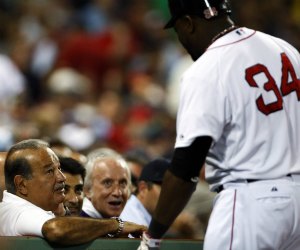
Red Sox designated hitter David Ortiz and some Mexican guy
Left, right?
Via Patrick Corcoran (Ganchoblog) comes an intriguing question that I thought might just be an outlier in political discussions, until I also heard it discussed on Televisa’s political press chat-show, “Tercer Grado” (“The Third Degree) — which means the talking heads are talking:
In response to reports that Ebrard said he was not a leftist a little over a decade ago, Jorge Fernández Menéndez says neither is AMLO, and that it doesn’t really matter anyway:
Who cares if Marcelo Ebrard is of the left of the center? Furthermore, who can identify today where the left, center, and right are located in the political spectrum? Personally I have always believed, for exampled, that Andrés Manuel López Obrador is a conservative reactionary: his discourse can be very nationalistic; his opposition to the government, very loud; his denunciations of “the mafia that stole power from us”, insistent, but that doesn’t make him a man of the left, much less that he sympathizes with the Cuban regime or Hugo Chávez, [both of whom are] as authoritarian as the Tabascan.
You could say that being of the left or not is defined by the attitude toward private capital. It’s partially true and Ebrard recognizes that he wants an open economy, but continuing with our comparison, it’s not that AMLO hasn’t don’t business with the private sector: he denounce the “mafia” as a group of economic power group, but he has worked a great deal with other groups. I remember, in his registration as a presidential candidate in 2006, how in the first row of guests were the construction executives that did so much business with the DF government then.
For what it’s worth, Ebrard is also far more socially liberal than AMLO.
Two things: while Patrick is correct that “Ebrard is… more socially liberal” — in the sense of pushing same-gender marriage and less restrictive abortion laws in the Federal District — I’m not sure “social liberalism” is particularly relevant to Mexican leftism.
Although in the United States, “liberal” is as close to “leftist” as you can get in a country with two liberal capitalist parties (and no others of any significance), they are not necessarily the same thing in Mexico.
Without getting into Mexican liberalism (Benito Juarez’ political ideology, and in the modern form, neo-liberalism, something generally associated with globalization and the market theories of the Chicago School… in other words, U.S. conservatism) Liberalism — in the U.S. sense — isn’t always seen as essential to Mexican leftism. U.S. liberals are assumed to favor individual rights. In Mexico, individualism is, when not seen as sinful (as it is by many Catholics for whom putting personal desires above communal values is the sin of Pride… the deadliest of the seven deadly sins), seen — in traditionalist communities — as a modernist threat. Reactionary Catholics are unlikely to be leftists (though there are plenty of leftist Catholics in Mexico) and, in a country where “traditional values” include “leftist” ideas like cooperative agriculture and communitarian self-governance, social conservatives are very often economic leftists.
Think of the Zapatistas, or of Emiliano Zapata himself, harking back to an agrarian communalist world and rejecting globalization, and the modern centralized state. And one can be nationalist and leftist without any problem: exhibit A being Lazaro Cardenas.
I think it’s a bit eccentric of Fernández Menéndez to view AMLO as a conservative reactionary (and a bit late for him to say so… where was he when the conservative reactionaries in this country were claiming AMLO was the Mexican Kim Il-jung?) . Both Ebrard and AMLO, as practical urban executives, of course worked with their city’s capitalists (notably Carlos Slim) and other power brokers (in AMLO’s case, even Cardinal Rivera was pulled in to lend support for a few projects), their differences being more of background than anything else.
AMLO, having grown up in a Tabasco grocery store, and making his political mark through social work among indigenous peoples and union organizing, naturally has a more “traditional” leftist base. Ebrard is an exemplar of the Chilango middle-class: the son of an architect, educated in France, and working his way up the political ladder as an administrator. His “liberalism” is nothing you wouldn’t find in any urban executive anywhere (except maybe the United States). I suspect Ebrard, being more the type of “leftist” the foreign powers consider normal, and not speaking in nationalist terms, has the edge with the foreign commentariat. We are used to urban social liberals, not rural communitarians. Who has the greater clout within the party (or parties, as it’s likely to shake out) is not altogether clear to me… although naturally I expect Ebrard is getting the better press, and — given his social background — more likely to be seen as an “acceptable” Mexican leader to the foreigners than a nationalist like AMLO, who may for all we know, actually have the most national support.
There goes the neighborhood
(my snark in boldface)
The United States is sending new CIA operatives and retired military personnel to Mexico and may deploy private security contractors to fight drug cartels, The New York Times said.
“Private security operatives” = mercenaries. I said this was gonna happen, and I hate being right.
Small numbers of CIA operatives and civilian US military employees have been posted at a Mexican military base, it said late Saturday.
So much for claims that foreign troops weren’t working in Mexico.
Security officials from both countries work there side by side in collecting information about drug cartels and helping plan operations, the report said.
Side by side, or Mexican under the thumb of U.S. spies “officials”?
Officials are also looking into embedding a team of American contractors inside a specially vetted Mexican counternarcotics police unit, it said.
Blackwater? And, anyway, aren’t Zetas “contractors” too?
The new efforts have been devised to get around Mexican laws prohibiting foreign military and police from operating on its soil.
So much for the rule of law, and transparency and all those other changes were were promised by the present administrations…here and there.
They also aim to prevent advanced US surveillance technology from falling under the control of Mexican security agencies with long histories of corruption, the paper noted.
As opposed to… oh… “contractor” corruption, and does this involve the kind of surveillance that the U.S. government had over gun-runners. That went really, really well… NOT!!
More than 41,000 people have died in violence blamed on Mexico’s drug cartels since the end of 2006, when President Felipe Calderon deployed some 50,000 troops to tackle organized crime.
Blamed on the cartels, or on U.S. financing and arming of said cartels… or the Calderón administration’s deployment?
I guess this is what the U.S. “jobs for veterans” program comes down to… find yourself a new war.
You remember when Hillary Clinton referred to our criminal exporters as “insurgents”? Insurgents are usually people fighting to drive out foreign military forces… and the U.S. may just be creating some real insurgents (as well as support for them).
This is fuckin’ insane!
Plus ça change
Napoléon III has always gone gone in history as a devious sleazoid, but you have to give him credit for being an honestly devious sleazoid. While his commander in Mexico, General Elie Frédéric Forey, was making the usual rationales always given when launching wars of aggression, proclaiming he was only there to “free Mexico from the tyrannous demagoguery of Benito Juarez, against whom, and not against the Mexican nation, we are fighting”, Napoléon didn’t mind setting his commander straight on the real reasons. From a letter of 3 June 1862 to Forey:
There will not be wanting people who will ask you why we expend men and money to found a regular government in Mexico. In the present state of civilization of the world, the prosperity of America is not a matter of indifference to Europe, for it is the country which feeds our manufactures and gives an impulse to our commerce…
We now see by sad experience how precarious is the lot of a branch of manufactures which is compelled to produce its raw material in a single market, all the vicissitudes of which it has to bear. If … Mexico maintains her independence and integrity of her territory, if a stable government be then established with the assistance of France, we shall have… established a friendly influence in the center of America, and that influence, by creating numerous markets for our commerce will procure us the raw materials indispensable for our manufactures. Mexico, thus regenerated, will always be well disposed to us, not only out of gratitude, but because her interests will be in accord with ours, and because she will find support in her friendly relations with European Powers. At present, therefore, … the interests of our industry and commerce, all conspire to make it our duty to march on Mexico, boldly plant our flag there and establish either a monarchy, if not incompatible with national feeling, or at least a government which may promise some stability.

Somebody is wrong!
Sorry posting is a little on the light side right now. I am working on a couple of other things (and I’ll be getting back to my “soap opera” version of the Spanish-English royal family conflicts that I think are the source for the U.S.-Mexican  mutual mistrust and misunderstanding), but when I started to write a short post about an upcoming American film related to Mexican history, I found myself in the middle of a long-overdue promised essay on history in the movies for a small academic publication… and — being appalled by the Wikipedia entry on that film’s main character — just spent most of the last two days writing a not so quick (but dirty… and, yes, I know there are several incomplete sentences that need fixed) revision of a fairly minor Mexican revolutionary (and post-Revolutionary) figure of note: Enrique Gorostieta Velarde, the rent-a-general hired to turn the Cristeros into a real army.
What set me off was that the Wikipedia entry for was the film version Gorostieta, not the historical figure. And — DAMN — I just found another biographical source with a little more weight than a film script: the late Jaime Nicolopulos of the University of Texas Department of Comparative Literature wrote and published an excellent website dedicated to studying the Cristeros and their heroes: Corridos de la Cristada.
I’m not a stickler about footnotes and references to be sure (I’m not writing for academic audiences), and don’t mind biased writing (not when the biases are acknowledged) but what was in the Wikipedia was another “Palinization of Paul Revere“… an attempt to revise history to fit the facts of a polemical discussion… (basically, a movie selling the pious righteousness of that 1926-29 rural insurgency) … that and the fact that somebody was wrong on the internet.
Enrique Gorostieta Velarde (Monterrey, 1889 – Atotonilco el Alto, 2 June 1929) was a Mexican soldier. He was one of the leaders of the Cristero Rebellion.

Not the picture on Wikipedia, but maybe that needs changed too
Gorostieta followed a military education at the Heroic Military College of Chapultepec and served in the Porfirian army. During the Mexican Revolution he served in the Federal Army of counterrevolutionary dictator Victoriano Huerta, being Huerta’s youngest general, and after Huerta’s fall fought with Juan Andrew Almazán, but soon fled Mexico for Cuba and later the United States. Upon his return to Mexico he worked as a soap manufacturer, but found the work boring, and sought a return to military activity. [1]
In 1926 the National League for the Defense of Religious Liberty chose him to lead the Cristeros, an army of Catholic rebels fighting against the government forces of president Plutarco Elías Calles.[2]
As a Mason [3] and life-long anti-clerical, Gorostieta’s motivation for taking command of the rebels was not only the high salary he was offered (about $3000 US Dollars a month, or twice the salary of a regular Army General), but also his political ambition. Although Gorstieta’s 1928 “Plan de Los Altos” called for changes to the 1916 Constitution’s Article 27 (which the Cristeros saw as restricting the rights of Catholics) and — more important to Gorostieta — install a Gorostieta regime on the country.
Philosophically, he believed in a return to the Juarez-inspired 1857 Constitution’s view of non-interference and toleration for religion, rather than the Calles’ administration’s reading of the 1916 Constitution as demanding subordination of religious organizations to the state. Although openly contemptuous of his subordinates’ religious faith (several of his officers were priests), he respected the military acumen of the Jalisco farmers under his command, and believed he could turn them into a professional fighting force equal to the regular army. [4]
His importance as a Cristero leader was in bringing military discipline to an unorganized insurgency. He is credited with turning Cristero “armies” into a Cristero Army, which, for a time, was winning battles in the states where it was able to operate: Jalisco, Michoacan, Colima and Zacatecas. However, without support from the Mexican church [5] or the Vatican[6] and torn by internal dissention [7], the Cristeros were largely irrelevant as a political or military force by the time a negotiated settlement was worked out between the Vatican and the Mexican state over interpretations of the Church’s rights under the Constitution [8].
Nineteen days before a cession of hostilities (2 June 1929), based on an agreement worked out by U.S. Ambassador Dwight Morrow, Gorostieta was killed following a Mexican government intelligence operation. With the movement rapidly collapsing, Gorostieta was attempting a retreat into Michoacan, where he hoped to recruit followers and continue the rebellion. A federal officer, who had infiltrated Gorostieta’s inner circle, tipped off the Mexican cavalry to the general’s presence in Atotonilco, Jalisco, and killed him in a short firefight. [9]
Popular culture
Gorostieta will be portrayed by Andy Garcia in the upcoming film Cristiada, an epic historical drama also starring Eva Longoria, Eduardo Verástegui and Peter O’Toole. [10]
External links
- The Anti-clerical Who Led a Catholic Rebellion by Jim Tuck at Latin American Studies
References
- ^ Tuck, The Anti-Clerical Who Led a Catholic Rebellion
- ^ Werner, Michael S., Concise encyclopedia of Mexico p. 147, Taylor & Francis, 2001
- ^ Mayer, Jean A. “The Cristero Rebellion: The Mexican People between Church and State 1926-1929 (Cambridge University Press, 1976) p. 53
- ^ Tuck
- ^ Bravo Ugarte, José. “Cómo se llegó al modus vivendi de 1929” en Temas históricos diversos. México, Jus, 1966, pp. 265-275.
- ^ Meyer, p. 203
- ^ Meyer, 80-81, et. passum
- ^ Grabman, Richard. Gods, Gachupines and Gringos: A People’s History of Mexico (Mazatlán, Sinaloa, Editorial Mazatlán, 2008) p. 342-43
- ^ Tuck
- ^ Cristiada (2011) IMDB, Accessed Oct. 8, 2010
Another trivial pursuit
Strange fits of passion I have known… while passionately tracking down a minor factoid about something entirely unrelated (well, at least tangentially related to Latin America), I learned something entirely unexpected.
Lucille Ball and Fidel Castro:
- Both were Communist Party members .
- Both married Cubans, and later divorced them.
- And they were both…. ???
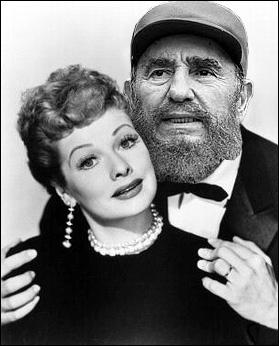
Hint: Havana, 1946
Yeeeee-haaaaaaaa!
Rick Perry, who thinks he wants to be President of the Republic of Texas, when he’s not making noises about trying to become President of the United States (probably, but not definitely, including Texas) has called for a “Day of Prayer and Fasting” at Reliant Stadium in Houston (seating capacity 70.000). About 8000 people have said they might show up (and even Perry seems to be not sure if he’ll actually be there himself).
As for me, I’ll be here...Y’all come.
Nothing new?
In a video released earlier this month, a Mexican army defector who allegedly rose to become No. 3 in the brutal and powerful syndicate known as Los Zetas was asked by a police interrogator where Los Zetas obtain their weapons.
“From the United States,” Jesus Rejon Aguilar, who was arrested by Mexican authorities on July 4, told his off-camera questioner. “All weapons come from the U.S.”
The [Mexico City] News 3-August-2011 ‘The US doesn’t care for Mexican lives’
Well, at least the Zetas have to pay for theirs. It appears more and more the Sinoala cartel has a different arrangement north of the border:
In legal pleadings submitted to U.S. District Judge Ruben Castillo, Zambada Niebla said the collaboration between the Sinaloa cartel and U.S. law enforcement arose from the 1995 drug indictment of Mexican attorney Humberto Loya Castro, “a close confidante” of Chapo Guzman.
Loya subsequently became a U.S. government informant, according to the pleading.
“Sometime prior to 2004 … the United States government entered into an agreement with Loya and the leadership of the Sinaloa Cartel, including Mayo and Chapo,” the document says. “Under that agreement, the Sinaloa Cartel, through Loya, was to provide information accumulated by Mayo, Chapo, and others, against rival Mexican Drug Trafficking Organizations” to U.S. authorities.
“In return, the United States government agreed to dismiss the prosecution of the pending case against Loya, not to interfere with his drug trafficking activities and those of the Sinaloa Cartel, to not actively prosecute him, Chapo, Mayo, and the leadership of the Sinaloa Cartel, and to not apprehend them,” the pleading claims.
Just hours before his March 2009 arrest, Zambada Niebla said, he met at a Mexico City hotel with U.S. agents who assured him the arrangement was still in effect, but that he would start communicating directly with the Drug Enforcement Administration, rather than through Loya.
EFE, via Latin American Herald Tribune, Mexican Kingpin Says U.S. Protected Cartel
Neither of these revelations is surprising in themselves though trying to find any mention of them in the U.S. “mainstream” press is a bit difficult.
Bill Conroy (Narcosphere), in a longish article laying out the connections between Zambada Niebla’s statement, the DEA, “Fast and Furious” and… possibly… the C.I.A. (US Court Documents Claim Sinaloa “Cartel” Is Protected by US Government) adds:
The protection extended to the Sinaloa leadership, according to the court filings, included being “informed by agents of the DEA through Loya that United States government agents and/or Mexican authorities were conducting investigations near the home territories of cartel leaders so that the cartel leaders could take appropriate actions to evade investigators.”
In addition, the pleadings allege, the US government agreed not to “share any of the information they had about the Sinaloa Cartel and/or the leadership of the Sinaloa Cartel with the Mexican government in order to better assure that they would not be apprehended and so that their operations would not be interfered with.”
My modest suggestion is that given the seemingly free reign U.S. undercover agents are able to work in Mexico, it’s only fair that Mexican undercover operations be allowed to work north of the border… maybe going after not the small fry like gun dealers along the border, but the kingpins… you know, the cartels like Wachovia Bank and Archer-Daniels-Midland, that are a real national security threat to this country.


 mexfiles.net