Oslo
I have been going back and forth all weekend about what — if anything to say about the Oslo massacre. Although the Mex Files has a very slight connection — Joanna Van der Gracht (Writings from Merida) an Editorial Mazatlán author, and husband Carlos are on their way to Oslo for their son’s wedding in a few weeks — as a rule, no matter how tempting, Mex Files tries to stick to Mexican and Latin American events and history.
“Norway,” as Pedro Echeverría V. writes (Chihuahua Resiste, my translation) is
… is a European country only 5 million, one 22nd the population of Mexico, and, in area, only a sixth as large. However, it is a privileged country, with extensive oil wealth, power and water, fishing, whaling, forestry, tourism, high culture and universities. It places second or third place globally in living standards, human welfare and respect for human rights.
While Echeverría complains about the Norwegian commitment to NATO, he recognizes its generally “collectivist” attitude towards the nation’s wealth, and genuinely egalitarian ethos.
Certainly, a wealthy nation, and one known for peace-keepers and commitment to a settlement of the “Palestinian Question” and generous development grants to less-wealthy nations, stereotyped as stolid, Volvo-driving, plodding Lutherans should not spawn terrorists.
Anders Behring Breivik, make no mistake about it, was a terrorist. Despite the rather pathetic (and often disgusting) attempts by right-wing websites to either change the subject (almost amusingly, there is the attempt to reclassify Breivik as a left-winger, or, rather weirdly, to somehow make him a secret Al Qaida agent — though, come to think of it, Al Qaida is a reactionary movement, not a leftist one), there is no way around the fact that this was an attack on the government of Norway, and on the political party in power. And, while some on the left (and on the right) have noted Norway’s less known (and decidedly violent) military actions in Afghanistan and Libya, terrorism is violence by non-state actors designed to intimidate the civilian population and/or leadership into acceptance of the terrorist’s political goals.
Sabina Becker has an excellent overview of Breivik’s goals and allies, which I recommend reading (and reading the links too). The lunacy of European rightists and their obsession with Muslims doesn’t seem to be directly relevant to Mexico, yet consider how this tragedy both was reported, and the assumptions that made it such a shocking event.
Terrorism, in too much of the media, seems to mean “Arab”, just as “narcotics violence” is assumed to mean “Mexican.” While I think it is a terrible mistake to use the word “terrorist” in connection with our gangsters (which gives too much credit to the gangsters, and ignores real human rights violations from the state — justified as in other countries as “anti-terrorist measures — while at the same time giving cover to what probably are genuine terrorist activities, which are written off as “drug related violence”).
That the moral (or rather, immoral) support for terrorists like Breivik comes largely from well-heeled and well-funded individuals and groups in the United States and Europe who deny their culpability, or seek to displace their own role in providing aid and comfort by noting they are not the actual perpetrator of the deed, is no different really than those that provide money and material to the “cartels” here. That those who disseminate a fear of the outsider — Arab immigrants in Europe, Latin Americans in the United States — and convinced, coerced, or co-opted the media into using their language, and their terms to denigrate the outsider (even reputable news organizations in the United States now use “illegals” for persons and not actions).
And, in the end, in Norway, and in Mexico, it is the youth who are sacrificed.

How much precursor makes a curse?
I’m not trying to be snarky, but not being a chemist (and becoming hopelessly lost when I had to study organic chemistry was a major factor in my switching my undergraduate degree program from Biology to English), I don’t whether this is as meaningful as it is made out to be or not.
But, with all the reportage on the seizure in Queretáro of ” the biggest seizure there’s been of precursor chemicals (in Mexico),” I am curious what exactly that means, either in terms of meth production or in value of goods. I know that the Army found “787 tonnes of phenylacetamide and 52.5 tonnes of tartaric acid, all in 25 kilogram (55 pound) packet”, but perhaps someone can help me out.
I’m assuming that is a large amount of these chemicals, but the only thing I know about phenylacetamide (and that mostly from Wikipedia) is that it is a “precursor” for a lot of industrial and pharmaceutical products, and tartaric acid is the acid found in wine, and an anti-oxidant. Via an AP article in the Citizens Free Pres Ireland Newsline, I gleaned that “Traffickers have increasingly turned to such chemicals after Mexico imposed tight restrictions on pseudoephedrine, the most popular raw ingredient for meth,” which means that restrictions on imports of more popular “precusors” is cutting off supplies, but still doesn’t enlighten us very much.

Reuters photo
Assuming the penylacetamide and tartaric acid were meant for meth production (and weren’t smuggled for other wholesale industrial use), are these difficult to obtain chemicals, and how much meth — which I understand requires several other ingredients NOT in this warehouse — are we talking about?
Several of us were burned when reports on something called the “Tepito Cartel” managed to set off a bomb (which only killed the would-be bomber) back in early 2008, leading to some ridiculous speculation about Al Qaida, or “escalating terrorism” based on the fact that the bomb used the same “precursors” sometimes used in Middle-Eastern political bombings… those “precursors” being mostly hydrogen peroxide (which you can get in any beauty supply store, or pharmacy, for that matter), sulfuric acid and gunpowder (both easy enough to find). I don’t mean to slam the journalists who covered this story, who if they had any science background at all, probably were also Organic Chem dropouts who transferred to J-School, but shouldn’t some editor along the way have asked, “what’s a precursor, anyway?
Mexico’s Murdoch
I have been wondering if there might be a Mexican connection to the Murdoch scandal. Although the scandal started with something relatively normal in Mexican scandals — intercepting private communications — the “real” scandal has been, and always way, the method and means by which a powerful corporation manages to control access to public information, and the ties that corporation has to governments.
Mexican PRINT media (including print on-line, the source of information I generally rely upon) is less affected in some ways. While the ethics of news gathering may not adhere to the standards of the wealthy countries, and we have more than our share of crappy reportage, one advantage of our print media is that it is not consolidated like it is in the major English-speaking countries. Had Murdoch’s properties not included papers of much better repute (not to mention other media outlets) beyond the News of the World, there would have been a lot of hand-writing over ethics and journalistic responsibility, but nothing like the international scandal that has blossomed. Or, if Murdoch’s properties were not so overtly politicized.
Mexican print media, while openly partisan, are not concentrated in any particular hands. While there are a few U.S. style corporate papers, like Universal and Reforma, their ownership style is more like the major U.S. independents, the New York Times, for example. That is, while they generate content for many of the country’s smaller publications (Noroeste, my local daily, for example, gets most of its national and international news and opinion from El Universal) and may have some local editions, they are partisan in the same way that the New York Times is partisan. However, we have nothing similar to media chains like Gannett or Knight-Ridder except on a very small scale. And, in the print media world, nothing remotely like Murdoch’s News Corp.
Despite the claims of “objectivity”, the perception of the object depends on the subject, which, in the case of the New York Times, or Reforma or El Universal, are the perceptions of those who manage and own large companies. That is, while not partisan in the way of political parties, the decision makers at the New York Times or Reforma aren’t all that different than the decision makers at Wal Mart or McDonalds or Vokswagen. Reforma is more conservative than its competitors, but then, it’s a Monterrey based business, and not a Mexico City based one. But, then again, the New York Times, being based in New York, is going to see the world slightly differently than Arkansas-based Wal Mart.
However, Mexican print media is political — and often in the sense of party bias. I don’t see that as a weakness for the media as a whole. I think Mexicans who want to be informed are better informed, and have a better understanding of complex issues (which is what one wants in a democratic society) when one is able to assess the issue as seen by its varied partisans. What Jornada writes about a given event, and what Cronica de Hoy say about it might be complete opposites, but if one has a fairly complete understanding of the rationale behind whatever the event means, by synthisyzing the two. And, maybe throwing in a few of the “betweens” like Milenio (more lefty) or Excelsior (more righty).
Where we do have concentration, and “Murdochian” attempts to control the political agenda is in television. Although foreigners pay more attention to, and seem to find, Carlos Slim the puppet-master of Mexican politics, very few pay attention to Emilio Azcarraga Jean and Televisa.
While both Slim and the Azcarraga clan are in the communications biz, Slim’s enormous wealth comes from information delivery, not information control. Azcarraga controls Televisa, which is the primary information source in this county (as everyone knows, Mexican homes are more likely to own a television than a refrigerator). While there is a second network (Azteca) and a few independent channels, Televisa, as the former state television monopoly, and has a tremendous advantage over any possible competitor.
Slim is sometimes seen as the “George Soros of Mexico” (which is a description I saw in a U.S. website comment, and a pretty good one — Slim seeming to recognize that cultural and political change is in his own interests, and not being shy about using his wealth to foment change, as in his open support for López Obrador in 2006, and various leftists since). As with Murdoch’s Fox News, which is always “exposing” social change as the work of Soros, Azcarraga’s Televisa insinuates that Slim is a social menace to the status quo (which I hope he is).
Televisa was responsible for “Initiativa Mexicana” project, which led to self-imposed press restrictions that favor the present administration, and were signed off on by the major print media (although several on the left, including Jornada and Proceso refused) … possibly out of fear of reprisals, not by the government, but by Televisa.
The “niña Paulette” incident (the botched investigation into the death of a handicapped child in the State of Mexico) was used to attack the network’s favored politician, Enrique Peña Nieto, then the governor of that state. Peña Nieto, who then bought massive advertising time on Televisa, was restored to good graces, and you won’t hear a word against him on their news programs. Although, legally he had the right to purchase air time, Televisa tried to prevent Andres Manuel López Obrador from buying time for his “alternative presidency” although he was finally able to purchase time in a useless 11 PM on Tuesday slot. When the Elections Commission ruled that television stations had to carry political ads (which are government paid) for all parties without discrimination — something Televisa saw as affecting their ad revenue stream — the network responded by running all the ads for a regional election back to back during a soccer game, not to annoy soccer fans, but to turn the audience against unpaid political advertising. They play hardball.
And, when it comes to that, no surprise, you find not just a Mexican Murdoch, but Murdoch (and News Corp.) himself in the fray:
From an article by Jenaro Villamil in (the lefty, independent) Proceso (my translation):
[The Mexican business publication] Expansión, in its special issue of December 20, 2010, branded Emilio Azcarraga Jean “the Mexican Rupert Murdoch.” Expansión quotes consultant Xepus Ginebra of theMedia Planning Group who said: “Both (News Corporation and Televisa) are businesses controlled by a single individual, focused on generating content for multi-platform distribution, and with a strong political influence in the countries where they operate, and distributed multi-platform, with a strong political influence in countries where they operate and where they are willing to invest heavily.”
…

"...what's puzzling you Is the nature of my game."
The presence of the [Rupert Murdoch] in Televisa began with negotions… to launch a platform known as DHT (satellite TV) which would… effectively displace cable television.
…[Murdoch’s] success in Europe would be replicated in Latin America. Murdoch associated with … Televisa…the Brazilian consortium O Globo and Liberty Media to create Sky Latin America.
Since late 2008, especially between 2009 and 2011, Sky faced competition from Dish Group…
Televisa pressured regulators, such as the Federal Communications and Competition commission, and the Secretariat of Communications and Transport, to block expansion of Grupo Dish and block consent for MVS [the Dish delivery system] to act as a provider of internet Broadband services in 2011, simultaneously waging an advertising and commercial war against Carlos Slim’s Grupo Carso.
As Murdoch was doing in Britain, the Azcarraga-run consortium uses its enormous capacity for intelligence and political lobbying as well as putting pressure on its major advertising clients.
In 2006 Televisa came up with the Munich Project, headed by David Robillard, at that time the director of the private intelligence agency, Kroll Marketing, Televisa Vice President, Alejandro Quintero.
The Munich Project, as uncovered by Etcetera [a media trade magazine], had as its objective, the development of “offensive competitive intelligence.” In other words, spying: not only on corporate accounts, but also digging into the personal history of its biggest advertisers executives.
Kroll said that to establish their research uses “intelligence techniques, field investigations, comprehensive review of public databases and private as well as consultation of confidential sources of information.”
Robillard denied the report published by Etcetera, but confirmed that Kroll has done work with Televisa to help “address the risks it faces”.
“At no time participated in obtaining private information,” he said in a letter on May 2, 2006.
And, of course, we believe that, just like we Murdoch when he tells us that there weren´t private eyes digging up information on “9-11 victims” in New York or celebrities and politicians in Britain. Right?
Although the largest religious denomination in the United States is the Roman Catholic Church, and the United States — depending on how you measure these things — is one of the five largest Spanish-speaking nations, what is broadly defined in the United States as “Hispanic” culture really doesn’t influence the culture there as much as it is influenced by it.
Case in point. “Father Alberto”, another TV chat show now being tested in a few U.S. markets, through the auspices of the Oprah Winfrey Network.
As “Padre Alberto,” Alberto Cutié — at the time a Roman Catholic priest — had a highly successful chat-show produced for Telemundo, the Spanish-language  U.S. television network, and distributed widely throughout Latin America. The Florida priest’s television career came to a crashing halt, after exposure (not in a U.S. gossip rag, but in a Mexican one) of his affair with a woman. As scandals go, this wouldn’t be all that big a deal in Latin America (where there is a long tradition of priests having discrete relations with women) but, coming on the heels of scandals involving Roman Catholic clerics and minors (usually of the same gender) it received more coverage in the English-language press than most Latin American television star scandals. And, of course, Padre Cutié, being a public figure, made it difficult to ignore the scandal.
Alberto Cutié left the Roman Catholic Church, and was ordained in the  Episcopal Church (and made an honest woman of his girlfriend, in a wedding officiated at by the Cuban-born Episcopal Bishop of Miami, with the retired Episcopal Bishop of Venezuela — who resides in Miami — assisting at the altar. And, having moved theologically to an Anglo community (they don’t call them Anglicans for nothin’) has moved linguistically to be born again as “Father Alberto” on English-language television.
I really have very little interest in “Father Oprah” (as the U.S. press has started calling him), but his career is an perfect example of assimilation, and why I often point out that “Latinos” and “Latin American” (and, by extension, Mexican and Mexican-American) are very different groups of people.
Cutié is not an immigrant, not in the political sense. His parents were Cuban, but he is a native of Puerto Rico, thus a United States citizen by birth. Linguistically and culturally, moving to the “mainland”, even in Spanish-speaking majority south Florida, he is an immigrant by culture … and, as with every other immigrant, is expected to adapt to the majority expectations, and is hard-pressed not to.

Assimilation: as it was in the beginning, is now, and ever shall be
There’s nothing particularly sinister or coercive in assimilation… it just happens… by assimilation, I suppose. The culture of the United States has been set by its original ruling class[i], English-speaking Protestants. It wasn’t unusual when I was in south Texas to run into third, or fourth, or sixth generation Tejanos who were Methodists or Episcopalians or even Southern Baptists, and spoke little, or no, Spanish.

Liberace wasn't the only one with a candalabra on the set
And, while the first televangalist was a Roman Catholic priest (Archbishop Fulton J. Sheen), religious television, was more or less a Protestant (and, perhaps in a bow to Bishop Sheen, and his fellow star of the 50s and 60s, Liberace) flamboyant… and somewhat “ghettoized” as lower class or, at least, appealing to what most Americans would consider unsophisticated people.
Emotionalism doesn’t fit the mainstream American image, and even some of the more flamboyant and outre religious figures (like Pat Roberson) developed a more “mainstream” format, more comforting to the U.S. middle-class audiences, who expected their churches, and their televisions, to non-threatening, sympathetic authority figures (I’m talking about the image, not the message. Pat Roberson was, is, and always will be a scary dude). And, being addicted to quick fixes, whether sitting in a pew, or in front of a television, people in the United States expect a quick resolution to “issues”. Preferably other people’s issues.
Jimmy Swaggert, and the colorful faith-healers, as well as Jerry Springer, gave the quick fixes people want, but it was Oprah who broke through the barrier to respectability and middle-class respectability … I don’t know how she did it, but for a heavy-set black woman she just had the right — something — to project the sympathetic, non-threatening authoritative problem-solver that television audiences wanted.
While Latin American television has developed similar programming, such programs are culturally based in our own expectations. Laura en America owes as much to Sabado Gigante as it does to Jerry Springer. And, of course, being in

Laura Bozzo, Peru's answer to Jerry Springer
Spanish, the market is limited in the United States. And “Padre Alberto” could only exist on Latin American television. Since Fulton Sheen went off the air, the image of the Catholic priest has changed dramatically in U.S. mainstream culture, and the nuances of Roman Catholicism, that are part of Latin culture (even for the Protestants, religiously indifferent and militant anti-clerical), aren’t likely to be stressed or accepted, except by the retro Catholics that have their own television programs and niche network. As a Episcopal priest, I don’t know that he’ll lose all that much of the Latin audience that understands English (Latins … and this is a stereotype I know… tending to accept that clothes make the man… or the collar makes the priest).
Although Cutié starts out with a few advantages over Oprah (he’s male, and  he’s…er… blessed with being conventionally handsome), and his slight accent is unlikely to turn off mainstream viewers whether the mainstream is ready for a talk-show problem-solving authority figure with a Roman collar is a question. Marketing for the program seems to depend on both the novelty of having a priest as host. The marketeers in selling Cutié’s notoriety are trying to both capture the market for other talk show hosts initially famous for falling from grace (Jerry Springer was a Ohio politician until he paid for a hooker by check, and it bounced) and those who seek a more “spiritual” authority, one that can, though, provide absolution and forgiveness, not for our sins, but vicariously for other people’s social failures.
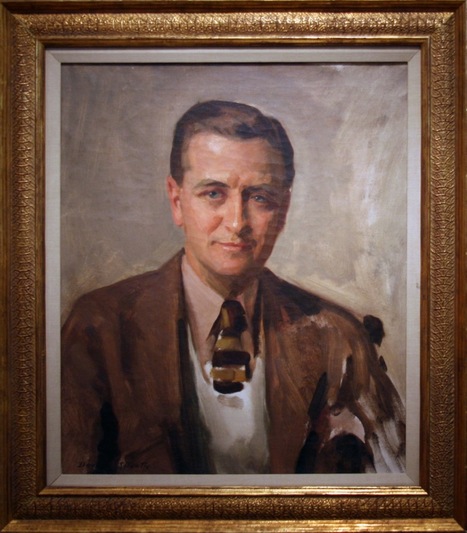
Scott Fitzgerald in WASP drag
Scott Fitzgerald may have believed “there is no second act in American life,” but then Scott … having reinvented his lace-curtain Irish self as a WASP … never had a television show, and never talked to Oprah.
[i]Having become interested in why the English and Spanish (and, by extension, English and Spanish-speaking Americans) have been at odds since the 16th century, I’ve been reading back through Spanish history — which leads to the Reconquista, which leads to al Andalus, which leads to Albert Hourani’s “A History of the Arab Peoples” (Faber and Faber, 1991). Writing of the collapse of the Ottoman Empire, and the French “mandates” in Lebanon and Syria after World War I, Hourani notes that Roman Catholicism absorbed a good number of Christians, who left traditional Arab Christian sects, as they also adopted French as their language.
The geography of Hell
Frontera NorteSur, via LaBloga:
In the Southwest US, smoke from massive wildfires contaminates the air and forces evacuations. 200 miles from the mammoth Wallow Fire, the skies of Albuquerque, have recently resembled Los Angeles and Mexico City in their worst years of pollution.
Stretching from Texas and New Mexico and deep into the Mexican interior, drought parches vast expanses of land. Mountain lions, bobcats and bears wander into urban El Paso and Albuquerque.
A major fishery for the US, Mexico and other nations, the Gulf of Mexico is poised to suffer its fourth environmental calamity in less than six years. According to the National Oceanic and Atmospheric Administration (NOAA), the so-called dead zone, which is traced to nitrogen-rich fertilizers washed into the Mississippi River and then into the gulf, could expand to a record size of between 8,500 and 9,421 square miles this year due to increased run-off from this year’s heavy flooding.
Although the reports are dramatic and growing, consumers of the US mass media will find little or next to nothing that suggests that the environmental catastrophes are in any way connected to the broader issue of climate change.
…
(Read the entire article here)
The “spill-over violence” that we never talk about is the violence done to the planet. Reading about Texas and Oklahoma governors expecting the Deity to resolve their local environmental problems, while continuing to deny ours (and their) role in creating the problem, I’m struck by how climate and weather (and environmental issues) are covered in the United States. From U.S. news reports, you would have thought that the wild-fires that raged from Queretaro to Kansas earlier this year were isolated phenomena, or that the fires magically stopped for border crossings.
I admit I don’t understand how people in a country supposedly better-educated and more technologically saavy than Mexico can’t fathom that what happens here in the southern parts of the North American land-mass aren’t also happening a bit further north. Texas has rocket scientists, but can`t figure out the simplest thing to do when you have a problem is to stop making it worse. Something as simple as changing the light-bulbs is too radical a step to take for the Texans (and Okies and…). We don’t have a lot of rocket scientists here, but besides understanding that it’s easier to change light-bulbs, getting out of the hole means not just stop digging, but start climbing out. We’re planting trees, and people are willing to take up arms to protect their trees. And changing our light-bulbs.
It’s a given that people in the United States don’t know as much about their neighbors as their neighbors know about them, but even so… you’d think they understood that political boundaries don’t affect things like the climate and wind patterns. I get the sense that people like the Governors of Texas and Oklahoma assume they’ll be beamed up in the Rapture… and they aren’t going to have to deal with the consequences of global warming. As we’re told, “never assume, it makes an ass of U and me” … awfully risky for them to think they’ll be going to the “good place” and not the one that Sam Houston said he’d be willing to swap for Texas with Satan.
Even for the Christian conservatives “willful ignorance” is as much a sin as any.. Whether it’s theological or pathological, I don’t know, but …. if they can`t learn from their neighbors, maybe they’ll listen to someone from… oh… Nauru. President Marcus Stephens of that tiny island nation (for a time, the wealthiest nation on the planet) writes in today’s New York Times:
… the lush tropical rainforest that once covered our island’s interior, scarring the land and leaving only a thin strip of coastline for us to live on. The legacy of exploitation left us with few economic alternatives and one of the highest unemployment rates in the world, and led previous governments to make unwise investments that ultimately squandered our country’s savings.
I am not looking for sympathy, but rather warning you what can happen when a country runs out of options. The world is headed down a similar path with the relentless burning of coal and oil, which is altering the planet’s climate, melting ice caps, making oceans more acidic and edging us ever closer to a day when no one will be able to take clean water, fertile soil or abundant food for granted.
…
Similar climate stories are playing out on nearly every continent, where a steady onslaught of droughts, floods and heat waves, which are expected to become even more frequent and intense with climate change, have displaced millions of people and led to widespread food shortages.
The changes have already heightened competition over scarce resources, and could foreshadow life in a world where conflicts are increasingly driven by environmental catastrophes.>
Who reads the Mex Files?

 Hail to the web-surfer
I don’t often check the traffic, but besides Mr. O (or, more likely, somebody in the basement at the White House having to prep a paper on David Romo Guillén and Santa Muerte for some reason, or just taking a break … at least they spent enough time to read the post), Mex Files also had recent visitors from the Secretaría de Relacións Exteriores, the Government of Saskatchewan and Jordanian intelligence. The usual.
18 July 1566
“All of us, great and small, educated, uneducated, ruler and ruled, public or private individual, all of us are bound unconditionally to help the oppressed, to help those suffering under violence, injury, any evil, with whatever power we have, official or personal.”
John Donaghy sent me a little reminder that today is the anniversary of Bartolomé de las Casas’ death in 1566. Las Casas, who originally came to the Americas to conquer (and was for a time a encomiendaro in Cuba) became a Dominican priest and launched a career as a fierce advocate for the rights of Indigenous Americans. And, in some sense, he was one of the “founding fathers” of the United States, being the first in the Americas to write:
“No state, king, or emperor can alienate territories, or change their political system, without the express approval of their inhabitants.”
Interestingly, he is considered a saint, not by the Roman Church, but by the Lutherans and Anglicans. This is in good part because of the one serious blot on Las Casas’ record, his suggestion (which he later and bitterly regretted) that African slaves be imported to the Americas to do the dirty work that was killing the indigenous peoples.
His Brief Relations of the Things of the Indies was, in one sense, the world’s first actuary and industrial labor study, and — more importantly — his condemnation of the encomienda system was the start of a long, and often overlooked counter-current in the Catholic Church wh ich sees the priest’s job as comforting the afflicted, and afflicting the comfortable. As Bishop of Chiapas, Las Casas denied the sacraments to those who would abuse the indigenous people, the start of another American tradition, the activist Bishop on the side of the people. The late Samuel Ruiz and his replacement, Raul Vega (later transfered to Satillo) were worthy heirs to Las Casas’ own position in Chiapas.
John works for yet another of Las Casas’ many spiritual heirs, Bishop Luis Santos Villeda of Santa Rosa de Copán, Honduras, as associate director of Caritas (Catholic Social Services) and a lay brother assisting with a rural parish. I have long followed his website, Hermano Juancito, which gives a better “on the ground” report of conditions in his troubled country than one will find elsewhere. He has also started writing on faith and justice at a second site, Walking the Way, from which I took the Las Casas quote at the head of this post.
Loved to death
Much as I might like to do so, I don’t have the time to comment on everything (though sometimes I admit to trying to do so). Working as I do in a tourism related field, or at least, having book sales that depend largely on foreign interest in this country, which is usually the result of, or results in, tourism, I though one of the most profound remarks I have ever read came from “Heyduke”, writing about tourism in Chiapas (where he lives) in a thread on the Lonely Planet’s Thorntree Message Board.
Tourist love every place to death
Which I thought of, when I read Karen Spring’s “Tourism & Ethnocide in Honduras” posted on Quotha.
On the beach of Trujillo, Caribbean coast of Honduras, at sunset in the now disappeared Garifuna community of Rio Negro, steps away from where Randy Jorgensen’s “Banana Coast” cruise ship dock is set to be built.
Supposedly, the cruise ship dock is an important piece of the privatized “Model City” construction plan.
Various Canadian investors – including Canadian ‘Porn King’ Randy Jorgensen and the Canadian Shield Fund (with investments from Barrick Gold, Toronto-Dominion Bank, Canadian oil and gas companies and others) – have partnered up and have held meetings with President Pepe Lobo of the post-military coup regime to plan the construction of a large-scale tourist project, presented as a privatized Model City, on the north coast of Honduras, in Trujillo.
Canadians investors are pushing the project forward while indigenous Garifuna communities, resisting the illegal incursion of this “development” project onto their communities, are being threatened and forced out.
Lands that have been ‘acquired’ illegally are being pitched and sold to buyers in Canada. Poor Hondurans are being exploited and excluded from decisions pertinent to their community and cultural survival under the so-called banner of ‘developing Honduras’ that the post-coup regime and Jorgensen are so desperate to promote.
Who owns history?
Via C.M. Mayo, “a profoundly important article by historian Richard J. Salvucci, about what happened to one of the priceless treasures of Mexican archives. ”
Salvucci’s full article appeared (on-line, naturally) on the Miller-McCune website
… in September 2008 … Google announced it was expanding the News Archive Searchback in time “to make more old newspapers accessible and searchable online.”
“History buffs: take note,” Google triumphantly proclaimed.
 Well, yes, history buffs, take note once more. In an unpublicized letter to its news archive digitization partners sent in May this year, Google told them the digitization project was going away, although existing material was, for now at least, still available. So the historical initiative at Google had really lasted less than three years. Is this any way to run a historical archive? I don’t think so. Historians generally have a longer attention span.
…
Google is a for-profit business, with stockholders, partners and bankers. If it can preserve primary sources for history and make money, Google will do it. If not, then not. That should come as no surprise, right? But, apparently, surprise some it did, since, after all, Google’s old motto was “Don’t Be Evil.” Historians have been known to confuse profits and evil more or less reflexively.
…
Paper of Record is a Canadian website that boasts of building the world’s largest searchable archive of historical newspapers. … Paper of Record is, to my knowledge, the most extensive searchable archive of Mexican historical newspapers in the world. There are more than 150 logged newspapers, some dating as far back as the 1840s. Paper of Record became, outside of the National Newspaper Library of Mexico, the single most important resource of its kind for scholars like me working in Mexican history — in Mexico, the United States, anywhere. With an excellent user interface and powerful search engine, Paper of Record made a vast collection of what had been nearly unusable and generally inaccessible primary sources searchable and exploitable, at no charge to users. For some scholars, especially those of us doing commercial, political or economic history, Paper of Record became literally indispensable.
Then Google bought it.
Google closed down Paper of Record, made the papers inaccessible, promised to make them available under Google News, but mostly didn’t, and then virtually refused to discuss what had happened with anyone. Research projects in Mexico and the United States came to a halt.
…
The Mexican newspapers were gone.
That is, until they returned, after a two-year hiatus, but now behind a pay wall operated by Paper of Record, under the proverbial “new management.” My university balked at a subscription because at any plausible level of use, a subscription could cost several thousand dollars a year.
What happened? Well, who knows? It’s not like Google has told anyone, or will…
Ms. Mayo is a specialist in the Second Mexican Empire and Dr. Salvucci, an expert on 19th century Mexican economics. Neither of the two scholarly specialties are, in themselves, burning issues at the moment, and limiting access to Mexican newspaper archives will not create some immediate crisis, even in the somewhat rarified circles of Latin American historical research. Still, this points out a serious problem.
As Mayo notes:
It should make us question the easy assumptions that digitalizing documents and books saves them for eternity, and so cheaply (a big argument thse days for cash-strapped libraries). Digitalization is more fragile, for both technical and economic reasons, than we often suppose…
Mayo’s books are mostly e-books, though she is considering printing in limited quantities (think of them as off-line backups), which at least preserves the work-product, and is an excellent idea (Editorial Mazatlán, by the way, generally publishes first as a “book-book” and only later as an e-book). That resolves the immediate problem of existing work, with some commercial demand, but misses a more important issue.
Whether one is an independent researcher, or in the happy position of having institutional backing, access to sources is always a challenge. While it is possible to physically visit archives that should include specific documents, most scholars have neither the finances, nor sometimes the ability to do so.
In one way, this has paid off for us, as we published Ray Acosta’s Revolutionary Days: A Chronology of the Mexican Revolution last year. The book is not a big seller, and we never expected it would be (though I think every Latin American scholar SHOULD buy it… ahem! Had Google, or some other cyber-corporation made a decision to make it possible to easily trace the Mexican Revolution day by day, there never would have been a need for the book. But they didn’t, there is, and it fills a niche. And such a bargain!
A small niche, perhaps, but consider a “hot button” topic like insurgent warfare and training. While I’m not contemplating writing anything about the subject, I  recently acquired quite by accident De Tuxpam a la Plata, published by the Cuban Army’s Centro de Estudios de Historia Militar in 1985. Although it is only 25 years old, the book is falling to pieces, it is a valuable book (not monetarily, to be sure) … not just because Fidel Castro is likely to be due for a new biography soon, but because it says so much how clandestine military operations are planned. There is a copy of the first edition (which, the authors admit, required revisions) listed on Amazon UK for £ 27.03 with no indication of what the book is about. And, claims it is in English, which it isn’t.
I don’t claim De Tuxpam is good writing — after all, being written by a team of Cuban Army officers (Marxists and military officers the world over, no matter their language, have their own jargon) — only that is potentially valuable even outside the easily dismissed field of pure historical studies[1]. Understanding insurgent movements is something that I wouldn’t expect every citizen and voter in the United States to study the Cuban Revolution, nor the Granma expedition, but those that depend on the scholars to make their decisions on how to invest military resources, and what the government should do, or not do, regarding Cuba (or Latin America, or insurgency movements elsewhere) are seriously handicapped when the scholars cannot assess the information available.
U.S. scholars for whom it is nearly impossible to research “the Cuban side of the story” are forced to depend on limited information, not because the information doesn’t exist, and not because it hasn’t been made public, but because a corporate entity decided it didn’t give a return on their investment. I doubt this was an editorial decision (there is a lot of crap on the internet, and even among historical documents, like old newspapers, a lot of what was published probably never should have been published, but was) but one reflecting the biases of a corporation.
Here in Mexico, our history is our destiny. In common with other Latin American states, discussions of policy, polity and politics are argued with references not to what could be, or how things ought to be, so much as by analogy to what we have experienced in our past.
Free access to our past is vital if we are to have a democratic playing field.  However, with a foreign corporation having simply decided our past does not matter, or making it available only at a price far out of the reach of the average citizen, or even the specialist, simply because it does not guarantee a short-term return, means we are in very real danger of ceding even more control of our own destiny to outsiders who — neither knowing, nor caring to know where we have been — are endangering not just our own ability to discuss our futures, but the corporation’s home country’s ability (and the corporation´s shareholders) ability to understand what it means when the unexpected (but, to us, had we known, wholly predictable) happens.
[1] Though it will force me to change a sentence in my own book, should there be a revised edition at some point.
Bumper crop?
There’s been a fad lately in Mexico for creating “world records”, usually in things like the largest tortilla or most naked people in one place or … so it appears… biggest marijuana field.
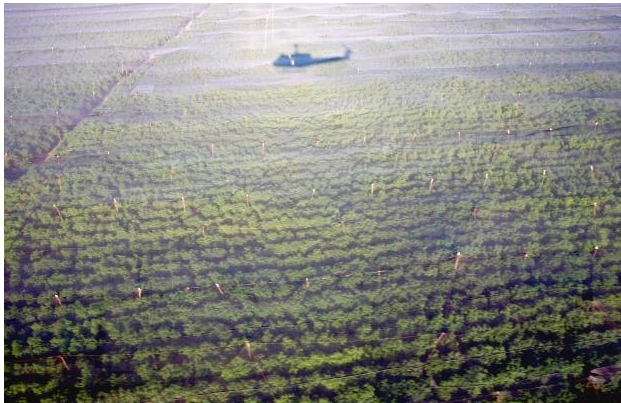
At least according to official reports:
The 300-acre [120 Ha] Baja marijuana plantation is four times larger than the previous record discovery by authorities and workers had even installed crude bathroom facilities, according to authorities. Army general Alfonso Duarte led the attack on the site saying it was difficult to detect because of the black screening used to hide the plants. The screening is often used by farmers in the area to protect plants from the desert sun.
The record-book designation needs an asterisk. This is the largest CONTIGUOUS marijuana field. Rafael Caro Quintero had 540 Ha. of marijuana under cultivation in El Búfalo, Chihuahua when the ranch was raided by Mexican military and police units in November 1984, but in several different fields.
I have no problem with those that just say legalizing marijuana would be somehow beneficial to Mexico. But, to whose benefit? There’s undoubtedly a place in this world for boutique marijuana grown in water rich British Columbia under artificial lighting (though at a high energy cost), but one’s kidding themselves if they think this is a benefit for Mexican family farmers.
The location — in the Baja — is ideal for sales in the United States, but I’d be more concerned about the environmental effects of large-scale monoculture plantations dependent on “a sophisticated system of piped-in irrigation to support the plants… fed by two wells” in the desert.
And, those plantations would probably in foreign control — not that it’s a conspiracy or anything, but with the government of the largest consumer country happily forking over tons of cash to wipe out the Mexicans entrepreneurs and limit their access to capital, operations like this are more likely to benefit Archer-Daniels-Midland than anyone in the Baja once the U.S. gives up prohibition. Caro Quintero at least invested heavily in Chihuahua and his native Sinaloa, which I don’t see some foreign corporation headquartered somewhere like Omaha, Nebraska (or, on Wall Street) doing. Nor, like Caro, at least leaving wild corridors between fields.
Of course, burning the crop (which the government plans to do) seems something of a waste, the estimated yield of 120 metric tons, that’s just under 100 Woodstock Units (based on the estimated 1.5 grams of marijuana per person per day smoked by the estimated 500,000 people from 15 to 18 August, 1969 at the Woodstock Music and Art Fair in Bethel, New York).
«No sieur, c-ést la Révolucion!»
Allons enfants de la Patrie,
Le jour de gloire est arrivé !
Contre nous de la tyrannie,
Métal lourd est levé!
Trafficking in minors?
U-17 Mexican forward Marco Antonio Bueno Ontivero is apparently being offered a contract by the Liverpool Football Club. He wouldn’t be the first Mexican to go abroad to work at a very young age, but aren’t the British big sticklers for pushing for laws against trafficking in minors? The Culiacán native just turned 17 in March.
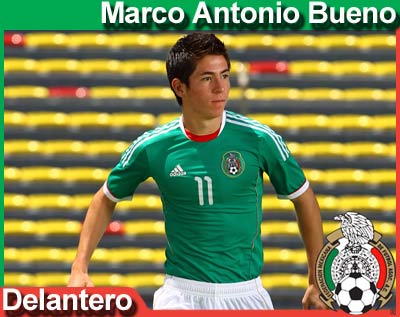
Photo: sinaloadeportes.com.mx


 mexfiles.net