Its draining men… hallelujah?
Writing on the skewering of the natural sex ratio of 105 males to every 100 female live births resulting mostly from sex selection abortions in India and China (and elsewhere) that have led to a world-wide gender imbalance of 107 males to every 100 females (and up to 150 males to every 100 females in some parts of China), Jonathan V. Last writes in Wall Street Journal:
There is … compelling evidence of a link between sex ratios and violence. High sex ratios mean that a society is going to have “surplus men”—that is, men with no hope of marrying because there are not enough women. Such men accumulate in the lower classes, where risks of violence are already elevated. And unmarried men with limited incomes tend to make trouble. In Chinese provinces where the sex ratio has spiked, a crime wave has followed. Today in India, the best predictor of violence and crime for any given area is not income but sex ratio.
…
The economist Gary Becker has noted that when women become scarce, their value increases, and he sees this as a positive development. But as [Mara Hvistendahl in “Unnatural Selection”] demonstrates, “this assessment is true only in the crudest sense.” A 17-year-old girl in a developing country is in no position to capture her own value. Instead, a young woman may well become chattel, providing income either for their families or for pimps.
There probably is a lot of truth in this, that communities (or cultures, or nations) with a surplus of unattached men have higher rates of violence. Think of the “wild west”, where at least in the movies about the only available women available were the schoolmarm and prostitutes. I’ve said before that the violence in the border communities is at least partially due to their “wild west” demographics, more in the sense that they are largely floating communities with a lot of younger, unattached adults, than having a skewered gender ratio.
Mexico is unusual in that the gender ratio is skewered the opposite way. Overall, the population is slightly skewered towards females (0.96 men for every woman) and in the Federal District and Oaxaca, there is a much more noticeable difference (both having almost 109 FEMALES to every 100 males). In several other central Mexican states (Puebla, Guanajuato, Hidalgo, Michoacán, Morelos, Tlaxcala, Veracruz and Querétaro) are more than a reversal of the “normal” gender ratio, all having at least 106 females to every 100 males (state statistics from Geo-Mexico).
While what statistics I can find on gender ratios suggest a normal 105 to 100 male to female ratio at birth, the “working age population” ratio is already skewered to females. Unless boys are dying at an alarming rate, emigration might be the most likely cause. As it is, there are entire communities in this country with nearly no adult men, which creates its own set of challenges, both for women, and for boys.
If Ms. Hvistendahl is correct, that the absence of women creates conditions for violence, then we should expect violence to drop, at least in those states with the “surplus females”. On the other hand, if Becker is right, then perhaps women need to worry about their future economic value.
Perhaps Mexico is once again an exception to the rules, or perhaps the Chinese and the Indians will need to develop a taste for wresting movies, Judy Garland and …. er… artistic pursuits while in central Mexico the women will have to wait for something unexpected:
Brand Mexico
I couldn’t have written a more succinct review than Elliot Brockner at Latin American Thought:
Roberto Newell Garcia of the Woodrow Wilson Center has published a great report titled “Restoring Mexico’s [International] Reputation.”
The basic premise of Newell’s argument is that Mexico is facing a number of problems, but that the one that gets far and away the most coverage – organized crime/drug-related violence – is not necessarily the most important. Citing successes across issues as disparate as improved health care/life expectancy and economic conditions that should be the envy of the BRICs, he implies that in many ways, things in Mexico are going well.
I heartily recommend Newell’s not overly long (about 40 pages) study of Mexican coverage by foreign (mostly U.S.) media, and its obsession with the “drug war” to the detriment of genuine Mexican successes.
HOWEVER… and there is always a catch… Restoring Mexico’s International Reputation assumes that various Calderon Administration initiatives should be included as the “good news,” which is not necessarily true.
I would certainly have expected a publication like the Wall Street Journal to have given more coverage to economic changes that benefit foreign investors, which is good news (or certainly, better news than the drumbeat of “drug war porn” suggests) but what Newell faults about business coverage is emphasis on some assumed deficiencies in the Mexican economy:
There are many reasons for this, but among the most pernicious are the unreasonably high cost of non-tradable goods (i.e. energy costs, telecoms), perverse incentive structures that cause the informal economy to grow at the expense of the formal economy where productivity levels are 30-40% higher, unresolved issues related to Mexico’s public finances that rely too heavily on oil revenues and impede the growth of infrastructure and issues related to the competitive structure of key sectors of the economy, including the labor market.
I think the report is excellent, but this assumption that the Calderon Administration proposals that — rather than strengthen the “formal economy” seek to legalize the “informal economy” — might not be considered positive steps (at least not in Mexico, although they might by the WSJ). The reforms “related to the competitive structure of… the labor market” coming from the administration seek to make it possible to legally hire workers by the hour (as opposed to today’s system under which those in the “formal economy” at least earn a theoretically living wage for their labor, no matter how many hours of actual work are included in the work day), open the market to temporary and contract laborers and give management a much stronger hand in labor relations.
Energy costs aren’t particularly onerous, although with “green pricing” wasteful energy practices are costly. Administration and opposition proposals to seriously consider alternative energy and energy savings policies maybe are more important news than carping about not following neo-liberal prescriptions.
As to oil revenues, it might not be what the north of the border press would like to hear, the news story was not that the changes were needed, but that the “reforms” proposed by the Administration simply were untenable. One might argue that the dearth of coverage of the oil extraction reforms was made worse by failure to adequately cover alternative proposals and tax reforms that have been made to at least begin to lessen dependence on what so far is not really a declining revenue source, just a declining resource that has been over-exploited since the 1890s, and should be expected to decline.
Which, by no means, lessens the value of Restoring Mexico’s International Reputation to understand the reason for misperceptions about this country.
I am much less taken with Jorge Castañeda’s sales pitch for his latest book, Mañana Forever? Mexico and the Mexicans, in Friday’s Los Angeles Times. Castañeda, who as foreign secretary in the Fox Administration, pushed for closer diplomatic alignment with the United States and in A Future for Mexico opined that Mexico’s “problem” is its historical memory, is now arguing that Mexico’s problem is that it isn’t — like the United States — a culture that prizes competition above co-operation and compromise, and one that like the ahistorical United States SHOULD simply reinvent itself, and seek to “transform its cultural, psychological and spiritual reality in a generation”.
While perfectly true that those who emigrate to the United States “adapt to a new economic, social, political and legal environment, or their enormous effort and sacrifice go to naught.” But that is true with any immigrant to any other country. One adapts to the new culture or one doesn’t.
Castañeda, like Newell, sees the “good news” being overlooked, writing:
Today, Mexico has a middle class encompassing nearly 60% of the population; it has a functioning representative democracy; it enjoys the benefits and vicissitudes of an open economy; and it has become one of the world’s most globalized countries. One out of every nine Mexicans lives abroad (a higher proportion than any other nation except El Salvador and Ecuador), foreign trade represents well over half of its gross domestic product, tourism is its largest employer and more civilian Americans reside in Mexico than any other foreign country.
This is a tremendous success story…
A growing middle class, a functioning (more or less) representative democracy and maybe even an “open economy” and “globalization” may indeed be success markers, but I am sure that the reasons eleven percent of Mexicans live abroad is not. And, I’m not sure an over-dependence on tourism (as opposed to a healthy internal market) or having a huge number of what are mostly foreign rentiers residing in the country is necessarily a “tremendous success story”. A different story than that presented by the foreign media with its fixation on narcotics and its related ills, perhaps, but one that needs to be understood. But, that story can only be understood within the context of that history Castañeda seems to believe we should all forget, and which the foreign media never learned.
It’s news to me
Two recent — and welcome — additions to the resource list:
- Reforming Mexico, which appears to come out of Washington, D.C., describes itself as “Reporting on the initiatives President Calderon is taking to improve the country and enhance Mexico’s visibility on the world stage.” It isn’t meant to offer critical analysis of the present administration, but to sell their side of the story. Perfectly fine with me… there already being more than enough of us out here in Blogswampia ready, willing and able to criticize, and even more that look at the present administration only in terms of its adherence to U.S. policy, but very few presentations in English of the administration’s own rationales.
- Mexico Perspective, out of Tijuana, is run by David Gaddis Smith, formerly of the San Diego Union-Tribune, and tends to focus on the Baja, another valuable addition, simple English language reports from that corner of Mexico too often drowned out by the voices of those with an agenda, pushing tourism, real estate, “drug war porn” or the sex trade.
A mind is a terrible thing to waste
Y… ¿cómo hizo el senador vive en Tejas por todos estos años sin tener que aprender español?
Nuestra Señora de las surfistas

She shows up in every medium from tattoos to auto-body paint and glitter on aluminum, so why not in a 3 by 3 meter glass and rock mosaic on a railroad bridge pier?
And, having taken an interest in the affairs of this world since she and Juan Diego Cuauhtlatoatzin conversed in Nahuatl back in 1531, why shouldn’t she show an interest in the way we treat the planet? La Virgen has appeared in any number of guises over the centuries, and why not on a surfboard?
Alas, the appearance of the Lady of Tepayac in Encinas California last Good Friday (and Earth Day) is less a miracle than yet another … er… irregular art installation… by Mark Patterson. Through his attorney, the artist send a letter to the City of Encinas, offering to assist with removing the work, which has attracted a serious offer from serious collectors (who incidentally also offer to reimburse Patterson for any fines he may face as a result of what is technically vandalism of public property).
One of the more ridiculous reasons given for removing the work is that Encinas mayor James Bond (that’s his real name) frets that the city could be sued for showing religious bias… towards saving the ocean?
A modest proposal, Mr. Bond. Seeing she’s a Mexican and all, perhaps la Virgen might be eligible for repatriation to her homeland. And, as a surfer-chick, perhaps the best place in Mexico for her would be Ahem… Mexico’s Surf City… which has good beaches and surf, and… as an added bonus… if installed in the proper setting, might at least visit bring the heathen into what is now in the running for the world’s ugliest cathedral (built of cinder block and yellow brick):

Days of future past in Oaxaca
Oaxaca has always been the most complicated of Mexican states. Where the rest of us make do with municipalities (roughly equivalent to a U.S. county, and usually doubling as a federal congressional district), the challenge, since Colonial times, has been to impose a centralized governing system on a multi-cultural, multi-linguistic, geographically fragmented political sub-division. In modern (post-Revolutionary) times, the state has been divided into eight regiones that correspond to various traditional ethnic communities, the regions being further divided into distritos, which have any number of municipios. Complicating the political situation, with the recognition of “usos y costumbres” added to the Federal Constitution in 2001, and to the state constitution, local government and elections may not conform to the standards of the modern state, but follow time-honored practices for better or worse.
Over the past few years, the state has been best known to outsiders for the sometimes violent confrontations between an entrenched PRI state machine and various opposition groups. With the electoral success of an opposition coalition in capturing the governor’s office last year, the state’s political troubles seem to have dropped off the radar for most of us, who forget that with the complicated governing structure in Oaxaca, there are still opportunities for heavy-handed machine politicians to maneuver, on a less noticeable scale.
In San Francisco Tlapancingo, a municipio of about 1250 people in the Silacayoapam distrito of the Mixteca region, the same election that saw the end of the PRI’s 80 year dominance of the state government and put a Convergenia candidate running as the head of the anti-PRI coalition, Gabino Cué Monteagudo, into the Governor’s office, also returned a PRI municipal government.
Claiming Governor Cué did nothing about the alleged fraud in the local election (San Francisco Tlapancingo’s presidente municipal, Pablo Abelardo Vargas Duran enjoying the backing of two powerful PRI deputies [state legislators], as well as having his own armed bodyguards, 200 or so citizens walked into the municipal palace and “went native”. They simply declared the community would be run by “usos y costumbres”, locking out the elected (and they say fraudulently elected) officers, installing their own, and informing the state elections commission that an assembly of the people would be running the community from now on.
The new municipal government is rejecting any state interference, including development, in their community, planning to go it alone through self-financing and “tequios” — compulsory communal labor. Oh, and by the way, that state interference includes the state courts, the state police and the federal army.
This may not be one of those types of events I mentioned in the post below. Or it may be. Mexico is not a primarily agrarian society (and hasn’t been in a very long time), so the happenings of an indigenous rural commune may not be all that important. Nor is San Francisco Tlapancingo exactly on anyone’s political or cultural radar, and what happens in Oaxaca generally stays in Oaxaca.
What makes it worth noticing is that here, the people are turning to tradition — history — to find a way out of what they see as a failed political and security situation.
Tacos, narcos and history with a capital H
Like any self-taught historians (and maybe those who went to Famous Historians School too), one is always conscious of the danger in saying event X was the proximate cause of event Y. One reason it took me a longer than expected time to write “Gods, Gachupines and Gringos” (besides annoying interferences like… life itself, and the need to earn a paycheck) was that I ended up writing the chapters on the Mexican Revolution of 1910-20 at least four different ways, based only on the most “mainstream” of interpretations of why the Revolution happened. Even by focusing on what X factors were seen as having Y result, I discovered that how “X” was experienced, or interpreted at the time it happened may have absolutely no bearing on its ultimate significance. Sometimes alternative histories simply provided a better guidepost: almost none of the “mainstream” histories, for example, say anything about the 1901 roundup of gay men in Parque Alameda, but alternative historians like Carlos Monsivais recognize it, in retrospect, as a major cultural landmark. If nothing else, the rumors that Porfirio’s son-in-law was among those picked up (but released) was an early sign of a growing resentment of “impunidad” for the ruling clique, and a reminder that resistance to the regime was not purely based on political or economic beliefs.
Very few, if any single events, can be said to “make history,” and even those events that are said to be watershed, are the results of events A, B,C… in some combination or another. The best I can do, or even the FHS grads can do, is say “something happened, which probably had a lot to do with these other things, which happened because of these other things” and hope there is some semblance of a pattern to the whole that lets us think creatively about the events (important and otherwise) that happen to us today.
What I tried to do in Gods, Gachupines and Gringos — and what seems most sensible to me — was pick among those singular events those which, whether their significance was recognized at the time or not — best fit the framework I chose. That Benito Juárez would order in tacos at cabinet meetings probably doesn’t affect history with a Capital H, the way tortilla-lovin’ Porfirio Diaz’ victory over Juárez’s successor, Sebastian Lerdo de Tejada, at the Battle of Tecoac did. But I included these non-significant events to provide a glimpse into the cultural sensibilities of the Mexican elites of the 1870s, and the tension between the “European” and traditional ways of life that I selected as the framework to understand this particular country’s recent (since 1521) history.
Had I been writing in the 1870s, I don’t know if I’d write about the eating habits of Don Benito and Don Sebastian and Don Porfirio. I doubt it would have even been newsworthy, and suspect had there been foreign bloggers in 1870s Mexico they would have been as dismissive of those Mexicans who mentioned such matters as 2011 bloggers were dismissive of those who wrote about Don Felipe’s supposed fondness for “adult beverages”.
Not that the choice of food or drink is at all an event of historic signficiance (not Capital H, Historic, anyway), but the hoo-haw over rumors of heavy drinking by Felipe Calderón — or the commentary and effect of commentary — about it, said quite a bit about Mexican sensibilities and the perceptions of the sitting President. Will it affect “history with a Capital H?”
Who knows, maybe will be considered worth mentioning in some Mexican history written about 2145. I am not in 1875 Mexico City, nor in 2145 Ciudad Carlos Slim, but in 2011 Sinaloa. Like anyone else, my perceptions of what is, and isn’t significant, and what will be seen as significant in the future, are biased and based on an incomplete understanding of what went before and what will come after. I choose not to write much about the “drug war,” not because I don’t notice it (there’s no way NOT to notice it), but at least in part because I have my doubts that any particular bit of criminality in itself it is anything more significance than Don Benito’s tacos, or Don Felipe’s alleged boozing.
I don’t mean that the mayhem and murder only shines a light on key individuals, of course, but only that I am not sure any shooting, or head-chopping or armored truck discovery isn’t just another example (out of any number of examples) of periodic banditry that crops up during social crises, or just another problem caused by agricultural exports, or just a by-product of the late 20th-early 21st century economic dominance of the United States.
I DO think the “Drug War” is coming to an end, and perhaps sooner than I realize. Rumors of alcoholism in Los Pinos wasn’t so much about the truth or non-truth of the story, but one of a number of signs of growing distrust of the visible leader of the “Europeanized” economic/social system which includes acceptance of “Plan Merida”.
Perhaps the “X event” is Javier Sicilia’s call for a complete rejection of “Plan Merida.” Although Ganchoblog, which sees Sicilia’s movement as more or less a meaningless sideshow, dismisses the importance of Plan Merida as “a tangential issue for Mexico,” it’s tangential only in the sense that the whole “drug war” has been tangential to history with a capital H”. hard to dismiss the impact the ill-conceived program had on this country.
We need to go to the root causes of the issue: the young people without opportunities, who are being killed or live in terror, who have a limited chance to make a living because salaries are so low, or the others who, without opportunities, join the ranks of organized crime–or unorganized crime, because we don’t even know what it is anymore, then the future of our country is dead; the future for our youth, our children, and our grandchildren is practically broken, undone.
If we don’t approach the problem holistically, if we just keep spending money on violent responses to it, then we’re on our way to a military/police state–a disaster worse than what we’re experiencing now.
— Javier Sicilia, interviewed by Laura Carlsen
It hasn’t only been the intellectuals (which have HISTORICALLY been of prime importance in setting the national agenda) who see the “war” as a U.S. financed operation, but Sicilia’s movement seems to be growing, and it’s not so much a question of whether the state responds directly to this or that specific demand, but whether such a movement represents a genuine trend in Mexican culture, and that the state is forced to respond to the trend in some way.
I believe we are seeing genuine change. Some are troubling, like the attacks on drug rehabs — which could be the gangsters response to fears of narcotics sales in Mexico, or extrajudicial action (i.e. death squads) with the same goal as the gangsters, or, as some of the ¡No mas sangre! people suspect, a desperate attempt to deter what is a growing social movement. Others, less noticed, are state actions.
Lorena Martínez, Aguascaliente’s Presidenta Municipal, in announcing new investments in cultural activities highlighted that the budget for new programs is coming, in large part, from her public security budget:
We are perhaps the only municipality in the country which has allocated more than 10 percent of its crime prevention budget to the Institute of Culture. Instead of spending money to buy guys and cars, we are investing in this area.
Can we say this was not a direct result of the ¡No mas sangre! movement or Javier Sicilia’s peace march, or that it isn’t part of the same anti-militarization trend?
While there is recognition that changing cultural attitudes towards the police — something supposedly financed by Plan Merida — will likely require generations of change, is the decision to fire 400 Juarez police officers (ahead of the Sicilia’s peace caravan) related, as the Latin American News-Dispatch suggested?
[Chihuahua Governor Cesar]Duarte also announced last month a call for young professionals and college graduates to join the police forces of Ciudad Juárez and other cities in Chihuahua that have been riddled with corruption and drug cartel influence. The new strategy, which raises the pay for recruits with higher education, hopes to draw in 2,100 college students into Juárez’s police force alone.
Both of yesterday’s announcements came as hundreds of protestors are crossing the country in what has been dubbed the “Caravan of Peace.” The week long, 12-state tour that ends in Juárez was started by poet-turned-activist Javier Sicilia after his 24-year old son was killed by cartel members in March.
And, is it only coincidence that in the United States there are question being raised in the United States is about how Plan Merida and other “anti-narcotics project” funding is being used?
“We are wasting tax dollars and throwing money at a problem without even knowing what we are getting in return,” Sen. Claire McCaskill (D-Mo.), chair of the Senate subcommittee that authored the report, said in a statement Wednesday.
In total, the U.S. government paid contractors more than $3 billion for work in the war on drugs in Latin America between 2005 and 2009. Counternarcotics contract spending increased 32% over the five-year period, from $482 million in 2005 to $635 million in 2009.
When Felipe Calderón gave the commencement address at Stanford University last week, an airplane flew over the stadium pulling a banner.

That the meaning was lost on most of the the Californians, but that is to be expected, given the lack of coverage of this country’s social movements in the United States. After all, no one expected the North African and Arab Spring either, which didn’t mean political and social change wasn’t in the air, and floating around in cyber-space and the marketplace.
I don’t know how much the foreign media is paying attention to Mexican cyber-communications, aside from that related to the narcotics story. Or to the frustrated middle class, the “ni-nis”, the “alternative politics” of MORENA and the Zapatistas and the ¡No mas sangre! and other peace movements.
Don Porfirio is said to have quipped, “nothing happens in Mexico… until it happens.” Those who report can only say “nothing happens” and those who look at our history — which ends in some surprising change that turns out to be a compromise (like those that ended the Cristero War, the Reform War, the War of Independence, the Revolution, the reign of the PRI, etc.) — can only hope that what we believe to be signs are signs of a change for the better.
Glad they cleared that up
Via SDPNoticias:
Mexico City – The PAN federal administration openly contradicted itself claiming first that killing and capturing “kingpins” in the “drug war” does not cause violence, then adding that the violence is due to a “succession crisis.”
rough national security spokesman, Alejandro Poire, the PAN government said it was a myth that killing drug lords increased violence in the country, blaming increased levels of mayhem on other factors.
However, the “other factors” which were specifically mentioned include disputes over control of territory by criminal gangs following the death or arrest of their leaders.
Higher politics
I know there are those who say the Andres Manuel Lopez Obrador associated MORENO ( Movimiento de Renovación Nacional) will go to any length to get its message across, but it appears it will also go to any height…
Makes sense to me
I’ve been bemused, amused and appalled by the attempts to define Mexican gangsters as something other than just gangsters.
“Cartel” has been the most popular term, although a cartel, properly speaking, refers to groups that collude with each other, not guys engaged in cut-throat (and head) competiton for the same market. There’s some support (among U.S. right-wing politicos) for “terrorist”, but — having realized that U.S. law strongly sanctions those who “aid and abet terrorists”, which would include the gun dealers who include the “cartels” among their best customers, that idea has sunk.
A few ridiculous bloggers, seeking to sound important, use the bureaucratic terms DTO (Drug Trafficking Organization) or TCO (Transnational Criminal Organization) more out of a sense that by using the mil-speak, they’re saying something more important than they are, or that they have access to some special information the rest of us lack.
I finally, though, ran across a term that works very well, and, more importantly, defines gangsters within a broader economic and social context:
Violent entrepreneurs are mostly private groups that create “a set of organizational solutions and action strategies enabling organized force (or organized violence) to be converted into money or other valuable assets on a permanent basis….Violent entrepreneurship is a means of increasing the private income of the wielders of force through ongoing relations of exchange with other groups that own other resources.”
The phrase itself was coined by Vadim Volkov, an Associate Professor of Sociology at The European University at St. Petersburg, and was the title of his study of Russian “business” organizations (criminal groups, private security services, private protection companies, and informal protective agencies associated with the state) in the 1990s.
Besides being applicable to Mexican marijuana and poppy exporters (and meth manufacturers), as businesses, and nicely encapsulating exactly what it is that Cartels … er… DTOs … er… TCOs… do… it seems to cover those organzations that are in the repression biz and should be — in a just world — treated the same way: Canadian mining firms that kill Salvadorian environmentalists and Peruvian Indians, Honduran palm-oil planters that sic private “security guards” on local farmers, private prison firms that invest in criminalizing immigrants …
Law and holy orders
Is it any wonder that journalism is even more dangerous a profession in Honduras than it is in Mexico?
Speaking on the subject of the historically sacrificial role of the Honduran police force, [Honduran vice minister of Security Armando] Calidonio has stated that the police “are now training in order to efficiently respond both to enemies of democracy that go around with AK 47s and enemies of democracy that go around with pens trying to discredit the police, who [themselves] put their lives in the line of fire every day so that the honest citizenry can enjoy peace and tranquility”.
Belén Fernández, “How to avoid extrajudicial execution in Honduras: throw popcorn”
At least, officially, it’s the gangsters who are said to have killed journalists in this country (those who haven’t been met untimely ends after covering environmental crimes, or report for dissident indigenous radio stations), but more than a few journalists have either fled the country, or been “detained” illegally to suggest a rather less than respectful attitude towards the fourth estate when it comes to the forces of law and order.
Felipe Calderon recently called for making police work a “civic priesthood,” suggesting that — somehow — it becomes a respectable profession (unless of course, he’s thinking of priests like the late Marciel Maciel, whose personal corruption was on a plane far above that of even the greediest of Mexican coppers), one that requires training and discipline. Which the U.S. government is supposedly assisting with. Or, rather, thinks it’s contracting for:
Private companies have played a major role in the U.S. government’s efforts to train Latin American law enforcement agencies and increase intelligence-collection efforts against drug cartels.
…
In total, the U.S. government paid contractors more than $3 billion for work in the war on drugs in Latin America between 2005 and 2009. Counternarcotics contract spending increased 32% over the five-year period, from $482 million in 2005 to $635 million in 2009.
…
The single largest category of contracts awarded by the Department of Defense during this period was for “intelligence, surveillance, and reconnaissance” in Latin America, according to the report.
Intelligence, surveillance and reconnaissance… directed against those “enemies of democracy” with AK-47s, or those wielding pens and television cameras?
Rockdrigo, the nopal prophet
Rockdrigo, Rodrigo González (born Christmas Day, 1950), left his native Tampico at 18 to study psychology at Universidad Veracruzana, in search of a better understanding of his own, and his nation’s complicated psychic makeup.
Rebelling against the prevailing Freudians in Mexican academia of the time, he abandoned the University, but continued his studies with the indigenous psychologists of the Huastaca, whose well-known mushroom therapies was sometimes credited by González both with his keen insight into his, and the general Mexican, psyche.
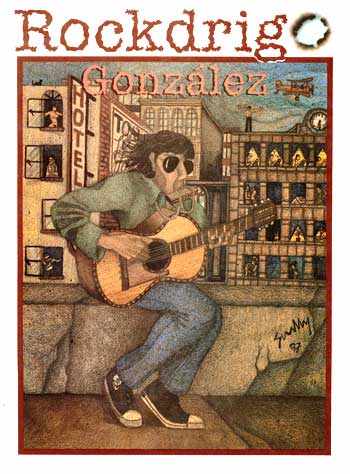 Arriving in Mexico City in 1977, he immediately identified himself as a Chilango… one burdened with a rich and complex tradition, forced to make one’s way in the heartless contemporary urban world. And, as the “nopal prophet,” gave his fellow Chilangos… and fellow Mexicans… a rare insight into their own complex psychology, in a most unFreudian setting.
In other words, he pioneered Mexican rock… creating a style based in the tradition of the humor of the cantinas and streets, the love ballads and lullabies of the countryside, mixed with the cynicism of the Mexican intellectuals and wrapped up in the new internationalism of the post-1968 generation.
Although he presented himself as a street musician, his was an increasingly influential public figure, sought out not only by musicians but by the intellectuals and artistic community as well. It is said, “He ate the City… and the City ate him,” dying at the age of 34 during the 1985 earthquake.


 mexfiles.net