A sweeping generalization
Sweeping my sidewalk last evening, I realized why the two Arizona shootings of note last week would not have happened in Mexico.
It’s not so much that the types of guns used in shootings here tend to be weapons one can’t buy in Mexico; are statistically likely to have been brought in from the United States; and likely as not the supplier of weapons to Mexican gangsters sources for the was an Arizonan. It’s that when there are shootings, they are rational business decisions: gangsters, not having recourse to courts to settle their disputes, have to use violence. And, after all, being gangsters, their in the violence business. Which, of course, leads to the state’s response with massive firepower, and — an eye for an eye and all that — sometimes the wrong people get killed.
And, of course, we have political murders… all too many of them although — trivial as it sounds — I like to point out that Mexico has never had a sitting president assassinated (Guerrero, Madero and Carranza were all killed after constitutional coups, and Obregón had not assumed office when he was murdered).
We have more than our share of shootings here in Mexico, and there’s no excuse for them. Nor for the shameful treatment (or lack of treatment) for mental illness. Of course, professional killers are — by by most definitions — probably not in their right mind (although, legally, more than likely sane) and the survivors of their victims and those who have been kidnapped or injured have experienced serious mental trauma, but the “crazed loner”, a staple of violence north of the border, is practically unknown here. The Balderas Metro killing in September 2009 was about as close as we’ve come to a slaughter like that in Arizona last weekend. In the Baldaras killing, a grafitti “tagger” pulled a gun and shot a police officer, and a civilian who died as he wrestled with the seriously disturbed shooter. As in Arizona, the killer appeared to have a incoherent political agenda (something about global warming in the Balderas incident, which makes a little more sense than mind control through grammar in the Arizona one) and a gun (but only with six, not 31 bullets, in the chamber). It shook this country deeply, and was a national trauma.
The “rational violence” we regret, but understand on some level. Balderas, and the shooting in Arizona make no sense to us, nor are they part of the culture, nor are we likely to experience that kind of thing… not so much because I sweep my sidewalk, but WHY I sweep my sidewalk.
I come from an individualist culture, and have lived a good part of my life independently. And, like a lot of writers (and crazed loners, I suppose), I have more than my share of eccentricities and crotchets that perhaps are not always considered “normal” wherever two or three are gathered.
Mexicans, while they prize personal autonomy, are part of a communalist culture. Quirky behaviors, even those indulged in publicly, are tolerated… within limits. Even anti-social acts are, to some extent, overlooked. If an individual’s anti-social behaviors are harmful, they are usually not ones that affect the community as a whole.
We are told that Jared Laughner lived with his parents. It’s something of a joke that in the United States, when a young adult lives with his parents, people ask what’s wrong with him. In Britain, they might ask what’s wrong with the parents. In Mexico, we’d wonder why anyone would think there was anything wrong. The Balderas killer also lived with his family, but — as I noted — he was (so far) an out-lier in this society. As a footnote to the tragedy in the Metro was the news that the killer’s uncle dropped dead … presumably of shame.
Family ties are that strong. While subordinating the individual to the family creates its own set of mental health and violence problems (domestic violence is a seemingly intractable problem in this country), the extended family provides society at large some shield against the anti-social acts of individuals. If the parents are unable to control an anti-social child, then a cousin, an uncle, a grand-parent is likely to step in. I once saw an elderly man whipping (literally) a drunk outside a cantina in my old Mexico City neighborhood. I was told to stay out of it (not that I would be involved), the old guy being the drunk’s grand-dad, who’d been called down to handle some disturbance which had violated the norms of rowdy cantina etiquette.
Of course, the flip-side is that there are anti-social family units. If you read the police reports, criminals are usually not free-lancers, but part of a “peer group” more often than not related by blood or marriage. And, once again, these are rational criminals, not the crazies. And one notices that gangsters very seldom take their work home with them… and there is a second line of defense against irrational violence.
Jared Loughner’s family apparently has lived in the same house all his life (or most of his life), which itself is somewhat unusual in the United States. And not at all unusually, the neighbors knew nothing about the Loughners, or very little. I can’t find it right now, but in either An Easy Thing or Some Clouds — the two first Hector Belascoarán Shayne mysteries from Paco Ignacio Taibo II I re-read last week, a character mentions leaving her Canadian husband because she couldn’t stand living in an isolated house standing apart from its neighbors. Of course, the character is a die-hard Chilango, but it’s not just cliff-dwelling urbanites who feel that way here. One thing that Mexican writers on Texas during the buildup and course of the Texas War of 1836 was that the gringo settlers lived on isolated, discrete farmsteads, unlike the Mexicans who lived in communities and went out to their fields, or farmed cooperatively.

Photo by Bob Fairbanks (http://www.worldisround.com/articles/10744/photo4.html)
It’s not so much that we live cheek-by-jowl in Mexican communities — even in the new, U.S. style suburban developments and gated communities — are social units, and not just collections of autonomous smaller family units (made up of autonomous individuals). Though my interactions with my neighbors may be limited to a civil “buenos días” or an uncivil complaint about parking spaces, even a newcomer is immediately a part of the community, and expected to adhere to community standards of behavior. One’s personal quirks are tolerated, as long as one follows the communal rules. The commune (even if the commune is a block of houses on one street in one colonia in one seaport) has its own unwritten code, one that may not always make sense to me (loud music from the workshop down the street is ok, unswept sidewalks are not) but one that insures that the neighbors will be keenly aware of aberrant individuals.
Even eccentric foreign writers try, as any rational person would, to adhere to the minimal standards of decency, and that means sweeping the sidewalk. A litter-free sidewalk doesn’t mean the crazed loner will be brought to the attention of the authorities, or receive any sort of treatment, or turned into a productive social unit, but a sense of community (and lack of access to Glock 9 mm automatic pistols) might at the least render the crazed loner harmless.
Guns don’t kill people: Arizonans with guns kill people
A 17 year old boy was shot in the back and killed last week in Nogales, Sonora. The gun was fired in Nogales, Arizona. The initial explanations from the U.S. Border Patrol made no sense. As Immigration Clearinghouse posted on Thursday:
It took the players all day to get their stories to a point where it was agreed that the agents fired their weapons into the air, and they put Torres as either “in the US, throwing rocks at agents, when he fell and hit his head on a rock and died”, or, he fell from the fence which he was trying to scale while chunking rocks at BP agents, a truly awesome display of athletic ability were it to be true.
By Friday, Jonathan Clarke, Luis Alatorre and Cesar Barron from the Nogales International were able to piece together what sounds like a more plausible explanation. Another boy, who admits he was in the United States and was trying to elude the Border Patrol and as the boy admits, “he was wearing a ski mask at the time – to ward off the cold, he said – and the mask may have frightened the agent.”
It’s unlikely (as a federal spokesperson was quoted by Immigration Clearinghouse) that a federal agent would have fired a “warning shot” in a populated area, but it is possible one would have fired off a shot if he felt threatened. That the International‘s source is admitting to wrong-doing makes the story all that more believable. The source suggested the agent was shocked by what happened… apparently shooting Ramses Barrón — who was in Mexico — through gaps between the upright metal poles on the fence. Adding to the plausibility is that no one (not even Barrón’s family, whose claims that the kid was perfect would be taken by any cynical news reporter at less than face value) claims Barrón would not have been likely to cross the fence: something he did regularly, to see his girl-friend on the Arizona side.
Still, one asks if this would have happened absent the political pressure to put armed guards and a fence through the middle of Nogales (a la the Berlin Wall) and if Arizona politicians and media figures had not painted informal border crossers (like a teen-aged boy from — literally — the wrong side of town) as criminals, gangsters and terrorists.
Of course, I don’t know the state of mind, the motives or anything about the Border Patrol agent who killed Ramses Barrón, nor do I know anything about Jared Laughner, the apparently disturbed young man who murdered a Federal District Judge, a nine-year old girl, two others and seriously wounded Arizona Congressional Representative Gabrielle Giffords and several others in Tuscon on Saturday.
It’s clear so far that Giffords was the intended target of the shooter. Ms. Giffords, a conservative “blue dog” Democrat, was one of those Arizona politicians who did push for armed agents along the border (she was pushing for even more “security” resources that was eventually appropriated) and was a moderate supporter of “gun rights”. For all that, Representative Giffords was targeted (literally) by Republican Party opponents as a insufficiently reactionary for an Arizona politico. As a Latin American scholar (and former Fullbright Fellow, working at the University of Chihuahua) she was considered slightly more reasonable by Mexican and Mexican-American activists than other Arizona politicians. That alone makes her a “liberal” by Arizona standards.
Although there have been attempts to “explain” Jared Laughner in terms of left-wing politics, it is becoming more and more apparent that his peculiar obsessions were ones usually found on the extreme right of U.S. politics. Of course, I tend to think the right-wing is nuts, but this guy was, from all indications, completely bonkers, and, if it hadn’t been some obsession with the gold standard and “mind control” through grammar, it would have been something equally wacky.
Certainly, the rancid political climate in Arizona that he glommed on to, in a state where guns are more easily available, even for the mentally disturbed, than most places. had a lot to do with this tragedy. The Arizona Legislature, by the way, last year made it easier for the mentally ill to buy guns, and slashed funding for mental health treatment.
Puedo ver una pendeja de mi casa
From Lima, Peru, a thought on U.S. politics shared throughout Latin America:
Apart from one person, I don’t care who you guys up there have for President any longer. Black, white, rich, poor, man, woman, Rep, Dem, the degrees of difference between them all on the things that really matter are minimal (though you’d hardly notice it from where you’re looking, it’s much easier from afar). If you want Romney, Clinton, Bloomberg, another Bush or anyone else from your limited spectrum of politics next time, that’s ok by me and you won’t hear me moaning. But not Palin. She’s not only a limited intellect but a liar, a vindictive petty-minded snake-oil salesperson, belligerent and dangerous not only to you but to the rest of us. I hope that’s clear enough.
English for idiots
… I would make the point that the leader and the speaker have established their integrity and their mendacity for years in this Congress…
U.S. Representative Steve King, new chair of the House Judiciary Committee, and proponent of English-only legislation.
I don’t often agree with Mr. King, but one has to assume that he knows English and said what he meant . He and his ilk have indeed proven their mendacity over the years.
A likely story…
According to the U.S. Border Patrol, Ramses Barron Torres, 17, was on the U.S. side of the border fence between Nogales Sonora and Nogales Arizona, chucking rocks at BP agents, when he slipped and fell (on the Mexican side), hitting his head on a rock, and dying.
Which requires a little explaination of why a truck with Arizona plates dumped his body in front of a Nogales Sonora hospital where an autopsy discovered the teen-ager had been killed by a gunshot wound to the back.
Business as usual on the border.
Danger south of the border … the Mexican border
Tim’s El Salvador Blog (one of the best English language blogs in/on Latin America) highlight this report from the Salvadorian daily, ContraPunto which Otto at Inca Kola News ran through his magic chart thingy:
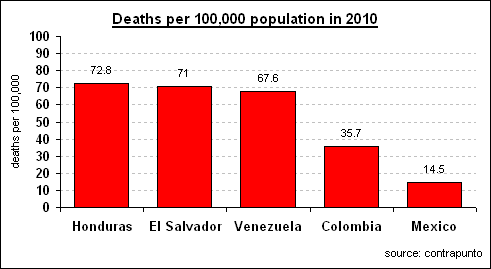
Erroneous data disseminated by international news agencies claim Venezuela, Colombia and Mexico as the most violent countries in Latin America and the world: However their murder rates are lower than those of Honduras and El Salvador.
As things stand, at the end of 2010 Honduras had a murder rate of approximately 72.8 for every 100,000 inhabitants, while El Salvador had a murder rate of 71.
Venezuela had 17,600 homicides in 2010. With a population of 26 million, its murder rate is 67.6 per 100,000 inhabitants. In Colombia, the murder rate is 35.7 per 100,000 and in Mexico 14.5 per 100,000.
Honduras is particularly dangerous for journalists. According to the Committee to Protect Journalists (which is extremely conservative in defining work-related deaths) three Mexican journalists’ deaths are work-related, and seven deaths are being investigated as possibly work related. CPJ also attributes three Honduran journalists’ deaths to their employment, although last June alone, seven journalists were killed.
The Swiss-based Press Emblem Campaign, which also tallies journalist fatalities, uses a different criteria, under which they list 14 deaths in Mexico, tying Pakistan for the most dangerous country overall, but records 9 deaths in Honduras, which has a population only 8 million compared to Mexico’s 115 millions, and has a much, much smaller media presence.
All rogues lead to Romo?
01 de marzo de 2011: A small correction, after reading José Gil Olmos’ La Santa Muerte: La Virgen de los olvidados (2010: Debolsillo, Mexico), who says Romo was never ordained a Roman Catholic priest.
Nine people, including one 17 year old, were arrested as the supposed members of a kidnapping gang. The usual perp-walk was unusual: The alleged gangsters (all but one, who is 17, and was turned over to juvenile authorites) paraded before the cameras were dressed in white, and “front and center” was the alleged leader, Bishop David Romo Guillén.
A bishop of the Iglesia Apostolica Catolica Tradicional, David Romo, is the leader of the Santuaria Nacional del Ángel de Santa Muerte — de facto “Pope”, if you will, of what’s usually described in more sensationalist media coverage as the “death cult”, or a “narco-cult”.
I’m not privy to any information about Mexico City criminal investigations and can’t comment much on the merits of this particular case. Whatever the merits, it remains a fact that David Romo, more than anyone else, is responsible for having turned an obscure sect that’s been around since the 18th century, into an organized religion with some political and social clout within Mexico.
If Romo is a gangster, he is something of the mirror image of that other Mexican clerical rogue of recent memory, Marciel Maciel, the leader and guiding spirit behind another sinister cult (though one more acceptable and tolerated by spiritual and temporal authorities) — the Legionnaires of Christ.
Romo, like Maciel, was a Roman Catholic priest who surrounded himself with a devoted following and built up a “cult of personality”. Romo, perhaps to his credit, never sought to deny or hide human frailties, but embraced them. Finding the strictures of the Vatican-headquartered Church too restrictive, he transferred his allegiance to the break-away Roman Ritual church, the Iglesia Católica Tradicional México-Estados Unidos. That sect, which is rooted in the folk beliefs of its adherents, was more willing to incorporate the cult of the “White Girl” (Santa Muerte) in their doctrine.
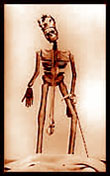
San Pasquilito Muerte
Although somewhat underground, Santa Muerte believers have been organized in some fashion since the 18th century. As a folk-saint, Santa Muerte was not all that unique. One thinks of San Pasquilito Muerte (“Dead Saint Pasqual”), a Chiapas and Guatemalan “sacred skeleton” which has been “doctrinalized” (if there is such a word) within the Mexican Apostolic National Church (a western-rite Orthodox communion). Other than the band named for the saint, however, the San Pasquilito “cult” never has gone “mainstream” like Santa Muerte. Both belief systems (sub-systems?) date from colonial times, both feature a death figure (San Paquilito’s wooden skeleton is venerated as a holy icon in at least one Chiapas church) which makes it a “death cult” — meaning not a worship of death, nor what is usually meant by “cult” in the United States (a small religious denomination we find distasteful). All religions in Mexico are technically “cults” (culto being the legal term for any organized religious body), and the death symbol is both a Christian memento mori and a symbol of the interconnectedness of life and death.
And, as it is, most students of Santa Muerte accept that the better known of these two “death cults” was heavily influenced by the iconography of San Pasquilito.

David Romo Guillén (Reuters photo)
Had Santa Muerte remained, like San Pasquilito Muerte, a rural folk religion, we’d see it as a colorful, weird, but harmless custom. Which, I believe, it is. The small number of Santa Muerte followers in the United States are probably more typical of Santa Muerte believers here in Mexico, despite the Los Angeles Times’ odd contention that California sunshine (in Los Ageles?) turn it into a “new age” belief system:
“It’s sort of like the Virgin for people on the edge,” said Patrick A. Polk, a folklorist and curator at UCLA’s Fowler Museum.
…
Followers, many of whom call themselves Catholics, talk less about death than about cleansing the spirit and developing inner strength.
“Everything depends on oneself,” said Miguel Velasco, a former administrator and a “spiritual guide” at the 3-year-old Sanctuario Universal de la Santa Muerte on Alvarado Street. “You can believe in God, or a saint, or even a tree. But what really matters is the faith you have. Faith can move mountains.”
Leaders here characterize the practice as benign, and devotees appear to draw from a broad cross section of people in immigrant neighborhoods — manual laborers, public employees, couples with children, laid-off factory workers.
Santa Muerte had a presence in Mexico City going back to the 1880s, but beginning in the late 1960s people much like the Los Angeles congregants — immigrants, though internal immigrants from rural Mexico — brought Santa Muerte believers in appreciable numbers to Mexico City. As a belief system that gave hope and comfort to the outsider, it was popular among convicts (much was Islam is in the United States among minority convicts) and the number of Santa Muerte believers grew exponentially in the 1990s, in good part due to the activities of David Romo, and as a 2004 Copley News Service feature by Lynn Walker notes, the inactivity of both the Roman Catholic Church and the government:
“People are disillusioned,” said Romo, …”Here, people call out to death because they feel abandoned when they have problems. They want an answer to their needs.”
Many poor Mexicans say they feel ignored by the Mexican government and the Catholic Church, two powerful institutions that are supposed to help them.
“The doors of the Catholic Church are open, but people don’t find what they are looking for there,” said Enriqueta Romero, 58, a housewife who runs a widely attended Santa Muerte ceremony in Tepito. “Their priests are not the priests we want. We don’t believe anymore.”
While the Catholic Church staunchly opposes this burgeoning adoration of Santa Muerte, some priests acknowledge the church has failed to meet the spiritual needs of the poor.
“People are looking for comfort, but sometimes we don’t seem to have the time or interest to go out and attend to these people,” said Father Candido Hernández, a priest at San Francisco Catholic Church in Tepito…
 Politically, the 90s also saw the growth of another “populist” movement in Mexico City fueled by disillusionment with the status quo, cumulating in Andrés Manuel López Obrador’s presidential bid. López Obrador, like David Romo, were (and are) masters of the unlikely coalition. Romo, having to fight both the rumors that his church was for gangsters (which may turn out to be true in some sense) AND the perceived “special rights” for the Roman Catholic Church, made common cause with Protestants, Orthodox, Mormon and Jewish congregations to fight discrimination and hold the government to its strict neutrality in religious matters. López Obrador, whose political success was a result of bringing “outsiders” into the political system (under PRD patronage — George Grayson’s Tropical Messiah goes into great detail on this, while, coincidentally — and unconvincingly — trying to present AMLO as a “cult leader” á la Romo… or Marciel Maciel).
Both political and religious populism are threatening to the establishment. The attacks the political elites launched on AMLO are, in some ways, similar to those by both political and religious elites launched against Santa Muerte and David Romo. There was considerable controvery in 2005, when the Roman Catholic hierarchy was able to convince then Secretarío de Gobernacíon Santiago Creel to “deregister” the Santa Muerte Church on the dubious grounds that the Iglesia Católica Tradicional México-Estados Unidos had changed its doctrine.
Romo, and Santa Muerte believers took to the streets in protest, but the Federal Government has been able so far to continue to harass the Santa Muerte church. Both Mexican and foreign press reports talk of it as the “death church” or a “narco church”, going so far as to destroy Santa Muerte shrines (while ignoring those of other “narco saints” like Jesus Malverde)
With Santa Muerte possibly the largest single belief system within Tepito, and Tepito the supposed “crime center” of Mexico City, naturally, criminals from Tepito are likely to be Santa Muerte devotees. Which is a very different thing than saying all Santa Muerte believers are criminals.
Whether Bishop Romo is involved in kidnapping (it’s very possible, and he seems to have been involved, like some of his Roman Catholic brethern, in money laundering and other criminal activities), what is interesting is the great care the authorities are taking to claim this is not religious persecution. Of course, Marcelo Ebrard’s administration and the controlling PRD are seeking a more middle-of-the-road respectability and playing down the “coalition of the downtrodden” and populist image of the past, but I’ll take it on faith that Romo’s arrest is not related to his religious activities… or was an alternative fund raising technique to build HIS cathedral (a little cruder than Onesimo Cepeda’s scams) but I’d be a lot more credulous if I say other clerical criminals paraded before the cameras.
Why learn Spanish?
Yeah, there’s the purely mercenary reasons, like better employment and salary prospects for U.S. workers who can speak Spanish, but Cindy Casares (Guanabee) came up with the best reason yet to learn the language of Cervantes…
Ever heard of an English lover? Hell no. It’s a Latin lover that rocks everyone’s world and the number one language spoken by Latin people? Espanich!
By the way…
I’ve been somewhat distracted by one of “ours” (a member of the cozy community of English-language lefty commentators on Latin America) being taken in by material published on what we have always assumed was a reliable alternative media source that apparently didn’t check the story fully. The blogger was able to revise the post that mentioned the alternative media site, and, at least the alternative media site has a comments section where those affected by the story (or knowing facts that were missed, starting with the author’s personal agenda) probably have contained the damage. And, it only involved a few individuals in one Mexican city. This is troublesome, but none of us like our credibility thrown into question, or like to be put into the uncomfortable position of questioning the credibility of those we depend upon for our material.
Without getting into the messy details (not right now, anyway), I’d just say that I don’t blame the blogger, and don’t completely blame the publisher (only the original author of what amounts to slander against perfectly respectable people and organizations) for a situation that is bound to come up when one is obliged to produce more and more takes from a fresh and different perspective on a limited subject (even when the subject is as huge and generally defined as “Latin American political and social trends”). For starters, none of us have the budgets or the time, or the staff to adequately edit, fact check and develop independent material. We all do what we can, and depend on each other to make sure what we steal (er… borrow, appropriate, graciously accept) has me the standards we set for ourselves.
What is more than irritating is when outlets that DO have budgets, time, staff, etc. and an unlimited amount of material from which to chose, not only chose poorly, but misrepresent the facts and serve not to present “news” but to undermine any sense of honesty in the media.
I can’t download it (and outside the United States, access is limited), but MTV has some sort of “news” program called The Vice Guide to Everything that recently featured a “border guardian” group in Arizona, (from 07:00 to 10:10 on the video). It gushingly reported on a “volunteer militia” … You know, just — in the words of presenter Ryan Duffy — “a bunch of volunteers out here patrolling 160 miles of desert.” A bunch of volunteers in that failed state where, in the words of the group’s leader, “you can own grenades, tanks even”.
A couple of problems. The “U.S. Mexican border” show in the program is in Stanfield, Arizona, specifically in the Sonora Desert National Monument, which is quite a ways from the border. And the leader of the group, affectionately referred to by Duffy as the “Ready Rangers” are led by (and spoken for by) their leader, J.T. Ready.

Ready set to go
You know… J.T. (Jason Todd) Ready who was thrown out of the Marine Corps in 1996 after being court-martialed twice: once being absent without official leave, larceny and “wrongful appropriation”; and again for conspiracy, assault and solicitation.
The J.T. Ready is the Arizona spokes-model for the National Socialist Movement… twhose website tells us “Only those of pure White blood, whatever their creed, may be members of the nation. Non-citizens may live in America only as guests and must be subject to laws for aliens. Accordingly, no Jew or homosexual may be a member of the nation. ”
The J.T. ready who , in October 2009, at a National Socialist Movement rally said “This is a white, European homeland. That’s how it should be preserved if we want to keep it clean, safe, and pure.” Keeping it “white, safe and pure” means placing landmines on the border and ridding Arizona of latinos and Jews.
The J.T. Ready NOT presented by Ryan Duffy who is either too lazy (and/or stupid) to do five minutes of fact checking, or whose employer is lazy, stupid or — dare I say it — simply filling the airwaves (and bandwidths) with lies.
I understand MTV is basically an entertainment media, but in setting themselves up as news presenters, they should have at least basic standards of intellectual honesty (not to mention factual accuracy). I wonder if the problem isn’t more the “need” to simply create a product that will generate an acceptable level of … viewership, readers, buyers, hits… something not limited to corporate media by any means, but something that calls into question not just the entire tone of the “immigration debate” but of the basic trust we can put into any of our sources.
Snowbirds, ca. 1938
From the Guardian (reprinted from the Manchester Guardian 3 January 1938):
… Nearly a year of retirement at the beautiful villa of the famous painter, Diego Rivera at Coyoacan, a residential suburb of Mexico City, seems to have agreed with Trotsky. He looks younger than his years. He has, however, lost a great deal of the fire of the former War Commissar, and, with his pince-nez and pointed grey beard, resembles a typical French professor.
… The villa is single-storeyed, built round three sides of a flower-filled court. There are some good stone idols, collected by Rivera. The room is bare, except for a brilliant portrait of Rivera’s wife in Mexican costume, a few coloured glass balls such as are used on Christmas trees, and some bookshelves filled with much-read works, chiefly on economics and politics. Prominent is a set of “Lenin” in Russian and the volumes of the Moscow trials report, interleaved with scraps of paper.
Rivera, huge and bulky, acts as host, and his extraordinarily handsome wife moves about in a dress similar to that in the picture.
Trotsky apparently relishes his present exile. Without being luxurious, it is cultivated, comfortable and pleasing to the eye. On certain days, when the sky is that deep, clear blue, the walls of the villa seem to enclose the world, which is in fact shut out by the high door and the five guards with bayonets. Yet those who have seen the usual homes of political exiles in a world where the right of asylum is, as Trotsky himself says, growing more and more restricted cannot help thinking that there could be many worse things than going into permanent retirement at Coyoacan, the ancient Aztec ‘Place of the Wolf’.
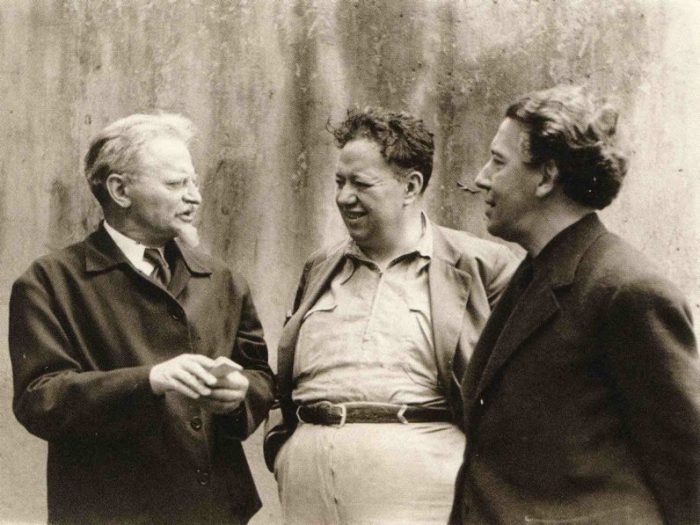
(Via Iconic Photos)
About Rivera’s unnamed “extraordinarily handsome wife”. Frida Kahlo was an unknown at the time, but her work briefly captured the attention of André Breton, who just happened to be in town in 1938 when the photo above was taken by the otherwise unknown Fritz Bach:
… This is the famous trip where Kahlo was ‘discovered’ by Breton. At Breton’s invitation, Kahlo went to France the next year and was featured at an exhibition of her paintings in Paris… However, Breton didn’t care much about Kahlo–he didn’t even bother to pick [up] Frida who didn’t speak French at the French customs, but his wife Jacqueline Lamba did.
Kahlo is said to have had affairs with both Lamba and Trotsky. As to the affair between the 60 year old exile and the 31 year old surrealist, perhaps it’s best for foreigners not to get too involved with their neighbor’s wives (and their friends) … it might lead to a serious headache:
… After Trotsky’s assassination in 1940 by a Stalinist agent, Kahlo was questioned by police for suspected involvement in the murder. She knew the assassin, Ramon Mercader in Paris and invited him into Trotsky’s refuge in Coyoacán.
The only problem
Outside this country, and even from commentators inside, you’d think the Calderón Administration’s attempts to control the narcotics export market was the only problem worth writing about. I said aboth here and in other places that narcotics are a commodity, the production here being overwhelmingly for export. But, if you think it is the only commodity of any importance, or even overwheming importance, think again. We’ll have national elections coming up in 2012, and there is a vital commodity issue that affects a lot more of the voters in this country than marijuana and opium poppies.
María del Carmen Martínez (The [Mexico City] News):
While tortillas, natural gas and gasoline registered price hikes in 2010, authorities said Thursday that the cost of these basic goods is expected to increase again in 2011, negatively affecting the economy of poorer Mexican families.
Throughout 2010, the price on tortillas rose by as much 2 pesos per kilo, depending on the area. In some regions, the Federal Consumer Protection Agency (Profeco) said, the price of tortillas increased from 8 pesos to 12 pesos per kilo, while in other states, tortillas cost between 13 and 15 pesos a kilo.
Nonetheless, Profeco officials said that there is no justification for the rise since many other basic products, including corn, experienced a price drop in the international marketplace. The price of a tortilla, Profeco said, is established by the cost of corn.
Well, the price of corn, the price of natural gas to cook the corn, the price of gasoline to transport the corn,..
The price of gasoline went up 10 times this year. Authorities said that regardless of Profeco’s official dispositions, tortillas will most likely go up again in 2011. Profeco also predicted that gasoline will undergo several increases next year, although these rises will be gradual.
Last November, the Treasury and Public Finance Secreariat (SHCP) said that the rise in gasoline prices in 2011 would be similar to that of 2010, meaning magna, premium and diesel gasoline will rise 8 cents per liter every month. The government agency said that this gradual rise does not mean that Mexico’s rates are above international standards. Natural gas prices are expected to rise by 5 cents a cubic liter every month.
Not to mention that, given the NAFTA agricultural rules that came into effect on 1 January 2010, Mexican farmers can’t compete against corporate U.S. farmers, and Mexico is more than ever dependent on U.S. corn production. And as to U.S. corn futures for 2011 …
Stephen Koff, Cleveland Plain-Dealer:
WASHINGTON, D.C. – The United States has long embraced its corn farmers, and just this month Congress extended tax breaks for ethanol refiners so they’ll keep making their corn-based alternative fuel. With China, too, relying on a lot of U.S.-grown corn for ethanol, 2011 could be a bumper year.
Yet if high demand brings tight supplies and higher costs, the coming year could also bring higher grocery prices for American families, according to analysts in the agriculture, commodities and grocery industries.
If corn prices rise as high as some extreme estimates, “you’re going to have more expensive lots of things,” said Tom Jackson, president and CEO of the Ohio Grocers Association.
The question neither he nor anyone else can answer is whether this will actually happen.
It depends on factors that include the weather, the kinds of crops that farmers choose to grow, the world’s supply of corn and its demand, the price of gasoline and other fuels, and even the world’s import and export practices. If none of these change, it follows that as more corn winds up in fuel tanks in the form of ethanol, there will be less corn for corn flakes, high-fructose corn syrup and feed corn for cows and chicken. A tight supply would drive up consumer prices for all these end products.
Prices for corn futures, at $6.23 a bushel this week on the Chicago Mercantile Exchange, are already higher than they’ve been in two and a half years. A brokerage in Singapore, Phillip Futures, this week predicted they would explode by another 36 percent in 2011, to $8.50 a bushel, driven at least partly by demand from China and by renewed tax incentives given to this country’s ethanol producers.
Mexico has already moved to control the price of corn tortillas, whose high costs in early 2007 touched off food riots. Mexico’s government bought futures contracts that guarantee a fixed price for corn until the third quarter of next year, according to the Financial Times last week.
Which means, about September of this year, the political situation may change radically, if it hasn’t by then as people lose even more patience with the lame duck government. If I have a prediction, it is that foreign press reports will continue, though, to write on any political or social unrest as somehow related to narcotics, which, it seems, is our only problem.
Gabriel García Marquez nude!
According to WordPress, the most popular Mex Files posts of 2010 were both old ones. A post on Gabriel Garcia Marquez, written on his 80th birthday (6 March 2007) got the most hits of any single post — the byproduct of a “by the way” mention in news reports on the Nobel Prize in Literature being awarded to Peruvian novelist Mario Vargas Llosa in October of this year. “Nude Gay Mexican!” (16 March 2008) on two Mexican-born silent film stars, Gilbert Roland and Ramon Novarro, is still the “greatest hit” of all times, but only #2 this year.
WordPress suggests that I “Consider writing about those topics again.”
So here goes…
I believe Garcia Marquez has been naked at various times in his life, but he is not gay.


 mexfiles.net