Mexico in 200 seconds

Sombrero tip to Esther (From Xico) for linking to Conacultura’s 200 second introduction to Diego Rivera’s Epopeya del pueblo Mexicano (1929-1935). While a nice overview, one really should spend more than 200 seconds on Mexican history and the nation’s historical figures. And, much as one SHOULD go to the Palacio Nacional, not everyone can this time of year… and Rivera only shows the course of history up through the end of the 1920s. Not exactly in the same medium, but there is ANOTHER work that extends through the mid 2000s, also accessible to the non-specialist, AND that can be delivered right to your own home.
Mysteries of Jefe Diego…
I have some real questions about Jefe Diego’s kidnapping and release. The supposed kidnappers were/are Red de Transformación Global — in English, “Global Transformation Network” which is also the name of a television ministry, but as someone said to me yesterday, sounds like it could be some kind of financial services company… perhaps the kind of company that assists in transferring assets to Lichtenstein?
Red de Transformación Global published a strange, very long three-part manifesto. I started to translate it, but manifestos (especially ones running fifteen pages of dense single spaced text) give me splitting headaches. If anything, it’s anti-globalist, yet begins with a quote from Berthold Brecht … and one that took me forever to find (from “Über das Töten” a fugitive essay on Bolshevism from the 1956 Mi-Ti Buch der Wendungen]. I’m not sure why a German Communist playwright would be quoted to rationalize a direct action agains the Mexican elites, especially when the manifesto’s analysis of the Mexican situation (and the justification for their action) seems to echo (with really bad writing) concerns expressed in Andres Manuel López Obrador’s speeches and books. More on that when I’m able to see straight again.
Right now, the big mystery is why did Jefe Diego’s facial hair grow about 8 cm, when his head hair is the same length it was before his disappearance?

Anti-Claus is coming to town

Diego Fernández de Cevallos, whose kidnapping six months ago was cynically seen as either a political ploy on his part, or perhaps “rough justice” against one of the most widely despised and feared political figures in the Republic (some people expressed disappointment he wasn’t tortured and executed on camera) or was simply an “alternative dispute settlement” with one or more of his legal clients (which have included Chapo Guzmán y Asoc., S.A. over the years), or any number of those who were financially damaged by his legal and political shenanigans over the years, was released from captivity after an undisclosed ransom payment was made.
If, as Jefe Diego said, his release was the handiwork of God and the Virgin of Guadalupe, it has to rank up there with Virgin birth as one of the all time miracles of the ages.
DREAM deferred
Although Mex Files has stopped, for the most part, writing about U.S. immigration politics (others are better qualified to do so, and have been better positioned to do so), it doesn’t mean I’ve completely forgotten about it. As most of you already know, last Saturday
Senate Republicans have blocked a bill to grant hundreds of thousands of illegal immigrants brought to the United States as children a chance to gain legal status if they enroll in college or join the military.
Sponsors of what they call the Dream Act needed 60 Senate votes for it, but fell five short. The House passed the bill last week.
It was a last-ditch effort to enact it before it Republicans take control of the House from Democrats in January.
Immigrant advocates viewed the measure as a step toward providing a path to legal status for up to 12 million illegal immigrants by focusing on the most sympathetic among them first…
I admit I had misgivings about the DREAM Act, mostly in that it forced immigrant minors into military service unless they pursued a higher education after high school. I am all in favor of post-secondary education, but immigrants have always faced a hurdle in obtaining even a minimal education, not the least for economic reasons. It seems unreasonable to expect a migrant laborer child to have the luck to finish high school. Nor is there anything wrong with a child whose aspirations are “traditional” and who might not need a higher education to work in the family business, or fulfill his or her expected social role. I may think it is “wrong” to start a family at 17 or 18, but these things happen, and parenting doesn’t always lend itself to educational fulfillment.
Which means, for many, basically being forced to join the military, though hardly of their own free will. It was ironic that this bill was defeated the same day another bill, which opened military service to gays and lesbians (or, rather, finally acknowledged that gays and lesbians are already serving in the military, and always have) finally made it though the Senate, only 18 years after proposing a perfectly normal change to an obsolete military personnel matter.
At least, those who can now serve openly are those who volunteered with at least a modicum of willingness (I’m leaving out those who join the military out of economic necessity), but “thanks” to the Republicans and other reactionaries, I suppose there’s something positive to be said in the defeat of the DREAM Act: at least slowing down for at least one group of U.S. residents the mindless trend toward creeping militarization in the United States .
But, I admit, that is a pretty thin argument for opposing the DREAM Act, which I did support (with reservations… I don’t believe for a minute it was an “opening”, but would have meant involuntary servitude for generations of irregular immigrants… a risk other supports of the DREAM Act were willing to take). Without passage, what I am likely to see from my small corner of a country that sends so many immigrants to keep the U.S. economy afloat is an increased influx of what are basically “foreign” workers. It’s not all that weird to me to run into people who are Mexicans by nationality, but Mexican-American by culture (sometimes two very different things, Mexican and Mexican-American culture) .
Because I live in a resort town, a lot of the existing work-force is already composed of people whose only edge is speaking English. Now we’re getting people who — not by their own volition, nor by any thing for which they can be held morally responsible — have to compete with established workers, and may not have the other skills sets needed. Just because an 18 year old can speak English doesn’t mean she can wait tables, especially if she’s just spent the past four years doing everything possible to get into the university, and her parents were sacrificing to keep her studying, and not having to work an outside job. And, we’re going to get those who have started a higher education, but still lack the professional qualifications needed in Mexico. A student in a field like accounting or computer science MIGHT be able to get some kind of job that will at least support him or herself, but what can Mexico do with partially educated people? They can’t all drive taxis and tout for time share companies.
This is a tragedy for the United States, where the workforce is aging and where the need is for more skilled workers. And for Mexico, which will have to somehow absorb these reluctant returnees. And even more, for the returnees themselves.
As a teenager, Langston Hughes was plucked from his home in Lawrence Kansas by his father who had emigrated to Toluca. Faced with the racism African Americans could expect to be their lot in the United States, Hughes Sr. planned to have Langston educated as an engineer in a more racially tolerant society. Langston had other plans. Although he would, in the end prevail, becoming a prominent U.S. poet, despite the racism and over his father’s objections, he understood very well the tragedy … and the potential for violence… of a dream deferred:
What happens to a dream deferred?
Does it dry up
Like a raisin in the sun?
Or fester like a sore–
And then run?
Does it stink like rotten meat?
Or crust and sugar over–
like a syrupy sweet?
Maybe it just sags
like a heavy load.
Or does it explode?
¡Viva Belzu!
Private property is the chief source of most of the offenses and crimes in Bolivia. It is the cause of the continuing struggle between Bolivians; it is the dominant principle of that selfishness eternally condemned by universal morality. No more property, no more proprietors, no more inheritances! Down with aristocrats! Let the lands be for all! Enough of exploitation of man by man.
 Che Guevara (who also ended up shot in Bolivia) might have said this, but the speaker was former Bolivian President (1848-55) Manuel Isadoro Belzu, shortly before his assassination in March 1865.
Manuel Belzu wasn’t all that remarkable as Latin American caudillos go — plotting and coup-making with the best and worst of them and mixing the political and the personal: his attempts to overthrow the other Bolivian strong-man of his time, José Ballivián started off with a bang — Belzu shot and wounded then-President Ballivián for making improper advances towards Mrs. Belzu. If he ascribed to any particular political theory at all, it might best be described as “Belzuism”.
Belzu does stand out though, from your stereotyped caduillo:
In his travels as a fugitive, Belzu had seen the deplorable conditions under which most of the population lived, with scarcely any improvements or public works by the government. His position established a strong base of support among the peasants…
Guevara also claims to have come to his political positions via his own experiences as a “poverty tourist” . What marks Latin “leftism” is that it is not doctrinaire.
Living among the poor, and coming to identify with them, does put Belzu in the company of any number of Latin American leaders, all of whom — with very few changes in wording — might have said the same thing Belzu said in 1865. While some (Pancho Villa, Andres Manuel López Obrador, Hugo Chavez and Evo Morales) might be called “socialists” , there are many others we’d have a hard time fitting into that particular political box — from José Maria Morelos to Emiliano Zapata to Eva Peron to Rafael Correa. Che (whom the CIA paid the back-handed compliment of referring to as “fairly intellectual for a Latino) was the scion of a intellectual, politically active, middle-class family. But, he was hardly an orthodox Communist.*
It seems, however, that Europeans (and in the last century, the United States) have either colonized the terms of political discourse as successfully colonized the rest of public life. That indigenous culture (and political discourse) masquerades under foreign labels should be no more a surprise than discovering that Quetazacoatl lurks beneath Christian altars.
Certainly there are differences between “socialism” and Peronism, and, for that matter, “Lopezobradorismo”, and the Bolivian “Movement Towards Socialism”, but — much as we lump the myriad American cultures together as “indigenous beliefs”, we lump the various political movements into uncomfortable boxes labeled “Socialism” or “Populism” or, as I tend to do, “Bolivarianism”.
Make that “leftist Bolivarianism”. I’m aware that successful Latin American political movements, like Peronism or the Mexican PRI, incorporate both left and right wing European/North American theories. But the rightist movements (or rightist tendencies within Peronism or the PRI) are knock-offs of foreign theories. Fascism and neo-liberalism, both foreign theories, have been adopted and have their adherents in Latin America. As I’ve written before, Bolivarianism was initially a right-wing theory. But, what it came down to was a 20th century update of Spanish absolutism — borrowed from what Francisco Franco had already achieved in Spain.
The leftist tendencies within Peronism and the PRI, while often using the language of the European left (especially from party intellectuals) in practice takes its cue from American-born experience. Of course European Marxists talked about the poor, for example, but it would take an Argentina — with a working class resentful of both the old post-colonial hierarchy and the neo-colonial British to create Eva Peron. Argentina, of course, also had a European working class, whereas most of Latin America’s working class is considered mestizo or indigenous, but a good part of Peronism’s appeal is rooted in strictly indigenous (or indigenized) “mythology” … the independent vaquero reduced to peonage by the landed gentry (with their British financing) resonated even with the Italian, Serbian, Polish, etc. masses of Buenos Aires. The PRI maintained hegemony (until it began espousing foreign — and largely rightist — concepts like neo-liberalism) by absorbing at least the mythology of the authentic indigenous movements like those of Zapata and Villa (and although Villa would define himself as “communist”, it was only after John Reed explained the theory to Villa that he realized at least in general principles Communism and Villa-ism were roughly equivalent). Lazaro Cardenás — by embracing the indigenous within the state — was essential for creating what was, and could only be, a Mexican political organization.
Today’s Latin leftists, like Andres Manuel López Obrador (a former social worker), Rafael Correa (once a lay brother in Quito), Hugo Chavez (the son of jungle catechists) or Fernando Lugo (once a bishop) show the influence of not a political heritage, but a religious one… listen to a speech by Hugo Chavez and you’re more likely to hear a reference to the Virgin of Guadalupe than to Fidel Castro. That’s not by accident. “Liberation Theology” — itself rooted in an interpretation of the Gospels based on the realities of Latin America, in turn had a profound impact on a generation of Latin political leaders, who — whether religious or not, Roman Catholic or not — view the Latin American variations on Roman Catholicism as an indigenous church. And, don’t forget Evo Morales, Bezu’s distant successor both in office and in philosophy. Morales does not speak of the “opiate of the masses”, but of Pamchaca, the indigenous spiritual heritage of his own Amayra tradition.
I sometimes wonder if the ferocious opposition to the populist-socialist-bolivarian isn’t based not so much on aversion to one or another European political theory as it is to something much simpler… the never completely forgotten fear of the conquistadors that Americans have not forgotten the idols under the altars and that even among the criollos and later immigrants, there is always the danger that the people will go native… and the natives may be meek, but nowhere does it say the meek inherit the earth through the good graces of an overseas benefactor, but may instead come into their inheritance by asserting their own rights.
* come to think of it, about the only orthodox Communist leader of note in Latin America, Fidel Castro, was a Jesuit-educated preppy. Even those who overtly identified themselves as Marxists, like the Mexican politician and labor leader, Vicente Lombardo Toledano, came from relatively wealthy or intellectual (or both) families.
The art of marketing
In Mexico, the distinction between “high” and “popular” art is not as clear-cut as in the northern countries. There is a story that has Diego Rivera, David Álvaro Siqueiros and José Clemente Orozco sitting at an outdoor café arguing about the role of art, and artists, in Mexico. Rivera and Siqueiros, as good Marxists, holding forth on the need of the artist to  teach the masses. Orozco, ever the sceptic, found his answer when a street vendor walked by selling the cheap home-made clay pots : Orozco, whose pedantic style was more in the nature of showing and not telling, bought a few objets de hogar for his comrades, driving home the lesson by saying “In Mexico, it is the masses who teach the artists.”
 Where is the line between “art” and everyday experience anyway? Because the water pitcher sits on display on a shelf, is it more “artistic” than the serving dishes in my kitchen cabinet? the water pitcher (at left) a work of art because it sits on a bookshelf, and the serving pots not art, because they sit in my kitchen cabinet? I tend not to think of serving dishes as “popular art” but as something to mash potatoes in. But then, is there any reason mashing potatoes, or watering the plants shouldn’t also be an aesthetic experience, and not just a chore?
Rivera and Siqueiros weren’t wrong. The Revolution didn’t ONLY make the common experience, and the masses the subject of fine arts, but — perhaps more lastingly — it erased the artificial boundaries between the “high art” of the elites, and the common art of the masses. To be a “traditional” Mexican today is to appreciate both the popular arts that grace our kitchens, and the “fine art” of stocking our larders.
As part of the Festival Internacional de las Artes de Lerdo (FIAL), soprano Celia Gómez , mezzo-soprano Melisa Reuter, tenor Dante Alcalá and baritone Ricardo López rescued opera from the confines of the high-ticket auditoriums, and presented it (along with tasty tomatoes, grapes and other staples) to shoppers at the mercado Donato Guerra in Ciudad Lerdo (Durango) last Sunday morning. The full video, and accompanying news story is in El Siglo de Torreón.
El Barbie
So, it looks like El Barbie, the U.S. born hitman and all-round villain, will be tried in Mexico after all. While some of El Barbie’s criminality did occur in the United States, he was arrested in Mexico for crimes occurring in Mexico. The arguments for his extradition seemed more based on the assumption that anything impacting the United States is more important than anything impacting Mexico. And that U.S. justice is “better” in some philosophical sense, based as it is in the punishment and not rehabilitation model.
Punishment is at least more permanent perhaps …

What should be commemorated
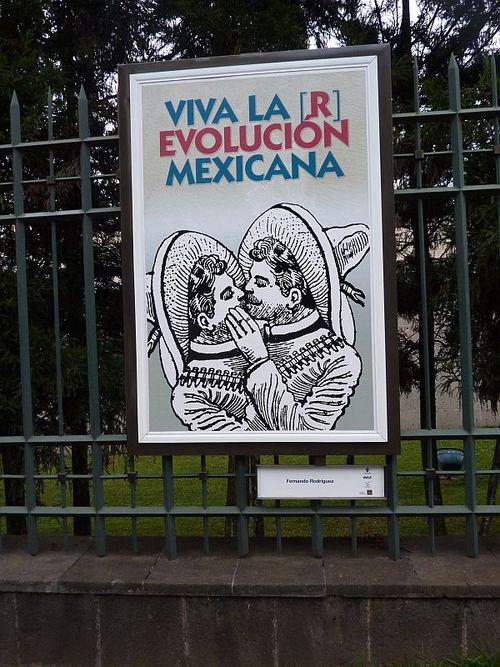
Rather ironic, considering art museums in the United States are uniting in protest of “Smithsonian Institution secretary G. Wayne Clough’s decision to remove a video by David Wojnarowicz from a show at the National Portrait Gallery, following protests from conservative Republicans and Catholic groups,” while the Museo de Antropología de Xalapa (Veracruz) has been exhibiting, without any protest, an outdoor poster show that is meant to have something to offend everyone.
Curator José Morelos writes:
This year of 2010 we Mexicans are witness to two historic events important in the life of the country: the Bicentennial of Independence and the Centennial of the Revolution. For those who are lovers of opportunism, this will provide an excuse for vulgar extravaganzas rich in advertising but poor in ideas. For the rest of us, all the way to the farthest corner of the country, these events will provide a great opportunity to indulge in ardent and sincere patriotic fervor. However, the economic crisis (more than fifty million Mexicans live in poverty), the millions of unemployed, the insecurity, the violence, the corruption, the impunity and the discrediting of authorities oblige and will continue to oblige our collective imagination to reflect and to reconsider what should be celebrated, what should be commemorated.
Via From Xico are two Revolutionary reflections bounds to annoy someone.

Guns, Guatamalans and gringos
The results of the Washinton Post’s investigation of arms purchases by Mexican gangsters is no more a surprise than Wikileaked cables revealing the U.S. State Department’s fixation on militarizing Mexico. The United States (and in previous centuries, France and Britain) have been glomming onto simplistic reactions (generally involving violence against Mexicans) to complex actions of their own.
Whenever there is at least an acknowledgment that the United States might have SOME negative role in Latin American affairs, I can always count on reactionaries attacking the messenger. While the attempts to shut down Wikileaks are more mainstream (more people’s oxen were gored), there is a lively pushback against the Post’s “revelations” from the right found on websites like “Free Republic”.
The best argument made on the right (besides the one that says people in the U.S. have a right to bear arms, and they do… but, not — as far as I can tell — to export them to foreign countries) is that arms ALSO enter Mexico through Guatemala, or are domestic military weapons that have been diverted to gangsters. Basically, the argument is that because not all weapons were traced to their point of origin, those NOT traced did not come from the same source. That in itself is a dubious proposition, and to be true would require the statistical sampling to be tainted (no evidence of that). Of course, the untraceable guns COULD come from other sources than the United States, and some of them do.
U.S. reports continually telling us the Mexican military and police are out-gunned, and don’t have the sophisticated weaponry the “bad guys” do should put the kibosh on the diverted weapons story (some are, of course, but not the ones under discussion).
However, the weaponry floating around Guatemala is mostly from the 197os, and the weapons seized in Mexico are much later models. Then, too, if you look at where weapons are showing up, it’s close to the U.S. border… all points I’ve made before.
 What gives some credence to the Guatemalan connection comes from a source the right-wingers have been attacking… except when it can be spun to bolster their weak arguments. A wikileaked cable, 10MEXICO77 dated 25 January 2010, originating from the U.S. Embassy in Mexico City deals with perceived laxity by Mexican authorities in preventing contraband from crossing the Guatemalan-Mexican border, specifically at the Talisman and Cd. Hidalgo (both in Chiapas) border crossings. While Mexican officials agreed that the border inspections were lackadaisical (or non-existent), “on-the-ground” observers noted that it seemed to be personal goods crossing back and forth… nothing particularly alarming at all. Given the easy access to firearms in Guatemala (and the extremely high murder rate in that country — about 1.5 times that of Mexico, even with its “drug war”), I suppose some of those “personal items” would include guns. But, unless arms shipments are going to the Mexican border with the United States via Guatemalans carrying personal items, as opposed to from Houston to Reynosa (or Nogales Arizona to Nogales, Sonora) it’s not likely. Again, as I’ve pointed out several times, the arms being used by Mexican gangsters are found near the U.S. border, not the Guatemalan border … and even criminals not associated with the drug cartels are less likely to be using sophisticated weaponry near the southern border.
What seemed to bother the U.S. officials at the meeting discussed in the 10Mexico77 cable was that:
… there are 30,000 U.S. CBP [Customs and Border Patrol] officers on the 1,926 mile Mexican/U.S. border, only 125 Mexican immigration officials monitor the 577 mile border with Guatemala. Mexican immigration officials repeatedly confirmed that they do not have the manpower or resources to direct efforts effectively along the southern border.
Meaning that the U.S. sees Mexican border-crossing as a security threat (or at least wants to invest resources in border control), while Mexico does not see Guatemala as a particular threat, or at least doesn’t seem to feel the need to invest heavily in manpower along what hasn’t been a problem for them since the Central American civil wars of the 1970s, when political refugees poured into Mexico . Other than a few stray Guatemalan guerrilla bands also ending up in Mexico during the civil wars, Mexico hasn’t seen Guatemala as a credible national security concern since the since the late 1950s, when a dispute over fishing rights led to the Mexican air force strafing Guatemalan vessels in Guatemalan waters. The whole thing ended farcical with Guatemalan dictator Miguel Ydígoras Fuentes offering to settle the issue by dueling Mexican President Adolfo López Mateos. The Guatemalan military establishment really, really thought this was stupid, and López Mateos concluded Ydígoras was nuts.
Since then, the only “issues” of note have been the problems caused by (or rather, the problems caused by Mexicans as a result of) Guatemalan emigres crossing Mexico and headed for the United States, or seeking work in Mexico. The Guatemalans are abused, and have been the target of criminal gangs (and are subject to harassment and worse by local authorities in Mexico acting under “color of law”), but that is not something which necessitates a heavy military presence along the Usmacata River.
The revelations in 10MEXICO77 are not particularly earth-shattering, and not likely to make the front pages of the New York Times… or even La Jornada. But they are symptomatic of the serious disconnect in United States policy in Mexico and Latin America in general.
Although no one realistically expects the United States to do more than pay lip service to its own role in the “drug crisis” (and to totally ignore, as much as possible, the roots of that crisis both in U.S. social behavior and in its economic system) there is some belief that it would at least do something to control its own firearms export trade. It’s too easy to make a target of the U.S. gun dealers, tempting as that is: given that some have suggested drone or missile attacks — directed from the United States — on Mexican gangsters, perhaps Mexico should suggest launching missile attacks on Carter’s Country Stores, starting with the one at 8927 Katy Freeway in Houston… during rush hour.
As the Washington Post article is careful to note, Bill Carter is not doing anything illegal, and is following the law (which he played a role in crafting) on gun sales. While the United States seems to suggest making radical changes to the Mexican constitution (see Mexico City cable ID #ID: 231890, dated 28 October 2009 from Deputy Chief of Mission John J. Feeley),
the U.S. legal system has a difficult time prosecuting even the most blatant arms trafficker, and finds attempts to even make mild changes in existing law politically controversial.
I’m not going to say U.S. policy is “hypocritical”. Of course it is, but no more hypocritical than any great power when it wants to impose its will on other nations. Hernan Cortés famously said, “We come to bring the true religion… and get rich”. Napoleón III set in motion France’s Mexican adventure claiming it was to restore order to a disorderly county, but never attempted to deny he also wanted control of the Sonoran gold fields. Woodrow Wilson thought he would “teach us to elect good men” — who would keep extraction taxes low. Cortés, Napoleón III and Wilson, aren’t that different from the 21st century diplomacists. Which is pathetic, given that in the 21st century, Mexico is hardly an unknown country, nor is Latin American thinking a mystery.
It’s not the hypocrisy of the U.S. diplomatic moves in trying to foster their own narcotics use problem onto Mexico that is so stunningly stupid. It makes me wonder if anyone in the State Department has really looked at Latin American policy — or really paid attention to anything that’s happened here in the last century — since William Jennings Bryan was Secretary of State.
The Wikileaks expose an administration that “assumes” the Mexican government will, or must be forced to, react to issues of concern to the United States (like their drug problem) the same way they would. Even without getting into the whole “we’re suppliers, not users, and our agricultural system was screwed over by U.S. corporate agriculture” meme, the Wikileaks suggest a State Department that has already made up its mind, and doesn’t want to be confused with the facts… or even read a little history, or think or … well, use their intelligence when gathering intelligence.
More troops to the southern border? C’mon… that would me a vastly different, and vastly expanded military (which, as it happens, is what John Feeley is proposing in Cable ID# 246329, 10MEXICO83…. but I’ll reserve comment on that for another time) and an assumption that because the U.S. feels its southern border is a national security concern, Mexico’s southern border should also be a national security concern.
Stupid, stupid, stupid.
Transporto in orator*
Apparently it isn’t only in Mexico where U.S. diplomats are in the habit of expecting smaller nations to do things the way they do them in the United States. Der Spigel, in reviewing Wikileaks from the Vatican, found one U.S. diplomat complaining not only are most Vatican officials “Italian men in their 70s,” but that
… the Cardinal Secretary of State, the name given to the Holy See’s equivalent of a prime minister, doesn’t even speak English…
* ut laudo Warren Zevon:
Location, location, location

Absolutely nothing to do with Mexico, but I’m rather taken with Maurizio Cattelan’s sculpture “L.O.V.E.” in Carrara marble. It was recently(and temporarily) installed in Milan’s Piazza d’Affari. Which perhaps should be its permanent home. That’s the Milan stock exchange behind it.
Pig — out
Who is hurt by the U.S. ban on Mexican cross-border trucking? Iowa farmers among others. Sam Carney, President of the National Pork Producers Council writes in Iowa Farmer Today, via Mexico Trucker:
U.S. pork exports to Mexico are falling, and it’s not because Mexicans have lost their taste for pork.
Since August, the price of getting U.S pork into the Mexican market has increased because of a tariff Mexico slapped on it, retribution for the United States failing to live up to a trade obligation.
That duty makes U.S. pork more expensive for Mexicans to buy compared with, say, Canadian pork, which enters Mexico at a zero tariff rate.
In fact, from August to September, U.S. pork exports going south of the border fell 20 percent while Canada’s increased 49 percent.
So, U.S. pork producers, who earlier this year emerged from more than two years of losses, and the producers of dozens of other products are suffering because of a dispute between the United States and Mexico over trucks.
THE MEXICAN government placed tariffs on 99 U.S. products, including a 5-percent duty on many pork products, such as unprocessed hams, and a 20 percent tariff on pork rinds, in retaliation for the United States’ decision to prohibit Mexican trucks from entering America.
…
Allowing Mexican trucks into the United States has been a subject of debate almost since the North American Free Trade Agreement (NAFTA) among the U.S., Mexico and Canada was signed by leaders of those countries in late 1992.
NAFTA includes a provision that opens the borders between the countries to trucks so long as the vehicles comply with all regulations applicable in the country of destination.
Unfortunately, just days before the NAFTA trucking provision with Mexico was to become effective in December 1995, the United States requested an indefinite postponement of it.
Then, after years of delay, Mexico sought to resolve the trucking issue, taking its case to a NAFTA dispute-settlement panel.
In February 2001, the panel ruled the exclusion of Mexican trucks violated U.S. obligations under NAFTA.
The ruling gave Mexico the right to retaliate against U.S. products entering Mexico.
… Mexico has safety protocols for its truckers comparable to ones for U.S. truckers, including drug and alcohol testing as part of the licensing process and random drug testing.
Mexican trucks that were allowed into the United States under the 2007 pilot program were held to the same safety standards as U.S. trucks and were examined and cleared by U.S. inspectors. Additionally, GPS systems would be installed in Mexican trucks that enter the United States to enforce hours-of-service standards.
CRITICISMS ALSO ring hollow given that since 1995 many Mexican trucks have traveled through the United States on their way to Canada, and several Mexican trucking companies have had U.S. permits for cross-border trucking since the 1980s.
…
In the current global economic climate, the United States must promote trade, not turn inward and erect obstacles to it. Resolving this issue would strengthen the United States’ relationship with one of its most-important trading partners, and it would prove to the world that America stands for free and fair trade — and abides by the agreements it signs.
…
Take a leak
I’ve managed to get the small number of Mexico related wikileaks somewhat organized (in date order, and by where they originated — so far, Mexico City, Madrid and Washington). I try — sometimes successfully — to stick to cultural and historical matters (although much of the material in the leaks is of “mere” historical interest), and haven’t been able to analyze them in any depth.
Anyone who wants to “take a leak” and tear into it is encouraged to do so. I honestly don’t have the time, or energy (or much understanding of the the organizational charts of the U.S. Department of State) to do more than a superficial commentary.
If anyone who feels up to the job doesn’t have a site to publish their own research and readings (and I’d be grateful for a link to those leak-o-logs), I’ll be happy to post them here as well.


 mexfiles.net