Nobody shot the sheriff…
So, somebody claiming to be the “Sinaloa Cartel” was cold calling cell phones in Arizona offering a reward for shooting Maricopa County Sheriff Joe Arapaio, huh?
From the Phoenix New Times, February 21, 2008.
There seemed to be no real threat to the sheriff — though his top deputies have been fixated on the notion that “America’s toughest sheriff” could easily be the target of assassination.
It’s been as though his staff believes that, without anybody trying to kill the sheriff, Arpaio’s hard-on-crime policies lose credibility. So the MCSO hasn’t been above manufacturing a plot to make the boss look like a tough guy.
In 1999, Arpaio and his chief deputy, David Hendershott, attempted to frame 18-year-old James Saville in a phony bomb plot supposedly aimed at Arpaio (“The Plot to Assassinate Arpaio,” August 5, 1999). TV reporters were called ahead of time to chronicle the teenager’s arrest outside an Italian restaurant where Arpaio was dining. Saville’s lawyer noted the obvious entrapment, and Saville was unanimously acquitted by a jury after the MCSO’s unscrupulous antics were aired in court.
Last year, the Sheriff’s Office revealed that it had spent an estimated $500,000 investigating a bogus death threat that involved such highly improbable co-conspirators as the Minutemen, immigrants rights activist Elias Bermudez, and hit men working for the Mexican mafia. On the word of a confidential informant who failed a key question on a lie-detector test about whether or not he was telling the truth about the alleged conspiracy, the sheriff’s Selective Enforcement Unit (the same group that nabbed Lacey and Larkin) staked out a dairy in Tolleson and flew to Connecticut to interrogate a teenage girl whose e-mail was linked to the pseudo-scheme.
Most recently, the MCSO trumpeted the conviction of Matthew Carl Sanderson, a native of Canada, for making an Internet threat against Arpaio. The sheriff flew to Toronto for the three-day trial. In the end, Sanderson received just three months of incarceration.
“There has never been any credible evidence of death threats against our Sheriff,” attorney Manning states in New Times’ notice. “Indeed, the only ‘death threats’ to Sheriff Arpaio have been made-for-TV productions procured or created by the Sheriff’s sizable PR staff.”
Arpaio’s obsession with such dubious threats would be comic if not for their dire, costly, and time-consuming consequences.
You can fool some of the people all of the time, but to fool all the people, you need Fox News.
North to south…
Miscellaneous items from the hemisphere I noticed over the last week and meant to say something about, but haven’t, and probably won’t.
Canada:
Researcher Russell Kerr is negotiating a profit-sharing deal with the Inuit living in Nunavut, Canada’s northernmost territory. Kerr, a chemistry professor at the University of Prince Edward Island, hopes to discover bacteria hidden in the mud of Frobisher Bay that can be used in commercial products like cosmetics or life-saving medicine.
Nothing is guaranteed, but an organism used in cosmetics could be worth tens of thousands of dollars. On the other hand, Kerr says, “At the upper end of the range, which is a real long shot, a cancer drug can generate billions of dollars.”
Kerr’s approach, which is “precedent-setting,” according to Jamal Shirley of the Nunavut Research Institute, could change how bioprospecting is done in the Arctic.
“Mud Bug Deal in Nunavut Could Set Precedent”, Americas Quarterly
The United States:
The prevailing political wisdom in America, to which the Obama administration evidently subscribes, is that it’s folly to challenge the gun lobby. When Mexico’s President Felipe Calderón addressed a joint session of Congress in May, he all but pleaded with lawmakers to help stop the flow of assault weapons. His call to action produced little more than a shrug of the shoulders in Washington. That ought to make us embarrassed. But the worst of it is that inaction on these issues has come to seem normal.
David Ignatius, Washington Post
Honduras:
Recent Honduran press reports have honed in on a spate of partisan teacher firings in the country’s primary education program for remote, rural communities, PROHECO (Honduran Community Education Program, Programa Hondureño de Educación Comunitaria). Journalists have documented how President Lobo’s Partido Nacional has replaced field staff with party activists, canceled teachers’ contracts to install party supporters and undermined parent organizations’ autonomy.
These reports suggest that the new ruling party has used PROHECO to divert resources and jobs to its followers, undermining the program’s ability to realize its stated objectives.
Daniel Altschuler, AQ Blog
El Salvador:
“We are all against the law [Arizona’s S.B. 1070]. We sincerely hope the judge charged with the matter will opt for a repeal, because the law in question is not only anti-immigrant, it is totally anti-human rights” said Archbishop José Luis Escobar of San Salvador.
The Archbishop said the Bill proposed in Arizona “turns innocent men and women into criminals and this cannot be allowed to happen in a country such as the United States of America, a nation of democracy. To enforce such a law would put the entire country in a very bad light”
Agenzia fides, via Tim’s El Salvador Blog
Ecuador:
The Galapagos Islands have been removed from the UNESCO list of sites endangered by environmental threats or overuse.
The island chain, about 620 miles (1,000 kms) off Ecuador’s coast, is home to unique animal species that inspired Charles Darwin’s ideas on evolution.
In 2007, the United Nations body included the World Heritage site on its endangered list because of damage from tourism, immigration and invasive species.
A UNESCO committee meeting in Brazil Wednesday said strong action by Ecuador’s government to battle these problems means the Galapagos Islands are now safer.
Colombia:
The rupture of diplomatic relations between Venezuela and Colombia after a special session of the Organization of American States (OAS) on July 22 marks increased animosity between the outgoing Colombian President Alvaro Uribe and Venezuela’s president Hugo Chavez.The dispute between the two bombastic leaders from opposite political poles is nothing new. What creates the drama — and the possibilities — of this new turn of events is the backdrop.
Uribe is a lame duck, ever since being denied a constitutional amendment to run for a third term. His successor, Juan Manuel Santos, will take office on August 7. Santos’ inauguration marks the end of the eight-year reign of Uribe, whose military strategies to counter drug runners and guerrilla groups such as the Revolutionary Armed Forces (FARC) have been backed by the U.S. government to the tune of some $7 billion dollars. While leading to some advances in reducing assassinations and kidnappings in Colombia, these strategies failed to achieve peace, and the Colombian conflict continues to take lives and cause tension throughout the region.
Laura Carlsen, Foreign Policy in Focus
Bolivia:
The view from Coroico:

Argentina:
… The Mexican Football Federation (FMF) stated that if there’s a rumor circulating that Maradona will replace Javier Aguirre as head coach of El Tri, it was started by the Argentine himself.
Nestor de la Torre and Justino Compean–director of national selections and president of the FMF, respectively– told the hosts of ESPN Deportes show Los Capitanes that a formal offer was never made to Maradona, and that in all likelihood, it was the soccer legend’s managers that started the rumor in an attempt to get him a job. It was announced this monday that the Argentine Football Association (the AFA) didn’t renew Maradona’s contract because of staffing differences.
On a similar note, the Venezuelan Football Federation, another soccer association supposedly interested in hiring Mr. Hand Of God, announced that they have no intention of getting rid of César Faría. They did, after all, just renew his contract until 2014.
Did he really say this?
“Is it a misfortune that magnificent California was seized from the lazy Mexicans who did not know what to do with it?”
I’ve run across this quote a couple of times lately — attributed to the wrong person… (which is a clue: think Laurel and Hardy, Simon and Garfunkel, Batman and Robin)… on extreme rightist sites, both in Mexico and in the United States, although the author is neither connected to the far right, nor lived in the Americas.
Answer on Tuesday.
Taking the Lord’s name in vain
The “wall of separation” between Church and State remains firm in Mexico, despite an occasional breach. Bishops sometimes get away with veiled, but unmistakable, references to one party or political platform or another, but the people who listen to their sermons were probably going to vote for (or against) whatever the Bishop was referencing anyway. For politicos and political parties, there is a controlling mechanism that — for all its faults — takes that wall very seriously.
From the Latin American Herald Tribune:
A Mexican politician has been fined $2,000 for referring to God in public during his successful campaign for governor of the northwestern state of Sinaloa, election officials said.
Gov.-elect Mario Lopez Valdez was slapped with the fine Wednesday by Mexico’s highest elections body.
“I will win with the will of the people and of God,” Lopez Valdez told supporters in an address during his run for the governorship.
The candidate, in fact, referred to God on two occasions ahead of the July 4 gubernatorial election.
Lopez Valdez was also fined for saying that “it cannot be stopped when the will of the people, the stars and God are aligned.”
The phrases cost Lopez Valdez a fine of 27,235 pesos (about $2,000) levied by the Sinaloa Elections Council and upheld by Mexico’s Supreme Electoral Tribunal.
The state elections agency also issued the governor-elect an official warning.
I don’t see that the Electoral Tribunal could put the fear of God into our new governor, not unless they substantially raised the fine.
Comment on comments
One Mex Files post is getting an unusual number of hits based on a link in an anti-semitic and racist (as in the guy also linked to Aryan Nations material) post on a commercial public website.
I changed the comments settings to require approval from any new commentators and to flag some “key” words that might be used in normal discussions. Since the post in question was about the role of the Conversos in colonial New Spain, many of the commentators are not regulars, but are interested in genealogy, or other legitimate interests that bring them here. My apologies if it takes a while for your comment to appear. If you’re one of the idiots who reads racist garbage and looking for confirmation of your moronic beliefs, there’s enough stupidity already in this world and you don’t need to add any more.
While I hope those that read through these posts learn something about Mexican history and culture, and welcome comments (even misguided ones), it’s my website, and I’m free to censure, censor and/or ridicule as I see fit.
This man is an idiot!
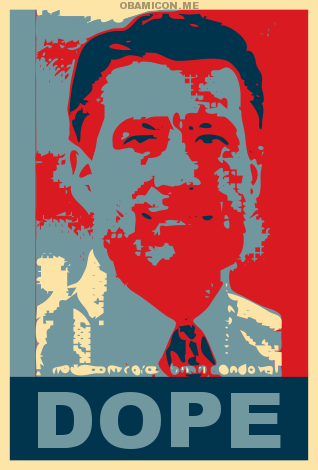 Brian Sandoval — a Republican candidate for Governor of Nevada who bills himself as the first “hispanic” to run for that office — was asked about the Arizona “show us your papers” by Univisíon’s Adriana Aravelo. His response, which the Spanish-language U.S. network did not broadcast, but confirms as true, was that he wasn’t worried about his children being potentially harassed.
He answered, with a note of pride in his voice, “my children don’t look Hispanic.”
What’s “hispanic?” and “what does a ‘hispanic’ look like?”. And what was Mr. Sandoval thinking? Was he thinking? Does he think?
Elections are life and death — literally
Electing a PAN government might be hazardous to your health, according to Melissa Dell, a graduate student in MIT’s Department of Economics. As Noel Maurer posts at The Power of Money:
She took daily county-level data on drug-related homicides (generally called “executions” in the Mexican data). She then tested a simple, but not intuitive, hypothesis. If the government crackdown prompted more violence, then we should expect drug-related violence to jump after a county elects a mayor from the Partido Acción Nacional (PAN). The reason is that Calderón’s party is the PAN. Not only did the federal PAN spearhead the assault on organized crime, but PAN candidates generally campaigned on a “tough on drugs” platform, and one would expect PAN mayors to be better able to coordinate law enforcement with the PAN federal government.
…
Violence jumps about 15% after the election of a PAN mayor. The dotted lines are confidence intervals, so you can see that effect is statistically significant. The violence does not occur after the election, but rather the inauguration of a PAN mayor. In other words, the expectation that a Panista will take office does nothing, but the actions the new administrations take after gaining office do something…
Melissa also used data on shootouts between cartel members; they jump after a PAN victory…
The jump in drug-related killings does not happen if a PRI or PRD mayor wins… It might be that PAN mayors are more corrupt that their Priísta or Perredista competitors, but that seems unlikely. In fact, the 2008 county-level data she analyzed showed n o difference in mayoral corruption (as reported by federal law enforcement agencies) across counties governed by different parties…
I haven’t a clue what this means for where I live — with both the municipio (what Maurer calls a “county”) and the state having just elected a coalition PAN-PRD-Convergencia-PT Presidente Municipal (Maurer’s “mayor”) and Governor. I know all the “cool kids” among the Mexican narco-blogo-statisto-sphere (Gancho, El Pinche Holandés, Diego Valle) have requested copies and will have something to say about it.
I do wonder though, how the parties will spin this. Neither “vote for us, for a statistically significant lower murder rate” , nor “more bangs for your votes” are exactly inspiring sound-bites.
Doing a job Englishmen can’t?

WWMFD? (What would MexFiles do?)
El Longhorn… one of the Mex Files more consistent and perceptive readers (and sometime critics), posted a long comment on the Pyrrhic victory post (below this one). Most of what El Longhorn says — that institution building was neglected for the last thirty years and that judiciary and police are too weak to deal with the crisis at hand, are good points. Nothing I would disagree with, noting that for the last thirty years, Mexico has been under a string of “neo-liberal” administrations, which — with the neo-liberal penchant for (in the words of Ronald Reagan) reducing government to where it can be drowned in a bathtub, may account for the loss of state prestige and the present institutional weaknesses.
El Longhorn ends by asking, “What would the PRD do? What other solution is there than for the government to try and get control back from the narcos? What do you suggest?”
I admit I’m more sympathetic to the PRD than to the other major parties in this country, but am not privy to their affairs. And, while I had expected a PRD coalition victory in the 2006 election (and think AMLO actually won the election), I cannot, of course, speak for a party, nor — as a resident alien — take any active role in Mexican politics. That said, the PRD — and many others — have looked at alternative role for the Mexican state beyond that of policeman.
Where, as El Longhorn says, “the narcos ARE the government”, perhaps there isn’t an immediate, one-shot (or rather, multiple gun-shot) formula for bringing those citizens back into the body politic. But “winning hearts and minds” is not a matter of firepower alone.
Speaking of the United States’ attempts in Afghanistan, Scott Lemiux (Lawyers, Guns and Money) wrote the other day:
… policymakers and analysts … seem to have no idea how difficult effective state-building is; effective authority isn’t something you can establish because you really want to. Staying in Afghanistan out of the belief that if we spend enough money and kill enough people an effective Weberian state will control the whole country and wipe out any Taliban influence is just nuts.
Substitute “cartels” for “Taliban” and you get the idea…it’s pretty well a given that MORE military incursion is not resolving Afganistan’s problems (and there will always be anti-governmental forces of some kind in the hills and hollers), nor will it solve Mexico’s.
In Tuesday’s Ciudad Juarez El Diaro, I read:
El presidente de la Comisión de Derechos Humanos de la Cámara de Diputados, Rubén Moreira Valdez, advirtió que si el Gobierno federal sigue la misma estrategia en contra del crimen organizado, el año terminará con 16 mil muertos, ya que cada mes se registran mil ejecuciones, a pesar de que al inicio del sexenio eran 100 en ese mismo periodo.
“Estamos acercándonos a mil muertos en sólo un mes, y si seguimos así, llegaremos al final del año con 16 mil muertos en la famosa guerra contra el narcotráfico”, aseguró el legislador federal del PRI…
(The Chamber of Deputies Human Rights Committee Chair, Rubén Moreira Valdez, warned that warned that if the federal government continues to follow the same strategy against organized crime, the death toll this year will be 16,000 deaths, or over one thousand a months, compared to about 100 a month at the beginning of the Presidential term.
“We are approaching a thousand deaths per month, and if we continue this way, we will reach the end of the year with 16 000 deaths in the famous war on drugs,” said the PRI deputy…)
So, it isn’t only the PRD that sees the present administration’s approach as wrong-headed and destructive. What I appreciate about the PRD, and their allies is that they present these alternatives, things like better schools and price supports for agriculture and expanded business opportunities not dependent on the one country that also buys most of the narcotics, for capital investment.
As in Afganistan, as in Vietnam, as in the Porfirian era here, a purely military/police response leads to opposition. The problem I see is people are forced into an either/or situation, with neither being the best option available: the Taliban or anarchy in Afganistan; the cartels or the negligent, inadequate state and federal government here. People need multiple choices. The PRD (and their allies) offer some creative solutions to the underlying problems that create a security vacuum, but so do other institutions, like the Church, and the PRI and some in PAN… and the Zapatistas (who were, unwisely, forced out, or opted out of electoral politics, much to the country, and their own, disadvantage). A healthy state would — or should — present its citizenry with transparent options. What the present administration has done, it seems to me, is define a symptom as the disease, and attack that symptom with the least effective medication… one that is likely to harm the patient and leave the disease organism possibly weakened, but hardly dead.
I’ve said before that the violence we’re seeing now only happened in this present administration. Diego Valle Jones, in the “Food and Fishing Blog” (his fishing is of the data sort… the guy’s a wonk who likes to cook) published this chart recently:
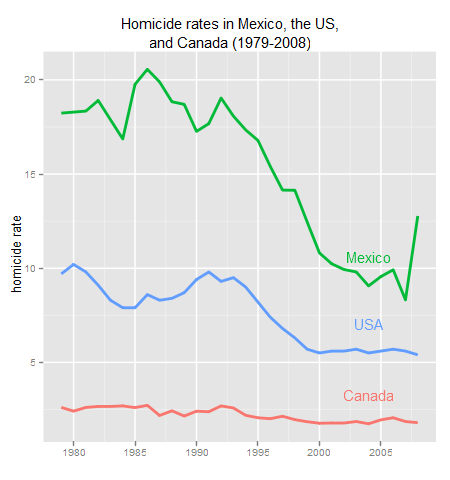
Notice which direction the always high Mexican homicide rate was headed… until the Calderón Administration started this “war.” Valle didn’t run data from 2009-2010, but I don’t see that the trend has changed. Yeah, there is the argument to be made that the state HAD to fight these cartels sooner or later… but one wonders if rather than going with more firepower, more attention had been paid over the last thirty years (or, is paid now) to the basics like education and social services, employment opportunities, government accountability and court reform, better criminal prosecution and basic anti-violence measures like controlling the gun trade, whether there wouldn’t be more victories in this “war.*”
Besides which… if the purpose of this “war” is to keep narcotics out of the United States, it just isn’t working.
To keep doing the same thing and expecting different results is insanity. So, a short answer to a complex question. What would Mex Files do? Something different.
* Assuming, it is even Mexico’s war, and not a proxy war to keep the United States from having to deal with its own narcotics problem on its own territory (cocaine can come in as easily through other nations as through Mexico, and the U.S. doesn’t seem to be concerned about marijuana except when it’s Mexican marijuana, which is, at any rate, a cash crop). Or, a simplistic tool to keep the Calderón Administration in power, or an excuse to apply the “shock doctrine”. But, that’s still being thought through.
Pyrrhic victory
The armies separated; and, it is said, Pyrrhus replied to one that gave him joy of his victory that one more such victory would utterly undo him. For he had lost a great part of the forces he brought with him, and almost all his particular friends and principal commanders; there were no others there to make recruits, and he found the confederates in Italy backward. On the other hand, as from a fountain continually flowing out of the city, the Roman camp was quickly and plentifully filled up with fresh men, not at all abating in courage for the loss they sustained, but even from their very anger gaining new force and resolution to go on with the war.
(Plutarch’s Lives)

Photo: Chihuahua Resiste (resistechihuahua.blogspot.com)
This is Rosa Angélica Marín Hernández’ quincena. Killed last Saturday while a riding in a car with her sister and some younger (as in four year old) neighbor children going to buy hamburgers, the Juarez teenager was buried in her gown. According to her family, the Federal Police were the shooters.
Whatever the circumstances, Rosa was not a victim of the “drug war”, but of “drug warriors”… Jesús Eduardo Martín Jáuregui, was not speaking of Rosa’s quincena, but of a sting of “victories” perhaps more notable than the victory over a girl’s coming of age for their higher body count when he wrote La guerra ganada, o la guerra Pírrica de Calderón (“The war won, or Calderón’s Pyrrhic victory”) in Crisol Plural (my loose translation):
Do not fail to note that — despite results that might lead soothsayers of disaster or apostles of discord to jump to conclusions, and assume that organized crime is having a successful day in this war — it is not so. Our nation’s forces are covered in glory as long as they and the cartels and their henchmen continue to confront each other and decimate each other. We can predict that what is done is done right — and when it comes to combating organized crime we’re marching to victory… hail to our Chief — as designated by the national emblem: an eagle about to be strangled by a snake.

I don’t think there is a a “war on drugs”, or “some drugs” or on the misnamed “cartels” (cartels are cooperative business arrangements, not competitors bent on killing each other off) — it does nothing to control drug distribution. If that is even the purpose. If there is a purpose. The “war” is many other things : blow-back from both Plan Colombia (or whatever the U.S. intervention in Colombia is called today) and NAFTA agricultural policies as well as an ill-conceived economic stimulus package for the U.S. “security industry” (and the Calderón Administration) that works against a U.S. policy that both encourages and punishes narcotics use. And, more than any of those, a needless militarization that has taken on its own logic — one that shunts aside resolution of social problems in favor of solutions that, costly as they are in the short term, are devastating in the end.
Judgement Day
Besides Susan Bolton’s ruling on the Arizona law (which only affects part of the law, and only covers three of the seven federal lawsuits seeking to enjoin enforcement) is only a temporary reprieve, as is yet another court decision, this one by the Costa Rican Supreme Court:
Jamie Way (Narco News), via Bananama Republic:
The Costa Rican Supreme Court last week agreed to take a case challenging the constitutionality of a US-Costa Rican agreement that would allow for a massive US military presence. The agreement cannot go into effect until the Supreme Court rules, thus postponing the arrival of US forces.
On July 1, Costa Rica’s unicameral Legislative Assembly, with 31 votes out of 57, approved the US Embassy’s request to open the country to 46 US warships, 7,000 US soldiers, 200 helicopters and two aircraft carriers. This permission was granted through at least Dec. 31 of this year, officially justified by the necessity of fighting drug-traffickers, providing humanitarian services and providing a place for US ships to dock and refuel.While most reports have put a Dec. 31 expiration date on the agreement, the Nicaraguan media last week reported that Costa Rican Foreign Minister Rene Castro, in a meeting with Nicaraguan Foreign Minister Samuel Santos, said that the agreement is for five years.
Prior Joint Patrol bilateral agreements between the countries allowed only US Coast Guard presence with Costa Rican law enforcement aboard. The US Coast Guard was permitted to follow vessels into Costa Rican waters while in pursuit and awaiting Costa Rican officials. Thus, the new agreement represents a substantial increase in the allowance of US military presence in Costa Rica, a country that abolished its army in 1948 and has a policy of neutrality.
And, in Fremont, Nebraska, where the city council had passed an ordinance written by Kansas City suburban attorney Cris Kolbach, which would have which would have created sanctions for housing or hiring “illegal” aliens, .the city council has voted to “suspend” the ordinance on the advice of Kolbach — and the realization that “”There are both sound legal… and economic reasons to suspend the ordinance at this preliminary stage,” as City Attorney Dale Skokan worded it.
The sound reasons being that there’s no legal way the city could win the expected lawsuits, and the city’s insurers already warned Fremont that its policies didn’t cover lawsuits resulting from bone-headed ideas, like listening to Kolbach.
Kolbach was instrumental in drafting the flawed Arizona law and the Fremont ordinance. He claims to be one of “five or six” specialists in “illegal immigration law”. The dirty half-dozen’s specialty, being unknown to any bar association or to any court in the United States.
Don’t do the crime, if…
Breaking into somebody’s pickup truck — whether on calle 4 Oriente in Cholula, or anywhere else on the planet — is probably best done when:
- It’s night-time
- When there isn’t a police truck two spaces down.
- When google-earth isn’t taking photos.
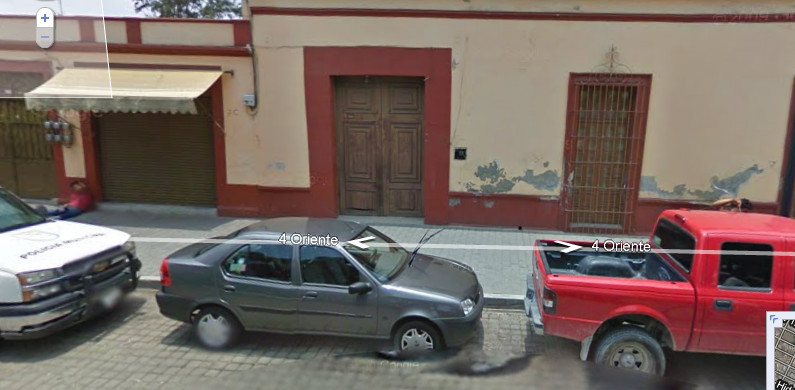
Sombrero tip to Laura Martinez)


 mexfiles.net