Captive beauty
It seems prime for snark, but there’s something wonderful about the whole idea of the “Captive Beauty” pageant scheduled for next Monday (8 March) at the Centro de Readacíon Social Feminil in Ciudad Juarez. As the name of the sponsoring institute (and present residence of the several contestants) indicates, the purpose of such facilities is not to punish the personm nor to “break” them of anti-social behaviors, but to re-adapt the person to an ability to function in “normal” society. One may disapprove of beauty contests in general, but there is no denying they are part of “normal” Mexican society, and these “normal” women — all but one serving sentences related to “crimes against public health” , i.e., narcotics offenses (the exception is doing time for murder) — are participating in a normal part of Mexican life.
If there is a “point” to the exercise, beyond just recognizing the incarcerated as human beings, it is to recreate a communal activity (beauty pageants require make up artists, stage designers, trainers, seamstresses, somebody to set up the hall, judges and so on) within the walls, and to present a slightly more benign image to the world of those we have temporarily cast aside.
From Ciro Gómez Leyva’s Milenio TV report:
Z-Day: 1 de Marzo de 1917


The decoded “Zimmerman Note” was published in U.S. newspapers today in 1917.
German Foreign Minister Arthur Zimmerman, who authored the note offering German support to the Carranza government for an invasion meant to re-annex Arizona, New Mexico and Texas (and, incidentally, keep the United States from supporting Great Britain in the “Great War of 1914-1918) had a Prussian sense of humor. When the note was published, and he was criticized in the German Parliament, it wasn’t his fault he had trouble making friends… Prussians being rather clumsy when it comes to the social niceties of Hispanic culture.
 As it was, Venustiano Carranza probably never saw the note (although the Wikipedia, in an uncited entry, says he turned it over to “a Mexican general” — unnamed — for followup). Although Carranza — like other Mexican leaders — himself tended to be pro-German (as were most Latin American leaders, German immigrants having naturalized themselves more easily than those from the United States and Britain, and Latin Americans then, as now, simply liking Germans more than Englishmen) , mostly as an alternative to United States and British influence (and control of the oil industry), there was no way Mexico would have considered the idea seriously. First off, the country was in the middle of a civil war, and couldn’t afford any imperialist adventures of its own, even if it had any intention of doing so. Secondly, the proposal was nuts… depending on Zimmerman’s ability to convince British ally, Japan, to switch sides.
Wacky as it seemed, Zimmerman’s proposal was not quite the blunder he claimed. It was a calculated gamble, not meant to create a war between Mexico and the United States, but to force the United States to consider its own protection, rather than involving itself in the European War. Unfortunately for the future of the German Empire, the British were able to spin the leaked document as “proof” of German perfidity and convince the already pro-British Wilson Administration that the Germans, not the British, were the bigger threat to the United States.
Carranza, desperate to maintain neutrality, offered to cut off all oil supplies to combatants, which — like the Zimmerman note — backfired. The British Navy at the time ran on Mexican oil. A cut-off would have effectively ended the “War to End All Wars” (which might not have been a bad thing), but was meant basically to pressure the British into agreeing to more Mexican control over their own natural resources. Instead, the British went out and hired a mercenary general, Manuel Peláez, effectively guaranteeing yet more Mexican bloodshed and a twenty year struggle to gain national control of the oil resources.
For Prussians, of course, a joke is a serious matter. Oil, the British, the Royal Navy and Latin American resource rights: it’s back in the news again, and maybe Herr Zimmerman is enjoying his practical joke on the British somewhere.
Carlos Montemayor, D.E.P.
There is no Spanish equivalent for the English word pundit for one simple reason. Whereas “pundit” (from the Hindi word for a religious teacher, “pandit”) was originally a humorous term for an figure who comments in the media on everything and anything, whether they have expertise or not, the public figures who comment on the news of the day here are true intellectuals.
A public intellectual, unlike a pundit is not a recycled sportscasters (like Rush Limbaugh or Keith Olbermann), or a news readerand disk-jockey marketed as an expert in areas about which they know nothing (like Lou Dobbs, Glenn Beck and many, many others) or someone expert in one small area who is expected to pontificate on areas about which they really know little or nothing. Not that some “pundits” aren’t well-educated people (like Rachel Maddow — a PhD in Public Health — or Charles Krauthamer — a physician), nor experts in certain areas, but pundits are a media creation, not an earned title of respect, as with the public intellectual.
A pundit, even though they may be right on occasion (or, more likely, we agree with them) seems to use ad hoc ergo propter hoc argumentation to present an opinion and attempts to sway public sentiment. A public intellectual, a person of high cultural achievement doesn’t so much give you an opinion as the reasoning behind a given position. Whether you agree or disagree with the public intellectual is less important than the fact that the public intellectual has presented a cogent understanding of an issue, based on research. A former sportscaster isn’t likely to be a public intellectual. One must be a novelist, a researcher, a historian, a figure sought out by the political establishment (and the opposition) — or preferably all of the above — to qualify.
The late Carlos Montemayor (born 13 June, 1947 in Parral, Chihuahua) who died early Sunday morning of stomach cancer, more than earned the title of public intellectual.

Photo: El Universal
A musical prodigy who, as an adult, both sang opera and wrote librettos, enjoyed a particularly rich educational background. He supplemented his law degree with a masters in Indigenous Languages and a later degree in Asian studies. He spoke a number of indigenous Mexican languages, as well as Greek, Latin, Arabic (both classical and demotic), French, Italian, English and, of course, Spanish. In recognition of his work as a linguist, he was elected to the Mexican Academy of Languages and was a corresponding member of the Spanish Royal Academy, and the Association of the 20th Century Latin American and Afro-Caribbean Archives.
Linguistics, however, was only a side-line to his career as a researcher of indigenous Mexican oral traditions. Which led, in time, to his own involvement in Indigenous affairs, and his studies of rural guerrilla movements of the 1970s and of social movements (some of which he actively supported). The latter was instrumental in Montemayor’s important government role as a trusted mediator between the state and the ERP. At the time of his death, he was working on a book about state violence in the State of Mexico.
If that was not enough for one lifetime, he wrote poetry and novels, founded and edited several magazines for the support of indigenous languages and wrote regularly for the popular press. As well as appearing on talking head television shows, where — as a public intellectual — his voice mattered to discussions of public policy and cultural matters, and where he was not shouting an opinion, but presenting a nuanced, well-thought out, rational statement that could not be simply written off by those who might disagree.
There are fine obituaries in Jornada, El Universal and Milenio.
Nota Policromática
Ignacio Dávalos, in Sunday’s Milenio had a crime story involving a bit more color than your usual nota roja (my translation):
Guadalajara – Are you a budding narco, moving up the ranks and finding you finally have disposable income? Did you have a big dream when you were a child about buying your mom that perfect Virgin of Guadalupe? If so, then this may be the place for you.
On Wednesday, agents from the Federal Attorney General’s Office (PGR, for the initials in Spanish) and the Nacional Insitote of Anthopology and History (INAH) raided the Casa Terranova Art Gallery, in the historic center of Tlaquepaque, recovering two pieces of sacred art dating from the 18th century: “The Adoration of the Magi” and “The Birth of the Virgen”, both being offered to the public at the low, low price of a mere 35 thousand U.S. dollars.
No one seems to be sure how the two works ended up in the center of this historic (and trendy) Guadalajara suburb. What is known is that the two works were illegally removed (ok… robbed) from Santa Matilde Church in Pachuca, Hidalgo on 5 September 2008. Following investigation by the Federal Investigative Unit for Environmental and Special Crimes, together with Federal and Jalisco State Police, all under the coordination of the INAH’s divisions of Judicial Affairs and Conservation of Nacional Patrimony, the pieces were located, and last Wednesday, reclaimed from the Terranova Gallery, Indpendencia 156 in downtown historic Tlaquepaque.
Despite the mess, the gallery has not closed its doors. On its website, Casa Terranova describes itself as “… a gallery that manages, retrieves, maintains and promotes ancient, modern and contemporary art, with the goal of making Mexican art available to the world. For over 25 years we have acquired works of art of major significance, creating a collection and cultural space worthy of acquisition.”
– “But, how did you end up with these works? Wasn’t there some way to ascertain their origin before they were offered to the public?” Said a clerk, wishing to remain anonymous, “When you’re an antiques dealer it is very difficult to know what the origin of the pieces that are purchased. You buy and sell in this world in good. But, this isn’t an uncommon problem… we were just the last link in a chain of purchasers. We are tranquil and this is something our lawyers can fix.”
When asked about other similar works the Gallery might have for sale, the clerk refused to answer any more questions. “We don’t want any more problems,” he said.
The reality is that there are such galleries (several of them in Tlaquepaque) where one can order works from the 17th century onwards, mostly sacred art, with prices ranging from $500 for contemporary crafts to over one hundred thousand dollars. Surely, dozens of these pieces, traveled long roads and passed through many hands before reaching the shops, but for now, two of them are being returned to their rightful owner and their place of origin.
8.8!
WOW!
An 8.8 Richter scale earthquake struck Chile this morning, which so far has not caused anywhere near the damage seen in 7.0 Richter scale Haitian quake . Of the 120+ reported deaths, most of the destruction being reported was a result of the tsunami which struck the isolated Juan Fernandez Islands, rolling through the one sizable community, named for early resident, Robinson Crusoe.

Residents on Easter Island (Rapa Nui), another Chilean possession, were being evacated to inland areas.
There are reports of major damage in Santiago and Concepcíon but so far the devastation seems to have not been on the scale seen in the much less powerful Haitian quake.
The strongest earthquake ever recorded was in Chile: the 1960 Valdivia earthquake measured 9.5 on the Richter scale, and triggered tsunamis across the Pacific, causing massive damage as far away as Hawaii, the Philippines and northern California.
The New York Times recently published an article on earthquakes, showing the most vunerable highly populated areas. I neglected to bookmark the article, but saved the (hard to read — sorry ’bout that) map of vulnerable communities. While much of Latin America is highly prone to earthquakes, none of those vulnerable communities faces the likelihood of a repeat performance of the death and destruction the country has seen in the past, having learned our lesson from the 8.1 Richter scale earthquake of 1985.
Better construction techniques and general preparedness (Mexico City has earthquake drills that are taken seriously), mean that only a few communities in the Americas are considered at extreme risk. Those communities at high risk, are mostly where urbanization has over-tzed the ability to regulate construction. Port-au-Prince is — or was — the prime example. San Salvador (Salvador), Guatemala City and Quito also face high risks; Santo Domingo (Dominincan Republic), and two Bolivian cities — La Paz and Santa Cruz — are also considered prime targets for major earthquake destruction in urban areas.
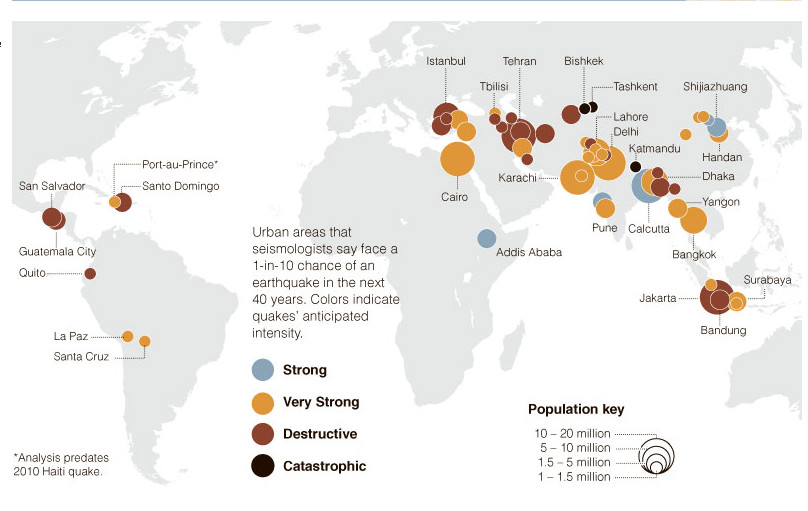
The destruction in Chile will be severe, and reports are still coming in, so I expect to update my posts later.
The first draft of the Amatlanahuatili Tlahtoli Tlen Mexicameh Nechicolistli Sentlanahuatiloyan, the official Nahuatl version of the Mexican Constitution, was presented to the Senate of the Republic by the scholars and historians tasked with translating the basic Mexican legal document. Translator Natalio Hernández has spent two years on the project, facing, among other difficulties, that there are thirty different forms of Mexico’s most widely spoken minority language.
In 1917, the Constitution was published in Yucateca Mayan, but this is the first “official” translation of the document which, since 1996, has recognized the rights of indigenous communities to use their own language. The problem is that no one seems to be certain exactly how many indigenous communities, and how many languages fall under the constitutional mandate.
Historian Miguel León-Portilla, who is charged by the Senate with overseeing the translation project said he hopes to see translations in at least the other common languages: Mixteca, Zapoteca, Otomí and Purépecha.
Hidalgo, Puebla and Veracruz have translated their State Constitutions into Nahuatl, with the State of Mexico having official versions in Nahuatl, as well as Mazahua, Otomí and Matlatzinca.
(Mileno, via Corresponsales Indíginas)
Sex and sex and sex and sex!
For the seventh year in a row, Mexico City’s Palacio de los deportes ( built originally for the 1968 Summer Games) will be the site of one of the most popular trade shows in Latin America: Expo Sex.
Opening to the public on March first, the seventh annual porn, erotica and related industries trade show is expected to break last years record of 105,000 visitors.
Also this year, the Sex and Entertainment Awards (with a statuette of a chile poblano as the prize) were handed out by Mexican porn star “El Diablito” assisted by Australian artist Pricasso who will, along with a bevy of porn stars, videographers, film-production companies, lingerie vendors, publishers, rubber, vinyl and leather-goods craftsmen and women and manufacturers of marital aids and others will be strutting their stuff (so to speak) next week.

So you wanna be a rock-n-roll star
1970s pop stars show up in Mexico regularly, to mixed receptions. With almost no mention in the Mexican press — and about the same amount of interest — comes word that Elton John will be doing a concert at Chichen Itza in April. Considering tickets to the concert easier to buy in Europe and the United States than in Mexico (although you can buy them at a few tourist agencies in the Yucatan serving foreign clients), don’t expect the fans to be much different than those at his last concert here: in other words, not many Mexicans.

EJ, before he lost it in the wind
John’s November 2001 appearance at Chapultepec Castle was at a fund-raiser for Marta Sahagún (Mrs. Vicente Fox)’s “charity”, Vamos Mexico. Having political ambitions of her own, the right-wing Sahagún tried to project herself as a Mexican version of Eva Peron, whose Fundacion Eva Peron shook down the rich and spent the loot on social services for the poor. Sahagún’s “Vamos Mexico” shook down the rich, the middle class and tried, when it could, to get the poor to pony up … so that the loot could be spent (what auditors were able to trace of the loot) on supporting right wing politicans and propping up some of Sahagún’s two sons more dubious business enterprises.
John’s appearance at Chapultepec was met with student and worker protests — not so much that they couldn’t afford the tickets — but that they saw John as a suck-up to the rich and powerful– and politically naive. Given that the guy is better known in Mexico for hanging out with rich wives with their own agendas (like Mrs. Charles Prince-of-Wales) than anything else, it’s not so much that Mexicans don’t care for his music (although the Village People are much more popular, and lyrics about Confederates and dead princesses are kinda hard to sell in Mexico, especially in English), but they don’t care for his amigas.

Evo: I'm with the band
Compare that to another pop star of the 1970s, who visited Mexico City last week and received a huge, enthusiastic and warm welcome. Michael Collins at Americas MexicoBlog writes on the frenzied fans who gathered by the thousands to greet the former trumpet player that top of the Bolivian pops favorite, the Royal Imperial Band:
It was a hot afternoon in central Coyoacán and the sun beat down heavily on the crowd as they awaited the appearance of charismatic Bolivian leader, Evo Morales. The public queued patiently and edged slowly into the Jardín Hidalgo, following mandatory security checks that are the norm at events of this nature. As the area filled, the more eager of the spectators began to climb onto the bandstand, trees and fences, to get a glimpse of their hero. The smaller members of the audience stood on their tiptoes in preparation for the Bolivian leader’s arrival. A scuffle broke out in the crowd, and the two perpetrators were comically berated by onlookers who reminded them that, “We are socialists, not neocons! Keep the peace.” To warm up the crowd, an M.C. read out some of Evo’s achievements since he began his presidency in 2006. Evo Morales has made Bolivia a literate nation. In 2008, during the financial crisis, Bolivia’s GDP increased by 6%. Evo has successfully nationalized the nation’s gas reserves. He also intermittently entered the stage to give updates on Evo’s whereabouts. “He’s leaving the airport now!” Cheers from the crowd. “His car’s just arrived!” Cheers again. “He’s making his way through the crowd! Yet more cheers.
…
He told the cheering crowd that “basic services are public services and must not be privatized.” The crowd responded by chanting “Calderón out!” recalling their own president’s recent decision to dismiss over 40,000 employees of the state electricity company for the purposes of privatization. Morales’ attack on the upper class continued as he told the crowd that, “There are more of us than these modern millionaires. They have all the wealth but are small in number, whereas we are poor but are the majority.” He told the crowd that these gold-diggers were only interested in exploiting natural resources for their personal financial gain. The crowd listened as Morales spoke of the importance of getting middle-class citizens and intellectuals on side, to fight the oligarchs.
When to start fighting the oligarchs? … ummmm….
Saturday night’s alright for fighting. Get a little action in.
The course of justice
Not all Mexican crime involves narcotics or murder of even bribery. And not all criminals get away. And the wheels of justice don’t always turn slowly. In most of Mexico, your typical crime story in the local paper is a nota roja — COMPLETE WITH PERP PIX — like this one, presented in its entire glory (my translation) taken from the Aguascalientes on-line news aggegator, Crisol Plural:
 Having been identified as the suspect who stole a 26-inch wheel white bicycle, as well as a burglar, the police officers in charge of unit 1305, captured at 19:45 pm Arturo Martinez Campos, a 34 year-old mason in the Municipio Libre sub-division of colonia San Miguelito y Esfuerzo National..
Maria de los Angeles Garcia Montoya is the person who accused Arthur and who says he tried to steal about 200 meters of electrical wiring: so after he was apprehended he was presented immediately to the judge.
What are friends for?
OK, Mexico and Bolivia are best buds these days, but let’s not take this beautiful relationship too far. All I have to say to El Duderino is…
¡GOL!
¡GOL!
¡GOL!
¡GOL!
¡GOL!
Exodus?
Not everything about Juarez, good bad or indifferent, necessarily is “drug related”. Cuidad Juarez — while as much a part of the “real Mexico” as any other city in the country — is different in several ways. As I’ve talked about before (back in 2006, before the latest “Drug War” was more than a blip on the usual “Mexico is dangerous” radar screen) it’s a frontier town and a boom town, with a different demographic than you’d find elsewhere. I’m not sure the census numbers are accurate (or can be accurate) for a community where so many residents are only there as long as there are jobs, or who intend to move on eventually (or were deportees and are stuck there for financial or other reasons).
Julia Cardona, in an 18 February 2010 Reuters dispatch on the population decline in Juarez begins “Tens of thousands of Mexicans are fleeing drug violence on the U.S. border in an exodus that is decimating a large city and threatening to leave a major manufacturing area short of skilled workers.”
 Cardona says 200,000 people have left Juarez, Ganchoblog says up to 500,000. But, given that manufacturing is down (fear of narco-violence having less to do with it than a downturn in U.S. consumer demand and the local economy’s nearly complete dependence on the U.S. economy) coupled with a decline in emigration to the United States, I don’t see the decline as all that surprising.
Detroit and Buffalo — to name two U.S. frontier towns dependent on heavy industry for their economic base — experienced huge population declines during economic downturns. In Detroit, crime — or the perception of crime — was the final straw for many of the emigres.
But, while the “drug war” — which only has taken off during the Calderón Administration (the last three years) — has somewhat speeded up the process, there isn’t all that much difference between Detroit and Juarez.
True, much of the decline of Detroit involved a move to the suburbs and a good part of the population that left the U.S. “rust belt” cities was absorbed by the surrounding communities, but Juarez is off in the middle of the desert.
Those whose livelihood is independent of manufacturing — service industry workers — are fairly likely to stay, but are going to move where the money is. Most articles on the flight of the Juarez focus on those who’ve moved a family business to El Paso… which is still Metropolitan Juarez. And the loss of amenities and services is likely to convince still more to leave.
Secondly, with emigration down, there are less people moving into Juarez to replace those who would have emigrated anyway. And, since so many moved there just to work, with the economic downturn, they’re going back home, or moving on to other parts of Mexico.
And, given Juarez’ uncontrolled growth over the last two decades, the never adequate infrastructure and city services suck … as does living in the desert in the best of times … coupled with the negative publicity the city garners, people don’t want to move there right now. Sort of like Detroit, which has harsh winters and had a very bad rep for crime and narcotics (although from the consumer and retail end, rather than the wholesale end of the trade).
It’s not surprising that industries in Juarez are now finding it difficult to recruit workers… many of them depended on the “floating” population which has floated away.
An Exodus? Perhaps. Certainly a trek through the desert might be involved, but to identify the “drug war” as the one and only reason is not just lazy thinking, it’s just another in an infinite series of attempts to “explain” Mexico in terms of U.S. concerns — like the “drug war” — and to view events in Mexico as somehow unique.
Maybe, maybe not
Yesterday, William Booth of the Washington Post reported:
For the first time, U.S. officials plan to embed American intelligence agents in Mexican law enforcement units to help pursue drug cartel leaders and their hit men operating in the most violent city in Mexico, according to U.S. and Mexican officials.
Later in the day, Arturo Saukhan, the Mexican Ambassador to Washington, and U.S. Ambassador to Mexico, Carlos Pascual, denied that that any United States agents are working in Mexican territory and that there are no plans to seek a change to Mexican law to allow such operations.
Of course, there ARE U.S. agents working in Mexico (we have a Drug Enforcement Agency office here in Mazatán. and –when the news cycle is slow — you can count on an expose of the U.S. agents at the Mexico City airport (looking for U.S. citizens transferring from Cuban flights to U.S. ones, no doubt) — but they aren’t “embedded” and, it sounds as if this is either wishful thinking on the U.S. government’s part, or Booth is talking about trainers of some sort… which isn’t controversial, given that Mexican police and military units have received training from Israeli, French and Spanish police in the past.


 mexfiles.net