GM Mosquitos?
Now here’s a genetic modificiation that sounds like a great idea:
(BBC, via Mercopress):
“Current dengue control methods are not sufficiently effective, and new ones are urgently needed.
“Controlling the mosquito that transmits this virus could significantly reduce human morbidity and mortality.”
The plan is to release genetically-altered male mosquitoes that will mate with wild females and pass on their genes. The scientists have shown that females of the next generation who inherit the gene are unable to fly because it interrupts normal wing growth. Male carriers of the gene remain unaffected.
Lead researcher Luke Alphey, of the University of Oxford and his own spin-out company Oxitec Ltd, said the approach was highly targeted.
”The technology is completely species-specific, as the released males will mate only with females of the same species.
“Another attractive feature of this method is that it’s egalitarian – all people in the treated areas are equally protected, regardless of their wealth, power or education.”
Aedis aegypti, the dengue-carrying mosquito, was an early immigrant to the Americas. It was traditionally only found in urban areas in tropical and sub-tropical regions, but, between global warming and better infrastructure, has dramatically expanded its range in the last thirty years, making it a public heath threat from the United States to Argentina.
You seldom die from dengue, but you wish you would.
Smugging operation uncovered
A narcotics courier was recently arrested in Buenos Aires with 55 kilos of cocaine. Apparently customs officials caught on that although fashion models often need a lot of suitcases, models in the lingerie trade really don’t. Or wanted a peek at her undies.
The mastermind of the smuggling operation, now believed to be in hiding in Mexico or Argentina is former Miss Colombia Coffee, Angie Sabselmente Valencia. Somebody might have seen her… er… face.

Imperial sunset
The first commentator thought I was suggesting military action against Britain… I rewrote the last sentence (and made a few changes to correct typos and editing errors) to clarify what I think is inevitable.
Argentina received the support of its Latin American and Caribbean neighbors Monday in its claim to sovereignty over the Falklands (Las Malvinas) Islands. According to the AP, the 32 countries currently gathered on the Mexican coast for the Rio Group summit backed a statement presented by Mexico’s Felipe Calderon saying “the heads of state represented here reaffirm their support for the legitimate rights of the republic of Argentina in the sovereignty dispute with Great Britain.”
The agenda for what should have been a Rio Group meeting decided on three official agenda items: #1 is long-term reconstruction in Haiti; #2, affirming Argentina’s sovereignty over the Malvinas; and #3, developing an alternative organization to replace the cold-war era (and U.S. dominated) Rio Group and get around the limitations of the (again, U.S. dominated) Organization of American States.
No one objects to reconstructing Haiti (except those that want to control the reconstruction) and returning the Malvinas (Falklands) to Argentina is probably not all that important to anyone except the five thousand people living on the islands, and the British taxpayers who spend over $20,000 per Kelper on military protection from their shift of governance to the Province of Tierra del Fuego.
What is important to the leaders of the new Latin American and Caribbean Union is making a statement, and a very clear one, about the seriousness of the alternative organization. With even the Mexican President (or, if you prefer, “resident of Los Pinos” for you die-hard Lopezobradistas out there) speaking of Bolivarianism, the Malvinas/Falklands dispute is simply a test for what is really important… and maybe as a needless distraction from the real story (or stories) for the English-speaking press.
Look who wasn’t there. Canada, Honduras and the United States weren’t invited. Canadian firms — and the Canadian government — have garnered a bad reputation in Latin America, especially among the left and among environmentalists for the way Canadian extractive industries have run roughshod over local communities. In addition, Canadian diplomacy in Latin America has been knee-jerk in support of U.S. initiatives, such as the attempted Venezuelan coup of April 2002.
Canada also has supported the coup in Honduras, which as the leaders meeting in Playa del Carmen made painfully obvious, shook the region more than perhaps its backers in the United States and elsewhere realized.

Calderón and Raul Castro (Photo: Milenio Televisíon)
The United States, besides backing the Honduran coup (and seen — even by reactionary supporters of the coup — as a puppet of the United States), the Venezuelan coup attempt, and most coups in Latin America going back to the 1829 coup against Mexican President Vicente Guerrero, and having more than enough of a history in Latin America and the Caribbean to annoy nearly any country you can name, was, of course, the dominant “partner” in previous pan-American organizations. The Organization of American States, for example,
… is funded largely by – you guessed it – the U.S. and Canada. Specifically, in 2009, of the US$78.6 million in regular fund quotas collected, 73.6% came from those two countries (US$47 million from the U.S. and US$10.9 million from Canada).
And he who pays the piper calls the tune. Both the Honduran coup, when what should have been an OAS crafted response was pushed aside in favor of a U.S. brokered “negotiation”, and the Haitian earthquake, in which the U.S. relief effort appears more and more like a unilateral invasion and less-and-less like a pan-American reconstruction program.

No wonder Evo's smiling (Photo: Milenio Televisíon)
Finally, it’s inescapable that the best economic growth in Latin America has been in those countries that have distanced themselves from the United States. Bolivia — yes, Bolivia — has seen the best growth rates south of the Rio Grande, Mexico — which depends on the United States for 90% of its foreign trade — and Peru have done the worst during the recent economic crisis. The Calderón Administration, here in Mexico, has had to slowly adopt the López Obrador program during its tenure whether they wanted to or not. López Obrador was pushing to expand pan-Latin markets, and, Bolivarian economics has its attractions, even for FeCal. As Sean Goforth writes in the Washington-based Foreign Policy Association Mexico Blog:
After a bruising 2009, Mexico’s economy should return to positive growth of around 3% this year, but the path to sustainable development remains uncertain. Reforming state-owned industries risks massive political backlash, but improving Mexico’s trade regime offers promise without the peril.
What trade strategies can boost Mexico’s growth? Several prospects have been bandied about. Talk of “deepening” Mexico’s commitment to the North American market was common before the recession, but diversification, not concentration, has proven more popular of late. To this end, President Calderon recently called for Mexico to “diversify its trade and investment (and) reduce its dependence on the United States.” His comments were made with an eye toward Europe, but he made similar statements regarding Brazil last August.
Since the inception of the Banco del Sur — the self-financed inter-Latin American (Venezuela, Brazil, Argentina, Uruguay, and a few others) development bank has proven relatively successful, Mexico has given more serious consideration to inter-Latin finances. This is part of the same economic trend we’re also seeing even among countries with traditionally bad relations. In Venezuela, where a particularly severe dry spell this year has meant a shortage of hydro-electric power, and the Venezuelans are turning even to the despised Colombians for electrical generating capacity.
So, everyone with the exception of Alan Garcia of Peru — from Alvaro Uribe of Colombia on the far right to Cuba’s Raul Castro — sees the new organization as potentially to their mutual advantage.
Uribe is largely seen — like the uninvited Honduran leader, Pepe Lobo and the AWOL Peruvian, Alan Garcia — as a U.S. puppet. Given the Colombian administration’s dependence on “Plan Colombia” funding, coupled with the increased U.S. military presence in Colombia, and Uribe’s boorish behavior at the conference, unreasonable assumption.
Bolivia’s Evo Morales called his Colombian counter-part “an agent of the United States, who came to the conference with the purpose of derailing it by creating an altercation with the Venezuelan President” (my translation).

Chavez (left, of course) and Uribe (on the right, as you'd expect)
Uribe arrived late, barged into a meeting and began interrupting the speaker with complaints about Venezuelan restrictions on the import of Colombian beef. Unfortunately for Uribe, the speaker was Venezuela’s Hugo Chavez, not a man easily interrupted. Chavez allegedly told Uribe to “go to Hell”, and finished his speech. Later, host Felipe Calderón said Dominican Republic President Leonel Fernandez was acting as head of a group that would work out an amicable solution to Colombian-Venezuelan trade differences… something impossible to do if the United States (which has a stake in continued animosity between Venezuela and Colombia) were involved.
Finally, even with Chile’s return to a conservative government, pan-American relations are better and there is consensus that the various states need to coordinate their economic and political activities. Chile was traditionally close to Great Britain, and Augustin Pinochet was personally close to Margaret Thatcher the last time there was a serious attempt by Argentina to regain control of the Malvinas. At the time of the Falklands War, Chile and Argentina were close to war with each other over the boundary and navigational rights to the Magellan Straits. That dispute ended with the Vatican Treaty of 1984, and — with Pinochet and Thatcher both gone, and a new spirit of cooperation not only between Chile and Argentina, but between all the Latin and Caribbean nations, the sense is that IF there is oil in the Malvinas, not only Argentina, but the entire region will benefit. If not, it doesn’t matter. I’m very much afraid the economic and political interests of 5000 aging English colonials and 500,000 sheep don’t stand much of a chance weighed against a those of a union of 500,000,000 people.
Little big man?
The capture of José Vázquez Villagrana, alias El Jabalí — despite being described (by Alexandra Olsen for the Associated Press) as a “key operator” in the Sinaloa Cartel may not be nearly as important as he’s made out to be.
Vázquez — a U.S. citizen, by the way — is singing, but to quote Gancho, “it’s not clear how close he was to Chapo.” Vázquez apparently spoke with Chapo on the telephone — once. Vásquez claims to have some insider information on Chapo’s organizational structure and operation (none of it, except that Chapo and company aren’t in the kidnapping biz, being particularly new or startling), yet his ties to the Beltran Leyva brothers and less-than-insider status make me think of all those “#2’s” in Al-Qaida that kept being captured or killed by the U.S. during the Iraq Invasion every time there was domestic criticism of the Bush Administration.
While it’s perfectly possible that El Jalabí is of some importance to Guzman and Associates, and that his information is correct, it’s equally plausible that either Chapo decided to get rid of a guy who really doesn’t have any trade secrets to spill, or that the Federal government is over-stating his importance. Given the growing criticism here in Sinaloa (and elsewhere in Mexico) that Chapo is an untouchable, I wouldn’t be surprised if a couple more #2s won’t be doing a perp walk (or laid out on a slab) for the media over the next few months.
Chapo associate, or rival, er, decomissioned?
The headlines this morning talk about the capture of José Vázquez Villagrana, alias El Jabalí (“the javelina”, which I’ve always thought of as kinda cute but dumb critters… though I suppose it could also mean “the boar”).
Vázquez is a close associate of the late Arturo Beltrán Leyva, and a compadre of his brother, Alfredo. Which sounds like he was more a potential or actual rival to Chapo and his not-so-merry crew than, as the police are crowing, a high-ranking executive in Chapo, Inc.
But we knew that already
I wonder how many sleepless nights (and long days) went into proving what everybody here has known forever. The siesta is good for you, although it’s nice to have science confirm one reason people in northern countries act like bone-heads so often…
The study, from the department of psychology at UC Berkeley, suggests taking a brief siesta not only refreshes the mind, but can also make you smarter.
And those who work long days without a rest become more sluggish, the study said. Pulling an all-nighter, for example, decreased the brain’s ability to learn by nearly 40 percent in those observed.
“Sleep not only rights the wrong of prolonged wakefulness but … it moves you beyond where you were before you took a nap,” said Matthew Walker, the study’s lead investigator.
(Sombrero tip to Inca Kola News)
Huiquipedia
Since 2003, Mexico has recognized the right of indigenous students to receive an education in their own language. There are, according to the Catálogo de las lenguas indígenas nacionales 68 language groups and 364 total language variants (not all of which may have speakers of school age).
The indigenous population has the least access to educational services, and is the sector with the worst infrastructure and teaching materials. An estimated 8.3 percent of the students between six and 14 years not attending school and are speakers of one of the indigenous languages. Nahuatl — being the most widely spoken of the indigenous languages — has the most developed curriculum, and the Huiquipedia is available to help Nahuatl students with their homework. It’s not complete, with only 184,457 entries there are several million articles still needed, so it desperately needs more so Tlatequitiltilīlli (contributors).
What they’re saying in las Malvinas
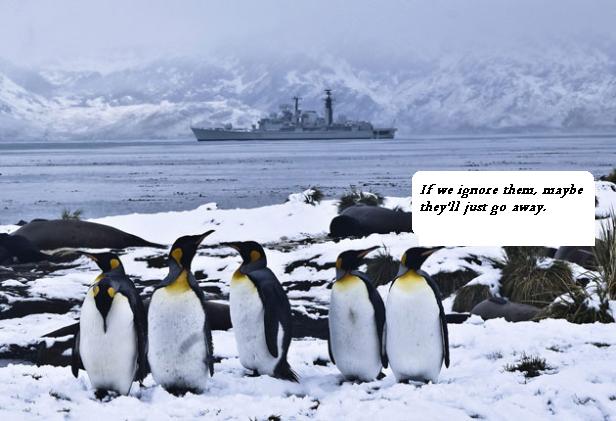
Britain feels it necessary to maintain 1,000 troops, a destroyer and £300m worth of Typhoon fighter aircraft on the islands to defend 3,000 people, 500,000 sheep and a claim that does not come out particularly well from historical scrutiny….
Like the “Treaty of Friendship, Navigation and Commerce” between Great Britain and the “United Provinces” (i.e., Argentina) in 1823, recognizing the transfer of the Malvinas from Spain (which had been recognized by Britain under the 1713 Treaty of Utrech) to the new country. Which of course, perfidious Albion forgot all about in 1832, when they suborned the Argentine naval personnel and occupied the islands. And, started thinking up rationales for why they were even there…and now spend something like 70 million pounds (no idea what that is in money anybody uses on this side of the Atlantic) to keep British politicians in office.
… it is altogether fitting and proper…
The first indigenous president of Bolivia, Evo Morales, will be offering a floral tribute at the Benito Juarez Monument, today in Mexico City.
It is “altogether fitting and proper” (to quote a contemporary of the Benimerito de las Americas) that Evo do this. Juarez was the Americas’, and Morales Bolivia’s, first indigenous President, but more importantly, it was Juarez who was the world’s first “non-aligned nations” leader, wisely noting that among nations, as among neighbors, respect for the rights of others is the way to peace. Redefined somewhat in the 1930s — and known also as the “Estrada Doctrine” — Juarez’ theory of international cooperation comes down to not sticking your nose into your neighbor’s business, unless asked, in which case, you RESPECTFULLY ask what they’d like you to do.
After his visit to Mexico City, Morales is headed for Cancún where the leaders from throughout the Americas are meeting to discuss a replacement, or redesign of the Rio Group, the cold-war era which subsumed smaller nations military and diplomatic interests to those of the United States. The United States, Canada and Honduras (which had its membership in the Organization of American States suspended after the coup) were pointedly not invited to the cool kids club… but Cuban President Raul Castro will be present.
Mexico pulled out of the Rio Group when, as a member nation of the United Nations Security Council, it was pressured to break with its own diplomatic tradition of non-interference in foreign affairs (the Juarez, or Estrada, Doctrine) and support the U.S./British/Spanish invasion of Iraq. U.S. and Canadian support for the Honduran regime — and the continued U.S. boycott of Cuba, as well as what is seen as an attempt by the United States to assume control of Haiti in wake of the recent earthquake — led the rest of the hemisphere to consider a new international body.
Tied to the meeting is a Caricom (Caribean community) summit, the clumsily named (for now) “Union of Latin America and the Caribbean Nations”: From Qué Es (my translation):
[The “Union of Latin America and the Caribbean Nations”] “has as its primary objective achieving greater unity and coordination among countries of Americas — with the exception of the United States and Canada. It will discuss the creation of a more flexible regional body, consistent with the existing Organization of the American States,” according to Patricia Espinoza, Mexican Foreign Secretary.
Brazilian leader Lula de Silva defends the new body operating “without supervision” of the major powers …
Mexican President Felipe Calderon will support the new entity as bringing together current mechanisms for cooperation.
For his part, the president of El Salvador, Mauricio Funes, says the new group aims to advance a “strong action” among Latin America and the Caribbean.
The immigration issue will center the discussion with a proposal by Paraguayan President, Fernando Lugo, that the various nations establish a coordinated mechanism to regulate migration.
The meeting could also serve the region for concrete new ways of assisting the reconstruction of Haiti, which would complement the $100 million U.S. dollar Partnership Fund agreed earlier this month in Quito by the presidents of the Union of South American Nations (UNASUR).
Good news, bad news
From Jason at Secret History:
Tourism numbers are in and Mexico experienced a 15% decline in tourism revenues for 2009. Bummer for Mexico, but not such a bummer for people who like to go to Mexico.
And people who “like to go to Mexico” will have an even better time if they read books. And, they can really make it a “quality visit” if they read books about Mexico.
Tenochtitlan will rise again!
EFE, via Latin American Herald-Tribune (Caracas):
A replica of the sacred center of Tenochtitlan, the capital of the Aztec Empire, will begin construction this year outside Mexico City, the directors of the project said.
Notable among the 21 buildings that will make up the replica of Tenochtitlan, a city founded in the 14th century and one of the biggest of its day, will be the pyramids of Coacalco, Cihuacoatl, Chicomecoatl and Xochiquetzal, the Temple of the Sun and courts for the pre-Columbian ball game that played a central role in Aztec culture, all of them surrounded by a canal.
“Rescuing history” is the key to this project, which will occupy some 300 hectares (740 acres), and where besides the pre-Columbian-style buildings there will also be offices, two Hilton hotels and two shopping malls, one of them dedicated to international designer fashions.
The buildings of the “sacred premises” will preserve the original dimensions, colors and paintings that, according to the observations of chroniclers like the Spanish conquistador Bernal Diaz del Castillo, decorated the Aztec capital.
These pavilions will be reserved for exhibitions and, in the case of the ball court, for concerts and cultural events. IMAX movie screens will be installed inside some of the temples.
“We must recover the pre-Columbian architecture, our true architecture,” the head of the project, Ivan Castañeda, said in Mexico City, but added that these will be “smart” buildings, “as required by businesses of the 21st century.”
In order to “save these roots,” whose importance is stressed by the creators of the project, the Nican Ca Tenochtitlan Center, as they are going to call it, will also include a Museum of Aztec Culture and an embassy of the indigenous peoples.
In addition, the canal surrounding the replica of the sacred premises will offer a nighttime boat tour featuring a representation of how the Aztec capital was destroyed by colonizers of the 16th century.
The team carrying out the project estimates that work will begin “in a few months” and that it will create more than 6,000 direct jobs and will take 5 years to finish, though the first replicas will be ready “by the end of 2010.”
The plan has a budget of $3 billion, all provided by unnamed private investors from France, Britain, Chile and Peru.
The exact location of this park of commerce and culture has not yet been revealed, though it is known that it will be in the town of Huixquilucan, chosen for its proximity to a planned highway linking Mexico City with Toluca, capital of the surrounding state of Mexico.
Were their Hiltons in the original Tenochtitlan? Oh well… perhaps selected guests can be invited to participate in the production of gringas and gorditas…

¡Buen provecho!
San Patricio
The Irish and the Mexicans — besides their shared history of being agrarian Catholics overrun and occupied by their Protestant English speaking neighbors and their dependence on remittances for much of their history — discover they have more in common than you’d think when the Chieftains take on the San Patricios — :


 mexfiles.net