Ernesto Nava Villa, 1915 – 2009, D.E.P.
Somehow I missed this. Ernesto Nava Villa, the last known son of prolific Mexican family man, Pancho Villa, died New Years’ Eve in Castro Valley, California.
 Nava Villa was born 4 July 1915 in Nazas, Durango, to Villa and one of his several wives, Macedonia Ramirez. His mother, fearing the child might be murdered by one of Villa’s personal or political enemies, fled to California in 1917, raising her son under an assumed name. Nava Villa was not told of his paternity until he was an adult, but… given the reputation of his father in the United States… was asked to keep it a secret. Which he did until 2003, when — on his first visit to his native Mexico — he discovered not only that he was a minor celebrity as the heir to an important and popular historical figure, but had a host of relations.
We think of Pancho Villa as having been responsible for a huge population drop in northern Mexico during the Revolution, but he certainly did his bit to reverse the decline… having children by several of his 23 wives and several girlfriends, and adopting 300 Mexico City orphans. It’s too bad Macedonia made the decision to flee so soon. By all accounts, Pancho was an excellent family man actively involved in his children’s lives and a good provider.
Nava Villa — truly a chip off the old block — is survived nine of his twelve (under California law) “legitimate” children, three other children, thirty one Grandchildren, forty nine great-grandchildren and four great-great grandchildren. And a lot more cousins, nieces, nephews and great-great-great-great….
Xipe Totéc meets CSI
The foreign press, as well as several of our expat bloggers have added their collective “eeewwww!” to the reports on the late Hugo Hernandez.
Hernandez was the Sonoran gangster chopped up — one assumes — by the Chapo Guzmán’s people, and his body parts scattered around various points in Los Mochis. And… in what gives it that soupçon of grossness that makes it so comment-worthy, we are told, “his face [was] stitched on a soccer ball”.
On the gross-out scale of 1 to 10, this probably ranks a nine at least. But, as another gangster rubout (albeit a more creative and more — er — in your face — one than the usual run of the mill head chopping variety) not worth much comment. Then, having read too many Patricia Cornwell novels and — stuck out in suburban Dallas for a month or so a couple years back — having watched too many re-runs of CSI, I began to wonder about the story.
Wouldn’t sewing into a soccer ball deflate it? Possibly not, though I’d think that uncured fresh skin would easily tear, and I’m not sure how it could be done… fishing line (afterall, this was in Los Mochis, which is a seaport).
The “how” is a problem, the “why” has just been dismissed as “that’s what gangsters do”… or, mental illness. Maybe it’s not that simple.
I’ve maintained that the narcos are not illogical, and the violence they mete out is for the most part rational. They are, after all, an industry that cannot turn to the courts to settle contract disputes or labor-management issues, and — seeing that their business IS killing people — they can’t, like the State of Texas, claim the death penalty is simply the ultimate in punishment for violating the rules of society. More is needed.
If you kill a gangster and nobody finds the corpse, there is no message. And with no news coverage, there is no media attention to serve — as is the theory with state-sanctioned murders in barbaric places like Texas — as a warning to others. It’s no wonder the more prominent narco-killings come with helpful media kits (crudely written and terribly in need of editorial revision to be sure), but meant to be publicized.
I’ve written before on the Latin American attitude towards violent deaths … people accept the reality of death, even gruesome ones as part of nature. But at the same time there is a certain amount of dignity surrounding what a friend of mine (a social worker being recruited by her dad to make a career shift, and take over the family undertaking parlor) calls a “significant transformative experience”.
The narcotics trade is an industry where violent death is an occupational hazard. While the risk is enough to deter most people from entering the field if they have other options, is an assumed risk and a “death penalty” for violating the business rules isn’t likely to be seen — in itself — as significant deterrence for misbehaving employees or violating industrial standards.
Something more is needed. Attacking the dignity of the person is the point. For those of us NOT involved in the narcotics export trade, if it was a normal business, your run of the mill gangster rubout might be the subject of a trade magazine (Narco-week?) or the labor press, and maybe an obit in the local paper. The head chopping would probably also be followed by a sternly worded memo from the Human Relations department reminding employees of the company rules. Or, in the case of the late Mr. Hernandez, perhaps a press release justifying the measures taken to preserve distribution rights and business relations.
But.. SEWING A FACE ON A SOCCER BALL? Burro Hall isn’t the only one whose reaction is “a mixture of terrified revulsion and awestruck admiration that, frankly, makes us hate ourselves just a little bit.” Which makes it sound like outside observations on the more spectacular religious rituals around the world.
Carlos Monsivías, who knows more about Mexican popular culture than anyone else, once wrote that there are three themes in Mexican culture: soccer, talking about soccer, and everything else. The soccer ball is contemporary Mexico’s true icon — its symbol and fetish. In classic Mexican culture (at least among Aztecs and Totonacs), the god of re-creation, vegetative growth, is Xipe Totéc, the flayed god.
 A manifestation of Tezacatlapolca — Lord Smoking Mirror, God of Reality and ruler of life and death — Xipe Totéc, according to believers, flayed himself and the earth, being covered in his fresh skin, was renewed. He is a rural god, and rituals honoring Xipe Totéc were rural fertility rites. One of the more spectacular — in which a priest was sewn into the skin of a flayed sacrificial victim, made it into Gary Jenning’s Aztec, which dwells on the more eye-popping details of Aztec legend and history. More commonly, the sacrificial victim’s face was used to cover a local icon representing re-generation and re-creation. Several of the soldiers left behind in Tenotitchlan when Cortés evacuated the city during “la noche triste” — and even a few of the horses lost by the invading Castillians — were flayed and their faces used for ritual coverings.
It’s winter… farmers have to think about next year’s marijuana and poppy crops. So do their buyers and their exporters. Re-creation, recreation. Soccer and the visible and outward signs of life. See where I’m going?
Of course, I’m not suggesting that Chapo Guzmán y Asociados have a professor of comparative religions on staff (though they could), nor that Los Mochis CSI should start looking for a skilled tailor knowledgeable in Aztec ritual, but I would say that even in the cut-throat (literally) world of modern capitalism, the traditional world finds its place.
Human beings are complex creatures, and human beings in a complex, syncretic modern culture like Mexico’s — even gangsters — based their actions in some part on their inheritance from the their past. Mexico, much more than the north of the border cultures, is conscious of this, and embraces it. That is not to say that any barbarous act is something to celebrate, but only that it is not some inexplicable and novel event, but something Mexican and human… and to just write it off as a mental aberration unique to gangsters is a huge mistake.
And who knows? Maybe there will be a good marijuana crop this year.
Ah, nuts!
First up, from a piece at Malcom Beith’s new blog on the “Global War on Organized Crime“:
One psychologist estimates that 90 percent of Mexicans are sociopaths. The country has always been violent in certain parts, that’s for sure, but the statistic is probably pushing it. But what happens when people witness this stuff every day? One psychologist estimates that 90 percent of Mexicans are sociopaths. The country has always been violent in certain parts, that’s for sure, but the statistic is probably pushing it. But what happens when people witness this stuff every day?
And, then, from an expat message board (which will remain anonomous to protect the naive):
My wife suffers gluten enteropathy. IS VERY HARD to find gluten free products in Mexico. Almost every processed food contains gluten from can soups to bread. If planning to be here for a while BRING AS MUCH GLUTEN FREE PRODUCTS AS YOU CAN FROM NOB. Occasionally you may find crackers at Sams…
Sociopath, is just an old term for “antisocial personality disorder”: “characterized by a lack of regard for the moral or legal standards in the local culture”. Which means, of course, that it’s culturally aberrant behavior… and cannot, by definition, be a majority of any culture. Besides, which, the DSM-IV limits diagnoses of “antisocial personality disorder” to persons over 18, which cuts out almost a third of the Mexican population right there.
That’s quibbling, and I’m not THAT anal… Malcolm’s site is a good one, but — like a lot of ex-newspaper people — he hasn’t gotten over the built-in “unbiased editor” in his head that would have allowed him to write something like, “A really stupid psychologist made the idiotic estimate…”
Gluten intolerance is, I’m told, a serious condition, but in a country where agriculture and cuisine has been gluten-free for the last dozen or so millenia, it’s VERY HARD to find glutenous food unless you go looking for it. Yeah, there is bread and breadstuffs everywhere, and you can get all kinds of processed crap at the supermarket (and I eat more than my share of it) but it’s not only NOT VERY HARD to find gluten-free Mexican food, it’s cheaper.
Sure, I can buy glutenous products (and Mexico makes great pastries and cookies), but one word — tortillas. The bread I buy is a little over 20 pesos for 386 grams… tortillas are 12 pesos a kilo. And the tortilleria is closer to my house than the grocery.
Since my idea of cooking involves mostly tossing something in the microwave, I depend more on prepackaged food than some. Other than a loaf of Bimbo pan integral, the only “glutenous” thing in the kitchen I can find is packaged mole poblano (which includes bread crumbs).
I suppose going to the trouble of actually took the trouble to look this stuff up could mean I have a problem, but it makes me wonder… what percentage of ex-pats are exhibiting “antisocial” behaviors?
Use of aliases is one sign of an antisocial personality disorder (and the expat message boards would go out of business if everybody had a handle to link back to a real person). Another is recklessness when it comes to their or others safety (normal tourist activity, and normal everyday behavior — if you count drunk driving and whatnot — for a sizable number of expats). So is “rationalizing the pain they inflict on others” … like cheating their maid; self-absorption (as in not noticing that Mexican food doesn’t include wheat) and a sense of entitlement.
I suppose without too much trouble I could come up with a 90% figure for serious mental illness among expats … which I would fully expect would have other bloggers claiming was idiotic.
NAFTA: “Old enough to be tried as an adult”
Writing about a proposed U.S. “Trans-Pacific Trade Agreement”, Guardian (U.K.) columnists Kevin Gallagher and Timothy Wise see the agreement as basically good, having learned (one supposes) from NAFTA. Which doesn’t do much for those stuck with that 16-year old botched experiment:
This month is the 16th anniversary of Nafta coming into force, so the agreement is now old enough to be tried as an adult. In the US, the agreement is blamed for job losses, for adding downward pressure on wages, particularly in manufacturing, and for contributing to a large US trade deficit. In Canada, critics point to job losses, the declining competitiveness of the manufacturing sector, and the constraints Nafta has put on Canada to deploy adequate policies for public welfare.
As we detail with Mexican economist Eduardo Zepeda in a new report, Rethinking Trade Policy for Development: Lessons from Mexico Under Nafta, the agreement has shown slow growth, weak domestic investment, anaemic job creation, and increased economic vulnerability – decimating many existing sources of livelihood, particularly in agriculture. Mexico’s economic performance is now among the worst in the hemisphere. In all three countries, legal scholars and government officials decry the capability granted for foreign investors to sue governments if legislation negatively affects their profits or expected profits.
NAFTA will probably get off with a warning, as a delinquent… but it needs to be put under adult supervision and strictly monitored.
Hermano Juancito asks “What Is Happening?”
… On Friday 600 families were forcibly removed from their lands in Bajo Aguán, in Colón, in northern Honduras. As their crops and shacks were destroyed by 300 members of the Armed Forces and the National Police, the people fled and one news source reported that they fled through the palm plantations in the area and were hunted down by the government forces.
It appears that the people had been working with the government, before the coup, to legalize their claim to the land. But three rich landowners who had rented the land years ago and now wanted it again are believed to be behind this violence.
The other event is also in northern Honduras.The Garifunas are Hondurans on the coast of Afro-Caribbean ancestry who maintain their culture. On Wednesday a small Garifuna-run radio station in Triunfo de la Cruz was burnt and its equipment plundered. The radio supported the efforts of the Garifuna to protect their ancestral lands against efforts to appropriate it by business, political and foreign interests. I’m not sure if this is why the station was destroyed, but it’s probably related.
The issue is land.
I think at least part of the answer lies with what has happened before, and the U.S. State Department’s willingness to disregardLatin American opinion, basic human decency and — Brother John would say, God’s law (“The earth is the Lord’s and all that is in it”) in favor of “restoring” so-called stability (meaning the same old repression that has existed for centuries but had a chance of being changed until the U.S. backed the coup).
Patricia Hayes, an appreciation

Undated news photo reprinted on Circle of Sand (http://members.tripod.com/circle_of_sand)
Patricia Hayes (in the dark clothes) — Patricia Hayes Franklin now — was transferred to a hospice in Odessa Texas this morning. Our thoughts are with Pat Hayes, and our sympathies go out to her family at this difficult time.
Patricia Hayes was one of the “right” kind of expats… not one who sought to recreate a north of the border life in Mexico, but who came to Mexico to create a Mexican identity, and who — despite the obstacles and bumps in the road — had a life few can imagine.
Perhaps, like some of us, she came to “escape from the ordinary” (and she certainly did that) and a future life of quiet desperation. But, unlike so many of us, her seemingly whimsical decision to move to Mexico was a clear-eyed decision to embrace the uncertainties and even dangers of the choice to change one’s culture, one’s norms, one’s country.
A perfectly “normal” San Angelo Texas blond, Hayes — then a music student at North Texas State University — was visiting relations in Del Rio when, on a lazy Sunday afternoon in 1953, crossed into Ciudad Acuña and saw her first bull fight. She came, she saw… she wanted to conquer. The bull ring is a place of esthetics and athletics, a physical and violent art — to the spectator perhaps a brutal spectacle meant to give an object lesson on life and mortality. If it is an incomplete art, then it is all the more valuable for that. As Rainer Maria Rilke wrote of the broken, “Archaic Torso of Apollo“, to observe, and to observe closely, the incomplete and imperfect relics of perfection tells us one thing: “… here there is no place that does not see you./ You must change your life”.
Change her life is exactly what Pat Hayes did. Now available only in cache, Linda Tarin wrote for the Spring 1992 “Borderlands” (El Paso Community College’s excellent border history publication), of Pat’s decision to move to Mexico:
… El Pasoan Bill C. Hayes laughs when he remembers the family’s reaction to his sister’s announcement about becoming a bullfighter.
Everyone lived in different parts of Texas, and no one wanted her to do it . “I’ll tell you, the wires were hot,” he exclaimed. When she was in Mexico, the family tried everything, even not sending her money, to get her to quit.
But they weren’t able to get her to change her mind and decided they had no choice but to back her up. Franklin credits her father, John H. Hayes, with having been the most supportive and confident in her abilities as a bullfighter.
Knowing almost no Spanish, Hayes convinced a travel agent to arrange for her to meet trainers. As a novillero (or, in her case, novillera) she was accepted by her peers — the bullring having always been open to women and minorities — but as a professional, she did have to overcome some sexism. The issue was one that resonates in the United States today — she couldn’t get health insurance.
 Bullfighting is a dangerous occupation, and the types of occupational injuries associated with the job are unique to it. The matador’s union provided hospital coverage, but the policies were written assuming the members were men. The union and Hayes finally reached a compromise — she was allowed to become a non-voting union member (and receive health coverage). She’d need the insurance, sustaining “receive bumps, bruises, broken ribs and brain concussion”, but according to Linda Tarin, no gorings. I had an e-mail from Hayes’ niece that does mention gorings, but have no confirmation on that.
In the United States, it’s assumed that her fame as a matadora was mostly as a “novelty act” — a good looking gringa blond, the “Grace Kelly of the Bullring”. But, she appeared in Mexico City’s Plaza de Toros… something akin to playing in the World Series in baseball, or Carnegie Hall for a pianist… as well as working in Ecuador and Portugal. Still, she was a notable, but not great, tauromachean, and — never earning what she needed as well as the greater difficulties many women athletes over 30 have compared to men the same age with recovering from sports injuries, she retired from the ring in the mid 1960s.
Basically forgotten by the public, Hayes drifted into other careers, other adventures. The e-mail I’ve had from her relation suggests there were tragedies, health problems, an unfortunate marriage… the things that can happen to us all. But Pat Hayes, as a matadora, had no choice but to accept her life, with its limitations, tragedies, bumps, bruises and all… As the greatest — and most thoughtful of 20th century matadors, Silverio Perez ” (1915 – 2006), “El Faraón de Texcoco”, would write:
Only by becoming one with our fear, and the bull’s fear, and becoming one with our own mortality, are we alive.
Whatever else happened or will happen in her time on this planet, Pat Hayes was vitally and consciously alive — and that is something to celebrate.
Greater love has no man than he lay…
This is one of those weird stories you run across (ok… I run across) looking for something entirely unrelated… aided and abetted by next to non-existent Portuguese reading comprehension skills . That’s my story and I’m sticking to it.
The problem with stereotypes is not that they’re universally wrong, or even that they’re necessarily negative, but that they overlook the complexities of human existence.
Consider Alexandre Senna, a pastor of the Universal Church of the Kingdom of God, an evangelical denomination, who preaches the Gospel to the poor and the imprisoned in Rio de Janeiro. While an active and full-time pastor, he works a second job to allow his wife, Sibele Trindade, to fulfil the stereotypical role of the stay at home caregiver to their children. In other words, a stereotypical evangelical, traditional, family values kind of guy.
We hear “Traditional Family Values” and “Evangelical” and … and mentally add terms like “conformist” and “puritan” that might belong to our own culture, but not necessarily to Latin America.
“Traditional family values” in Latin America mean not so much having the traditional family (although the Sennas — a working dad, a stay at home mom and a couple of kids, — certainly fit OUR definition of one), but a tradition of suppressing personal desires in the interest of the family, of doing whatever is necessary to support the family, even when there is a contradiction with expected cultural norms.
While we are likely to see “ministering to the poor” suggesting the Rev. Senna is not some over-paid, over-hyped TV performer or political actor, our stereotype of the “Evangelical pastor” is of someone upholding the older, puritanical values of our past. Which is only possible by denying two more cherished stereotypes about Latin Americans — the hedonistic Latin, and the rebellious Latin.
First, Latin Americans in general, and certainty not Brazilians, have ever been known as puritanical. There aren’t that many puritanical values to uphold. And although evangelical faiths in both Latin America and the United States appeal to those who feel “left behind” by the cultural and political elites, the Latin evangelicals has no nostalgia for whatever it was they “left behind” . What I mean is that in the United States, the evangelicals tend to be cultural and political conservatives, uncomfortable with, or hostile to, social change. Latin American evangelicals are more likely to embrace it.
After all, Latin America is traditionally Roman Catholic. Protestantism, in opposition to the traditional Catholicism of Latin America, has always placed its emphasis on personal salvation. Catholicism speaks more of a community of believers and works well for mass movements, especially conservative ones, whereas Protestantism is the ideal religion for the poor and ambitious individual, seeking his or her personal salvation — economic as well as spiritual.
So, back to the Reverend Senna. Obviously, the poor and the imprisoned can’t toss much in the collection basket, and — being a good family man and all — the pastor needs to make a living if he is to minister to his flock. There is no shame among Latin Americans in doing a job that requires something other than one’s formal training and experience. Especially when it allows one to continue both one’s “calling” AND contibutes to the family’s welfare.
I only said he wasn’t a TV performer or political actor… not that he isn’t a performer and actor of some kind. Of the porn actor kind. Of the gay porn actor kind. Of the gay muscle-man porn actor kind to be precise.
Rev. Senna has had featured roles ina numerous films with titles like Sugar Cane Studs, Muscle Resort 3, and Brazilian Hot Truckers . He was the star of Gay Cops. There goes another stereotype!
Probably two. Cops and truckers might have the “macho” stereotype, the titles of Sennas’s oeuvre don’t sound like films dealing with “artistic sorts” or sissies. Our assumptions about Latin American assumptions about both machismo and gays need to be readjusted.
I’m sure Alexandre Senna knows I Corinthians 6:9. It’s a favorite with Evangelicals in the United States. But where the American Standard Bible uses the modern word “homosexual”, the classic Protestant Bible in Portuguese — the 1654 translation by João Ferreira de Almeida — says “effeminate” men. Just a guess, but Muscle Resort 3 and Sugar Cane Studs don’t sound like they have much to do with girly-men.
Besides, Sibele Trinidad says as long as he’s not with other women, and its only a movie, it isn’t adultery, and doesn’t impact her and the family. Alexandre Senna, macho gay porn star and “out” evangelical, may not compute to us, but makes perfect sense in a Latin way.
Brazil´s robust porn industry is itself a stereotype… exploiting lower cost natural resources for the foreign market … and based on stereotypes: of Brazilian beauty, of Latin hedonism, of machismo. It’s another stereotype of Latin America that people make use of what they have in creative and lucrative ways. Maybe these two — the creative exploitation of foreign markets and the creative use of what the Rev. no doubt considers God-given attributes, are the one that we should have focused on all along.
Perhaps we have allowed ourselves to be misled by our assumptions about “traditional values” and “evangelicals” and even “machismo” based — not on Latin stereotpes — but on our stereotyped response to stereotypes. As a good shepherd to his flock, a Christian and family man seeking to improve his financial condition … he’s a walking, breathing (heavily breathing?) stereotype … just not the stereotype we stereotypically expect.
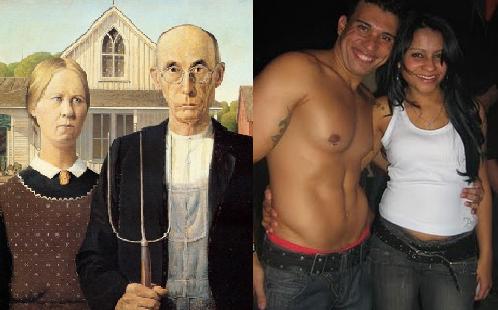
Stereotyped Christian couples, north and south
(Late) Friday Night Video
Proof, as if any were needed, that tradition and modernity exist side by side in Mexico. Dance has played a vital role in the sacred space once occupied by the Templo Mayor — and now by the Metropolitan Cathedral — as long as there has been a Tenotitchtlan-Mexico …
Heavy metal band(its)
Another environmental activist has been murdered in the department of Cabañas. This follows by just five days the murder of Ramiro Rivera, another leader in the fight against gold-mining in that part of the country..
Never mind that several regional governors protested the high risk of water pollution and glacier depletion. Barrick wanted to mine, and Barrick got its way. It overrode the Argentine senate and house of deputies, not to mention the will of an entire people, and essentially stuck the president in its vest pocket. And to make sure that no pesky ministers tripped them up, they sent out thugs to threaten a former minister of the environment. Romina Picolotti, who was expelled from the government, tells how she received death threats, and threats against her children. Whom does she blame for these mysterious menaces? Who else but Barrick. The threats followed hot on the heels of her denunciations of Barrick’s polluting activities in the Argentine parliament!
Chile’s largest gold mine, Pascua Lama, could face legal sanctions after Chile’s national water commission (DGA) reported that the company is failing to comply with Chile’s environmental laws.
The DGA last week petitioned regional environmental authorities in Chile’s Atacama Region III to file a legal complaint against the company. The DGA’s concerns emerged after a study into construction at Pascua Lama highlighted possible environmental damage to nearby glaciers.
Atacama Region governor Viviana Ireland confirmed on Tuesday that authorities would look into the issue.
…plans for the open pit mine proposed by Canadian-owned Vista Gold Corporation are sparking opposition from environmentalists and residents. Critics contend that metals and chemicals used in the mining process could contaminate precious groundwater supplies, scar a fragile ecosystem and threaten public health. Further, they fear critical sea turtle and whale habitats could be jeopardized from the construction of a desalination plant designed to pipe in water for mining operations from a coastal site at Las Playitas.
…
The central Mexican state of San Luis Potosi is another front in the mining vs. environment battle. A long-running fight between local landowners and a national network of environmental and human rights activists on one side, and the Vancouver-based New Gold Incorporated on the other, almost came to a head last month when Mexico’s Secretariat for the Environment and Natural Resources (Semarnat) revoked an operating permit for the company’s Cerro de San Pedro mine.
We USAnians owe a debt of gratitude to Canadian Prime Minister Stephen Harper. Thanks to his government’s policies, and its opposition to Parliament Bill C-300, which would force his country’s mining companies to adhere to basic human rights, environmental and heath standard, we’re no longer always the bad guys in Latin America. With their record of environmental rape, murder, inimidation, labor heath and safety violations, and overt support for bribery (the Harper government also opposes bills that would make bribing foreign officials a crime under their laws), we almost look like normal people. Almost, eh?
Well, welcome Canada to the big leagues! Now you can be exploiters and imperialists too.
Do you hear me now?

Daniel Hernández Salazar’s iconic 1998 polyptych, Esclarecimiento is(more on the artist and his work here) silently stood in the background as Guatemalan President Alfredo Colom accepted last February, as President of the Republic and Commander-in-Chief of Guatemala’s armed forces the United Nations Commission for Historical Clarification report on the estimated 200,000 known deaths and 500,000 disappearances under state sponsored terrorism in the 1970s and 80s.
Esclarecimiento a photo-montage shows a Mayan “angel”, the wings being the shoulder blades of some of those victims disinterred from mass graves years later.
The wings that appeared to the forensic anthropologist to be those of a butterfly struck Hernández as those of an angel. But the photographer’s angels would represent more than art. They would also critique the reality of Guatemala, where silence contributed to the violence and impunity. “I don’t want to see, I don’t want to hear, I don’t want to speak of what I don’t like.” While for Hernández, seeing and hearing seemed involuntary, silence was a choice. The three images of the angel that he created thus became, “I don’t see, I don’t hear, I am silent.” People chose silence.
And, thus the fourth… hopeful… image. Guatemala’s Bishop Juan José Gerardi, oversaw the report that was rejected by then president Alvaru Arzu in 1997, and only accepted a dozen years later by Colom.
Two days after its presentation [in 1997]… Monseñor Gerardi was killed, [the angels] also became the visual representation of public mourning as thousands of people marched through the streets in silence carrying the banner of the angels as their voice.
Via Lillie (Memory in Latin America), comes Susan Fitzpatrick-Behrens NACLA article on the healing process for Mexico’s southern neighbor, in a conflict that cost the small country of 14 million people an average 35,000 lives a year, year in and year out for twenty years.
Although Mexico’s population is about nine times that of Guatemala, and the deaths and disappearances here during the “dirty wars” probably number in the low thousands, there has never been an accounting.
And of our new “war” ? We’re still counting the casualties.
Whose skull beneath the skin?

Alas, poor somebody… somebody knew him…. well, maybe.
It appears the economic mess largely created by Skull and Bones Society alumni George Herbert Walker Bush and his numskull spawn has finally caught up with the elite secret society.
NEW YORK — A human skull that apparently was turned into a ballot box for Yale’s mysterious Skull and Bones society is going on the auction block.
Christie’s estimates the skull will sell for $10,000 to $20,000 when it is auctioned on Jan. 22. Fittingly, the auction house has agreed to keep the seller’s name a secret. On Monday, it described the person only as a European art collector.
The skull is fitted with a hinged flap and is believed to have been used during voting at the famous society’s meetings. The auction house said it also may have been displayed at the society’s tomblike headquarters on Yale’s campus in New Haven, Conn., during the late 1800s.
 Hard times are hitting us all.
It’s been rumored for years that the skull dates slightly later than the 19th century, and belongs to that great anti-immigration leader, Geronimo (who died in 1909 in Fort Sill Oklahoma) — which would have made the private Yale University’s possession illegal under the 1991 Protection of Native American Graves and the Repatriation of Human Remains and Sacred Objects Act.
A less well known, but intriguing, rumor holds that the skull was acquired in the 1920s, belongs to someone else, and made its shady way to Yale via a shady character:
Three years after [Pancho] Villa was buried, someone dug up the corpse and stole the head. Who, or why? Woodrow Wilson can be eliminated as a suspect—he died in 1924. General Pershing wasn’t known to hold grudges. Obregón’s amputated arm (like Santa Ana’s leg) had been saved and made the center of a memorial, but there is no evidence he went about collecting other people’s body parts. Theories range from probable (old enemies still out for revenge—with their own ideas about justice—or ghoulish souvenir hunters), to implausible—a favorite with American newspapers of the time had Villa’s head stolen by California gangsters in the pay of an Oklahoma spinster with an unrequited love for the ex “movie star”. There is another popular gringo suspect: George W. Bush’s grandfather.
A story that has taken on popularity since the 1990s is that the head was taken by members of Yale’s ultra-secret Skull and Bones society, which uses a human skull in its rituals. The society is connected with the York Rite Masons (Poinsett’s “Yorkistas”) and both George Bushes are members of the organization. Prescott Bush, father of the first George Bush, also a member, was inducted a few weeks after the head disappeared, and, it is said, was in México at the time Villa’s head disappeared. How anyone would have known that the student joining the organization in 1926 would havea son who ran the CIA and later would be president of the United States and a grandson who would also be president, is never quite explained. Or why they wanted the head. Villa’s headless body was cremated and interred in the Monumento de la Revoluciónin Mexico City in 1972.
(Gods, Gachupines and Gringos, page 299, ©2008, Richard Grabman)
Oaxaca: come together, right now
Although I’d read a few excerpts and briefly skimmed Mexican Messiah, George Grayson’s 2006 biography Andres Manuel López Obrador, I picked up the Spanish-language edition at the supermarket (marked down to 30 pesos) and am now engrossed in that. While extensively researched and footnoted, the premise is ridiculous and more than slightly forced: Grayson believes AMLO is modeling his career on Jesus Christ, Jesus had some loyal female followers, AMLO’s police security detail were “las gazelas” — female officers with martial arts training — ergo…
Still, the book is worthwhile not just for the biographical information, but as a look at how practical politics is done in Mexico. Or anywhere, for that matter, especially when a politico is looking to challenge the entrenched status quo. That requires building coalitions, even fractious ones. I thought of that when I read last week about the upcoming Oaxaca elections. The [Mexico City] News (30 December 2009):
State leaders of the PAN, PRD, Convergence Party and PT confirmed their alliance for the 2010 local elections.
Meeting at a restaurant in the north of the city, they presented the candidates who will contend for the state government led by Convergence Party Senator Gabino Cue Monteagudo.
Also present were the remaining candidates: Federal Deputy for the New Alliance Party, Irma Piñeyro Arias; former Treasury Under-Secretary during President Ernesto Zedillo’s term, Carlos Altamirano Toledo; and local PAN Deputy Gerardo Garcia Henestroza.
Carlos Moreno Alcantara, local leader of PAN, stated that the presentation of these candidates is confirmation of the progress of this great opposition alliance for next year’s elections. In which “we will have to face the whole state apparatus that wants to maintain control of the power in Oaxaca.”
At first glance this looks nutty — PAN and the PT, Papists and Maoists (er, Carlos Salinasists that claim to be Maoists), together in perfect harmony? Of course not, but that’s the way Mexican politics has always worked. Independence back in 1824 was achieved when Iturbide and Guerrero put together the “Three Guarantees” somehow yoking together the Church, the propertied classes and the masses; Obregón’s “barrage of gold pesos” — uniting anarchists, proto-fascists, Communists and agrarians into an unbeatable force effectively ended the Revolution and kick-started the modern Mexican state. López Obrador built an effective political machine in Mexico City by not just appealing to the “pure” left as his predecessor, Cuautémoc Cardenás did, but by roping in every unclaimed organized group around (everything from prostitute’s union to semi-criminal pirate taxi owners clubs to neighborhood merchant’s associations) and effectively creating group identities for people like “third age citizens” (what we call “senior citizens”) and indigenous workers.
Others — notably Patricia Mercado — have tried to sell their own ideology to several “unclaimed” potential voter blocs, but the successful politicians — like Obregón and López Obrador — have been those who let the ideology grow out of balancing the goals of those blocs.
In Oaxaca, Gabino Cué has been a candidate for an anti-PRI coalition ticket before. That effort failed partially because of dubious electorial processes to be sure, but also because it seemed to follow the unsuccessful Mercado model rather than the Obregón-AMLO one. Cué was a united opposition candidate for PAN, PRD and his own Convergencia party in 1994. Dissident PRD members complained that Cué (then Presidente Municipal of Oaxaca city) was too closely tied to some of the smellier PRI officials, and backed the Social Democratic (then “Social Democratic Alternative and Campesinos Party) candidate. That party was, of course, the successor party to Mercado’s failed “Women, Protestant, Gay and Lesbian, Indigenous” Mexico Posible Party and suffered from the same “purity” problem that has kept the opposition out of power in Oaxaca.
While there is no sense that Cué is “pure”, and radical social change in Oaxaca is still a goal with significant numbers of people (many of whom have given up on electoral politics), there is a better chance in the 2010 gubernatorial election of finally breaking PRI control over the state IF that is the only goal.
Bringing the small PT into the coalition is something of a coup. The PRI can count on the usual subservience of the Greens, but Esther Elba’s Nueva Alianza party (PANAL) which is basically SNTE — the main teacher’s union — at the ballot box could become vitally important. Oaxaca’s social uprising in 2006 began with a strike by dissident teachers and a fight within the unions, and it was thanks to PANAL draining support from the united dissident Presidential candidate (AMLO) and giving Oaxaca’s always questionable voter count to Felipe Calderón, of PAN.
Calderón has been bending over backwards ever since to keep Esther happy. But, with the state PAN itching to gain at least some power, as the national party loses ground, and with PANAL and PT both seen as the right and left wings of Carlos Salinas’ personal machine, which means the Salinas clients have some cover to defect to the opposition by voting PT. And, the Oaxaca PRI is something of an embarrassment to the national party, which may be willing to sacrifice the governorship in that state with the goal of electing another Salinas protegé (Mexico governor, Enrique Peña Nieto) to the Presidency in 2012. PANAL, sensing that PAN is losing clout, simply sit this one out and try for a better deal with the national PRI.
Oaxaca being Oaxaca, dubious voter counts are expected, but those dubious counts may just count out the PRI this time around. No one will be completely satisfied with the results, and no one will be able to claim a complete victory, but in Mexican politics victory, is seldom pure and never simple.


 mexfiles.net