Sunday readings: spare change
Burro Hall commemorates an important date in the history of tourism:
November 8, 1519: Aztec ruler Moctezuma II welcomes a large Spanish package tour organized by Hernan Cortés and a local representative, Doña Malinche, to his lakeside hotel in Tenochtitlan (now Mexico City).
Hector Tobar (Los Angeles Times) on the transformation on another, more benign, conquest…
I first met Ben Reed, a veteran Idaho radio DJ, while reporting a story for The Times nine years ago. Ben is not someone you easily forget. He’s a former Mormon missionary and fluent Spanish speaker who used to be a conservative talk show host. Among Spanish radio listeners in southern Idaho he’s known by his on-air persona as “El Chupacabras,” or the goat vampire.
Reed once was a devout Reagan Republican. Then his corner of southern Idaho filled up with Spanish-speaking people. He fell in love with his new neighbors. They were emotional people who always seemed ready to hug him. He became addicted to their music and their food. And he fell hard for Deyanira too.
All of this has led him to put on “the moccasins of the immigrant,” Ben told me. Now nothing looks quite as simple as it used to. Love and empathy will do that, which is why some people think love and empathy are as dangerous to America as the swine flu.
“I’ve been radicalized by this whole experience,” Ben told me.
…
Ben, now 39, met Deyanira when she was an exchange student at Brigham Young University-Idaho in Rexburg.
Before their scheduled wedding in 2007, she returned to Mexico to see her family. At LAX, she was told that returning for her wedding without having obtained a “fiance visa” constituted fraud. She was deported and her tourist visa revoked. Ben tried for a year to get her papers sorted out. Then he moved to Mexico.
“He gave up everything to be with me,” Deyanira, 34, told me over the phone from Queretaro, Mexico.
Ben and Deyanira were married in December in the picturesque town of San Miguel de Allende. These days, like Nicole Hernandez and others, Ben is an American living with a Mexican spouse in immigration exile.
He says he’s never been happier…
British tax expert, Richard Murphy (taxresearch.org.uk) carps about one American nation’s reluctance to turn over a new leaf when it comes to money laundering:
I have been reading more of the evidence submitted to the Senate Committee on Homeland Security and Governmental Affairs hearing on Business Formation and Financial Crime.
That of the American Bar Association is shocking. They say…
a) We want law enforcement but not if it costs anything or might work
b) We want an exclusive crave out for ourselves that provides competitive advantage
c) We wish that competitive advantage to be based on turning a blind eye to criminality.
Yes: I know about client confidentiality. But crime is always a crime and whilst lawyers must be able to defend their clients it is an unfortunate fact that lawyers have also been found,time and again, to be assisting tax abuse in the US.
Although some might say that getting a quasi-semi-sorta-public health reform bill through the United States House of Representatives was the biggest change in the Americas this week, and others might note the bad-faith “negotiations” in Honduras that seem to solidify a governmental change, and still others noted Haiti’s cabinet changes… yet another place in the Americas also experienced a radical political upheaval — every single member of the Falklands Islands assembly was defeated for reelection:
Not one of the old council survived the cull. Through the ballot box, people said they were fed up with the men and women who decided almost everything, from parochial domestic issues, through the multi-million pound budget and administration, to foreign relations. As a result, the Islands are now facing one of their most interesting political periods for many years.
The election results show that the old days of councillors assuming adequate consultation meant no more than occasional public meetings in drafty halls are over. Now, the electorate expects their leaders to be good communicators who are up to speed with the latest technology and transparent in their work. Even in the Falklands, the information revolution has changed the way people think. They expect to be informed, consulted, kept in the picture and listened to.
Prince Potty-mouth
This must be the start of a trend… this is the second time the Dutch royal family has appeared in the Mex Files.
Thursday, while Queen Beatrix spent the day doing the queen thing — wearing a big hat and waving to the little people in Guanajuato.
Being fairly well-informed on what’s of vital concern when you’re going to inherit a country known in Spanish as “Países Bajos” because it’s mostly under sea level, I guess it was appropriate for Crown-Prince Willhelm-Alexander to spend the day in Mexico City speaking at a global warming seminar. As heir-apparent to the throne of a former Spanish possession, and having an Argentine wife, you’d might think the guy knows Spanish. Either he does, or doesn’t.
In the course of his remarks, His Royal Highness meant to say, “un camarón que se duerme, se lo lleva al corriente” (the sleeping shrimp will be washed away with the current) — a rather obscure bit of folk wisdom, meaning “get with the program.”
What he said instead — and actually makes more sense — was “un camarón que se duerme, se lo lleva a la chingada.
The sleeping shrimp is gonna be fucked over.
Maybe it wasn’t a “gaffe” as has been reported.
¿Porque no, mon?
Per EFE (via Latin American Herald Tribune, Caracas):
Jamaica’s foreign minister says his country should adopt Spanish as a second official language to foster expanded trade and cooperation with its neighbors in the Caribbean and Central America.
Growing ties between the Caribbean Community and Latin America, the Dominican Republic’s desire to join Caricom and the fact that Jamaica is surrounded by Spanish-speaking countries make it imperative for Jamaicans to become proficient in Spanish, Kenneth Baugh said.
…
“One has got to accept that the wider horizon of Latin America and the Caribbean integrating economically and in trade, is offering a much larger opportunity to Jamaica. It means that enterprises in Jamaica will need to expand and increase exports that will increase revenues for the country,” Baugh said.
WE kill the criminals?
The following editorial (my translation) appeared in today’s El Universal and was read on the radio:
The massive uproar over the mayor of San Pedro Garza Garcia’s announcement that he would create an anti-crime “cleaning squad” is compounded by his revelation of a suspected drug trafficker’s execution in Mexico City, before Capital officials had confirmed the event. Death squads in Mexico? A grave development, but the evidence has been there for some time. The real problem is that people do not seem angry that discretionary authorities are promoting the use of brute force.
While there is no national survey to confirm it, citizen comments suggest support. A chilling coincidence with this is discussion of the death penalty. Seventy-five percent of people supported it in 2008, even with the knowledge of this country’s inefficient judicial system, which leaves in doubt the guilt of those arrested and convicted. One party ran on a platform supporting the death penalty and won votes with their stand. Who benefits when politicians run on on “vengence” platform, like the mayor of the Monterrey suburb? It is a terrible precedent.
Citizens must understand that opposition to death squads is not squeamishness. They understand history and human behavior. Mercenaries hired by governments or business groups to eliminate criminals eventually become part of a gang of kidnappers or assassins. It has happened before here in Mexico, with an elite military group giving rise to the “Zetas”. In Colombia, paramilitary groups were established entrepreneurs that the country who now can not undo the damage. Civilians — who can not afford “white guards” — always end up in the crossfire.
Impunity must never be used to justify the irrational use of force.
While the stress of fighting even foreign wars has been known to dehumanize soldiers and even break down professionals trained to deal with brutality, fighting a “war” against one’s one population is even more likely to have consequences within the population. Unleashing mercenaries — whose only loyalty is to a paycheck — is an invitation to disaster.
Lucha Reyes: the Janis Joplin of Mexico
Lucha Reyes, born Maria de la Luz Flores 23 or 28 May (different sources use different birth dates) 1906 in Guadalajara, was one of the earliest of Mexican recording artists, and though recordings in the 1920s, introduced European audiences to Mexican music. Due to her European success, her difficult personal life and her apparent vulnerability, she has been called “the Mexican Piaf” — and her voice does have some similarities to the French singer — although her throaty renditions of lower class and generally masculine popular music form, as well as her self-destructiveness, might make her better styled “the Mexican Janis Joplin“.
Having moved with her mother and sister to Mexico City, by her early teens she was singing Revolutionary songs in the Capital and singing between acts in visiting circuses. At the age of 15, she toured California, becoming a hit on the Mexican-American entertainment circuit. Returning to Mexico, and taking her step-fathers family name (Reyes) her then-pure soprano voice was known throughout Mexico where she was one of the first radio-era stars.
In 1925 she was invited by impresario Juan N. Torreblanca to join his Orquesta Típica Mexicana on its European tour. The soprano whose artistic renditions of Mexican classics would not be the Lucha Reyes who returned home in 1927.
 The story is that Reyes was just unprepared for a winter in Berlin, and a bad cold or throat infection forced to leave the tour. The story goes on that a gentlemanly piano player moonlighted in a whorehouse to raise the cash for Lucha’s return to Mexico where she could spend the next two years recovering. Of course, her non-stop drinking and partying may have had something to do with leaving the tour, and with the dramatic change in her voice: huskier, edgier and, suited not for delicate songs about La Paloma but perfect for the music of cowboys and cantinas: mariachi and ranchera.
It’s not just the riotous living and heavy drinking that makes leads to the comparison of Reyes and Joplin. Remember that when Janis Joplin first came on the scene, woman singers like Joan Baez and even Grace Slick were a sort of earth-mother or girl-friend in their stage persona. Reyes and Joplin both opted to join a male sub-culture (mariachi for Reyes, the southern blues for Joplin) and burned out trying too hard to out macho the machos.
Reyes, like Jopin, often performed with a liquor bottle in hand, and made on stage references to her rowdy lifestyle. That Reyes was the first female mariachi lead singer of note made her antics fodder for the gossip columnists and — like Janis Joplin — an improper example to be pointed out by proper parents to their misbehaving daughters.
And, in the end, it got them both. Janis Jopin was only 27 when she died of a combination of heroin and alcohol in 1970. Reyes managed to survive a bit longer, but ended her own troubled life (25 June, 1944) at the age of 38, washing down about 20 barbiturates with a bottle of tequila.
Lucha Reyes was in very few films, in part because her erratic personal life made he a director’s nightmare. But sing she could:
Evidence of more deaths foretold
Early on in the Calderón Adminstration’s “War on Drugs” the Army was sent into Zapatista controlled communities, allegedly to search for marijuana plantations. Given that the Zapatistas are many things (many of which I disapprove of) but are certainly not drug dealers (if anything, they’re more like the Taliban when it comes to narcotics) it was a warning that a military/police crusade against one group of social deviants could easily be used to wipe out other opponents of the regime. While so far, political and social discourse has not been completely destroyed in the name of “security”, another danger — that an over-reliance on violent repression would lead to more violence, has come to pass.
And it isn’t just the mayhem among the organized groups, but — with carte blanche given to repression, the basic rules of justice are in danger of collapse. I question the wisdom of using the military forces in local police work, or the destitution of local police in favor of a single unified national force for the same reason. I’m not convinced such a move makes the individual charged with keeping the peace more honest, and — more importantly — it puts local policing in the control of outside, impersonal, forces. I once wrote in a guide book for would-be Mexico City teachers:
Unlike the U.S. and Canada, you do not call the cops for minor annoyances (barking dogs, loud parties, etc.) or even for minor incidents. Neighbors will reason with the local drunk, threaten the local peeping tom. And sometimes the police are not even called after serious incidents. When an intoxicated suburban bus driver killed a child, the neighbors torched the bus – then took the drivers to jail themselves. In another bus accident, friends of the family injured by a bus didn’t go to court: they stole a few buses and only gave them back when the company agreed to pay medical bills and compensation to the injured family.
The danger is that outsiders won’t know the local peeping tom (or village drunk) and may not deal with it in an appropriate way. Or, the folks who now might take a bus hostage as collateral on an accident settlement, with a “national police” more concerned with national goals rather than settling local disputes, will turn more and more to extra-legal remedies for settling disputes.
It’s easy to slip into the mindset that permits this. One can sympathize with people who complain, as Maggie’s Madness did yesterday, about over-sensitivity to police abuses:
… two human rights organizations … will be testifying … before the Inter-American Commission on Human Rights against high ranking Federal, State and Local law enforcement authorities in Tijuana who these groups claim have abused human rights in the fight against organized crime. I don’t suppose anyone will … testify against human rights abuses and mayhem caused by organized crime? I didn’t think so.
But, that’s why “organized crime” are the bad guys. The good guys shouldn’t be acting this way, and should be held to a higher standard. It’s like torturing terrorism suspects. Once the good guys do the same thing the baddies do, they lose their ethical superiority, and can no longer claim to be upholding the standards of civilized behavior, nor claim legitimacy for civilized people.
Maggie was recently the victim of some vandalism probably in retaliation for her work to force non-conforming builders to stick to local building regulations. Having worked hard — and endured more threats than necessary — to protect her environment and home, something like tagging makes me think that she probably deserves some twisted form of revenge. The more gruesome the better. It’s probably natural to think it, but — despite the claims of “madness” she’s too sane and normal to act on my impulses.
Not that something happening is out of the realm of plausibility. It’s not like I expect a perfect world, where taggers don’t get their comuppance, or where bus companies don’t get their vehicles irregularly impounded, or where peeping toms aren’t run out of town, but — when we have no control over the justice system, and it answers to outside forces — where does it stop, and what is the price we pay for putting security before justice?
Carolina García, in Wednesday’s El Universal, draws no conclusions in her article Ojo por ojo ¿Comandos blancos o escuadrones de la muerte? (my translation), but marshals evidence that suggests our government’s obsession with one criminal activity is creating not more security, but leading us into barbarism:
Reading the daily headlines, you see death everywhere. Insecurity is one thing, but more worrisome than the death statistics are signs that people are taking justice into their own hands.
In the State of Chihuahua alone, there were 2,400 murders in 2009, of which 70 percent, or more than a 1,800 occurred in the municipality of Ciudad Juárez.
This year, it took only fifty-one days to reach the first thousand deaths; the toll mounted another thousand fifty-nine days later. Chihuahua, for the second year in a row, was the state with the most drug-related crimes.
Or were they?
The social decomposition begins to smell when it appears that groups unconnected with organized crime are also committing revenge killings or have used the crime situation as a pretext for launching their own extermination campaign against petty criminals.
Last Thursday, Leonel Aguirre Meza, president of two Sinaloa non-governmental human rights groups, the Comisión de Defensa de los Derechos Humanos and Frente Cívico Sinaloense, expressed his fear that death squads were taking the law into their own hands. It was, he said, an extremely dangerous situation, and one outside the law.
In the specific case of Sinaloa, a few months ago, warnings surfaced about a campaign against car thieves. It was no joke. A massacre last August in Navalato shows that the messages appearing with dead bodies of suspected car thieves are to be taken seriously.
When commandos sprayed party goes with machine gun fire, killing eight, including several minors, the local prosecutor admitted that one likely motive was the execution of suspected car thieves.
Over the next several months, more bodies have appeared, with messages excusing the crime on the pretext that the victim was a suspected thief. Toy cars are placed with the bodies.
The curious case of the prescient alcalde
Tuesday, the mayor of the nation’s wealthiest community, San Pedro Garza Garcia, Neuvo Leon, Mauricio Fernández, fueled more speculation when he publically spoke of the alleged killings of some Beltran Leyva crime family members in Mexico City… befote the authorities in the Capital had even known of the crime.
Elected as a PAN candidate to govern San Pedro Garza García for the next three years, Fernández Garza vowed during his inaugural address last Saturday to launch a frontal war against organized crime, even if it means going beyond the scope of his powers as mayor to end kidnapping and drug trafficking in the region.
In presenting his security plan — which includes special teams of “cleansers” who will work to eliminate organized crime, underground clubs and three hundred sales outlets for drugs within the municipality – the mayor-elect announced the death of the Beltran operative, while at the same time mentioning the victim had made death threats against him.
And just the previous Monday Fernández Garza had said his administration would not be an idle spectator to organized crime.
Matazetas
In Veracruz, someone uploaded a video to YouTube showing suspected “Zetas” – including a former Tiberones futbol professional – being interrogated. Several of these suspects were late found killed by a group calling themselves “Matazetas” (Zeta-killers).
The videos include a message addressed to President Felipe Calderón Hinojosa, in which the self-described Matazetas praise the president for his administration of the fight against organized crime.
“Here [in the “Matazeta” group] you have the children, siblings and parents of entrepreneurs, farmers and businessmen who lost their lives for refusing to pay “protection money”, the message accompanying the tapes went on to explain. It added that each of the two tapes recorded the “interrogation” of three suspected Zetas.
The interrogators in the tape (and suspects in the murder of those being interrogated) have the appearance of military personnel, but this has not been followed up on.
¿Patria y justicia?
Starting in early 2009, a group calling itself Comando Ciudadano por Juárez (CCJ, or Citizens for Juarez Commandos) sent a statement to the media, announcing their existence, and claiming they stood for a “righteous society”. Their motto: “Patria y justicia” (Fatherland and justice).
Their goal, according to the news release, was to “terminate the life of one criminal every twenty-four hours … (because) the death of a bad person is better than letting that evil person continue to pollute our community.”
The statement went on to note that the CCJ had written a “manifesto for those interested in joining us to clean our city of these criminals under a united command.” It invited interested citizen to join in their campaign, adding “If criminals have found (sic) soon you will be able to send (the data) to an email address to end his life.”
Comandos blancos
According to a published article in the Proceso’s special El México Narco edition, employers are sponsoring armed groups dedicated to eliminating suspected criminals in Tijuana and Mexico City.
These groups are a sort of “commandos blancos” (white guerrillas), similar to the so- Pepes of Colombia in the 1990s: the “ Perseguidos por Pablo Escobar (PPE), who, as it turned out, were neither citizens, nor simple vigilantes.
In the early 1990s, when narco-terrorism in Colombia was taking a heavy toll, the Pepes murdered some fifty lieutenants of Cali cartel leader Pablo Escobar, under the pretext that they were victims of Escobar, or the innocent survivors of his victims, reluctantly forced to take drastic action.
However, as it turned out, the “vigilantes” included employees of the CIA, the DEA and various Colombian paramilitary groups.
Progress not perfection: coups and resistance
Laura Carlsen — if not the best informed, then certainly in the top five, of well-informed foreign political correspondents writing about Mexico and Central America, questions the so-called “Guaymuras Accords” that either do … or don’t… end the coup in Honduras:
… from this observer’s view, negotiation and dialogue played a minor role in the apparent resolution of this phase of the crisis. In the end, the mobilization of Honduran society sent a clear message that “normal” government would not be possible and even more widespread insurrection loomed unless a return to democracy reopened institutional paths. International pressures and sanctions played a far greater role in cornering the coup than the technical terms of an accord that is vague, difficult to implement and contentious.
The last-minute decision of the coup to sign also begs the question: if this is what it took–a little strong-arming from the State Department’s A-team–why didn’t they do it before twenty-one people were killed?
Joseph Shansky, a Democracy NOW! en Español employee lately working as a reporter in Tegucigalpa argues the “real winners” were not the Hondurans:
… what the Guaymuras Accords actually do most is create a space for the United States to recognize the legitimacy of the upcoming presidential elections, scheduled for November 29. With National Party front-runner Pepe Lobo likely to win (thanks to a campaign season in which any independent voices were sharply silenced by media censorship), the US also likely secures another puppet in the region who will be opposed to the progressive social, economic and political reforms being articulated and demanded by the country’s social movements. This also serves to counter the region’s growing independence from Washington’s political and economic influence.
Furthermore, throughout the entirety of the coup, neither Secretary of State Clinton nor President Obama (surely occupied with political concessions of his own at home) have acknowledged the repression and violence perpetrated by the Micheletti government and Honduran military in its wake. And they still refuse to do so.
So the actual power returned to Zelaya may be symbolic at best. But it’s extremely important for another group involved- the Resistance movement all around the country.
…
Still, the bottom line remains the same. Military coups in Latin America are not a thing of the past yet, and their outcome can be strongly influenced, in fact practically determined, by the US.
The “symbolic” return may be more important then the U.S. State Department — or the old guard in Honduras — realizes. The future of Manuel Zelaya and Roberto Micheletti — their various hangers-on, apologists and henchmen — are “normality” and insomuch as the negotiators bought a few more months or years of “normality” is not necessarily a win.
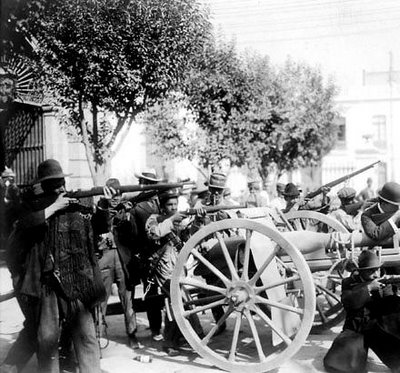
Mexican resistance, 1913
Without resorting to my usual fall-back of the Ten Tragic Days of Mexico (9 -18 February 1913) when a bloody coup — which was easily defended as “constitutional” — overthrew the mildly reformist Madero administration (and bumped off Madero for good measure), it unleashed the first of the modern social revolutions, redefining the nature of the governed and the governing powers, there is a recent example of democratic slow progress resulting from a brokered coup agreement.
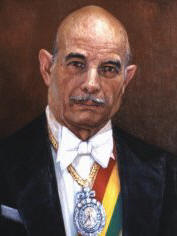
Presidente Guevara Arce
Ironically, the thirtieth anniversary of that coup — the 1979 Todos Santos coup in Bolivia — was November second, almost coinciding with the Honduran accords. Longtime dictator Hugo Banzer — like Porfirio Diaz in 1910 — reneged on promises to return his country to “normal” constitutional rule in 1978. The presumptive winner of the election — was not the people’s choice, but fraudulently, General Juan Pereda Asbún was installed in the Quemado Palace. Perada surprised everyone when he admitted his Presidency was nothing more than a military coup, and struggled with Banzer to rectify the situation. Perada lasted only four months in the Presidency, being overthrown by more democratically inclined officers, led by David Padilla, who scheduled elections.
Here, if we had followed the Mexican example, the popular reformer should have been elected. However, Bolivia’s constitution requires the winning candidate to receive more than 50 percent of the total vote. With no clear winner, Congress selected — constitutionally — Senate leader Wálter Guevara Arce to serve until the “regular” 1980 election.
Given the instability of the political situation, and the obvious weaknesses of the Constitution, coupled with economic problems (NOW it sounds like Honduras, ca. 2009), Guevara suggested extending his term for another year. This was the excuse given for the Todos Santos coup headed by Colonel Alberto Natusch Busch.
Guevara — like Mel Zelaya in Honduras — was hardly the perfect democrat, nor the most successful of reformers… but, again like Zelaya, the people realized a president headed in the direction of reform (and holding out the promise of better political and economic conditions) was worth fighting for.
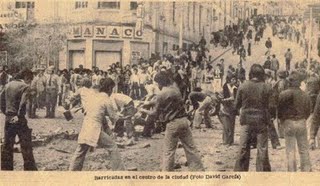
Todos Santos, La Paz, 1979
The resistance was fierce. Natusch’s 16 day presidency is mostly remembered for the eight people left dead, 221 wounded, and 124 disappeared fighting to force the Colonel out. Natusch agreed to mediation, and offered his resignation on one condition… that Guevara not return to office. Congress — again acting constitutionally — elected then speaker of the house, Lydia Gueiler Tejada* to serve what remained of the “normal” presidential term.
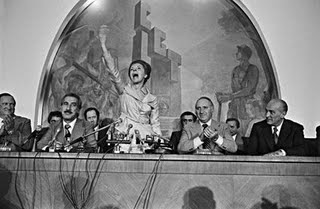
Presidenta Gueiler, 1980
While the Bolivians had the extreme good luck to go through their crisis during the Carter Administration in the United States, which was one of the few in U.S. history to have the decency to NOT always retard social movements in Latin America on the premise that they might be a threat to private financial interests — and Gueiler herself would be driven from office by the “Cocaine Coup” of July 1980 (by which time Ronald Reagan was in the White House, and democratic left-wing reformists could expect little in the way of assistance) — what is important is that an organized, creative resistance to exploitation and misuse of power had coalesced in support of imperfect reform.

Honduras, 2009 -- ?
Bolivia would remain politically and economically unstable for several years, but … the resistance — bringing together unions, indigenous groups, the urban poor and middle class — would eventually succeed in creating a new state, one hardly that intended by Wálter Guevara in 1979 (or perhaps even by his supporters) any more than what Mexico became in the 1920s was that which Madero’s defenders foresaw, and … who knows… what will eventually emerge from an energized Honduran resistance.
(Sombrero tip to El Duderino for remember the Todos Santos coup)
* In selecting Gueiler, Bolivia became the first nation in the Americas to have a female head of state who had not been preceded in office by her husband (like Isabella Martinez de Peron of Argentina), or father (the Commonwealth’s Queen Elizabeth).
Shit, shower and shop
Joe Bageant, a self-confessed redneck intellectual, lives in what some describe as the “unreal Mexico” — the gringo ghetto (or, if one prefers, “colony”) of Lago Ajijic. His 2007 book Deer Hunting With Jesus is a report on the “class system that dare not speak its name” from below… the white working class of his own native Appalachia.
Fellow hillbilly (and — though he might argue you needed shootin’ for saying so — intellectual) turned Mexpat, Fred Reed, wrote in his review of Deer Hunting for the “paleo-libertarian” (i.e., batshit crazy right wingers) political website LewRockwell.com:
Bageant is a redneck, and his book is about rednecks, who are a huge, sprawling class of people found everywhere but mostly invisible. They aren’t what people think they are… They actually have lives, and problems, and stories.
Those redneck, lives and problems and stories are “typically American” … a strange culture when viewed from Jalisco:
Every afternoon when I knock off from writing, after I suck down a Modelo beer and take an hour nap, I step out onto the 400-year-old cobbled street, with its hap-scatter string of vendors lining both sides. All sorts of vendors — vegetable vendors, vendors of tacos, chicharrones, chenille bedspreads and plucked chickens, cigarros, soft drinks, sopa and suet. Merchants whose business address consists of a card table in front of their casita.
These vendors are not poor people or peasants. They own homes, drive cars, watch cable television, send their children to college and do most of the things North Americans do. But their jobs are their livelihoods, not their lives, and every transaction is permeated with the ebb and flow of daily neighborhood and family life. “Is Maria going to graduate after all? Si! But by just by the hair in her nose! Who is going to sell fireworks for the Feast of Saint Andrew?” (Saint Andrew is the patron saint of Ajijic.)
Behind the plastered brick walls along the street mechanics fix cars, dentists pull teeth and teachers cheer preschoolers onward in a chirping Spanish rendition of Eensy Weensy Spider. The entire street is busily, but not hectically, engaged in making a living, most of the people doing so within 50 feet of where they will sleep tonight. But before they sleep they will sit out on the street, or perhaps the tiny neighborhood plaza, gossiping with the same neighbors who’ve been their customers all day. The same families into which their children will marry and whose sick elders they will burn candles for in the ancient stone church…
It may be my bias, or my imagination, or my distaste for toil, but from here America looks like one big workhouse, “under God, indivisible, with time off to shit, shower and shop.” A country whose citizens have been reduced to “human assets” of a vast and relentless economic machine, moving human parts oiled by commodities and kept in motion by the edict, “produce or die.” Where employment and a job dominates all other aspects of life, and the loss of which spells the loss of everything.
Yeah, yeah, I know, them ain’t jobs — in America we don’t have jobs, we have careers. I’ve read the national script, and am quite aware that all those human assets writing computer code and advertising copy, or staring at screen monitors in the “human services” industry are “performing meaningful and important work in a positive workplace environment.” Performing? Is this brain surgery? Or a stage act? If we are performing, then for whom? Exactly who is watching?
Needing Mexico
In his short post “Mexico: U.S. Totem” on Secret History, Jason Dormandy hits on one reason “The United States desperately needs Mexico, and I’m NOT talking about trade and labor”:
I consider the general U.S. obsession with Mexico as a place to get cheap and easy sex and booze as serving as something of the same function as Carnival serves in Latin America. Americans take a few days to blow off some steam before returning to the norms of society – at least in their minds. Once more, the presence of an “outside” entity allows U.S. citizens to consider themselves more saintly at home than they really are, letting them address issues of consumption and sexuality they would otherwise be unwilling to address.
I wonder if this doesn’t also have something to do with our obsession with Mexico as “A Dangerous Place” (the title of a one of the worst books ever written about Mexico, by the way) — our need to project our own phobias about our carnal nature onto the “other” — something dark, mysterious and tinged with evil.
¡Feliz Día de los Muertos!
Otherworldly Sunday readings
Alien Invaders!
Orson Wells’ 1939 “War of the Worlds” was probably the best hoax in the radio age. Too good to pull off once, the joke was tried again in Santiago, Chile in 1944, and in Quito, Ecuador in 1949… which led to serious consequences (Erwin C., The Latin Americanist):
…[O]n February 12, 1949 listeners to Radio Quito were interrupted from an evening of music and told that Martians landed 20 miles outside the capital city.[Radio Quito Drama Director Leonardo] Páez acted as a reporter and claimed that the aliens overran a military base and were on their way to Quito.
Predictably, word of mouth spread over the spoof alien landing and panicked citizens took to the streets. Quito’s mayor was fooled and called on people to “defend our city” while priests tended to flocks of repentant parishioners. Some didn’t believe that aliens had landed but instead blamed neighboring Peru …
Eventually, Radio Quito staff were informed of the panic and publicly admitted to the hoax. Mass fear quickly changed into collective anger as all hell would break loose:
El Comercio, the largest and most respected paper in the country, owned radio Quito and the station was housed in the same building as the newspaper. It was to this location that the mob advanced, and in what might have seemed an ironic act by the crowd, set fire to copies of the El Comercio newspaper and hurled these (and other objects) at the building. The main entrance was blocked and a fire swiftly broke out…
Francisco Franco meets the Aztec Mummy
From Inexplicata, the Journal of Hispanic UFOlogy:
Generalissimo Francisco Franco… would issue a slight cough whenever he watched a movie – a sign of his discomfiture at what he was seeing. His iron legion of censors would then get to work on a persecution that the author describes as “one of the most ruthless, extensive and arbitrary” of the 20th century…
As could only be expected, the marauding zombies, mummies, wolf people and vampires that plagued B-movies for generations were not only enemies of the state, but also of the Church…
The censors sharpened their scissors, however, not for an American B-movie but a Mexican production straight out of Churubusco Studios: Director Rafael Portillo’s La Momia Azteca (The Aztec Mummy, 1957). This time they did not bother attacking the subject of the film, but the intelligence of an entire nation, rejecting it as “a mixture of confusion and errors for the uncultured masses, which represent the majority” and “suitable to the cultural childishness of the Mexican people,” chock-a-block with reincarnation, transmigration and other “shenanigans”…
And still dead…
Chris Hawley (USA Today) in Aguascalientes:
“Mexicans have death imprinted all over their art and culture,” museum director Jose Antonio Padilla said. “So why not a museum about it?”
The museum came about because a Mexican art collector had a lot of skeletons in his closet: dozens of tiny calaveritas, or skeleton dioramas, along with hundreds of other death-related artworks he had acquired over 50 years.
The owner, Octavio Bajonero Gil, was looking for a museum to take his collection. Meanwhile, the Autonomous University of Aguascalientes, a state college, was looking to found an art museum and wanted something different, Padilla said.
The museum, with Bajonero’s donation as its core collection, opened in 2007 in two buildings owned by the university in downtown Aguascalientes. Admission is 20 pesos, about $1.53.
…
About one-third of the museum’s 70,000 annual visitors are from other countries, mainly the United States.
“It’s definitely kind of bizarre,” said Spencer Garcia-Stinson, 24, of Gilford, N.H. “In the United States, we don’t like to talk about death, but here they’re dealing with it so openly. … It’s amazing.”
Haiti: consitutional coup #2?
In what the foreign “assistance” community that controls Haiti right now are calling a troubling, but constitutional, move, the Haitian Senate’s sacked Prime Minister Michèle Pierre-Louis and her cabinet. While it appears that either the lower or upper house of the Haitian Parliament can remove the government at will, there are questions about the legality of the move. During a nine hour Senate session, lawmakers continually walked out (or ran out) accusing each other of being armed. In the end, 18 of the 29 Senators voted for sacking the government.
Pierre-Louis, who was educated in France and the United States after her family fled Papa Doc’s dictatorship in 1964, returned to Haiti in 1977 as a community organizer, developing a international reputation for her administrative abilities and skill at handling assistance funding.
Haiti — occupied by UN forces since the aftermath of the U.S. sponsored coup against former President Jean-Betrand Aristide (in whose government Pierre-Louis formerly served) — is dependent on foreign aid, especially from Canada and France, for its operating budget. Since the coup, it has been occupied (as it has been through most of its history) by foreign troops.
With President Rene Préval’s party leading the move for removing the government, there is suspicion that the rationale for Pierre-Louis’ removal had more to do with her tight control of foreign aid funds than with any domestic issue:
Leslie Voltaire, Haiti’s special envoy to the United Nations, said the international community should recognize its role in what happened to Pierre-Louis. For example, he said, only the Inter-American Development Bank has increased its disbursements for this year. And only 15 percent of the $346 million promised at an April donors’ conference in Washington has been delivered.
“Had the international community disbursed the resources pledged in April, maybe this situation would not have happened,” he said. “We all hope that the process will be seamless and quick and that Michèle Pierre-Louis will continue to be a great asset for Haiti and accompany the Haitian people in their quest for democracy and development.”
…
Micha Gaillard, spokesman for the opposition Fusion political party, said that relationship became Pierre-Louis’ undoing.
“The error of Michèle is that she depended only on the international community. She did not look to build alliances in other sectors domestically. And the international community’s error is they depended solely on Michèle,” Gaillard said. “We should not panic. We have made a lot of effort toward stability, and it is now up to Préval.”
Several Haitians have suggested the problem was that Pierre-Louis was not only that she was not a member of any of the political parties, but that she was “too careful” with assistance funds, marshaling them into long-range development projects, like roads and infrastructure development, instead of spreading the graft around. And her commitment to building democratic institutions from the ground up, rather than depend on local elites and foreign assistance.
Speaking to Michael Delbert of InterPress Service in July, Pierre-Louis laid out her independent program for the country, and her return to politics after the elected President, Jean-Bertrand Aristides was removed by a coup d’etat:
For a long time, a lot of the elite would say that Haiti was not ready for democracy, and I was totally against that. It’s not because people are poor and they are illiterate that they are not ready for democracy. When you go to the people at the bottom, I have a deep feeling that these people really want things to change, and they are waiting for the leadership that will not bring miracles but will show them the way and not lie to them.
All the elites – the mulatto elites, the university elites, the union elites, the peasant elites – are like a huge elephant sitting on this country and you cannot move it, because there is no political class, because there are no political parties, and everyone becomes corrupted and perverted. If you can’t go into that system, the system rejects you. And so far we have not found the wrench that will move this thing.


 mexfiles.net