Strange fruit in the Texas Big Bend
Having been for a very short time the Brewster County Bureau Chief for the now world-famous Big Bend Sentinel, I wasn’t so surprised to hear about alleged shennagins in the Presidio County Sheriff’s Department (Marfa businessman Randy Quaid is alleging that Sheriff’s Deputy James Davis provided information about his and his wife, Evi’s arrest over a disputed California hotel bill to gossip magazines and websites). Ehhh… that’s just typical Marfa … a place where the rich and famous pay good money to pretend they’re locals, and the local-locals pretend they don’t know who the famous people are. And usually don’t care.
However, when one of Brewster County’s own, Terlingua-based river guide, bionic woman and “la Benimerita de Boquillas” — Cynta de Navaéz — fesses up in the same publication to smuggling, that is reason for concern:
Editor:
Several weeks ago a friend of mine and I went to Ojinaga to shop. We managed to do it in 7 exhausting hours and then found ourselves at the Presidio Port of Entry.
“Have anything to declare?” We told him everything we had (or rather, thought we had). No, we could not get out of the truck and refresh our memories by lifting the cooler lid, we had to stay in the car so the officer could be safe. They went back to look in our coolers, came back to our window and asked a second time: “What do you have to declare?” We went through our memories again, laughing because it was all so ridiculous because, we live here. We know the score. But we didn’t. My friend had done some “impulse shopping” and there were 5 guayabas in a fruteria bag that we had completely forgotten about. The officers asked us a third time. We answered again by listing everything we could remember verbally. And that was our third strike.
We were informed that we owed the port $300 for trying to smuggle 5 guayabas into the country. If we would have declared them, said their name out loud, they only would have been confiscated. But $300 smackers? It wasn’t as if we had 5 crates of guayabas under the floorboard. I thought I saw some of the other uniformed officers wince. Yes, very harsh. To us it felt like entrapment. My friend was furious and refused to sign their ticket. It would have been an admission of guilt, even though we would only have had to pay $175 at the time. We took the ticket with us, feeling angry and cheated and as though we need to protect ourselves from our own government.
Who knew guayabas would be so heinous? Especially since we had both completely forgotten that we had them? The next day my friend called the Agriculture Department of the Customs Department in Virginia to plead his case. The officer said, “Look. Just don’t buy your groceries in Mexico. The list of acceptable and unacceptable goods changes regularly. There is no way to know.”
So, my friends, the moral of this story is: Make A List of Everything You Buy In OJ And Hand It To The Officer In The Booth. Plain and Simple. It’s Mexico, for Chrissakes, you are going to want to try new things to eat, to impulse buy, if you will, in the produce section. And you are going to forget something you have purchased. If your purchases have all been put on a list then all that can happen, if you have something unacceptable, is that they confiscate it. No one wants to pay $300 for fruit they cannot eat.
I will say, in all fairness, that the officers were respectful and professional; this isn’t about the officers, it’s the law. Be forwarned.
When she’s not smuggling fruit, Cynta is doing what she can to lend a helping hand to the remaining people of Boquillas de la Carmen, Coahuila who were wiped out economically and socially when the informal border crossings were closed after 11 September 2001. “Weekend America (National Public Radio)” interviewed Cynta last January. Much more impressive than being a movie actor.
Let us now praise famous men (and women)

Photo: Milenio
Mercedes Sosa’s body laid in state in the Argentine Palacio Legislativo over the weekend, an homage reserved for very few Argentines in public life.
Poet Mario Benedetti was similarly honored by the Uruguayan government after his death earlier this year.

Photo: BBC
Compay Segundo, the Cuban guitarist, did not receive a formal state funeral after his death in 2003, but his funeral cortage included a military honor guard.

Photo: AFP
Celia Cruz, another of the Cuban greats, died the same year, but in exile. The services (in Miami, and later in New York’s Saint Patrick’s Cathedral) — replete with the laying in state, and a flag-draped cortage — were those a people offer to a fallen national leader, not a mere nightclub singer.
Maria Felix, the film star, was laid out in the Mexico City’s Palacio de Bellas Artes following “La Doña’s” death in April 2002, in a ceremony similar to that given intellectual heavyweight, Octavio Paz in 1998:
Though Mr. Paz was a cerebral and not a populist poet, his death moved many Mexicans. Thousands of admirers, mighty and humble, filed past his coffin yesterday during a wake in the Fine Arts Palace in Mexico City that had all the pomp of a state funeral. At the ceremony President Zedillo paid an unusual homage to Mr. Paz, calling him a ”universal Mexican” and praising him for his pioneering and persistent criticism of the political system that Mr. Zedillo now heads.
Other than Michael Jackson’s funeral, a commercial affair to which they sold tickets (and had an “official website), you hear almost nothing about it when a cultural figure dies. In the United States, people talk about the “culture wars“, but to the fallen warrior, we give no glory.
With friends like these … U.S. economic impact on Mexico
Agence Press-France, via Raw Story:
In its economic forecasts published Thursday, the IMF [International Monetary Fund] said that Latin America had begun to recover from the global economic crisis and would post growth of 2.9 percent in 2010.
But there were wide disparities, with countries such as Mexico, which depends heavily on the United States, losing out and others like Brazil benefiting from rising exports to China.
…
In its economic forecasts published Thursday, the IMF said that Latin America had begun to recover from the global economic crisis and would post growth of 2.9 percent in 2010.
But there were wide disparities, with countries such as Mexico, which depends heavily on the United States, losing out and others like Brazil benefiting from rising exports to China.
…
The economist said that generally the region’s economic health depends on the degree of economic links to the United States, saying Colombia, Brazil or Argentina were at a safer distance.
Mexico, which is a partner with the United States and Canada in the North American Free Trade Agreement, is like Central American and Caribbean countries, many of which have free-trade pacts with Washington, in that it relies on remittances from emigrants in the world’s largest economy.
It also appears to depend on the economy’s closeness to the IMF… Bolivia and Ecuador (which told the IMF to shove it).
The countries taking the brunt of the U.S. downturn (Mexico, Peru and Colombia being the big ones) are also those with conservative “neo-liberal” administrations.
In Mexico, there were sporadic attempts to broaden the export market to other countries. Vicente Fox, at his most effective, was a salesman for Mexico, though he seemed to have trouble closing deals. The “dangerous populist left” in the last election had suggested broadening Mexican exports and a more pan-Latin American market, but, of course, was beaten back and kept from taking power.
The neo-liberal administration — faced with the huge downturn — has offered only the standard “conservative remedies” — some minor budget cuts and increased sales taxes, as well as cancellations of large-scale development projects.
The latter (such as cutting off federal funding for expanding Mexico City’s Metro) are seen as “short sighted”, even by
Concamin (“la Confederación de Cámaras Industriales,” basically the national manufacturers’ association). While the association, of course, sees more manufacturing jobs as THE basic answer, one long-range solution to the crisis in their view is better tax collection, according to the group’s trade journal, Pulso. When business guys are looking to help the tax man, it’s news.
Texting while stupid
Via Hasta Los Gatos Quieren Zapatos (which, for inexplicable reasons, comes up with a warning that it contains “questionable” content… which seems to be an attempt to censor the not in the least dubious, or even salacious writers, Leesee and Reenee. It’s ok to proceed) from the Tampa Tribune:
Wikler Moran-Mora texted his wife to say he had been kidnapped and wouldn’t be let go until he gave his captors money.
His worried wife called law enforcement.
…
After a full-scale manhunt, deputies tracked him down. Turns out, it was a hoax – Moran-Mora faked his kidnapping so he could cheat on his wife…
This story deserves an abundance of snark, and Moran-Mora is rightly called a bonehead.
I don’t have the source anymore, but back when Colombia was the world champion in kidnapping, some studies showed that a surprisingly high percentage of them were either creative pre-divorce asset redistribution (soon to be ex-wives would arrange their own fake kidnappings), children extorting money from their parents, or other attempts to resolve domestic disputes.
In Mexico, which is now supposed to be #1 in that particular area of crime, there are from time to time reports on similarly stupid interfamilial extortions (one made the news when it went horribly wrong, and the “junior” [upper crust twit] ended up getting killed for real by his prep school buddies). Moran-Mora might have gotten away with it if kidnapping wasn’t a still fairly rare crime in the United States.
Also, given that much of the economy here involves businesses that cannot turn to the law to settle disputes, “kidnapping” is sometimes a business tool. I gave English classes for a time to a group that factored debts (made loans against outstanding receivables) who talked about the small business owner who hadn’t made the payroll just before a holiday weekend, and was “kidnapped” … er, not allowed to leave the company parking lot … until he paid up.
Or, is simply a catch-all criminal offense. Besides including other things like shoving someone into an ATM booth at knifepoint which might be called “armed robbery” in the United States, kidnapping (“secuestro”) is charged when little old ladies stand off against cops raiding their pirate CD stands, or campesinos interfere with police officers during demonstrations.
Or, guys coming up with a new and different excuse for being late for dinner…

Mercedes Sosa: Gracias por TU vida
Mercedes Sosa, “la Negra”, who — as Adam Bernstein writes in a fine Washington Post obituary — “emerged as a electrifying voice of conscience throughout Latin America for songs that championed social justice in the face of government repression,” died 2 October in a Buenos Aires hospital. She had been in declining health for the last several months, suffering from liver, kidney and heart problems.
Sosa was a major figure in the nueva canción movement of the 1960s, which rescued traditional Latin American music from the anthropologists and returned it to the people, giving the old music new relevance both musically and politically. Although born (9 July 1935) in provincial Tucamán, the Argentine singer was an international figure who interpreted music from throughout Latin America… and beyond, performing with everyone from Sting to Joan Baez to Pablo Milanes. And — more to the point — she had an amazing contralto voice that reached two octaves.
As an indigene from the poorest of backgrounds (her parents were migrant workers) in Argentina, as well as a leftist (Bernstein says “Marxist”, but “left-wing Peronist” might be more accurate) it was increasingly difficult for her to work after the 1976 coup that put her county in the hands of a right-wing, fascist military oligarchy. She continued working, despite regular bomb threats until 1979, after police strip searched her on stage during a concert in La Plata. She went into exile, working in France and Spain until 1982 when Argentina returned to sanity, and she to her native country.
She returned to Argentina in 1982. About her United States tour in 1987, Esquire Magazine said, “Mercedes Sosa requires no translation. Hers is the song of all those who have overcome their fear of singing out.”
Poets — and those who sing their words — may, as Shelley said, be the “secret legislators of the world”, something Sosa seconded when she said:
Human beings have to resolve their own problems. But music can console people who suffer from problems, and perhaps it can inspire people to try to solve their problems. Singers have to sing whatever they believe in. They have to stay true to themselves. These are the songs I believe in, so I have to keep singing them.
The clip is subtitled in Portuguese. Here are the English lyrics to her signature piece, lyrics and music by Violeta Parra:
Thanks to life, which has given me so much.
It gave me two beams of light, that when opened,
Can perfectly distinguish black from white
And in the sky above, her starry backdrop,
And from within the multitude
The one that I love.
Thanks to life, which has given me so much.
It gave me an ear that, in all of its width
Records— night and day—crickets and canaries,
Hammers and turbines and bricks and storms,
And the tender voice of my beloved.
Thanks to life, which has given me so much.
It gave me sound and the alphabet.
With them the words that I think and declare:
“Mother,” “Friend,” “Brother” and the light shining.
The route of the soul from which comes love.
Thanks to life, which has given me so much.
It gave me the ability to walk with my tired feet.
With them I have traversed cities and puddles
Valleys and deserts, mountains and plains.
And your house, your street and your patio.
Thanks to life, which has given me so much.
It gave me a heart, that causes my frame to shudder,
When I see the fruit of the human brain,
When I see good so far from bad,
When I see within the clarity of your eyes…
Thanks to life, which has given me so much.
It gave me laughter and it gave me longing.
With them I distinguish happiness and pain—
The two materials from which my songs are formed,
And your song, as well, which is the same song.
And everyone’s song, which is my very song.
Thanks to life
Thanks to life
Thanks to life
Thanks to life
Sunday readings in the age of empire
Anti-imperialist hero
… If national honesty is to be disregarded and a desire for territorial expansion or dissatisfaction with a form of government not our own ought to regulate our conduct, I have entirely misapprehended the mission and character of our government and the behavior which the conscience of the people demands of their public servants.
Grover Cleveland, 1893
Writer Sarah Menkedick, who with photographer Jorge Luis Santiago, put out Posa Tigres, post from Oaxaca… often about Oaxaca… always put out something worth reading, or looking at, as in Sarah’s “My Crush on Grover Cleveland“:
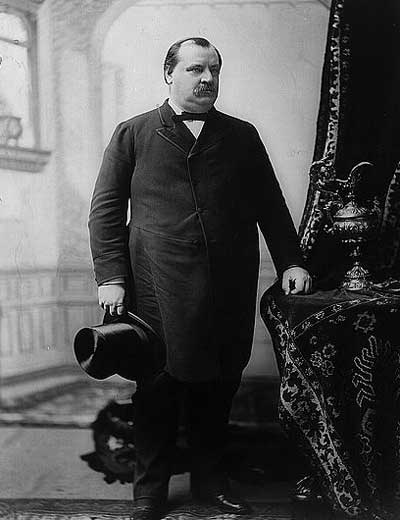 Something about Grover Cleveland is funny. I don’t know why, but Grover is just one of those things you can sprinkle into the conversation for some sudden hilarity. He’s one of those presidents that we all vaguely remember from some high school history class we dozed through, but unlike, say William Henry Harrison, he’s funny. All the stiff mustachioed seriousness of White Male American History is summed up by Grover.
I realized Grover was funny when I was writing a stick-a-needle-in-your-eye boring TOEFL passage about his second presidential term. As sometimes happens writing these passages about tapirs or biomechanical engineering, I get sucked into the topic. So with this slight curiosity about why Grover was so funny I wikipedia-d him and found out that actually, his presidency contains some of the great themes of American history. Namely, fruit company barons taking over sovereign countries, American businessmen snuggling up with Congress to take over a country here, overthrow a government there, and the general subjugation of native peoples, etc, etc, etc. It also contains one strikingly NON-American theme – a president who apparently opposed imperialism.
Blow against the empire
Dr. Nagarjuna G. of Mumbai (Gnowgi) fires off a sternly worded letter to U.S. Ambassador to India, Timothy J. Roemer in protest of the unfair treatment of one class of visa applicants:
… namely, an imposition on all citizens to use a particular proprietary commercial software in order to submit their application for visa.This is how it happens.
All applications for a U.S. visa from India are done through the Visa Facilitation Services (VFS). The procedure is to first pay the visa fee, wait for two days or till the number gets activated, and then proceed through the filling of forms at the website (http://www.vfs-usa.co.in). As I did the above, along the way I found that the VFS site did not work with my Mozilla Firefox browser. On inquiring with VFS I found that the site works with Microsoft Internet Explorer only.
As a regular user of the GNU/Linux operating system, I do not use any proprietary software either at work or at home, hence I found this an unwarranted restriction on my individual freedom.
The growth of empire
David Mobert (In These Times) on the unlikely roots of our imperial overlords:
The success of Wal-Mart is in many ways paradoxical. The world’s biggest corporation—and one of the most technologically sophisticated—emerged from the poor, rural backwaters of Arkansas, a state regularly at the bottom of most state achievement rankings. Increasingly global in procurement and sales, it grew from a base that was racially homogenous—a result of the violent expulsion of African-Americans—and suspicious of all outsiders. A company that plays on “family values” is based in a region with one of the highest divorce rates in the United States. A region of low-income families adhering to a range of anti-materialist Protestant faiths gives birth to this colossus of consumerism…
A division of the spoils
The right wing in the United States, normally the “we’re number one!” bunch, cheered when the International Olympics Committee by-passed the United States when awarding the 2016 Summer Games to Rio de Janeiro. In the weird world of U.S. political discourse, the right decided that losing the Olympics was more important than the temporary discomforture of the President (who lobbied for his home town of Chicago). What they didn’t seem to realize is what it says about the previous President and about those U.S. visa problems:
… the International Olympic Committee (IOC) may have chosen to reject hosting the 2016 summer olympic games in Chicago due to the post-9/11 visa tourist policies established by his predecessor, George W. Bush. Michael Froomkin, Professor at the University of Miami School of Law, is convinced that the “the same stupid anti-visitor policy that is destroying American higher education” also sunk Chicago’s Olympic bid.
Imperial style
“Prairie Mary” — whom I discovered through Jason Dormady’s “Secret History: Reflections on Latin America” — is Mary Scriver, a Montana writer and minister. Prairie Mary introduces us to the upside down discussions of imperialism in the work of world of “Eric Blair” — not the one better known by his “nom de plume” George Orwell, but University of Chicago professor Norvel Morris.
Morris’ work was focused on the insanity plea, but within the context of the hard work of trying to get justice to bear some relationship to the law — or the other way around — esp. in places where an empire-mongering nation had come in over the top of an ancient pre-existing way of doing things. In order to do this in a class discussion without either free-floating in theory or invading someone’s privacy (often legally forbidden) and in order to make sure the salient points were covered, Morris wrote up what amounted to short stories…
…
Morris decided that he would write taking Orwell’s real name as his nom de plume. Orwell/Blair is considered one of the finest of writers of his type. Morris pretended — as has often been done, maybe more commonly with paintings — that he had found a cache of long-lost manuscripts. Morris, as an Aussie, was rather audacious. The trouble was that since he could write as well as Orwell, his faux essays were picked up by the credulous media as real. So he had to get a friend to label him a hoax. It happened that I was typing for him and even answering his phone (his secretary must have been on vacation) when the media began to call about the “hoax,” which excited them as much as the original “discovery.”
La Pared (San Cristóbal, Chiapas) moves
La Pared, in San Cristobal Chiapas — one of the handful of English Language bookstores in Mexico — has moved They’re having a sale, so this might be a reasonable excuse to take a trip…
A rejuvenated La Pared re-opens on 1 October at Ave.Miguel Hidalgo #13-B, still on the same pedestrian walkway, just a few meters before the Arch of El Carmen. Deborah Colvin, the new owner, plans creative changes and promotions while maintaining the same mix of new and used books in various languages for sale or exchange. Special orders welcome.
New e-mail lapared_sclc@gmail.com.
No news is good news: Honduras
I just love that idea of “we’ll restore civil rights when it’s convenient” (for us).
The running of the anarchists
In what is an evolving ritual, the veterans of the 1968 movement and the Tlatelolco Massacre held their memorial march yesterday. Forty-one years on, with still no official accounting or prosecutions for the events of 2 October, the annual protest march, surviving members of the “Comité del 68” (some on walkers, and some assisted by children and grandchildren) led the several thousand protesters from students to grandmothers.
 As in past years, there is some property damage. I watched windows at the KFC shatter when I observed the 35th anniversary march. This year, KFC got smart. On that occasion, then Secretarío de Gobernacíon Santiago Creel tried to blame — of all people — the goths for fomenting trouble. And even fingered some goth girl from Germany as a foreign agitator. When everyone stopped laughing (except for the German Ambassador, who took it very seriously), and the goths themselves. Besides, its the punks who are anarchists (er, the anarco-punks are anarchists, the rest are Marxists), not the more conservative Goths, who are only slightly less wimpy that Emos among the tribus urbanos of Mexico City.
Everyone felt better, and the ritual was better defined, once the annual atavistic action contingent were finally given the generic title of “anarchists”. Some are, but the term includes the glue sniffers, vandals and plain assholes you find in any large crowd.
While it might be a sign of progress, and a victory of sorts for those demanding change in 1968 that Mexico City police are less prone to automatically resort to brute force, there is also the recognition that the anarchists (the real ones) are engaging in a ritual outpouring of anger and frustration against the financial forces that they see as their repressors. In front of Banco de Mexico, it’s a rough form of slam dancing. In the video, you’ll see that even among the more energetic protesters, there is some attempt to maintain order. It’s ritual up to the point where guys start throwing rocks. Then the tear gas came out.
Windows were broken at the Antigua Ayuntamiento, the former city hall on the Zocalo, which led to several arrests. Ironically, the rock throwers were under the impression that the Federal District government leaders were in the building, but they were in the new District office building…ironically enough, the former Foreign Secretariat complex in… where else… Tlatelolco Plaza.
Our war: as it is, as it could be
Unlike “pundits” on television in the United States, Mexican “talking heads” are generally either intellectuals or academics or both. Lorenzo Meyer is less known as a journalist and weekly participant on” Primero Plano” (Instituto Politecnico Nacional’s Canal Onze’s version of “Meet The Press”) than as a historian and professor of international relations at the prestigious post-graduate institution, Colegio de Mexico. He turns out a weekly newspaper column, Análisis: Agenda ciudadana for the conservative Reforma (which appears as well in 50 newspapers throughout Mexico), he is considered to be on the “left”, given his contention after the 2006 Presidential election that other well-known public intellectuals backed Felipe Calderón not out of conviction, but out of a fear and mistrust of the general populace.
Although he is not a Calderónista, and he cannot — with his heavy writing and work schedule — fully explicate his ideas in a weekly newspaper column, Nuestra guerra actual y las posibles (my translation) — last week’s Análisis will be (and is) taken seriously in Mexican policy making circles.
Priorities:
In the three years since December 2006, when the Mexican government committed its Army to a war against drug traffickers, the casualty rate in the battle with organized crime have risen to 14,000 (11 September 2009 El Universal). Perhaps it is time to ask whether it makes sense to continue this war with the same intensity and with the same tactics.
One could argue that the “drug war” should be buried – or reburied – not just because too many have died already, but because there are more urgent needs for our limited resources, and because there are legitimate alternatives available that change the direction of our current collective drive against the drug cartels.
To start with, this war drains the country of the funds needed to fight poverty, and reverse a declining education system. And, there is a need for other battles … against unemployment, against environmental destruction and for the struggle to turn the growing informal economy into a formal one.
What would be really popular a national crusade against public corruption and insecurity: that is, crime that affects the ordinary citizen … not just drug trafficking. Still, there is no shortage of wars to fight, but there is a shortage of resources to fight all these wars.
So we set priorities. But maybe the battle against drug cartels is a conflict that is not entirely or even genuinely our conflict, or worse — one where no real victory is possible.
The essence:
Successfully waging a real war implies that society is willing to bear extreme strains upon its social and institutional relationships. Such a war requires the country’s leadership to develop a plan that has clear means and goals, identifies the opponent, explains why the fight is necessary, and what steps are needed to win.
For its part, the society has to be willing to accept a high degree of responsiblity, of personal and collective sacrifice and commit to one of the largest enterprises a community can undertake.
In short, the decision to go to war is one that must be undertaken with the society’s full awareness of the burden and responsibilities
Narcotics traffickers as the great collective enemy:
In principle there is no doubt that Mexico as a country and the world in general would be better off if “The Family”, the Gulf cartel, the Juarez cartel and all the other drug trafficking organizations, were already history.
However, specialists in this field, as well as our own common sense tell us that as long as there are external sources of demand and, therefore, financing — especially if that source is the most powerful country on the planet — those fighting the Mexican drug trade will continue to suffer from the same disadvantage they face. For starters, the armed groups opposing the army have their main source of supply and support in another country.
The United States, even with NATO assistance, cannot defeat the Taliban in Afghanistan for the same reason. It finds shelter and resources in Pakistan. For Mexico, there is also an external factor that is a major obstacle in the effort to eliminate organized drug trafficking — the ability to pressure and force Washington to act is infinitely more limited than Washington’s to pressure Islamabad.
Under the so-called Merida Initiative the Mexican government received a strong and historical commitment on the part of the U.S. government to really act against demand and against supplying arms and money transfers to Mexican criminal groups.
However, for historical or political reasons the U.S. authorities can not prevent its citizens from acquiring weapons and for some of those citizens to transfer arms to the Mexican cartels.
Examining the budget items, according to a paper by Eric Olson and Robert Donnelly (“Confronting the Challege of Organized Crime in Mexico and Latin America“, 2009, Mexico Institute Woodrow Wilson Center, Washington DC.), so far, two thirds of the funds the U.S. government has invested in the fight against drugs has been designed to combat the supply and only one third to confront the very source of evil: demand,
A logical basis:
Felipe Calderón unleased the army to fight the war against drug traffickers as part of a move against several criminal organizations.
As in many other administration actions, one objective– perhaps the most basic – seems to have been to create a situation in which the public would stand on the side of a “strong and determined leader.”
In that sense, the move seems to have born fruit: according to a Pew Centrer poll, published 27 September, eighty-tree percent of Mexicans support the use of the amry against drug cartels.
However, Olson and Donnelly, as do many other investigators, are cognizant of the fact that “rarely has a victory been possible in this type of war, especially when the demand for illegal products is high.”
The alternative could be, experts say, to use the military simply to selectively limit the influence of organized crime, raising the cost of their business; concentrating on the less violent and dramatic activities, such as money laundering; rebuilding the institutional framework of the police, prosecutors, courts; educating or reeducating potential consumers; and, above all, make activity of the part of Mexican authorities conditional upon U.S. progress in effective arms control, currency controls and a real reduction in demand for drugs in their society.
Possible solutions:
A German researcher, specializing in the economic effects of internal conflicts, Achim Wennmann, has suggested exploring another possibility: the Government of Mexico could enter into negotiations with the cartels through formal intermediaries with the clear objective of limiting the areas of activity of the cartels, including agreements not to operate in schools, nor to extend its reach into other violent activities such as kidnapping or human trafficking.
What is needed is an economic incentive for the cartels to limit their activities and the areas under their control, that will enable Mexican society to return to civility.
Certainly, in principle, the idea of negotiating with organized crime is morally repugnant.
However, there is an ethical defense. War without possible victory is an indefinite extension of slaughter and brutality.
However, it has a defensible ethical side: a war without victory is possible indefinite extension of the slaughter and brutality.
Mexican society, particularly those youths who have a chance of social mobility, are getting used to the idea of seeing violence as a normal and extremely effective way of getting ahead.
A hardened collective consciousness will have a huge cultural cost. It mortgages the future.
Mexico does not have to pay a bill that should be entirely in the hands of consumers. They are the ones who ultimately have developed in the mountains of Sinaloa not only to a producer of marijuana and poppies, but a region where totally dehumanized characters are imposing their life style, values and destructive relationships on the rest of society. Look at Italy for an example of how difficult it is to uproot the Mafia culture.
Obstacles:
Negotiations with criminal organizations is not an ideal solution but the alternative is worse. But, as things stand, the obstacles to achieving a world not as bad as other possibilities, are many.
On the one hand, the “drug war” has paid dividends to Calderon which does not have many alternative sources of political capital.
On the other, Washington will raise objections. While that government has not been able to reduce the demand within its own society, it has ample resources to pressure Mexico.
Ironically, that same Washington may consider negotiating with evil itself, for example, with some of its own enemies in order to isolate the Taliban hardliners.
Only possible Friday Night Video
Starts with “T”, rhymes with “reason”
For a guy arguing that the Honduran coup-meisters were upholding the rule of law, Senator Jim De Mint of South Carolina sure has a strange way of going about it… like flirting with treason, and flaunting his intentions to violate his own nation’s laws, specifically the 1799 Logan Act (U.S.C.A. § 953):
- Any citizen of the United States, wherever he may be, who, without authority of the United States, directly or indirectly commences or carries on any correspondence or intercourse with any foreign government or any officer or agent thereof, with intent to influence the measures or conduct of any foreign government or of any officer or agent thereof, in relation to any disputes or controversies with the United States, or to defeat the measures of the United States, shall be fined under this title or imprisoned not more than three years, or both.
- This section shall not abridge the right of a citizen to apply himself, or his agent, to any foreign government, or the agents thereof, for redress of any injury which he may have sustained from such government or any of its agents or subjects.
Simply put, in the on-line “Law Library – American Law and Legal Information Encyclopedia,”
The Logan Act (18 U.S.C.A. § 953 [1948]) is a single federal statute making it a crime for a citizen to confer with foreign governments against the interests of the United States. Specifically, it prohibits citizens from negotiating with other nations on behalf of the United States without authorization.
Although there has never been a prosecution under the act, Senator De Mint should be aware of a 1936 Supreme Court decision (United States v Curtiss-Wright Export Corporation, 299 U.S. 304) which held that “[T]he President alone has the power to speak or listen as a representative of the nation. He makes treaties with the advice and consent of the Senate; but he alone negotiates. Into the field of negotiation the Senate cannot intrude, and Congress itself is powerless to invade it.”
Where the Senate fears to tread, this fool goes rushing in…
So, De Mint, claiming a foreign Supreme Court upheld its constitution by allowing its president to be exiled (in violation of its constitution) is violating his own country’s Supreme Court rulings. Maybe there will, at least be an indictment… or better yet, De Mint will flee the jurisdiction of the United States and stay in Honduras. Sucks for them, but one more crazy gringo shouldn’t change the ecological balance that much.


 mexfiles.net