La tumba abandonada
Villa’s life is largely a mystery and so is his death. He had made
his hacienda a model farm along the lines of Madero’s visions. It
had the schools, clinics, decent housing, its own electrical plant
and telegraph office. Like the old haciendas, it had a company store, but with a twist. The hacienda was too far from Hidalgo del Parral for the workers to go shopping, so the hacienda bought wholesale and sold items below retail to workers and neighboring villages—a sort of revolutionary “Sam’s Club”.
Obregón’s last surviving important rival was regularly featured
in the press and was hardly forgotten. When the government,
hoping to revive the economy, offered to lease some old haciendas to American companies, Villa’s loud and public objections to the anti-revolutionary idea forced the government to change its mind. When Obregón’s government hoped to re-establish diplomatic relations with the United States there was one minor issue with the United States: the lingering resentment of Pancho Villa. His attack on New Mexico and a few raids into Texas could not be forgiven. After all, he had successfully attacked the gringos and might still cause problems.
So, what happened in Hidalgo del Parral on 20 July 1923 isn’t a
complete mystery. Villa was driving home from a christening when an unknown group of men—in a house rented the day before, then barricaded—opened fire on the car, killing all eight occupants. The men rode out of town on horseback and were never seen again. A state legislator later claimed to have masterminded the assassination, but there are too many questions about his claim to accept the story. At any rate, it doesn’t explain the real mystery of Pancho Villa’s death.
Three years after Villa was buried, someone dug up the corpse
and stole the head. Who, or why? Woodrow Wilson can be eliminated as a suspect—he died in 1924. General Pershing wasn’t known to hold grudges. Obregón’s amputated arm (like Santa Ana’s leg) had been saved and made the center of a memorial, but there is no evidence he went about collecting other people’s body parts. Theories range from probable (old enemies still out for revenge—with their own ideas about justice—or ghoulish souvenir hunters), to implausible—a favorite with American newspapers of the time had Villa’s head stolen by California gangsters in the pay of an Oklahoma spinster with an unrequited love for the ex “movie star”. There is another popular gringo suspect: George W. Bush’s grandfather.
A story that has taken on popularity since the 1990s is that the
head was taken by members of Yale’s ultra-secret Skull and Bones society, which uses a human skull in its rituals. The society is connected with the York Rite Masons (Poinsett’s “Yorkistas”) and both George Bushes are members of the organization. Prescott Bush, father of the first George Bush, also a member, was inducted a few weeks after the head disappeared, and, it is said, was in México at the time126 Villa’s head disappeared. How anyone would have known that the student joining the organization in 1926 would have a son who ran the CIA and later would be president of the United States and a grandson who would also be president, is never quite explained. Or why they wanted the head. Villa’s headless body was cremated and interred in the Monumento de la Revolución in Mexico City in 1972.
(Gods, Gachupines and Gringos, ©2008 Richard Grabman)
La Tumba abandonada was composed by Pepe Albarrán, and is performed by Los tremendos Gavalanes
This other Eden, this demi-paradise…
Clive Warner is an Englishman living in Monterrey, Nuevo Leon. His “Why I Love Mexico” appeared in 17 September The Telegraph (U.K.):
When you listen to the news media, you often hear phrases like “narco state”, and “failing”. There are also reports of an estimated 8,000 recent drug slayings and dissolvings (in acid), decapitations and kidnappings.
We don’t like it, but we regard it as a self-cleaning oven – except in one respect. Many police have been slaughtered by the syndicates, so it is not uncommon to come across retens while driving. These are chicanes manned by soldiers. There’s usually an armoured car nearby with a mounted and manned machine gun.
This expat, though, feels infinitely safer in Mexico than in London, or Manchester, or Liverpool, or many other major British cities. One thing I don’t miss is the British alcohol culture. In Monterrey, it is rare to see a drunk on the streets, and if a mess is made of the sidewalks in the nightclub district – the “Barrio Antiguo” – the newspaper, El Norte, is likely to get on the case fast.
Latin Family Values: Friday Night Video
One thing that’ll always be true… during a crisis, everyone in the family gets involved.
Not completely safe for work:
Captain Louis Renault Memorial Award to…
…Santa Cruz County Sheriff Tony Estrada who was “shocked” to discover that Richard Cramer, a high ranking Immigration and Customs Enforcement (ICE) official who had worked as liaison between his agency and the Drug Enforcement Agency in Guadalajara before taking over as resident agent in charge at Nogales, Arizona was arrested for conspiracy charges.
Cramer has been under investigation since 2006, and remained with the Federal agency until 2007.
Cramer allegedly advised traffickers on law enforcement tactics and pulled secret files to help them identify turncoats. He charged $2,000 for a Drug Enforcement Administration document that was sent to a suspect in Miami by e-mail in August, authorities said.
“Cramer was responsible for advising the [drug traffickers] how U.S. law enforcement works with warrants and record checks as well as how DEA conducts investigations to include ‘flipping subjects,’ ” or recruiting informants, a criminal complaint says.
Other than they cost more to bribe, why would anyone assume that U.S. agents are any less likely to go to work for the cartels than any other cop? And given the D.E.A.s track-record around Latin America, I have the terrible inkling that what brought Cramer down was that he forgot the first lesson of Kindergarten: when you have goodies, bring enough to share.
¡AI! Viva Zapata panned
In a melodramatic scene based on a generally discounted legend, angry young peasant Emiliano Zapata confronts dictator Porfirio Díaz in Mexico’s National Palace. The young Marlon Brando plays Zapata, which is a problem mainly because the young Marlon Brando could only play Marlon Brando. They’ve taped his eyelids up in a bizarre attempt to make him look like an indigenous Mexican, but he just looks like Marlon Brando with his eyelids taped up. In a few scenes, he attempts a Mexican accent, but he just sounds like Marlon Brando doing a half-hearted impression of Speedy Gonzales. Incidentally, the real Zapata was renowned for his high-pitched, delicate voice.

English film critic Alex von Tunzelmann, on Elia Kazan’s 1952 mish-mash of Mexican history, Viva Zapata! John Steinbeck was the screenwriter, proving something. That even Nobel-prize winners can screw up? That Mexican history is best written by obscure eccentrics?
19 de Septembre de 1985


The actual number of deaths from the 1985 earthquake can never be determined. Estimates range from the official 10,000 casualties to as high as 40,000 deaths.
Several apartment buildings in the Tlatelolco complex simply pancaked. While several residents were pulled alive from the wreckage (and the rescue attempt led to the creation of one of the world’s best search and rescue units, the “Mole-men of Tlatelolco” the Brigade de Rescate Topos Tlateloloco) the rubble was eventually sodded over and is now a memorial park.
A baseball stadium, since torn down (there is a Liverpool department store on the site now) was turned into a temporary morgue.
(Photos: El Universal)
Rememberance of Beats past
With the tourist season about to start (one hopes), we really don’t expect a lot of the so-called “drug tourists” that worried U.S. officials claim are going to inundate Mexico. Besides, we remember some of our consciousness-altering visitors rather fondly:

Obama ≈ Chavez ?

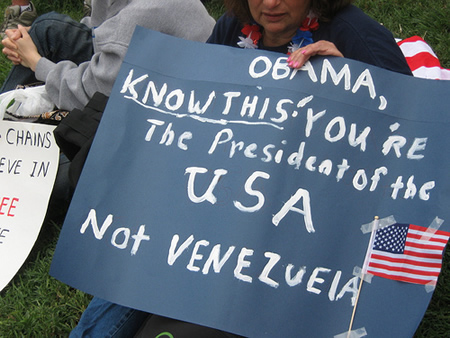
An overwhelming portion of the intensely demonstrated animosity toward President Barack Obama is based on the fact that he is a black man…
During his own tenure as President of the United States (and after) Jimmy Carter — who, having grown up in the segregated south, and having served as one of the first post-segregation southern leaders, knows racism when he sees it — was, like Barack Obama now, also tarred with being a socialist by the far right (and the merely uninformed).
Living in a country where two of the three main parties (PRI and PRD) explicitly define themselves as “socialist” and where another national party (Convergencia) calls itself “Social Democratic” (as did the Social Democratic party, which has lost its national registration, being somewhat redundant) and another — PT — claims to be Maoist, this seems to be a lame insult for the 21st century, but then, the United States has a different political vocabulary than the rest of the planet.
Socialism, for whatever reason, is anathema in the United States and politicians go out of their way to deny that any proposal of theirs is at all influenced by Socialist thinking. When Carter was attacked (and he was despised by many for all kinds of reasons) he was usually slurred as a “European Socialist” — presumably meaning his proposals might do for France or Italy or Sweden, but not for the U.S. of A.
But when Barack Obama is called a “socialist”, he’s not being compared to some French or Italian leader, but to Hugo Chavez. There’s a reason, one that bolsters Carter’s observation.
Nicholas Kozloff, writing on “The Politics of Race” in Venezuela back in 2005, said:
Unlike the United States, Venezuela has not experienced poisonous anti black racism. But the idea of racial democracy does not stand up under scrutiny: the caste like divisions of the colonial period are still latent in society. “Venezuelan elites,” one scholar has remarked, “judged people by their appearances. Accordingly, individuals with ‘anxious hair’ or ‘hair like springs’ lived in the shadow of their black slave ancestors. The elites considered respectable the whiter Venezuelans who had ‘hair flat as rainwater, of an indefinite light brown color which is neither fair nor dark.'” Though some blacks were able to enter white society through marriage and miscegenation, “in the long run, such individuals provided the exceptions that proved the rule.” Blacks who sought social acceptance had to adopt the clothing, education, and language of the white elite. In present day Venezuelan society, notes respected commentator Gregory Wilpert, “The correspondence between skin color and class membershipis quite stunning at times. To confirm this observation, all one has to do is compare middle to upper class neighborhoods, where predominantly lighter colored folks live, with the barrios, which are clearly predominantly inhabited by darker skinned Venezuelans.” Meanwhile, journalist Greg Palast noted that rich whites had “command of the oil wealth, the best jobs, the English-language lessons, the imported clothes, the vacations in Miami, the plantations.”
Hugo Chavez,who does not “adopt the … language of the white elite”, as does Obama, does have something in common with the U.S. President however:
Physically, Hugo Chávez is a pardo, a term used in the colonial period to denote someone of mixed racial roots. “Chávez’s features,” writes a magazine columnist, “are a dark-copper color and as thick as clay; he has protruding, sensuous lips and deep-set eyes under a heavy brow. His hair is black and kinky. He is a burly man of medium height, with a long, hatchet-shaped nose and a massive chin and jaw.” In an interview, Chávez remarked that when he first applied to the military academy he had an Afro.
I agree that Venezuela (and most of Latin America) has not had the anxiety over “race” that was experienced in the United States, but, when it comes to political tactics, the overt displays of racism are cross-cultural:

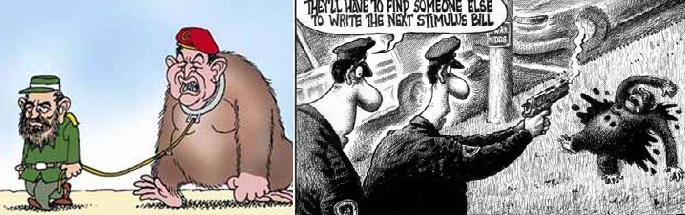
The photoshopped images I took from political opposition websites, where one might expect the ethics of journalism are not applicable, but the two political cartoons appeared in “respectable” daily newspapers in Caracas (left) and New York (right).
Confusingly enough, the same political groups that claim their nation’s elected leaders are socialist and compare their black(ish) Presidents to monkeys will also try to compare them to Herr Master Race himself. That confuses me, but in both Venezuela and the United States, there is a sense that the traditionally controlling “race” deserves to remain in control… as it was then, so it shall be, forever and ever, Amen.
That attitude doesn’t depend on being the majority (as “whites” supposedly still are in the United States). In Venezuela, the majority is non-white, as it is in Bolivia, where very real fascists accuse the indigenous president of fomenting “race war” and also resort to comparing him to a monkey. But, Evo Morales for some reason, isn’t seen as a threat by the right in the United States… could it be there aren’t many Indians in the U.S., but a lot of blacks?
“Digby”, a U.S. political blogger, writing about a connected issue 8the attempts by the right to deny they are racists) notes:
… these people are a perfect example of the modern racists. They don’t go around calling black people “boy” (to their faces) and they certainly don’t think of themselves as bigots. But in their minds, racial minorities [or, in Bolivia, majorities] are dangerous barbarians who are threatening to destroy their way of life.
This being a Mexican site, I’d be remiss if I didn’t mention that anti-black attitudes exist here, too. Alex Okeoko writes a well-balanced article for Time about Afro-Mexicans and mentions both that persons identifiably Afro-Mexicans only number about a million people, whose discrimination is based more on social class than color. And that country has had Afro-Mexican leaders.
Okeoko mentions historical leads like Vicente Guerrero, but ovelooks contemporary ones like former Quintano Roo Governor, Joaquin Hendricks Diaz. Racism, as such, is not the same as it is in the United States and the irrational fears raised by the “other” have different causes.
As to “white privilege” in this country, I have to go back to the 19th century to find overt evidence of it. The Emperor Maxmiliano, called Juan Altamonte, he Regent who ran the occupation government until Max could get to Mexico, “that nigger”. And Maximiliano was never a Mexican, just a wannabe.
Carlos Fuente’s “The Days of Laura Diaz”, concerns itself with the social changes among the Mexican upper class after the Revolution. Laura doesn’t so much marry down under Pre-Revolutionary thinking because she marries an Afro-Mexican, but when she marries a poor man for whom “the revolution has done justice” … in other words, a political hack, not a member of Laura’s own haciendado class.
Norman Borlaug, D.E.P. (25 de marzo de 1914 – 12 de septiembre de 2009)
To my knowledge, only two streets in the entire Republic of Mexico have ever been named for U.S. citizens during their lifetime. One is calle Neil Armstrong, a very small street in a fraccionamento in Mexico City where you’ll also find calle Apollo XII, calle Saturn, etc. The other — a major one — is calle Norman Borlaug –in Ciudad Obregon, Sonora.
Borlaug, like Armstrong, changed the way we see the world. They were icons at a time when we had faith in the ability of mankind to conquer the limits of nature though our technology and science. Both modest men, they preferred to fade into relative anonymity of academia. But where Armstrong’s fame rests on leaving earth, with the considerable assistance of high tech innovation, and billions of dollars in engineering development, and a huge investment by the military-industrial complex, Borlaug’s rests on a few wheat fields in Sonora and outside of Toluca.
Following on the land redistribution of the Lazaro Cardenas administration, Manuel Avila Camacho came into office in Mexico in 1940 with the goal of, among other things, increasing Mexican crop yields that would make the ejidos and small farms profitable. In the United States, the Roosevelt Administration, recognizing it would soon be involved in the world war, was looking to improve relations with Mexico, and to assure access to Mexican resources, including food crops. AND… the Vice-President of the United States was Iowa plant breeder and former Secretary of Agriculture, Henry Agard Wallace.
For cultural, political and historical reasons, the Mexican government could not — and would not — sign into a direct partnership with the United States government, but with support at the highest levels, the Rockefeller Foundation was encouraged to underwrite a Mexican agricultural research institute, with both U.S. and Mexican scientists and agronomists.
A native of a Norwegian agricultural settlement in Iowa, Borlaug was a first-hand observer of the collapse of agriculture in the 1930s, and the very real malnutrition that was found in the upper mid-west during the Great Depression. Despite the hard times, he Work on an off for government-sponsored conservation projects, while pursuing an education in forestry and plant pathology, and was just finishing his doctorate when the Second World War started. Like other scientists, he was drafted into “war research”, but developing a glue that would stand up in the jungles of the south Pacific was probably a misuse of his particular talents and knowledge.
He was transferred to the Mexican “Office of Special Research” in 1944, despite an offer to double his salary (DuPont liked his glue). While what he did in Mexico was what plant breeders and farmers have always done — cross bred varieties for desirable traits — his single minded search for wheat varieties that would give a higher yield and were resistant to common plant diseases, was undertaken in the same spirit as the space program in the United States: as a scientific and economic government priority with national defense implications.
The only really new scientific breakthrough Borlaug made was the realization that wheat seed did not need to “rest” after harvesting, and could be planted immediately. Although this meant transporting seed around the country (and Mexico is fortunate in having enough different climate zones to have several discrete growing seasons), it also meant developing entirely new varieties… one for every possible growing condition.
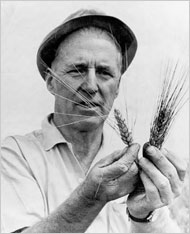
Borlaug with dwarf wheat, 1970 news photo
The results of Borlaug’s work was a doubling of the Mexican wheat harvest, and — though application of his research elsewhere — a massive increase in crop yields (and the food supply) around the planet. Coming as a result of the most destructive war the planet has endured, and at a time when the human population was skyrocketing, it was logical for Borlaug to be honored with a Nobel Peace Prize in 1970.
At the time, saving an estimated billion people from malnutrition seemed miraculous. Borlaug deserved his award. But, with the human population still growing exponentially, a billion people still face malnutrition around the planet. Borlaug has been accused of creating the conditions where the population would continue to grow, although he can’t be held responsible for the failure of governments to adequately address the issue. Nor, really, can he be blamed for those that profited from his scientific work, who have created “frankenfoods” and forced farmers into a situation where they grow single varieties of a crop that fits the needs of a corporate entity, not of the consumer.
It’s an old tragedy. Mexico gives the world food — corn, chocolate, beans, squash, tomatoes, etc. — and the world’s rulers seek not the benefit of all, but the benefit of the very few.
Zombies and the balance of power
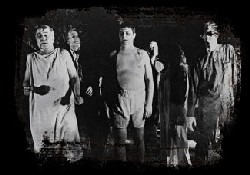 There are, it seems, more than one kind of zombie, and different tactics are needed to deal with them. With the relatively harmless walking dead, the Presidencia Zombi, the tactic being employed by the Senate is new and untried: call it the Nancy Reagan approach — just say “no”.
The Procurador General de la Republica, the Attorney General (or rather “national prosecutor”) is one of the few cabinet positions requiring Senate approval.
There were some objections to Attorney-General Designate Arturo Chávez Chávez, mostly from women’s groups and human rights organizations, stemming from his previous job as Chihuahua State prosecutor. As I’ve argued for the last several years, I don’t think the “femicides” in Juarez are more the result of the frontier conditions of Juarez than a result of any official complicity, but the State Prosecutor’s office has continually been blamed for faulty or sloppy investigations and a lack of any prosecutions in the 300 or so murders over the last 15 years.
While there have been chronic human rights abuses involving the Mexican police and army for years, the Administration’s use of soldiers in the anti-narcotics exporter fight has only exacerbated the problem. Chávez has also held some federal posts overseeing human rights protection within the Federal Prosecutor’s office, again with less than stellar results.
These are legitimate concerns, and should be raised, but normally, they would be brushed aside after a few Senators raised the objections, and the Administration made some pretense of responding to the objections… usually a matter of vague promises to review the situation.
But, this is — as far as I can tell — a new situation. For the first time ever, there is a single opposition party in control of the Senate (PRI) and in a position to reject a cabinet nominee. Human rights and justice are legitimate issues to be considered, but Chávez is going to be rejected for purely political reasons: weakening PAN.
I’m not saying that PRI is “better” than PAN, but, I will say this is a step forward for Mexican democracy. There is considerable overlap in the governing style and neo-liberal economic policies between the two largest parties, as well as dependence on the same “special interests”, making leftist sneers at “PRIAN” valid.
Of course, in the United States, where there are for all realistic purposes there are only two parties, both of them overlap considerably more than this country with its more ideologically based politics. It’s foolish though, to expect parties not to attempt to maximize their power. The problem in Mexican governance since independence has been the overriding power of the Presidency, at the expense of a balanced federalism.
There is a possibility that the Senate — seeking a short term gain — will start demanding more oversight of the cabinet, eroding the presidency even further. Which, when the PRI returns to the Presidency (which it probably will in 2012), should minimize some of the danger of a return to what was once known as the “perfect dictatorship.”
Whatever happened to a letter to the editor?
The directors of a Mexican newspaper, Diario del Istmo, have filed complaints with human rights commissioners and the public prosecutor after a police chief issued a death threat to a reporter and stormed into its offices accompanied by armed colleagues.
Raúl de Lucio Rincón, chief of the intermunicipal police in Nanchital, in the state of Veracruz, is reported to have threatened reporter Artemio Hurtado Ruiz. It followed an article in the paper detailing claims of police abuse.
When the paper then reported the threat … Rincón and several of his men “stormed into” the newspaper’s office to complain. They left after he had made his protest.
Fiesta patria
82,000 lightbulbs were installed two weeks ago on the Zocalo in Mexico City to celebrate tonight’s Independence Day kickoff… and the countdown to the Bicentennial. Maybe it’s in line with Prez Calderón’s sudden interest in austerity… or maybe it’s because the poor folks might enjoy the show, and he thinks using less electricity is a help to the poor that these are 10-watt bulbs.
By the way, besides the usual suspects put up in lights (Hidalgo, Morelos, Josefa Dominguez), this year Francisco Primo de Verdad y Ramos has been added to the “illuminati”. He died before the War of Independence even started (in 1808) in a Mexico City dungeon, where he’d been thrown for having the temerity to suggest independence for Nuevo Espagna. A criollo intellectual and attorney, his new prominence is seen by some as an attempt to downplay the more radical heroes like Morelos and Guerrero.


 mexfiles.net