Another police roll-out

Photo: EFE
Mexico City skater-cops demonstrated their skills yesterday at the Museum of Anthropology plaza, including formation skating, stair climbing and descending and skating down fleeing suspects. All patrol officers with at least three years experience, the skater-cops were trained by roller hockey players, artistic skaters and skatopunks. The skater-cops have been patrolling plazas, transit centers and shopping malls since last December.
Safe Sunday Readings
Is it safe?
Sombrero tip to Lillie (Memory in Latin America) , who found a travel guide to Nazi war criminal Joseph Mengele’s hideaway in south Paraguay (Graeme Wood, “Mengele’s Undisclosed Location”, The Atlantic):
Hohenau is a pleasant little Paraguayan backwater. It offers much to escaped Nazis and to normal people: an agreeable, temperate climate; a prospering economy, due to the mate boom; and a sizable German population that to this day cooks a mean schnitzel in local restaurants. But Hohenau is still a mud-road farming community. It is no Buenos Aires, and has none of the high culture an educated Nazi like Mengele (survivors say Mengele whistled Puccini arias while selecting victims) would want.
Safe Investments
Nezua, the Unapologetic Mexican, reprints Angel Luna’s “Managing Your Money Oaxaca Style” (Debug: The On-Line Magazine of South Bay) on how to save money and invest the old fashioned way:
I had delinquency notices strewn across the carpet that I stepped on every morning when I woke up and every night when I went to sleep. That’s when I made the decision to ask elders from my Oaxacan community to help me solve my debt burden and joined a “tanda.”
The tanda is an ancient custom that was brought to Mexico by the Chinese in the late 1800s. A common practice in Latin America, the tanda is essentially a rotating credit association that is built on trust. It is a system for people to save money as well as a way to build relationships with each other. I told my mom that I wanted in, and she told me that this was a monthly commitment that I would be expected to pay.
Unsafe Sects
James A. Haught (“Council for Secular Humanity“) provides an object lesson in why Mexico has the right idea, keeping the church separate from the state, and keeping religious language and symbols out of public discourse.
Incredibly, President George W. Bush told French President Jacques Chirac in early 2003 that Iraq must be invaded to thwart Gog and Magog, the Bible’s satanic agents of the Apocalypse.
Honest. This isn’t a joke. The president of the United States, in a top-secret phone call to a major European ally, asked for French troops to join American soldiers in attacking Iraq as a mission from God.
…
This bizarre episode occurred while the White House was assembling its “coalition of the willing” to unleash the Iraq invasion. Chirac says he was boggled by Bush’s call and “wondered how someone could be so superficial and fanatical in their beliefs.”
After the 2003 call, the puzzled French leader didn’t comply with Bush’s request. Instead, his staff asked Thomas Romer, a theologian at the University of Lausanne, to analyze the weird appeal.
A World Safe for Democracy
Inca Kola News notes the passing of Harry Patch, the last surviving English World War I “Tommy” with a poem by Wilfred Owen. Patch, having survived the carnage of the trench warfare of the western front, lived long enough to be a celebrity simply for being old (he was 111 at the time of his death). As one of the last survivors of that mass slaughter, he used his celebrity to speak on the stupidity and futility of war. At his own request, pallbearers at his well-attended media-event funeral included both British and German soldiers.
Safe to say?
“Disappearance” has a more than sinister nuance in Latin America, especially in the Southern Cone (Argentina, Chile, Uruguay). Some less fatal — but equally sinister disappearces are still going on, according to Secrecy News:
In the early 1970s, the Nixon Administration plotted to interfere in Uruguay’s presidential elections in order to block the rise of the leftist Frente Amplio coalition. But when the State Department published its official history of U.S. relations with Latin America during the Nixon era last month, there was no mention of any such activities. Instead, the State Department Office of the Historian said that Uruguay-related records could not be posted on the Department website because of “space constraints.” Following repeated inquiries, however, the Historian’s Office revised its position last week and said it would include Uruguay-related records in its Nixon history after all.
Safe for general audiences
Julie Carmann, has been writing on “the life and times of a gringa in Mexico City” on her “Midwesterner in Mexico” site for about a year now. Ms. Carmann is a U.S. Embassy spouse, but nothing wrong with that. Carmann is in the great tradition of Edith O’Shaughnessy, who wrote well on the Huerta regime, and was a perceptive observer of Mexican culture and society. But, the maddening Mrs. O’Shaughnessy didn’t take photos, and never got to attend a Luche Libre Convention:
Despite my husband’s claims of being “lucha-d out”, I convinced him that since I’d spent half my weekend in class, I TOTALLY deserved to go see shirtless men in external underwear prancing around on Sunday afternoon. It worked.
The expo had a big lucha ring set up with stadium seating on four sides in one corner of the event hall, supplemented by loads of booths featuring both vendors & luchadores, and then 2 smaller rings– one where kids were flopping all over the place and another where young men were trying to learn the tricks of the trade.

Mexicans conquer Austria… sorta
So that’s why Mad Max von Haspburg wanted to be Emperor of Mexico…
(El Universal, 6-August-2009, my translation):
Consuming an average 26 kilos per person per year, the Mexican native red tomato is the favorite vegetable of Austrians, for whom Saturday (today) is “National Tomato Day”.
The consumption figures come from a study of AMA, the authority responsible for overseeing the national agricultural market. In 2008, Austrians consumed about 34 tons of red tomatoes, or about 80.5 million individual tomatoes.
Today, this red vegetables of different sizes is imported from other regions of the European Union, but also cultivated and harvested in about 185 hectares of Austria, mainly in less mountainous regions in the east near the border with Hungary and Slovakia.
The Aztecs called it “Tomatlan”, from which both the Spanish and German name for the fruit derives its name, although in German the tomato is also known as “Paradeiser,” a term that evokes the idea of a “taste of Heaven”.
The red tomato is known mostly as “jitomate” in Mexico, although the RAE (Real Academia Española) accepts for “tomate” and “jitomate” as legitimate names.
The Guadalajara Trilateral Summit
Steep economic decline, rising public insecurity, and the resurgence of swine flu threaten North America today. As U.S. President Barak Obama and Canadian Prime Minister Stephen Harper head to Guadalajara, Mexico to meet with President Felipe Calderon, the agenda looks quite difficult. Add to this the equivocal support within the U.S. government for free trade, and the outlook for this summit looks grim…
While both see NAFTA as positive on the whole, they note — like the rest of us — that the theory (which was good) and practice (not so good) haven’t always meshed. My previous post on the Summit wasn’t an objection to the summit, only to the way the agenda was being spun to suggest it was only about resolving a U.S. based problem (narcotics). It is a “security conference” but the U.S. media has ignored the substantive issues where the conference could make progress (“Joint programs and collaborative action to address climate change, environmental degradation, and renewable energy initiatives will make faster and deeper progress than individual activity in these areas.”) instead forcusing on the all-consuming “drug war”.
Their prescription — and a good one — is simple:
… it is time to open the process to a broad array of citizens, non-governmental organizations, labor unions, and private sector organizations. The recent Summit of the Americas in Trinidad and Tobago gave a strong voice and platform to these groups, as many leaders and their ministers attended a wide variety of events and discussions on regional initiatives with presentations from aboriginal groups, a youth forum, and a regional business forum in addition to the formal plenary summit sessions. A more inclusive process would provide both a broader set of ideas and solutions, as well as greater support for summit outcomes.
Friday Night Video: Going green — it’s golden.
If you don’t understand the title, maybe it’s just as well.
Erwin (The Latin Americanist) found this Brazilian commercial, that recommends one simple water conservation tip anyone can implement.
Bonus Portuguese lesson for today: “Xixi no banho” (Pee in the bath)
A small change in the carbon footprint
Starting today, new ten, twenty and fifty centavo coins go into circulation. Small business people find the small change (especially the ten centavos) difficult to work with, and often prefer to set prices at the peso amount. Larger businesses (with automated systems) — especially chain stores — often ask if you want to donate the odd centavos to some charity like the Red Cross.
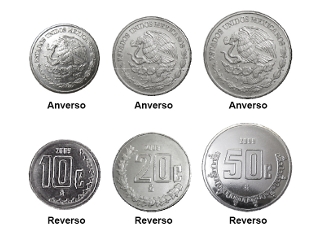 The current ten centavo costs more to produce than it’s worth and the Banco de Mexico actually did studies of what people pick up when they drop their change. People who drop ten centavos don’t much worry about it.
Although it’s already tiny (dismissed by gringos as “tiddlywinks”) the ten-centavo coin is being slightly reduced in size. The present twenty and fifty centavos will use the same design, and — unlike the present 12-sided brass-alloy coins, will be, like the ten centavo, made of stainless steel.
The biggest reason for the change in change? It takes less energy to produce steel than to produce brass alloy, and the cost and energy savings aren’t chump change.
The twice-dead Scotsman
(First in what I hope is something of a series)
In early February, 1914 a Scots rancher entered a house in Ciudad Juarez. His wife never saw him again. She suspected foul play and called on assistance not from the British Embassy, nor the local police, but the United States consul in Juarez, who could not do much more than ask the house’s occupant, one Mr. Francisco Villa, if he had any ideas.
Villa did, but wasn’t particularly forthcoming, which led to wild allegations in the U.S. and British press: much as the disappearance of foreigners in Mexico still does today.
Mr. Villa, a rather busy gent with business all over the State of Chihuahua took the time to respond to his critic in the press. He explained the situation in a Letter to the Editor of the New York Times, published 21 February 1914:
Chihuahua, Mexico. A court-martial sentenced Benton to death with complete justification, due to his crimes in having made an attempt on my life, as I am able to prove.
FRANCISCO VILLA, General in Chief
What had annoyed Pancho was not that Benton had been executed, but that his gringo friends were speculating that he killed Benton over something so mundane as robbery. Benton had gone to Villa to complain about his cattle’s “liberation”, and Villa — always careful to maintain good relations with foreigners and respect foreigner’s property rights — made Benton an offer he shouldn’t have refused. Villa would expropriate Benton’s ranch, and pay the fair price for the land, cattle and buildings. And in return, Benton (who wasn’t particularly well liked in Chihuahua) would leave Mexico. Sounded reasonable… to Pancho Villa anyway.
Benton — rather foolishly — pulled a pistol on Pancho. Villa was probably more annoyed that some Scotsman had got the drop on him than anything, but not wishing to create a scene (he had guests — specifically the widow and children of one of his soldiers for whom he was arranging a pension — and executions during dinner are bad manners), asked Rudolfo Fierro to take care of the situation. Fierro hustled Benton out the back way, put him on a train headed south, held a court martial and — formalities over — stopped the train near Samalayuca. Soldiers dug a hole and then Fierro — being less loathe to execute prisoners than many, and never one to shirk the dirty work — decided it was a waste of bullets to shoot a minor irritant like Benton. He bashed the Scotsman over the head with a shovel, tossed him in the hole and that should have been that.
The Scots corpse could have stunk up the Revolution. Venustiano Carranza, Chief of Constitutionalist Forces and Villa’s nominal political and military superior, was particularly annoyed that the U.S. consul had not followed protocol going to Villa, and not gone through proper channels. It wasn’t something to be taken lightly. Carranza had rebelled, not for the sake of change, but to restore what he saw as constitutional government, overthrown by Huerta’s coup * .
Secondly, the British government still recognized the Huerta government, an untenable position to Carranza. He made it very clear – in an interview with John Reed set up by Isadoro Favela, that the United States consul in Juarez had no jurisdiction over Mexican-British relations, and by recognizing the illegitimate government, no standing with him:
… England, the bully of the world, finds herself unable to deal with us unless she humiliates herself by sending a representative to the Constitutionalists; so, she tries to use the United States as a cat’s paw. More shame to the United States…!
While Carranza also had in the back of his mind the need to remind everyone (including Pancho Villa) that Villa was subordinate to the Constitutionalist government, Villa had his own ambitions and agenda. He sought U.S. support, and was less a stickler about protocol and official recognition. Enter Benton again.
To rebuild the trust with his U.S. backers, Villa offered to turn over Benton’s corpse to the media for examination. Which created a problem – two problems.
First off, they had to find Benton, and hope he hadn’t been dug up by coyotes. Which he wasn’t, but Villa had been under the impression that Benton was shot, and had already said there had been a firing squad. I don’t think he fibbed, but Fierro may have. No matter, no one makes a liar out of Francisco Villa.
Benton’s corpse was dug up and in good enough condition to be tied to a post and shot a couple of times. Villa’s staff pathologist warned the General that even in pre-CSI days, it was obvious when somebody had been shot after they were dead. Villa was a smart guy, just not a well-educated one. The concept didn’t quite sink in, as he told the pathologist, “OK, then make it look like he was alive when he was shot… even if there’s a second autopsy.”
There never was an independent autopsy. Carranza finally just told the British, Villa and the U.S. media to stuff it (their whining, not the corpse). The U.S. newspapers had no right to Benton’s body anyway. Carranza won, in a way. Foreign recognition was years away, but governments learned that independent operators weren’t welcome in Mexico, and one had to go through official channels. Favala, the young diplomat who helped John Reed get his interview would make a name for himself in the 1930s and 40s in setting the standards for the proper behavior of foreign governments, and the rights of diplomats, during wartime. And – if you wonder why outside “free agents” like “Dog the Bounty Hunter” or Canadian attorneys who barge into routine accident investigations and throw accusations of foul play and demand their own autopsies when one of their citizens does something fatally stupid like get hit by a car or fall off a balcony… now you know…. If you’ve got a problem with it, take it up with Mr. Benton, wherever he is now.
* A with the Honduran coup of 28 June 2009, Huerta’s February 1913 coup was within the letter of the law. With the resignation of President Madero and Vice-President Pino Suarez, as well as the third in line for the Presidency, the Attorney General (all at military insistence), #4 backup, Foreign Minister Pedro Lascuráin, was sworn in as President, appointed Huerta acting Interior Minister (#5 on the lineup) and then resigned himself. The governments of the United States and Great Britain both claimed Huerta was “constitutionally” President, but – like the “constitutionally” selected Roberto Micheletti in Honduras — nobody bought the convoluted explanation. Forcing a president out at gunpoint is a coup.
A Dios le pido… tambien Hillary Clinton
Erwin, at The Latin Americanist, posts:
Colombian pop-rocker Juanes is not shy from organizing concerts for peace; he was one of the main minds behind the March 2008 “Peace Without Borders” gig along the Colombia-Venezuela boundary. Yet it appears that Juanes is planning a second set of the “Peace Without Borders” series next month in Cuba.
Actually, the Havana concert will be the third planned “Peace Without Borders” concert. Although Juanes is known to favor the right-wing in his own country’s politics (or at least has given support to Alvaro Uribe), he he refused to be a party to political manipulation by the “de facto government” of Honduras and pulled the plug on a 26 July Tegucigalpa “Peace Without Borders” event.
With some of the biggest names in Latin American music being U.S. residents or citizens, and travel between the United States and Cuba being highly restricted, a concert like this involves “international negotiations” at the highest levels. The Juanes- Hillary Clinton summit was held at an undisclosed location.
Honduran connections

Photo: Notimex
Honduran president Mel Zelaya was received yesterday in Mexico City, which scrupulously followed the protocol for receiving a head of state. The conservative Calderon administration has no problem referring to the Micheletti government in Tegacigalpa as “illegitimate”, though the United States STILL does not call a “coup” a coup (neither apparently, do the Canadians)
The reasons why might be found in Machetera’s excellent two-part article on the pernicious influence of former U.S. Ambassador to Honduras Otto Reich. Journalist Michael Fox, in Counterpunch, offers some insight into what lies behind the U.S. “ambivalence” towards what should be a cut and dried matter:
While the perpetrators of the biggest threat to regional democracy in years were allowed to keep their US visas, bank accounts and even lobby on behalf of a former Clinton lawyer in Washington, the democratically elected leader of Honduras was warned that he should be patient, and that his actions could lead to violence.
Why such leniency towards the de facto coup plotters? Would the Taliban be allowed to hire a Clinton Lobbyist? Would Guantanamo detainees be permitted to lobby in Washington? Would suspected terrorists be allowed the freedom that Washington had allotted Micheletti and his cohorts?
Of course [Former Hillary Clinton campaign organizer Lanny] Davis is not paid directly by the Micheletti government. He’s working for the Honduran chapter of the Latin American Chamber of Commerce (CEAL).
“My main contacts are Camilo Atala and Jorge Canahuati. I’m proud to represent businessmen who are committed to the rule of law,” Davis told Roberto Lovato of the American Prospect a week ago. Both Atala and Canahuati represent vested business interests in Honduras.
Atala is CEO of Banco Ficohsa, “the third-largest bank in terms of loan portfolio and deposits” in Honduras. Canahuati is the majority owner of two of Honduras’ largest newspapers, La Prensa and El Heraldo, both of which have supported the coup. He also happens to be on the Executive Committee of the Inter-American Press Association (IAPA), and head of the IAPA’s International Affairs Committee. The IAPA is an organization of newspaper tycoons, owners, publishers and editors, who among other things immediately recognized both the 2002 Venezuelan coup and the Honduran coup.
Of course, the kind of people who can pay Lannie Davis to talk to Hillary Clinton are not the same kind of people who talk to Albor Ruiz, of the New York Daily News:
Honduras, one of the poorest countries in Latin America, is a nation where eight wealthy families control politics, business and the media.
“The only thing we want is to live in a country that respects everybody’s will, not only the will of the rich,” Wendy Cruz, who was with Vallejo Soriano when he was shot, wrote in a harrowing e-mail.
“The military were beating everybody and more than 80 people were arrested and taken to ‘la Cuarta’ police precinct,” Cruz added. “There are many people wounded.”
So much for Micheletti’s sanctimonious claims that there is no violence in Honduras.
It might, in the short run, be to the advantage of those eight families (and their patrons in Washington) to let this coup stand, with the legitimate government having already agreed to considerable (and, in my opinion, humiliating) concessions to the golpistas, foot-dragging by the United States will ultimately create more problems than it solves. As Zelaya pointed out to Jens Glüsing of Der Speigel:
[A negotiated settlement] will only work if the international community increases its pressure on the coup leaders. It has to make sure that coups don’t become an epidemic. That would jeopardize security and stability on the entire continent. If coups, revolutions and uprisings were to spread throughout Latin America once again, the United States and Europe would also pay a high price.
As did the Hondurans before the coup and do as a result of it. Where only three percent of Mexicans depend directly on remittances from the United States,about twenty percent of Hondurans do. That is besides the heavy investments in Honduran infrastructure, “maquiadora” plants and military presence. What do the Hondurans want?
Hermano Juancito, the church worker from Iowa (who I blackmailed into updating regularly*), sent me a link to this from Catholic News Service:
Bishop Luis Santos Villeda of Santa Rosa de Copan also said the country needs a dialogue between the elite and Honduras’ poor and working-class citizens. “Some say Manuel Zelaya threatened democracy by proposing a constitutional assembly. But the poor of Honduras know that Zelaya raised the minimum salary. That’s what they understand. They know he defended the poor by sharing money with mayors and small towns. That’s why they are out in the streets closing highways and protesting (to demand Zelaya’s return),” the bishop told Catholic News Service.
In a July 30 telephone interview, he said it is misleading to consider Honduras a democracy, either before or after the June 28 coup. “There has never been a real democracy in Honduras. All we have is an electoral system where the people get to choose candidates imposed from above. The people don’t really have representation, whether in the Congress or the Supreme Court, which are all chosen by the rich. We’re the most corrupt country in Central America, and we can’t talk about real democracy because the people don’t participate in the decisions,” he said.
Juancito, on his own website, writes:
There are many very capable people , very committed Christians, many who want the best for their villages and their country. But the poverty, the system, the corruption, the polarized politics make it very hard for them. Yet they persist. The persistence of the poor is a virtue that needs to be recognized and respected for what it is – a sign of hope that must not be frustrated.
* I remember very well what has happened to church workers in Central America who did their job — comforting the afflicted and afflicting the comfortable — when right-wing thugs have felt threatened. I “suggested” he post every day, so I didn’t feel compelled to bombard the United States Embassy with telephone calls and e-mails. Not that I trust the U.S. Embassy to do the right thing.
Even if you build it, they will come
Carlos Guerra, at the San Antonio Express-News cites a 15 page academic paper “Reforming the Management of Migration Flows from Latin America to the United States,” by Wayne C. Cornelius, and published by the Brookings Institute –comparing illicit border crossings before and after the Great Wall of bullshit went up. It comes to the not so startling conclusion that:
… the eventual success rate is virtually the same for migrants whose most recent crossing occurred before 1995, when the border was largely unfortified, and those crossing in the most recent period. In other words, the border enforcement build-up seems to have made no appreciable difference in terms of migrants’ ability to enter the United States clandestinely.
The late Ann Richards (Texas’ last smart governor) is usually credited with being the first to say the same thing in more succinct language:
“If you build a 50-foot fence, I’ll show you a 51-foot ladder”.
If immigration is a social problem, relying on physical controls is not going to resolve it. Sort of like the narcotics trade that way: something I’ve written on extensively, and will be posting more about later today or tomorrow.


 mexfiles.net