Make work, not war
Lázaro Cárdenas used to be a sleepy city before it became the international cargo hub it is today. Ships coming from Pacific Rim nations as well as South America unload their containers by the thousands every day, and the port authorities pride themselves on a seamless operation which moves containers through customs and out of the facility in less than 36 hours.
In the past few years, however, this expediency and volume of trade did not go unnoticed by drug traffickers who have made the port a haven for themselves.
Unfortunately, the growth of the port, the existence of a steel mill and other industries have proven insufficient to create jobs needed by up-and-coming generations.
It is locally known, however, that drug traffickers are offering young men and women wages starting at 10,000 pesos a month. In addition, they offer them perks such as 100,000 pesos in life insurance, transportation, etc. And the young are flocking to the traffickers ranks.
On the other hand, the federal government is at war with the gangs of traffickers who control the area. Now caravans of federal cops roam the streets of the city, instilling fear in the civilian population.
As Samuel, a worker at the steel mill says, “you don’t fight narcotics traffickers with violence, when what is needed are jobs“.
And what is sensed in Lázaro Cárdenas is that as long as the federal government does not produce the conditions for companies to create jobs, their war on drug traffickers will be futile.
One factor I have yet to see anyone write on (including myself, since I don’t know enough about it) is the effect of increased U.S. trade with China in the growth of “la Familia Michoacana” and other criminal gangs. The Mexican meth trade (as was discovered when Ye Gon was arrested) depends on Chinese (and to a lesser extent, Mongolian) imports of pseudoephinidrine. With the U.S. appetite for Chinese manufactured goods overwhelming west coast ports, Lazaro Cardenas was expanded to handle — not Mexican trade — but U.S. trade.
One way to cut the meth trade would be to go back to the spirit of NAFTA and buy Mexican textiles, agricultural products, steel and automobiles, as opposed to importing them from China. Especially from unionized workers who can buy life insurance (and, think of the opportunities for U.S. insurance companies that are afraid they’ll lose business when the U.S. finally joins the rest of the world and offers universal health coverage).
That would suck for dockworkers in Lazaro Cardenas, of course, and probably unleash a whole new set of unintended consequences, but anyone have a better idea?
Coup-coup
With the “government in exile” camped on the Nicaraguan side of the Honduran border, and rightly complaining that the U.S. Secretary of State is acquiescing in the coup, the “de facto government” is getting downright testy… putting the entire country under a state of siege (basically doing away with all civil rights).
The so-called negotiations, which I’ve always suspected were more to buy time for the coup than to really resolve any consitutional issues, are going off into the realm of the surreal, with everyone seeming to go off script. A few minor Republican congressmen (misidentified in the Honduran press as Senators) meeting with the de facto government and — in what may actually prove more important — military officers have been meeting with unnamed U.S. “congressional aides” (whatever that means) and have issued a “communiqué… drafted in Washington after days of talks … Posted on the Honduran Armed Forces Web site, it endorsed the so-called San José Accord that was forged in Costa Rica by delegates representing President Zelaya and the man who heads the de facto Honduran government, Roberto Micheletti.”
Although there is no reason to trust General Romero Vasquez Velasquez, he is quoted in this morning’s El Pais (Spain) as saying the armed forces will not fire on civilians on the border.
Although that may mean the end of the coup, it’s not a good sign. Although its packaged as meaning the military would prefer a civilian solution to the political crisis, it also means the military — specifically General Vasquez — is taking on an extra-constitutional role as arbiter of what is, and what is not, acceptable political life in the country. If you’ll remember, the rational for the coup in the first place had less to do with the dubious constitutionality of a referendum (or opinion poll, or whatever it’s being called today) than with civilian control over the military chain of command. Honduras has an unusual legal system, with the commander of the armed forces appointed by Congress, but answerable to the President. When Zelaya sacked General Vasquez, the Congress demanded his reinstallation. Vasquez then quit, then hustled the president out of the country, and post facto was restored as head of the armed forces.
Meanwhile, Zelaya says he’ll cross back into Honduras again … third time’s a charm?
5-0

Coach Javier Aguirre’s team won a memorable victory in front of a largely pro-Mexico crowd of 79,156 at Giants Stadium on Sunday afternoon, trouncing the defending champion United States, 5-0, to win the CONCACAF Gold Cup for a record fifth time.
Mummy dearist

Meet “Oqui Ópata”, who doesn’t look all that bad after spending the last 400 or so years holed up in a cave in the Sierra Madres Occidentales.
Ms. Ópata was probably a curandara, a natural healer, and among the last of her people, who disappeared as an identifiable ethnic group soon after the Conquest. She was buried, together with the cremated remains of a baby, in a cave in Bavispe, Sonora, in what had been from about AD 700 to AD 1200 the ceremonial and cultural center of her people. That she was buried in the cave suggests she was a highly regarded figure in a culture near the end of its existence.
Besides the textiles and ceremonial ceramics which show the survival of her culture long after it was thought to have disappeared, “Ópata Woman” (“Oqui” is the Ópata word for “woman”) the mummy is in good enough condition to allow for DNA testing. The Ópata’s complete disappearance was due more to mestiaje (intermarriage) than genocide or disease, and DNA results may provide an answer to what happened to this particular strand in the Mexican cultural fabric.
Bored patrol?
I was kind of taken aback that some saw yesterday’s post on the murder of a Border Patrol agent Robert Rosas was taken as an attack on the Border Patrol (or its agents). I noted some contradictions in Mexican news reports, and that this was an unusual event — the last time Border Patrol agents where shot at the border was over a decade ago.
I also questioned — as I always do — whether the very quick arrest of suspects meant the crime was solved. In Mexico, it’s all too common for high profile crimes to lead to immediate arrests… of people who turn out not to have anything to do with the crime in question. And, for U.S. writers, to assume all border incidents are caused by drug smugglers (which leads to the question of whether they’re not caused by drug users, but that’s another story). As it is, the “usual suspects” rounded up in this case are “people smugglers.
What I noticed when I was writing my post was how many agents who died on duty were killed working on their own — it’s dangerous to be out in the desert at night and falling off cliffs is a very real hazard. And from my time in rural west Texas, I’m well aware of the problem the Border Patrol has in being expected to function as a local constabulary on top of enforcing national policies that aren’t always realistic.
Among those national policies is the quasi-militarization of the borders, which requires a paramilitary police force in the first place. And — absent a well-defined military objective, that leads to a completely different set of problems.
From the Wayne County (New York) Star, comes this bizarre story of Immigration and Customs Enforcement (ICE) agents with wayyyy too much time n their hands… and wayyyy too little common sense.
RED CREEK – The U.S. Attorney’s Office and the Department of Homeland Security, at the request of Wayne County District Attorney Richard Healy, are investigating posts on the Wayne County Star’s website that purport to have been made from U.S. Border Patrol/Homeland Security computers. There were three posts showing different Border Patrol/Homeland Security Internet Protocol addresses in response to a story on the Star’s website about a June 12 Border Patrol detention of Mexican nationals on Lake Ontario.
One post pretended to be from a woman with a Mexican boyfriend; the other two posts insinuated the boat had come from Cuba, berated farmers, accused them of breaking the law and praised the Border Patrol for doing a good job.
The posts, which were made anonymously on June 20 and 21, identified themselves on the public part of the website with fake Internet addresses: Imaapplehog2@yahoo.com, poorbabies@hotmail.com and hahaha@hotmail.com. The Star discovered they all had Internet protocol addresses that showed as originating from cbp.dhs.gov. Dhs.gov is the homepage of the U.S. Department of Homeland Security.
…
Divorce, Mexican style
Elisabeth Malkin visits Mexico City’s divorce court, where — other than the power drill — it sounds like any divorce court anywhere:
… Under the old law, a divorce could drag on for years, but the judge would grant the divorce and determine the custody arrangements, the amount of child support, the alimony and the division of property all at the same time.
Now, divorced couples battle over those issues through repeated legal motions, so the stacks of documents and morass of delays have not gone away.
The article, focusing on the problems a new “no fault divorce” law is having on the legal process is very good, but The News York Times — as it usually does — makes assumptions about Mexican culture that just aren’t true and which harm the article.
One serious error in Malkin’s article suggests legal divorce was rare or new in Mexico. President Venustiano Carranza signed the law legalizing divorce on Christmas Day 1917*… giving Mexico, at the time, the most liberal divorce laws in the world. Even up into the late 1960s, given the choice of sitting in the Nevada desert, or laying on the beach in Acapulco, the rich, famous and unhappily married opted for a quicky Mexican divorce.
Divorce — in itself — has never been seen as particularly onerous or shameful to most people. And, since a lot of people never bother to register their unions in the first place, a lot of divorces are from those who only register a marriage when they need a divorce to divide joint property.
Malkin’s figures for the rising divorce rate are correct, but misleading. The Mexican census calculates divorces per 100 marriages, which creates what looks like an alarming rise in the divorce rate from 7.4 per 100 marriages to 13 per 100 since 2000. Very few countries (mostly in western Europe) use these parameters. Of the twenty listed in “Nation Master” , Mexico’s divorce rate is the lowest on that list comes in 20th, about half that of the next lowest figure (Greece) and almost a third that of third from the bottom, Poland.
Normally, divorce rates are usually calculated by the number of divorced people in every 1000. By those statistics, the United States leads the pack (at 4.95 per thousand), followed by Puerto Rico and Russia. Mexico comes in 31st place at a measly 0.33 per thousand.
The big problem I have (and whether it’s Malkin’s assumptions, or those of her editors, I can’t say), comes with the assumption that any social change in Mexico somehow reflects its being a “Catholic” country. Mexico is no more “Catholic” than France or the Czech Republic. And France while also known for its intellectual anti-clerical tradition, didn’t separate the Church and State until 1905, something Mexico did in 1854.
Besides, Catholicism doesn’t seem to have much to do with a low divorce rate. Panama, Portugal, El Salvador, Ecuador and even Chile (where divorce has only been legal for a couple of years) — all “Catholic” countries — have higer divorce rates than Mexico.
* Perhaps the Times’ copy editors might be able to get shareholder Carlos Slim to spring for a book that includes this kind of useful information.
Border Patrolman killed… more questions than answers
[Updated in boldface]
From Maggie’s Madness:
All Mexican agencies are reporting that a USBP Immigration officer was shot and killed last night in the Tecate area. The reports differ however on exactly where and when this took place. AFN is stating that the killing occured by the substation at 9:15 last night, so that would put it in Campo. Frontera is not reporting an exact location. El Mex, however is clearly stating that the shooting took place shortly before midnight last night on the Mexican side in the vicinity of Roca Magisterial and Ejido Jardines del Rincon. AFN is also stating that the officer was beaten first, then shot in the head.
The obvious question is what was a U.S. Border Patrol Agent doing on the Mexican side (assuming he was on duty). [In the comments, Maggie updates this information. The San Diego Union-Tribune says the shooting occurred on the U.S. side, which makes more sense]. There seems to be a round-up of the usual suspects (and the usual assumption that this involved narcotics smugglers), but another confusing detail is the report (in the same paragraph) that the supposed killer was using a weapon only issued to Mexican military, but was a Border Patrol gun. Both cannot be true [It sounds as is the police arrested the guy for “having a weapon reserved for military use” which holds true for just about any firearm, and doesn’t mean a Mexican military issue weapon] .
At the same time, there are conflicting reports on the number of suspects, and — with the U.S. Border Patrol offering a monetary reward, it sounds as if no one believes the real suspects have been identified.
[The Los Angeles Times, and other media are reporting a person in San Jose, California — a very long way from the border — was detained in connection with the slaying. The last time border patrol agents were killed (as opposed for dying in accidents or exertion) was in 1998 when two agents were shot near El Paso].
Upside down world, Central American edition
During the ’80s, Honduras was used by the US, particularly the CIA and its Contra puppets, as a staging base for anti-Nicaragua, anti-Sandinista military attacks. Now, Nicaragua is turning things around–helping its Honduran neighbors get their democracy back from a bunch of US-backed putschists.
News of the Restless has coverage from Venezuelan-based Telesur of the Return of Zelaya… which featured the President doing exactly what he said he was going to do — momentarily re-entering his own country — and the coup plotters not doing what they say they’re going to do — arrest the guy.
De facto President Micheletti told Notimex (the Mexican state news agency) that Zelaya was not arrested to avoid an international incident. As if hustling him onto an airplane and flying him to another country wasn’t an “international incident” in itself… and as if — were there legitimate criminal charges (and not just political ones) Honduras couldn’t follow international law and request an Interpol warrant.
La Gringa Blogicita (the gardening site that is covering this from Honduran state controlled sources) tries to make a big deal out of the fairly small crowds that greeted Zelaya’s temporary return. She, of course, fails to mention a noon to dusk curfew along the border — and discounts reports of shots fired (by police — who are said to be on strike — or military is unclear) reported by legitimate news sources (mine being the Times of London — hardly a bastion of leftism).
Everyone, except Al Giordino at Narco News missed the possibly symbolic point of Zelaya’s decicison to cross the border on Friday, instead of Saturday as originally announced. Friday was Simon Bolivar’s 226th birthday. Giordino also makes the observation that Zelaya and Micheletti are sideshows… the real action, and real drama is elsewhere.
Like in Copan, where Hemano Juancito — who I’m happy to report has been able to spend the day on normal parochial business — heard an intriguing suggestion for ending the situation:
What is interesting is how the US Secretary of State Hillary Clinton is reacting to all this. Today she had said, “President Zelaya’s effort to reach the border is reckless.”
I don’t know if it is reckless or not. But it reminded me that some actions of people like Martin Luther King were called “unwise and untimely.” I do not want to compare Zelaya and King. King was an advocate of nonviolence; he had a strong strategic sense; he was not corrupt; he was not a politician seeking power. But I think we should be wary of political calls for “prudence” which may be based more in realpolitik than in discerning what is just and good.
My continuing question: Where will this go from here?
I don’t know.
But I heard an interesting suggestion from a campesino this afternoon. Both deposed president Zelaya and de facto president Micheletti should be replaced by a person who is poor to serve as a real interim president.
That will be the day!
Legendary Mexican political boss Carlos Hank González once famously remarked “A politician who is poor is a poor politician”, but maybe Juancito’s friend is on to something. An poor man would — one presumes — not be a politician, and maybe that’s what Honduras (and the rest of us) need to turn the world right-side up again.
Not that bad
This chart, courtesy of the smart money guys (i.e., Inca Kola News) shows that while the rest of the world is in deep do-do (as the first President Bush was wont to say), the economic prospects for Mexico aren’t all that bad.
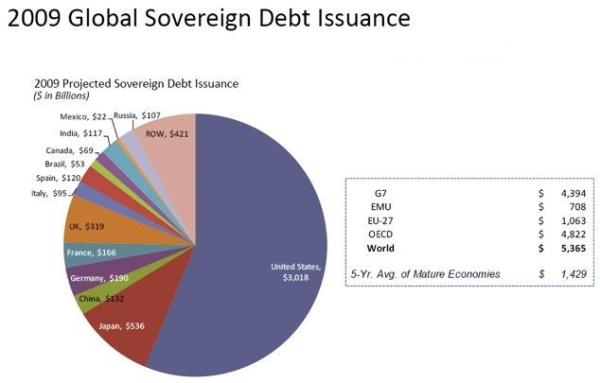
With the economic downturn, every country expects to go into debtnext year, but Mexico’s projected borrowing — a measly 22 billion U.S. dollars — is extremely modest for a major economic power (and — as we tend to forget — Mexico is the world’s 10th largest economy).
One thing PAN had going for it was that the country had almost no debt (in fact, the United States was indebted to Mexico, which is unusual), but — between the Wall Street crash, the lousy tourist season, the flu and increased military spending — and falling PEMEX revenues, sooner or later the country was going to have to borrow.
PAN won’t be controlling the national agenda with a new legislature, and even this minor amount of debt may not be necessary. PEMEX — having more money to plow back into exploration — is spending money on refinery upgrades. Additionally, as Oil Online reports, “Although Pemex is behind on its investment targets, the company has spent heavily on oil exploration and production this year.” Specifically, PEMEX has announced contracts for 500 new wells. That may not make sense if oil prices are dropping, but it will mean more domestic fuel sourcs (and less need to import refined gasoline) as well as more jobs… all of which will lessen the need for borrowed funding.
Also, one of the Calderon Administration’s few successes was changing the tax code to lessen dependence on PEMEX revenue for governmental operating expenses. The tax code has largely made up for the lost revenue, but the Administration — caught short by the financial downturn — is looking to cut spending. However, the Calderon Administration now a “lame duck presidency”, there is likely to be resistence to cuts in social spending.
Which, in itself, may not also cut into the need for foreign borrowing. The new legislature is likely to cut military spending, which unlike social programs, depends on foreign purchases. Social programs depend on internal resources (and create jobs, as well as increase the purchasing power of Mexican consumers), while military expenditures depend heavily on foreign purchases (Mexico produces some guns, trucks and uniforms — and even exports them — but the big ticket items like planes, tanks, and so on are purchased from abroad). Domestic programs might create some internal debt, but not a balance of trade problem.
Alabama-riachi!
Uploaded by “bamachick1101” from Acapulco Mexican Restaurant in Birmingham, Alabama
As the coup turns
Padre Fausto, whom I’ve written on before, runs a training center for health workers in San Juan de Opoa, Copán. Hard to say that it’s unconnected to the Padre’s outspoken criticism of the coup that the center was searched by police yesterday “looking for weapons.” No one, so far, is reported hurt or arrested, but the clinic is “under surveillence and being investigated.” For what… helping people resist diseases?
Earlier today (er, Thursday), CIPOL (“Plan Colombia and Beyond”) wrote “A general strike has closed schools and hospitals and blocked roads. President Zelaya is talking about crossing the border from Nicaragua as early as today.”
The Micheletti regime has definitely broken off all hopes of a negotiated settlement. I never thought the Micheletti gang saw the Costa Rican talks as anything more than a means to buy time to consolidate their position.
With even The Economist — and one can’t get more mainstream conservative that that — weighing in on the stupidity and futility of allowing the farcical “de facto regime” to stay — the Micheletti gang is more and more isolated. When the regime claimed support by one key regional leader (Alvaro Uribe, the Colombian President who sucessfully changed, possibly by fraud, his nation’ s constitution to allow him a second term, and is now pushing for infinite re-election) the is, in fact, no foreign support for Micheletti outside the far right, mostly among Latin exile circles in the United States and well-heeled expats within Honduras.
With President Zelaya expected to return to Honduras today or tomorrow,what happens next is anyone’s guess.
Honduras … Left behind?
I’ve speculated before on the role Christian Dominionists play in the Honduran (and Central American in general) reactionary politics. “The Family” or Washington “C Street” group — led by Dominionist pastor Doug Coe — has ties to reactionary figures in Central America, but BoRev.net hit on the first solid evidence of a tie between Dominionists and the Honduran coup leadership that I’ve seen.
Among the goals of Christian Dominionist theology is a state in which:
All religious organizations, congregations etc. other than strictly Fundamentalist Christianity would be suppressed. Nonconforming Evangelical, main line and liberal Christian religious institutions would no longer be allowed to hold services, organize, proselytize, etc. Society would revert to the laws and punishments of the Hebrew Scriptures. Any person who advocated or practiced other religious beliefs outside of their home would be tried for idolatry and executed. Blasphemy, adultery and homosexual behavior would be criminalized; those found guilty would also be executed.
BoRev.net found an on-line ad for “The Kingdom Government” conference in Miami, featuring General Romero Vasquez Valesquez (whose firing was the excuse for the military rousting of President Zelaya and “constitutional” replacement of the sitting president in Honduras) speaking at a workshop this Saturday. Leading to the question of how the General received a visa to enter the United States, and what the General’s connection is with “Prophet” Jaime Chavez.
I found a short clip of the “Profeta”, speaking about the Kingdom of God in Central America, and — in the accompaning explanatory text on the “youtube” posting — learning that the General was also at another “Kingdom Government” conference (this one in Paris) in 2008.
I keep wanting to spell “Prophet” as “Profit”… and maybe for good reason. Setting up the Kingdom Government costs money. Profeta Chavez’ group… MIGA Partners seeks “partners” willing to pony up a thousand to five thousand U.S. Dollars in return for which Profeta Chavez will bless your region, nation or economic zone… or something like that.
Outside the Kingdom are the Garifuna, the afro-indigenous people of Honduras. If you’ll remember, the “rationale” still being used to justify the coup was to prevent a referendum on a constitutional convention that might (not would) lead to a new consitution, that would probably have incorporated new trends in Latin American political theory that don’t bode well for the old power elite … who apparently, being already blessed on this earth, are the logical heirs to the Kingdom.
The Garifuna, according to the Miami Herald, are opposed to the coup.
Although removing term limits (something adopted from the Mexican Consitutiton) has been the most talked about possible change a proposed new Honduran Constitution would have made, the changes proposed seemed to reflect the same trends seen in other recent Latin American constitutions.
The single presidential term came from the 1917 Mexican Constitution, which was the model for most Latin American consitutions. In Mexico, where the Madero Revolution of 1910 (which started off the wider social revolution) originally was a reaction against Porfirio Diaz’ continual re-elections to the Presidency, it has been criticized both on the right (as in Mario Vargas Llosa’s critique of the Mexican political system as a “perfect dictatorship”) and left. Rightist countries like Colombia, as well as left-wing governments like Venezuela have recently changed their constitutions to allow for re-election.
Mexico added an indigenous rights clause to its constitution in 1994, which is controversial in some respects, but the concept of enshrining communal rights in a Constitution is well established in Latin American legal theory.
As is, proportional representation in the Legislature, as a means to opening representation to traditionally under-served groups. In Mexico, proportional representation has been used mostly to maintain political parties rather than communities, but in theory opened the legislature to any group that could at least obtain a small number of votes. A few parties have tried (and have managed to obtain a voice in the Chamber) by openly appealing to under-served minorities. The parties themselves generally have internal rules regarding “affirmative action” for legistlative seats (requiring a percentage of candidates to be indigenous or female), but the concept — setting proportional seats for under-represented groups like minority language or ethnic groups — is also fairly well established in Latin American political thinking. Bolivia and Ecuador both have new constitutions that seek to open the system to under-represented groups.
But, then a Kingdom Government is not a democracy.


 mexfiles.net