The first coup in the Americas
Geeze, I missed it (and so did Otto, at Inca Kola, who usually is up on these things). From Daniel Schmidt’s “To The Roots” is a short piece on the first American coup, like those that have followed, having more to do with maintaining the economic status quo, and only incidentally (and after the fact) justified as a need to prevent a dictatorship.
[26 June] in 1541 (478 years ago) Francisco Pizarro, conqueror of the Inkas, founder of Lima, first governor of Peru, was hacked to death in his palace in the capital city. Of course, the killing was factional – the elimination of the
Pizarro brothers for the ascension of Diego Almagro II. The killing was also politically motivated. Almargo II was the son of Diego de Almargo, founder of Chile and companion and later rival of Pizarro, who would be sentenced to death in 1538 by decapitation, carried out under orders of the Pizarro brothers. Almargo II sought revenge (he would be captured within a year and assassinated as well after the Battle of Chupas) and threw Peru into a lengthy civil war. The Spanish fought back the threats against its interests in Peru, which made it the richest nation on earth at the time, and interred the country for another three centuries.
The Mexican connection: Pizzarro and Hernán Cortés (full surname: Cortés de Monroy y Pizarro) were first cousins. Cortés was better educated (he’d studied law at the University of Salamanca) and — when he faced a coup in 1523 (while in HONDURAS!) — knew enough law to justify retribution against the assumed plotters, though it forced the Crown to reorganize the government in New Spain. In turn, this set the stage for Mexico’s broader class of elites than that in Peru, where a small class of European-descended elites still have a stranglehold on the economic and political power.
By the way, “To The Roots” is a very good U.S. based (Old Dominion University) general Pan-American blog covering both recent news and history throughout the hemisphere (written from the left hemisphere, I s’ponse). Recent posts, besides news events on historic events from Canada (there was a recent piece on John Cabot) to the Southern Cone (another on the suspension of democracy in Uruguay in 1973) .
The biggest loser… PAN
Via Ana Maria Salazar (Mexico Today) is a Bloomberg report written by Thomas Black and Jens Erik Gould, on expected results for the 5 July mid-term elections.
Mexican President Felipe Calderon’s National Action Party may lose its position as the biggest political group in the lower house of Congress in July 5 elections after the economy shrank the most since 1995.
The economy is the most important issue for 40 percent of Mexicans, according to a Consulta Mitofsky poll, up from 17 percent when Calderon took office in 2006. That’s bad news for Calderon amid record unemployment and predictions by Goldman Sachs Group Inc. that the economy will shrink the most since 1932 this year, said Jesus Cantu, a public administration professor at the Monterrey Technological Institute in Monterrey
….
Job losses are eroding support for Calderon’s party, even in states it governs such as Aguascalientes, said Roy Campos, director of Consulta Mitofsky. Last year, a PRI candidate became mayor in the state’s capital city, also called Aguascalientes.
“The PAN won easily before. Now it won’t have it easy,” Campos said about this year’s elections in Aguascalientes. “A lack of economic growth always results in punishment for the incumbent.”
Salazar also links to El Universal’s “Bajo Reserva,” the collaboratively written (and unsigned)– and generally reliable — political gossip column, which has two items suggesting even further woes for the administration.
Party chair German Martinez was widely quoted as saying he wanted to Guanajuanto-ize the country (create a PAN majority… specifically a piety-wing majority), which is probably what a party chair would say (think of a Republican Party chair wanting a Texas type U.S. House — a scary thought, but not one that would raise eyebrows within the party). Unfortunately, German’s remarks came the same day Guanajuanto was in the news for another reason — a shootout between the Army and narcos left 12 dead. Within the party itself, which is expected to be in opposition, there is a three-way fight for congressional leader, only one of whom is a reliable supporter of the Presidenial agenda.
Bullshit never goes out of style at VDare.com
The notorious stoopid racist white supremacist website has outdone itself this time.
Some lying sack of shit named Ned Garver (you can send him an email here) wrote, and the bone-heads at VDare printed this:
I worked under a tourist visa for three months and could legally renew it for three more months. During that six- month period, our Mexican and American attorneys worked on my behalf to secure a permanent work visa granted to a person for a specific job called an FM2 or FM 3 lucrativa—“Lucrativa” as in “making money.”
Foreign residents who work in Mexico are required to have them. They are to be carried at all times in addition to your U.S. passport.
To apply for the FM3 work permit I needed to submit the following notarized originals: my birth certificate for (as well as my wife’s), our marriage certificate, high school transcripts with proof of graduation, college transcripts for every university I attended as well as proof of graduation, two letters of recommendation from supervisors for whom I had worked at least two years, a letter from the St. Louis Chief of Police stating I had I had no arrest record or outstanding warrants in the US and was “a citizen in good standing,” Finally, I had to write a letter about myself that clearly stated why there was no Mexican citizen with my skills and why my skills are important to Mexico…
 … and so on. The mention of the “St Louis Chief of Police” rang a bell, and I knew I’d seen this exact same letter — word for word — before. YUPPER. It is a supposed e-mail by someone named Tom O’Malley who claims to have worked at the South West Bell Telephone Company office in Mexico City.
I worked with David Bodwell (who moved to Mexico in 1997) on deconstructing the original fake e-mail back in May 2006 (here’s the original on the old “Mexfiles.blogspot.com” site).
I had further adventures with the phony e-mail, including mention in a John Birch Society publication, as I hunted for the “original” Tom O’Malley (who I don’t think ever existed) letter. The closest I could get was this myspace page, posted by some guy in Houston named Brad… back in April 2006.
Proving, once again, as if proof were needed, that for all their vaunted superiority, white supremacists are awfully gullible. Probably they’re just culturally inferior… as in not havin’ no culture. Dumb fucks!
When progressives go bad
WTF???
Yes, coups are bad. Bad coup, BAD coup. Except in this case, where the president of Honduras was an ally of Hugo Chavez, and was trying to set himself up for an illegal second term, in violation of a court order and ruling by the country’s congress. The military refused to go along with the president’s plans to, in essence, have his own coup, so they staged their own.
What’s shocking isn’t that this quote came from some right-wing bonehead, or even someone who buys the neo-liberal agenda, but from the Democratic Party organizer and supposed foreign policy expert, John Aravosis on his supposedly progressive website, “AmericaBlog.com“.
It’s not surprising (as I commented on that site) that U.S. policy experts get Latin American political events so wrong (I’m not alone in posting on the factual errors in Aravosis’ post… which he based solely on the International Herald-Tribune.
When even the Latin American Herald-Tribune managed to get the facts straight, it’s pretty obvious that Aravosis, like other U.S. experts, just doesn’t look at data from Latin America. Geeze, he could have read the Latin American Herald-Tribune or Inca Kola News (hardly a lefty site, being a business publication), or any almost any newspaper in Latin America and saved himself from looking like a shill for the very people he supposedly opposes.
Or… maybe he should talk to AP Photographer Dario Lopez-Mill:
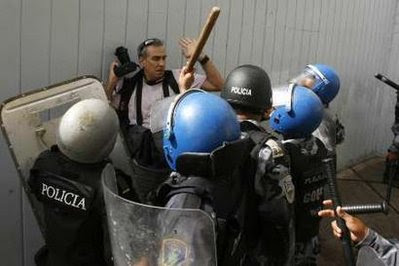
Perhaps John Aravosis might also check out the reports from several news agencies that police have fired on “hundreds” of demonstators in Tegucigalpa, and at “several dozen” persons are reportedly injured… and the demonstations in San Pedro Sula and Progresso (where at least two demonstators have been shot).
John might ask why a “good coup” has closed local radio and television stations, and has blocked CNN en Espanol and Telesur.
John might ask why every nation in the hemisphere has condemned this “good coup.”
John might ask why foreign diplomats were beaten by military forces of this “good coup.”
John might ask why even the conservative Mexican government has broken diplomatic relations with the Micheletti regime, and offered political asylum to Foreign Minister Patricia Rodes … and why she feels it necessary to flee her country.
John might ask himself why Latin American nations don’t believe the nonsense about a change in U.S. policy towards the region, when even “progressives” show nothing but contempt for democratic values, and the rule of law.
Thanks for nothin’… maybe we should just listen to our own, like Lula de Silva:
We can no longer accept in Latin America that some want to solve their problems of power through a coup because we cannot accept that some see solutions for their country without democracy or free and direct elections.
“Evolved into a coup”
Hillary Clinton, continuing to show her ignorance of Latin America, has a hard time understanding that using the military to overthrow an elected President is a “coup”… not something that “evolves into a coup” as she is quoted as saying this morning.
While those who supported the action — like foreign blogger “La Gringa” (in La Ceiba, Honduras) — hesitates to use the word (“All this international blustering about the “coup” in Honduras is really bothering me. I really regret using that word because after learning more about what happened, I would not call it that“) hesitated to use the dreaded word, at the same time they feel comfortable praising those (like Mary Anastasia O’Grady in the Wall Street Journal) who openly call the Honduran military strike against their constituionally mandated chief) a “coup.
[As an aside, the Honduran Constitution is somewhat unique in that it spells out the military chain of command. Much of the legal rationale for the coup comes from the bi-furcated command structure. The Commander-in-Chief is appointed by Congress. However, the C-i-C must obey Presidental orders. Zelaya had fired the C-i-C, whose reinstatement was ordered by the Supreme Court. The C-i-C then resigned. I’m no expert, but it would seem this means that the President was the ultimate commander for the armed forces and soldiers were following illegitimate orders.]
La Gringa also echoes Jack Nicholson in “Mars Attacks!” when — as the President of the United States — reacting to the Martians having vaporized the United States House of Representatives, he reassures the nation by saying, “We still have two out of three branches of government, and that ain’t bad.” Writing that this is not a coup because “the government of Honduras (at least two branches of it) have been and continue to be in charge.” is ridiculous. Sending the Army to arrest the legislature, or close down the courts is also a coup.
While I think “La Gringa” is correct in writing:
We don’t want or need international intervention from Venezuela, Nicaragua, the US, or anyone else. I feel a little resentful hearing the meddling comments from other countries. The US can’t and does not need to try to save every country in the world.
What I particularly resent living and writing on Latin American affairs is the way real events (and real deaths) are spun by foreign commentators not for the benefit of anyone “down here”, but as a way of pushing their own domestic agendas. This came clear to me after the 2006 Presidential elections here in Mexico when the U.S. “left” (or rather, the non-right) used it as a way of talking about Al Gore, and “gee, why didn’t we go to the streets (uh… maybe because in the U.S. people are afraid to take a stand that might seriously inconvenience them?) or by the right to talk about the dangers of economic upheaval (and the need to fight gun control laws!).
Latin American nations need to resolve their own problems, based on their own history and political culture. And, as I always do, I point out the wisdom of Benito Juarez in saying “among nations, as among neighbors, respect for the rights of others is the way of peace.” But that does not mean justifying our neighbor’s actions when they act like boneheads, or make excuses for criminality. And, in some ways, this is Mexico’s concern, given the county’s traditional role as an arbitrator in Central American affairs (Honduras was part of Mexico at one time), as a refuge for those fleeing persecution and as a national security concern — when there is violence in Central America, armed groups have crossed into Mexico territory on a number of occasions.
Anyway, there is universal condemnation (and even Hillary Clinton has “evolved” to the point of getting the point) for subverting the political process. Preserving the economic system — that gets more support — but, how deep that support is in Honduras is questionable.
As of this morning, protests (turning violent) had already begun in Tegucigalpa, but — as “La Gringa” and major news organizions are reporing, news within the country is being controlled, or blacked out.
With the news controlled in Honduras, there’s not much choice but to rely on alternative sources. But, there’s also some danger in relying on foreign bloggers (including me) for your news… or bloggers in general. As To The Roots says, vis-a-vis the Honduran and Iranian crisises:
Obviously there is no internet (or power) for the people of Honduras – a major problem for the fickle do-gooders in Western democracies. If one cannot see it, if one is not horrified – then it’s easy to look away. There will be no tweets from Honduras, no upper-class revolt. For Honduras, the upper-class, the oligarchical class, is against social movements and is, in fact, orchestrating and supporting the ideology of this coup. There is a surprising solidarity of classes protesting in Iran – it has way more wealth than Honduras – makes it easier for the West to support.
And, apparently, if the Army isn’t shooting people in front of the gardener from La Ceiba, there is no coup.
Color me skeptical
The proposal by the “usual suspects” on the U.S. right — including Steve Moore from the Wall Street Journal; James Carafano, Heritage Foundation; Matt Kibbe of Freedom Works; and Mario Lopez, Hispanic Leadership Fund — unveiled a “red card solution” to some immigration concerns in the United States which is not bad… in theory.
Benders Immigration Daily, which mentions the proposal, links to a press release, which in turn links to a not very informative piece on a site for employers in the temporary worker industry.
This is a neo-bracero program, and though I realize most of those in the immigrant rights movement reject out of hand a bracero type program — based on the abuses in what was meant to be an emergency program to free up labor in the United States during World War II for military needs, but was expanded and continued through the 1960s. Still, there are some merits to the idea.
It’s been the tightening of immigration rules that have, ironically, led to higher immigration. Before, when workers could reasonably expect to return home, workers were only in the United States long enough to save the money needed for some purpose at home, and would return to their families. Under the stricter rules, the workers are separated from their families, and need to arrange for the family’s subsequent migration. Not all these workers intend to, or want, to become U.S. citizens, nor are their families necesarily well-equiped to emigrate.
Employers, under the old non-rules, especially in border regions, often had informal agreements with workers… using traditonal family and village networks to meet their staffing needs (a pretentious way of saying a crew of orange pickers or constrution laborers, but let it pass). A community, or family, provided A worker, just not any particular individual to the employer with the understanding that there would be a worker for the job, and a job for someone in the community that contributed to the group’s welfare. When Jose did his time, came home and married, his younger brother, Juan worked until he had enough cash to go to college, when his cousin Julio would fill in for a season, then…
I haven’t seen the specifics of this “red card” plan (and the backers make me dubious that workers’ rights are upmost in their minds), but there’s no reason hiring can’t be orderly, done through Kelly Services or other agencies with a few provisos:
The employees have to receive a living wage. One problem now is that in low wage countries like Mexico, $8.00 an hour in the United States sounds like a lot of money… until the worker discovers what housing costs, and that he can’t work 60 hours a week, and… if he is injured or gets sick… the employer doesn’t pick up the costs (and the taxpayers start complaining about “illegal immigants” using public services).
Workers rights have to be protected. One question that I have (and the Red Card Solution folks gloss over is whether workers can leave their jobs, can file grievances, and would enjoy the normal liberties of any worker. I get the sense that workers might be in the position of those that take those “work in Saudi Arabian and earn a $50K bonus upon completion” jobs… only paid if they follow the exact rules, but likely to be let go just short of meeting the contracted job duration (and working jobs designed to make completing the contract impossible), and forced to live in dormitories without chance of social interaction.
After all, we’re talking mostly about younger people here. You have to assume some are going to find girl-friends or boy-friends, or want to get out and do something once in a while. Or go home. Some will drop out, and some will form bonds in the United States and want to stay.
I don’t automatically assume all the problems with the Bracero program were due to exploitation and theft, though the program was plagued with them. A big part of the problem (and one that allowed for misuse) was the lack of a good paper trail for work and pay records. Of course, this was in the days before computer records, and it’s somewhat understandable that a farmer in California might not have the right names for his employees, or his local bank didn’t keep the records of set-aside deposits separated out correctly, or any number of things… including theft.
Tying an employee ID number (which could be a social security number, or even a special temporary social security number) to bank records, health insurance, etc. is possible today, as are banking transfers, which makes it possible to create a temporary worker system. And, it’s not rocket science (just some programming science) to set up a payroll system where a percentage of the workers’ check is also deposited in an interest bearing account at Banamex or Banco Azteca or Santandar or wherever.
Where I see the bigegest problem is in regulating the hiring agencies. In theory, if Kelly is doing a bad job, workers will opt for Manpower (word will get around), but without clear labor standards (and a way of enforcing standards both in the host country and in the United States), just selling this as a “private business solution” doesn’t sound promising.
I won’t reject the idea out of hand, but color me skeptical until I see the details.
If it walks like a coup, and quacks like a coup…
I love the way people are quibbling over the word “coup” to describe the coup in Honduras — and still trying to convince the world that somehow this “action” was something within the parameters of the Honduran Constitution.
Which I seriously doubt any of these commentators have ever read. Neither have I, but I did look up the document in the U.S. Army/Library of Congress “county studies” series. Here’s what it says about the Honduran Constitution, and the role of the President and the military:
“The government is republican, democratic and representative” and “composed of three branches: legislative, executive and judicial, which are complementary, independent, and not subordinate to each other.” In practice, however, the executive branch has dominated the other two branches of government. Article 2, which states that sovereignty originates in the people, also includes a provision new to the 1982 constitution that labels the supplanting of popular sovereignty and the usurping of power as “crimes of treason against the fatherland.”
Whether this means holding a referendum without court approval is supplanting of popular sovereignty… or whether using the courts to order the army to stop a referendum is usurping of power…might we worth discussing, but somehow, I don’t think anyone has bothered to actually read the document before they started writing. And, certainly, nothing allows the courts to call out the Army to force the President out of the country.
As set forth in Article 272, the armed forces are to be an “essentially professional, apolitical, obedient, and nondeliberative national institution”; in practice, however, the Honduran military essentially has enjoyed autonomy vis-à-vis civilian authority since 1957. The president retains the title of general commander over the armed forces, as provided in Article 245 (16). Orders given by the president to the armed forces, through its commander in chief, must be obeyed and executed, as provided in Article 278.
I could be wrong, but I don’t think it says that a judge can issue an order to break into the President’s house at 6 in the morning, hustle him on a plane and send him out of the country still in his pajamas. Nor anything about the judges sending the Army out on the streets to attack dissidents… or foreign ambassadors.
And, as in this BBC photo… it sure looks like a coup to me:
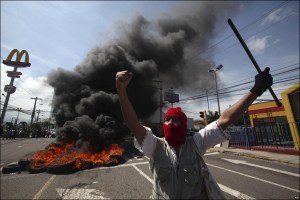
Smells like coup spirit
Coup in Honduras

Photo: Reuters
All media is reporting that President Zelaya was taken by military units at 6 AM, and flown to Costa Rica, where he is reportedly staying in a guest house and has not asked for political asylum.
EFE reports that the first lady, Xiomara Castro de Zelaya, has taken to the hills for her own protection. Apparently, EFE was able to reach her by phone. In Costa Rica, President Zelaya met the press with Costa Rican President (and Nobel Peace Prize Laureate) Óscar Arias at his side, to call for peaceful resistance to the coup.
Honduran radio is telling people to stay home and not vote in the referendum which was scheduled for today, despite a ruling from the Electoral Court that the referendum was invalid.
The Congressional President, Roberto Micheletti, has been sworn in as “Provisional President” and Notimex is reporting five F-5 Honduran Air Force planes are flying over the small nation to fend off air attacks (from whom?) while communications appear to have been cut between the capital and the port of San Pedro Sula.
Notimex is also reporting that the OAS (Organization of American States) will hold an emergency meeting this morning to discuss the situation, described by Honduran representative Carlos Sosa Coello as a “kidnapping” and coup d’etat.
Huffington Post writes that “Congress voted to accept what it said was Zelaya’s letter of resignation, but Zelaya said the letter wasn’t his and vowed to remain in power.” This sounds exactly like the situation during the attempted 2002 coup in Venezuela, where the President was also kidnapped, and a supposed letter of resignation (which was fake) was used to justify swearing in a Provisional President.
As usual, and I’m surprised by it, the Latin American Herald Tribune is providing the best objective coverage of the Honduran situation.
You know as much as I do, and I know very little about the background of this situation, but the news is getting worse:
A report from Venezuelanalysis states that “[Honduran] military personnel kidnapped the ambassadors of Venezuela, Cuba, and Nicaragua in Honduras, along with the Honduran Foreign Relations Minister Patricia Rodas, according to Venezuela’s ambassador to the Organization of American States (OAS), Roy Chaderton.”
…
The kidnapping of their ambassadors, if confirmed, would suggest that the Honduras military coup is ideological, and targeted not only at Zelaya, but potentially at the many Latin American national leaders who have formed the wave of leftist revolutions that have swept Central and South America over the past decade.
Zelaya, who was elected as a conservative, shifted dramatically to the left during his presidency.
Death squads and better business
I don’t pay a lot of attention any more to the latest in gangster rub-outs. But, one last 19 June in the tourist zone of Cancun might deserve closer scrutiny. It appears the press were called before the police were told where to pick up the latest batch of dead gangsters. As with other mob hits, there was a explanatory note… this one, left helpfully in the front windshield, read:
Somos el nuevo grupo de mata zetas y estamos en contra del secuestro y la extorsión, y vamos a luchar contra ellos en todos los estados, por un México más limpio.
We are a new group of Zeta-killers, opposed to kidnapping and extortion, and we are launching a struggle against them in all states, for a cleaner Mexico.
Two things about the incident are troubling:
- While the translation is somewhat clumsy (my fault), it is in proper Spanish, and even the accent marks were in the right place. The sentence would not be out of place in any Mexican business correspondence. That alone suggests this wasn’t your ordinary gangland hit: becoming a hit-man does not require much in the way of literacy, and this is the first “narco message” I’ve heard of that didn’t require a fair bit of paraphrasing to edit.
- The un-bylined story from SISPE-Novades reprinted in ChetuMail (an on-line Quintana Roo service) reports that — because of the presense of media (and by-standers) — the detectives from the State Prosecutor’s Office (PGJE) towed the Jeep with the dead gangsters off to the forensics lab. I can’t say for certain, but that sounds like there wasn’t any attempt to investigate the scene of the crime.
I won’t jump to conclusions but Blogotitlan — based on this incident, and a few other under-reported crime stories — will. It’s a fairly long article, so my translation is after the break.
A few observations. Although the Blogotitlan article is propaganda for the Lopez Obrador supporters, neither the idea of a death squad, nor the sense that the Calderón administration is creating the drug war for political reasons (and to hold on to power, in spite of others calls for major political and cultural changes) are fringe ideas. Calderón’s claim that “democracy is at stake” in the “drug war” was for foreign, not domestic consumption… and has to be seen in light of similar claims about Colombia, where support for the “war on drugs” was also sold to the U.S. as defense of democracy, but used to mask violent crackdowns of opposition forces, economic and social repression and the systemic murder of labor leaders. Many in Mexico fear the same could happen (or is already starting to happen) here.
While others object to the “war on drugs” out of fears of Colombianization, or concern for human rights, still others note — as one Sinaloa business woman put it to me — and I paraphrase: The narcos are local businessmen investing in the community creating local jobs.” Another way of looking at that is the sense that the “war on drugs” is more a war on local entrepreneurship, for the benefit of the established (or PAN-approved) business interests. Or so, their arguement goes.
And, so the Blogotitlan article…
Born Again
About 25,000 U.S. citizens are born every year outside of hospitals. The majority of these births are in rural areas, along the Canadian and Mexican borders. However, the bone-heads in Washington, not being rural folks and likely to know nothin’ ’bout birthin’ babies… or anything much about life in rural border regions… decided in their infinite wisdom that of course anyone born in the U.S. was born the way they were — delivered by an obstretian paid for by some private insurance policy — and having a birth certificate signed by a midwife, or not witnessed by a doctor, was suspicious.
The U.S. legal system may assume one is “innocent until proven guilty” but regulations don’t. The assumption was that if one was delivered by a midwife, lived in rural Texas AND had a “spanish” name… there had to be some funny business involved. And… wiph the new regulations requiring a passport to cross the border — which is required in border regions — the rural Texans were shit out of luck. The American Civil Liberties Union found nine particularly sympathetic victims of this bit of stupidity to sue for overturning the regulation.
(Rio Grande Guardian, sombrero tip to South Texas Chisme)
Return to Sender
Zenli Ye Gon, the little-old meth maker from Mexico City, COULD be extradited to Mexico, though the government probably is in no hurry to put him on trial.
When Mexican police raided Ye Gon’s property in Mexico City and turned up a whopping 205 million dollars — in CASH — the DEA came up with the brilliant idea that — given the Mexican cops used DEA training material, this was a DEA operation, ergo the DEA should get a cut of the loot. The DEA never got a dime (happily, at least a good chunk of the Mexican seizure went to the Health Department to fund addictions treatment programs) , but they were able to nab Ye Gon in the United States.
Then it got messy. Ye Gon had low friends in high places — the Fox and Calderon administrations. He claimed the 205 million wasn’t his… he was just holding it for Felipe Calderon. The mess, as it stood at that point was covered in the Washington Post (28 October 2008) as well as here.
BLT (Blog of Legal Times) has the latest twist — a prosecutorial screwup that means the U.S. government will have to drop charges, supposedly because Mexico has an interest in prosecuting him… sometime in the far, far future, I imagine.
Disappearing act in Mexico City
Yes, the late Michael Jackson did have a Mexican connection. It’s not my usual line of research, but the indefatigable Burro Hall unearthed the story (from that impeccable historical resource, People Magazine) on Jackson’s aborted 1993 “Dangerous” tour which — like that of so many sagas of “persons of interest” to U.S. law enforcement authorities — with his trail going cold in Mexico.
In place of the Gloved One himself, last seen somewhere in Mexico City, was an audiotape, released by his handlers on Nov. 12 [1993]. “As I left on this tour, I…was accused of horrifying and outrageous conduct,” the quavering, high-pitched voice confessed. “I was humiliated, embarrassed, hurt and suffering great pain in my heart…. I realize that completing the tour is no longer possible…. I love you all. Goodbye.” And with those words, Michael Jackson vanished.
Jackson was facing several accusations in the United States involving improper relations with minors, as well as having serious problems with his teeth that required surgery at the exclusive ABC hospital in la Capital.
As it was, the Mexican press was under-whelmed by the tour, and bad jokes about Jackson (“Why did Michael Jackson reserve an entire hotel in Acapulco? Because he heard children were free in every room.”). In addition, he was facing legal action in a copyright infringement suit, and — as was popular at the time with those facing serious legal problems — suddenly claimed a need for addiction treatment.
Elizabeth Taylor (back in the news then for having married a guy she met at an alcoholic rehab center) — a part-time Mexican resident — allegedly arranged for Jackson’s disappearance from the country.
For those who can’t get enough Jacksonian trivial… here’s footage from that 1993 Azteca Stadium concert:
(Posted on youtube by “Alex84” in January 2007)
Close to the edge… Honduras
Update 28-July (Sunday): Reports out of Tegucigalpa are that the President has been arrested by military troops… which sounds like a coup to me.
There may or may not be a referendum in Honduras this weekend. Then again, there may or may not be a coup d’etat, too. It’s hard to tell, and everyone outside Honduras is more than a little confused by the situation.
The outgoing president, Jose Manuel “Mel” Zelaya, has called for a non-binding referendum on calling for a constitutional convention. Fears that a new constitution would allow for re-election of the president (Zelaya’s term ends in January 2010) have led to extreme oppositon.
The Honduran Supreme Court ruled that the referendum was illegal, and the Army — which normally oversees voting in that country — has refused presidental orders to ignore the court and distribute ballots. Last Wednesday, Zelaya sacked Army chief Romeo Vásquez Velásquez, who disobeyed the President. Zeleya supporters have seized the ballots, and the Army has taken to the streets to prevent the referendum.
Short of a military coup, Congress may take action. Honduras, like several Latin American countries, allows for Congress to vote on the president’s mental fitness to hold office. Zelaya wouldn’t be the first Latin President whose congress decided he was loco.
Nearly all English-language reports have claimed the point of the referendum was to extend Zelaya’s tenure in office, but — given that the referendum is simply a non-binding resolution designed to nudge the Honduran Congress into taking up the issue, and any new constitution wouldn’t be finished before next January — these reports make no sense. The only two sources to have the story right that I’ve seen are Al Jazeera’s English language service and the Caracas-based Latin American Herald-Tribune. While Zelaya is considered an ally of Hugo Chavez and part of the “axis of Evo”, it should be noted that the Latin American Herald-Tribune is generally considered a “conservative” publication, and is considered “anti-Chavista”.
Other than providing immigrants and as a transit point for Colombian cocaine, Honduras is not particularly important to the United States. Although largely spared the worst of the civil wars of the 1980s, Honduras “hosted” a large U.S. military presence — it was the base for Oliver North’s “Contra” operations, and was used for training rebel Nicaraguan units. Although the EXISTING Honduran Constitution forbids permanent foreign troops on Honduran soil, Sota Cana Air Base has been operational since 1981, used by the United States Air Force.
Zelaya, whose background is as a land-owner and business-man, came to office on a “law-and-order” platform, and has succeeded in doubling the number of police officers, which cracking down on organzied crime, specifically the Mara Salvatruca gangs that infest Central America. However, crime has increased during his tenure, and his foreign policy has cost him support among the “traditional elites” who favor better relations with the United States.
When subs are outlawed, only outlaws will have subs
In what The Agonist’s Nate Wilson Turner calls “the wack-a-mole aspect of the farcical ‘War on Drugs’, the United States government has taken it upon itself to outlaw un-registered submarines in interntional waters… and is prevailing about it’s largest cocaine supplier (and recipient of foreign “aid”) to do the same. Turner quotes a Christian Science Monitor report on innovative home-built submarines (ok, techically they’re semi-submersible vessels) that ply the seas, keeping the U.S. and other wealthy countries supplied with the Andes’ most valued agricultural commodity:
IT IS STILL LEGAL in Colombia to build, transport, or possess unregistered semisubmersible vessels. So, if no drugs are found in a seizure on land or at sea, there is no crime. But a bill that gives authorities the tools to prosecute anyone linked to the subs is soon to become law. Prison sentences for those convicted range from six to 14 years.
The bill follows a new law passed last fall in the United States that outlaws unregistered subs in international waters, regardless of whether they can be shown to have been carrying drugs.
How’s the Colombian space program coming along?


 mexfiles.net