Don’t drink the water, and don’t eat the food?
Maybe the Aztecs shouldn’t have given up cannibalism. Today’s border absurdity from the Houston Chronicle:
People for the Ethical Treatment of Animals plans today to announce an unusual marketing pitch to the U.S. government: Rent us space on the fence for billboards warning illegal border crossers there is more to fear than the Border Patrol.
The billboards, in English and Spanish, would offer the caution: “If the Border Patrol Doesn’t Get You, the Chicken and Burgers Will — Go Vegan.”
“We think that Mexicans and other immigrants should be warned if they cross into the U.S. they are putting their health at risk by leaving behind a healthier, staple diet of corn tortillas, beans, rice, fruits and vegetables,” said Lindsay Rajt, assistant manager of PETA’s vegan campaigns.
The comments on the article are a hoot… the best being written by “Jose Morelos”:
Hola Amigos!
These idiotas have no idea of their laughable ignorance and stereotyping.
Most have never tasted good Mejiicano vegetable dishes based on such things as napoles, jicama and cirvela to name a few. Corn and beans and tortillas, Madre de Dios!
Norte Americanos have never approached the creative and beneficial meat-based cuisines indigenous to south of the Rio Bravo. Cabrito and associated products as Cajela and Mejicano Feta. The idiots should be promoting reducing bovine milk products with goat products, which cost far less and have less toll on the environment.
The idiots have it backwards. They should be promoting immigrants crossing the border in order to escape into the relatively vegan North America if they are serious. Have the idiots never experienced the delights of the parilla or asador tradition further south of Mejico, have they never experienced bife de chorizo, asado de bife, churrascos, lomo, vaco, bife de costilla, ojo de bife…? Don’t they know that the bull from the ring after the most prolonged and skillful tercio de meurto, the honoring of the valiant bull by drag around the ring and the jumping of the children on the carcass results in the most delicate and revered meat there is?
How about initiating an exchange program, one of the PETA idiotas for one innovative immigrant with master parilla/asador business skills?
Jose
Becoming a non-person in Texas
A few years ago, a couple of midwives in south Texas confessed up that they forged about 15,000 birth certificates. Homeland Security, fearing someone might slip through the cracks (God Forbid!) is determined to make life difficult. For people like Juan Aranda, a life-long resident of Weslaco this is more than just an inconvenience:
His birth certificate says he was delivered unto Weslaco 38 years ago, and church records say he was baptized here soon after. School files list him as a student in the local district from kindergarten through high school, and voter rolls show he votes for president here.
But to the U.S. State Department…isn’t sure he’s an American.
Miriam Jordan, 11-08-2008 Wall Street Journal
Not a big deal? Think again:
…locals need a valid passport more than ever. A new law that goes into effect next year requires Americans to use a passport, rather than just a birth certificate or driver’s license, to visit Mexico and Canada. The situation threatens to isolate thousands of people in the Rio Grande Valley who regularly travel back and forth to Mexico for work or family reasons.
At least one Border Patrol agent is among the people who need a passport for their job, but can’t “prove” they are American citizens to the satisfaction of the passport office.
Not having a birth certificate isn’t all that uncommon, though it’s fairly rare now. My father was either never issued a birth certificate in 1917, or it was never found (his home county courthouse burned down in the 1930s). A baptismal certificate was enough to obtain his passport in the 1970s. But he was born in Pennsylvania, not south Texas. And that was in the days when the United States was still a free country without government surveillance of its citizens.
South Texas, or at least south Texans with a year-round tan, are not the same as other American citizens, at least according to the Homeland Security regime. At Weslaco’s Saint Joan of Arc Catholic Church:
Eva Gonzalez, the church secretary, says that she has been issuing baptism records at the rate of 30 a week for passport applicants. “I have people coming in here crying,” she says. “Ladies are saying, ‘I was born here and have lived here all my life, but the government doesn’t believe me.’ ” Ms. Gonzalez’s own mother, who was delivered by a midwife 75 years ago, is among those caught in the confusion. She says federal agents also visited recently to inspect church ledgers for fraud.
That’s typical for what you get in the age of Patriot Acts … don’t trust the people, don’t trust the churches, don’t trust nobody.
Nobody Writes Off The General
I wouldn’t exactly call General Sergio Aponte Polito a victim of the “drug wars”. He was a popular figure in Baja California, kicking ass and winning the support of even even “an old radical surfer from the 60’s fighting fascism.” Whether the General’s law enforcement techniques bordered on fascism or not, he was a “clear and present danger” to democratic institutions.
I’ll concede that narcotics dealers are a danger to the Mexican State, but I’ve always thought the response has been out of proportion to the problem. Defense Secretary Guillermo Galvan claims there are a half million people involved in narcotics, but when you look at his figures, 300,000 of them are just marijuana or opium poppy growers and another 160,00 are small time dealers. Reducing the number of farmers might be better handled by the Secretary of Agriculture or the Secretary of Development rather than the Secretary of Defense. The small-time dealers might be a matter for local police (or maybe social workers or the health department). The 40,000 others are not necessarily armed and dangerous. This includes financers, couriers, suppliers (even narcos need car parts), packagers, etc. None of these are the kinds of people that require a military response.
It was the Calderon Administration’s “mano duro” that set off a surge in violence among the various narcotics exporters. Whether or not the massive crack-down on narcotics dealers was necessary, the already alarming death rate made military intervention popular in places like the Baja. Whether this escalated the violence, or whether it can do more than provided a short fix to the problem (assuming narcotics exports are a problem), there were two serious — and related — dangers in using the military as law enforcement personnel.
First, there is no denying that local and federal police agencies are terrible. Army personnel were only meant to back up the police departments as they cleaned up their act. That is going to take a long time, and some cultural changes. The huge scandal over the Fernando Marti kidnapping and murder (Marti was the 14-year-old son of a self-made millionaire with no known ties to organize d crime) in Mexico City — which has led to calls for extreme measures like instituting the death penalty for these types of crimes — implicated Federal Police, not Mexico City policemen. While Mexico City’s police still have their problems, the types of reforms that have been made in the Federal District — better pay and training, allocating resources in less-wealthy areas, and probably the most important, paying attention to social service needs in “at-risk” communities — are starting to work.
The Federal Government, however, has been looking to make immediate changes. I tend to think it has to do with the political stability of the Federal District government. With one political party pretty much guaranteed long-term control, it can afford to look at changes that will take ten or fifteen years. The Federal administration, however, looks at the six-year Presidential term, and — given the tendency of Mexican administrations to try to impose their program in the first two years of the “sexennial”, soldify it in the next two, and instutionalize it in the final two — even during the “perfect dictatorship” of guaranteed PRI control — the Feds are going to look at making an impossibly complex change within too short a time frame.
I’d also add that the Federal District administration, being PRD, looks at bottom-up solutions, where the Federal PAN administration wants top-down changes. The response to police corruption at the Federal level (and failures like the Marti murder) has been to change the management, but not the management style, nor the law enforcement culture. Just appointing military officers to police command positions (as is done here in Sinaloa) is not wrong, and may bring in some needed experience in areas like command and control, tactical training or intelligence, but the improvements depend on the quality of the individual, and may not change the institution. Rather than sitting down and figuring out what the staffing needs are for police administrators, and then recruiting or training the people needed, it appears the civil authorities are just taking whatever retired military officers are willing to take on police command positions.
A second problem is with internal control. Most of the criticism of military policing has been the very real danger that the military will be used to crack down on legitimate dissent under the guise of anti-narcotics control, as it has in Colombia, and already has in Mexico. Military death squads are not unknown in Mexican history. Most of the criticism of “Plan Mexico” has come from the political left (though also from the extreme right) — mostly based on very real fears that militarization will be used for political ends . The specific concern on the left (and in the mainstream) is that the crackdown by the Calderon Administration could be used against organized dissent to his government. This is already happening n Chiapas, according to the Zapatistas)
But, outside of politics, there is another issue. Mexico’s legal system is making changes, but there has been — and still is — a chronic problem with official abuse. Citizens have SOME redress when it comes to police misconduct, but military misconduct is nearly impossible to address. A major screw-up by the Mexico City police resulted in a police commander going to jail. So far, serious screw-ups by military forces have resulted only in the prosecution of low-level offenders. Military courts almost never punish the higher-ups, and human-rights prosecutions are rare.
General Aponte’s actions were unacceptable for two reasons. It wasn’t so much that he complains that the Federal Police are corrupt (what else is new?) but that he saw himself (personally) as an alternative police force — encouraging people to directly go to the Army for police matters. Secondly, when one of his own staff officers committed a serious breach of discipline (setting off a firearm in a restaurant) the General covered it up. I suppose it’s normal for a commander to look out for his guys, but on top of the General’s tendency to shoot from the lip (and let the Lord sort ’em out), he was becoming an embarrassment to the military establishment — and undermining civilian control of law enforcement.
What’s frightening is that the General has been transferred to a new post: president of the Supreme Military Tribunal.
Bi-illiterate

The good ol’ days … pre-Vienna Convention
I’m working on a short history of Mazatlán, and ran across an item in the 22 May 1866 New York Times on some Americans who didn’t get their consular visit and came to grief here during the French intervention.
The French are generally considered a civilized and humane people, but here they are fast degenerating into barbarism, perpetuating cruelties and outrages unheard of before among any civilized nation. Americans are imprisoned without the slightest evidence of guilt and held after being tried by court-martial, when no charge has been sustained. A young man named FITZGERALD, and another named HOUCK; were arrested and kept in prison charged with having bought corn of the enemy outside. Some time after their confinement there was a break among the prisoners, when HOUCK attempted to escape. He was ordered to Tepic, but while on his way, was shot by his guards, who robbed him of his gold watch; his other effects were sent to the British Consul at Tepic. The authorities promised the friedns of FITZGERALD that he should be released on the condition of his leaving for California on the first steamer; but instead, he was heavily ironed in his cell and subjected to all manner of indignity and insult, with treats of instand death upon the slightest provocation…
Arbitrary detention and military tribunals for foreign civilians? Imprisoning people waiting for deportation? Trial and execution without access to their nation’s consular officials?
The nineteenth century was barbaric indeed!
(By the way, since someone asked. The United States never recognized the French imposed Imperial government, and after April 1865 was openly supporting the legitimate Republican side. Great Britain — which had contributed troops to the original January 1862 French-led intervention — did recognize Maximiliano’s government, and acted as “protecting power” in occupied areas, like Mazatlan.
Sunday readings: 10 August 2008
Tlatelolco 1968, Beijing 2008
As CHINA cracks down on dissidents in preparation for the 2008 Olympics, The Unapogetic Mexican can’t help but think of the slaughter at Tlatelolco.
Even if we don’t know all the facts of Tlatelolco, or exactly what is going on in China from our vantage point, or the particulars of any of the violence that proceeds, trails and surrounds our grand and fraudulent symbols https://mexfiles.wordpress.com/wp-admin/post.php?action=edit&post=2548of international family. Because anywhere the People gather to express their voice, the government—be it communist, democratic or otherwise—will be infiltrating and disturbing the cohesion and strength of that voice, finally using violence with no real hesitancy or remorse. And wherever these games go, the hosting governments will have to deal with this, and I imagine more and more. Because the People’s issues and voices—now increasingly outlawed, punished, minimized, or sent to Fenced-in ‘Free Speech’ areas—do seek a hearing, will always seek the public eye. And the unsettling juxtaposition of profit, spotlight, and ignored oppressions will always cause this confluence of energy and tumult. This is our modern-day Olympic Games Carnival settling down uneasily into a world where war and class divides are hurting so many.
Just beneath the surface
I’ve always thought cocktail parties were a step above Hell… apparently, this is literally true:
(Jack Chang McClatchy Newspapers)
SANTIAGO, Chile — During the darkest years of this country’s military dictatorship, Mariana Callejas was an up-and-coming writer and the hostess of the era’s most glamorous literary salon.
Chile’s leading authors trekked up to Callejas’ hillside mansion every Thursday night to talk literature, have a few drinks and sometimes dance until the next morning.
…
As the literati danced and debated upstairs, Chilean intelligence officers were downstairs torturing dissidents and manufacturing the toxic nerve agent sarin in a secret laboratory.
McJustice.
Speaking of crack-downs, The New York Times’ Julia Preston on the criminal trials of the 300 people arrested in Iowa who were tried and convicted in just three days:
“It does make it look like the prosecutor and the judge have worked it out ahead of time and made it a fait accompli,” Professor Bibas said. “The defense can think the judge is behind this.”
The Agriprocessors hearings have become a national test case for the Bush administration’s crackdown strategy of bringing criminal charges against illegal immigrants caught in workplace raids. Until recently, most illegal immigrant workers, if they had no prior records, were swiftly deported on civil immigration violations.
Tijuana is the End of the World as we know it.
Michael Hemmingson reviews the history of violence in the border city for the San Diego Reader:
A mile east of the Tijuana International Airport is an area police call El Fin del Mundo, the End of the World, where drug-cartel assassins dump their victims. Both Mexican and American citizens have been found there. On December 18, 2004, according to Sergeant Tom Bulow of the San Diego County Sheriff’s Department, San Marcos resident Noé Chávez García was lured to Tijuana by two acquaintances who shot him several times and left him in this corpse-disposal zone. He survived his wounds to tell his story to the FBI and Mexican officials. His is a rare case — he lived.
“A total of more than 4,800 Mexicans were slain in 2006 and 2007,” reports the Washington Post on March 16, 2008, “making the murder rate in each of those years twice that of 2005. Law enforcement officials and journalists, politicians and peasants have been gunned down in the wave of violence.”
“What affects one side affects the other,” Mayor Jerry Sanders tells USA Today on February 5, 2007. “We’re literally one region with a fence down the middle.”
Translations that dare not speak their name.
Sexual attitudes and definitions seem to be culturally determined. With the International AIDS Conference in Mexico City this last week, some attention is now being focused on Mexican culture’s much more fluid definition of “gay” and “straight.” I disagree with some of Marc Lacey’s contentions in his New York Times article, “Vulnerable to H.I.V., Resistant to Labels” (like a lot of U.S. writers, he talks about “machismo” without defining what he means. If he means “sexism”, there’s a good English word for it. If he means, as the Academia Real defines it, “things predominately done by men,” that would cover men having sex with men). However, the whole article is worth reading:
Here in Mexico, where the 17th International AIDS Conference is taking place this week, some hombres que tienen sexo con hombres, or HSHs, as they are called, consider themselves gay. Some swear up and down they are straight. Many fall into the gray area in between.
“Sexual identity is a very complex thing,” said Hector Carrillo, a professor of human sexuality studies at San Francisco State University who has done research in Mexico. “We like to think that once someone figures out their sexual attraction, they will fit into the categories we’ve created. But life isn’t like that.”
H.I.V. and AIDS are concentrated in Mexico among men, particularly those who have sex with other men. While the H.I.V. prevalence in the general population is 0.3 percent, among men who have sex with men it approaches 15 percent.
I’d never considered this…
In Mexico same-sex marriage is probably legal. I say probably, because so far only one state explicitly allows same-sex marriage (Coahuila), but a marriage in one state is recognized in throughout the Republic. If there have been any legal complications, I just haven’t heard of any.
There really wasn’t much fall-out from this, mostly because marriage in Mexico is a contractual matter, and the Church (or churches in general) aren’t involved. The legal benefits and liabilities kick in when you sign the papers in the judge’s office. If God, or your relatives, require some further procedures, that’s not the State’s concern. This creates some confusion for U.S. tourists, who want to get married in Mexico, and sometimes find they aren’t legally married since all they had was a religious service.
The basic marriage laws are much the same system in all “Napoleonic Code” (Code Civil) countries, one reason that same-sex marriages have not been a particularly divisive issue in European countries or in Mexico (and, recently added to the list of countries allowing same-sex marriage, Uruguay). It’was just a matter of dropping the requirement that the two parties to the contract be of opposite genders.
But, in the United States, ministers in the various religious denominations do double-duty: the religious service IS the legal act. There seems to be some fear that because same-gender marriages are allowed by law, then religious denominations will be required to perform them (as if any minister is required to perform a wedding now… Rabbis don’t have to marry Catholics, nor priests Jews — or same-gender couples, nor divorcees, nor…). And, same-gender marriages are a hot-button political issue. This is one of those rare times that the Mexican way probably does trump the U.S. way of doing things… and it seems even some clergymen are coming around to realizing it:
In a letter last month, Bishop Marc Handley Andrus of the Episcopal Diocese of California directed his clergy to “encourage all couples, regardless of orientation, to follow the pattern of first being married in a secular service and then being blessed in The Episcopal Church.”
The bishop’s missive illustrates what a tangled web we have woven when clergy intone “by the power invested in me by the state.”
Because the Episcopal Church doesn’t sanction same-sex marriage — but gives the option of blessing the union — the bishop appears to be seeking a way to bless all couples while distancing the church from legal arrangements sanctioned by the state.
“There are a lot of benefits in getting out of the legal marriage business,” the Very Rev. Brian Baker told The Sacramento (Calif.) Bee in reaction to the bishop’s letter. “This way the clergy and the couple can focus on the spiritual blessings the church has to offer and not the political stuff.”
On the theological flip side, many conservative clergy worry that as agents of the state they will be pressured to perform same-sex marriages — or, in some other way, coerced into recognizing same-sex relationships in contradiction of church doctrine.
Maybe the bishop is on the right track: Separate secular from sacred by drawing a bright line between civil arrangements and the sacrament of marriage. Each state would limit itself to defining marriage as civil benefits for committed couples (as mandated by state law) — and each religious group would be free to define marriage according to the tenets of its faith.
Oops, they did it again
For there to be an equivalency, the death penalty would have to punish a criminal who had warned his victim of the date on which he would inflict a horrible death on him and who, from that moment onward, had confined him at his mercy for months. Such a monster is not to be encountered in private life.
Albert Camus
Heliberto Chi Aceituno, 29, was pronounced dead at 6:25 pm Texas time (2325 GMT) Thursday (7-Aug) after receiving lethal injection at a death chamber in Huntsville, the Texas Department of Criminal Justice said in a statement.
Chi was convicted of murder after killing his former employer in a 2001 Arlington store robbery. While the question of Chi’s guilt isn’t in doubt, this time Texas managed to justify their execution by basically claiming “Well, at least we didn’t kill a Mexican.”
Chi was originally arrested in California, where he should have had consular access before his extradition to Texas, and this execution violated not just the Vienna Convention, but a separate 1927 treaty between the United States and Honduras.
As a result of the execution, Honduran authorities are having to take special measures to protect the twelve United States citizens in their prisons from possible reprisals by fellow convicts.
(several sources: AFP, Houston Chronicle, Dos Centavos)
“The Shadow” knows
A slight misunderstanding on my part (one of his readers was referencing a comment on one of my posts) put me in touch with “the shadow”, and I’ve already added his site to my reference list of Immigration websites. He is an American college student, with the normal worries about his girlfriend, keeping up his grades and doing something with the rest of his life… but there’s a catch. Having been brought into the United States as a baby, he is an “illegal alien” with no memory of the country to which is is likely to be deported.
Here, he writes about not being able to get a drivers’ license:
…I would love to go to NY before leaving. I just want to be able to say, I was there. I stood there. But from the looks of it, going to NY is long ways away.
Other people have the same idea as me. Most of us want to have DLs, be able to go to college like our classmates, and travel. It specially hurts when I hear friends casually telling me that they’ve gone places over the summer. Just today I asked a friend what he did for the summer. He went to England for 6 weeks of school, and then a trip to Germany, Austria and another country I can’t remember. All I can say is that I bought an Xbox 360.
You know, one of the funniest things about my scholarship at my school is that it would cover all study abroad charges. Except…it’s a joke because I can’t study abroad. I asked if they were kidding when they told me, the scholarship office wasn’t…
Oh deer… (Friday Night Video)
Not the highest quality film, but much thanks to “javelogom” for the youtube posting of this danza del venado, from the Compañia de danza regional de Puebla. This ritual dance of Yaqui and Mayo peoples. The deer hunt has a religious significance beyond a simple thanksgiving ritual. The deer, like Jesus or Osirus or any of those other guys you read about in the Golden Bough is the culture hero who must give his life, and be destroyed by the negative forces — paskolas — and die so we may live.
The principle dancer is Alexis Velazquez Gomez.
Hostage taking on a grand scale
The Asociación Mexicana de Laboratorios y la Industria Químico-Farmacéutica de Occidente, the pharmaceutical manufacturers association, is claiming 40,000 jobs are at risk… and it’s the government’s fault. Why? Because Abbot Laboratories wants to charge full price for anti-retroviral drugs, and the Secretariat of Public Health has said they’ll substitute lower-priced generic medication rather than pay the inflated price.
Full disclosure: A couple of us did an over-the-weekend translation of the entire documentation required for the United States Securities and Exchange Commission under the Sarbanes-Oxley Act for the Mexican subsidiary of Abbot Labs. The complex documentation had been ignored by Abbot’s management until the last possible minute, when the documents were written by a secretary who received no instructions or guidelines on the SEC requirements. While she did a better-than-expected job, there were huge gaps in the required data, and the sections outlining fiscal responsiblity was thrown together by some manager, who didn’t know how funds were handled, and just threw in things like “Pedro and Maria check the numbers,” which was unacceptable. I know… I’d done both ISO and SEC documentation when I was a technical writer. Four of us worked 20 hours a day to translate the thing, and I edited it to SEC standards, as well as homogated the four different translations into a single document. We got it back to Abbot on time, and then, using the excuse that the manager who contracted our services had been fired for fucking up the job in the first place, Abbot just decided not to pay us. I’m still owed about 9000 pesos, but doubt I’ll ever see a centavo of it. They’re bastards.
Not like they’re hurting for money. If the Asociación honestly believes that generics are a threat to Mexican public health, then they can lower their prices. They’re dicks when it comes to small contractors (I’m not the only one who was screwed over… I met some computer supply people who refused to make deliveries to Abbot Labs of things like paper and printers unless they were paid up-front in cash), but they can afford the big stuff. The company’s sales are up 15% over the last quarter, and it’s net income rose to 1.32 billion dollars.
Jacking around a few contractors is one thing… taking a country’s national health hostage is another. Abbot has pulled this stunt in Brazil and Thailand among other places. Brazil and Thailand have a respectable generic pharmaceutical industry as a result. Not to mention they make capitalists look like cartoon villians. Fuck ’em.

“Sketchy” border incident
Four Mexican army soldiers entered southern Arizona and pointed their rifles at a U.S. Border Patrol agent early this week, the Border Patrol said.
The incident Sunday was the Mexican military’s 43rd incursion across the U.S. border since October, the agency said. However, it was unusual because firearms were involved. The Border Patrol and the Mexican government are investigating, Border Patrol spokesman Mike Scioli said.
Details remain sketchy…
Sean Holstege of the Arizona Republic is the first reporter I’ve seen in a long time who admits “I don’t know wtf happened”.
I don’t either, but even Fox News is reporting that this appears pretty innocuous. Armed troops? Well, of course… unless they were on a beer run (which used to be a fairly common reason Mexican soldiers entered the U.S. informally before the border became a political issue), you sort of expect soldiers on patrol to carry weapons. And, since “The Mexican government has sent soldiers north along sections of the border in efforts to tamp down drug-related violence” the soldiers have a legitimate reason for being along their own border. As did the armed Border Patrol agent.
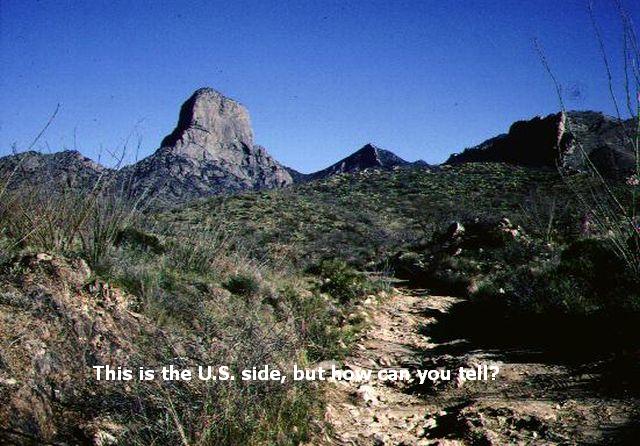 This particular stretch of the border, which is the Tohono O’odham Reservation on the U.S. side, isn’t well marked (Tohono O’odham live on both sides of the boundry line — a Reservation on the U.S. side, and communal land in Mexico, which is pretty much the same thing) and often, not marked at all. I suppose there is an argument for saying the border should be clearly marked, but how you do that, and not destroy the landscape… or the property of the Tohono O’odham peoples is beyond me.
Spending four minutes to determine if the other armed guys were friend or foe… and then discover you’re a few meters from where you should be, isn’t that sinister sounding.
Fox News mostly got it right, but they might need a little fact checking. Quoting T.J. Bonner of the National Border Patrol Council, who has been known to make inflamatory and factually-inaccurate remarks before (and does so regularly), errs when he says “we have no incursions with Canada”. Not recently, true, but then, the Border Patrol doesn’t do a very good job on the Canadian border, and there aren’t a lot of Mexican soldiers in Canada that I know of.


 mexfiles.net