Total Recall… el Terminator and FeCal
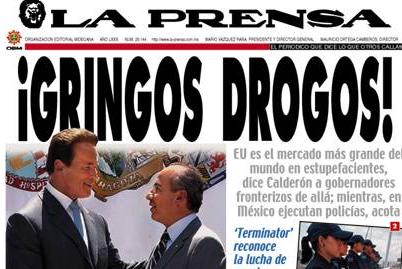
El Terminator thinks FeCal is “a great leader” though many Mexicans would beg to differ. The Calderon administration is still dithering about whether or not to allow the United States access to military and police records in return for the U.S. government using U.S. funds to buy those Mexican officers the weapons they need to fight drugs (and … many assume… those citizens who don’t buy off on Calderon’s policies… including many of the country’s elected representatives). Even the Spaniard Calderon lets run the government these days is a bit dubious about “Plan Merida.”
The U.S. government, being thwarted in its efforts to spend their tax-payer’s money on weapons, wants to spend it propping up corporate farmers. Calderon seems happy to make up the difference.
I don’t see how this will help in the long run, or even in the short term. All it does is undercut the Mexican farmers who haven’t been forced out of business by corporate agriculture in the United States and will convince even more of them to give up. And — of course, you know who will be happy to “loan” the money to buy grain.
I’m not sure what to make of La Prensa’s screaming headline of the day. Everyone knows who buys the shit… maybe he’s asking Ar-nuld to buy more… and keep the economy afloat. Alas, it creates a lot of job openings in the police departments, but it does more for the rural economy than guns or foreign corn imports.
Heck of a job, Felipe!
When the United States catches a cold…
… Mexico develops pneumonia. And when the U.S. is really down in the dumps…
Report from Al-Jazeera:
A little late for Memorial Day, but still…
Let us remember the second United States soldier killed in Iraq…
United States Marine and Guatamalan “illegal alien” Jose Antonio Gutierrez.
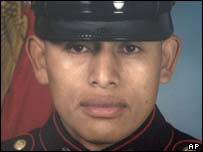
Doing the dying for oil that American’s won’t.
Who wants to be a gringo?
I hate to say it, but if you read this aloud, it’s hard NOT to think of Charlie Chan:
Subject: CONGRATULATION!!! YOU RECEIVE IMMIGRANT U.S .A VISA NOTIFICATION LETTER.
You have been selected as one of the lucky winners of the U.S Visa through our internet balloting email extracting and screening machine, your application was applied and processed by our internet balloting email extracting and screening machine which randomly extracts and screens 50 thousand of emails addresses around the world. This visa program is held annually as part of our New Year lottery programmed to give free easy U.S Visas to citizens of developing countries around the world to enable them travel to the U.S and start a new life and work. The U.S Department of Citizenship Immigration released millions of US visas till the end of the year program. All the selected lucky winners will get the constant legal status of the U.S inhabitant, an opportunity of free country entrance and departure, the right to be working in the USA legally and getting American Salary, Green Card holders also receive health, education, retirement, taxation, social security and other benefits.
All I have to do is send
$1,590 per family (legally married couple with or without children, and any winning applicant is hereby required to pay the fee for handling and submitting his/her application on his or her behalf. The payment of the processing fee should be directed to any of our regional office where your winning details falls for the processing of your visa claim application documents.
(No the parenthesis never did close — but I’ve been know to write just as badly). This amazing offer came to me in Mexico, from the “Asia-Pacific Office” of the U.S. Consulate in Kentucky — which has a telephone number in Thailand.
Me one number-one lucky gringo!
UNIPOL and police “desertions”
Sorry about the dearth of reference links. I was half-responding to a post on another forum, and shoved together my original UNIPOL post with a response to a post on Juarez police desertions. I’ll add my references — and add categories — later this evening.
Engel Francisco Luna Vega, a would-be car thief, has the dubious distinction of being the first person arrested by UNIPOL — the latest innovation in a series of Mexico City police reforms. Until he was branded a “fiery leftist” by the U.S. press, AMLO generally got high marks from the U.S. press (when they noticed anything in Mexico beyond the narcotics suppliers) for innovative urban management. One of the real stars was then-police chief Marcelio Ebrard — who came from a background in public administration, and was not a policeman or military officer.
While Mexico City’s crime rate would have probably dropped anyway for simple demographic reasons (the Federal District population is slightly declining; more importantly , it is aging. Most criminals are men under 30), the police reforms were overlooked when the Fox Administration decided that AMLO was a threat, and launched a media campaign designed to discredit AMLO and all his works. There was a horrible price to pay when the Feds starved the District for funding, and there wasn’t enough money to keep police helicopters in the air. When Federal Policemen were targeted as potential child molesters and lynched in a remote and isolated indigenous community within the District, the local police simply had no way to respond. Televisa helicopters, which were able to reach the scene, filmed the lynching, which was used over and over again by the pro-Fox network to create an image of instability within the Federal District.
Rudolf Guiliani, brought in by then Police Chief Marcelio Ebrard and paid for by Carlos Slim and other businessmen, was largely seen as a buffoon by the Mexican press (touring Tepito in an armored car was not the way to burnish a “fearless crime fighter” image) though he tried to sell himself to the U.S. as the guy paid a million dollars to “clean up Mexico City’s police.” Nonsense. His company was paid a very high fee to make recommendations for police reforms. At the time, it seemed Guiliani had no basic understanding of the Mexican legal system… he seemed unable to grasp the fact that each Delegation has their own municipal police department, the District has their own investigative police and there are separate police departments for separate Federal, District and Delegation functions. And that the Judiciary and Executive Branches (at all levels) have different police functions and departments.
What Guiliana’s company was brought in to do — and did a relatively decent job of — was to make recommendations as disinterested outsiders that could be spun by the District’s administration as they went about making reforms. I don’t see that any of Guiliani’s recommendations were anything that wasn’t already in the works, or contemplated.
The District was already on the right track. Officers were being paid a living wage, and the departments were starting to get better educated, motivated and physically-fit officers. It’s only anecdotal, but one change I noticed was that you saw fewer fat, lazy cops hanging around taco stands, and more young, well-built cops flirting with girls. And more women officers too.
None of that, though, changed the organizational structure of the police departments. Ebrard made some progress there, though the number of different departments in the district was well over 40. He even introduced some new units, like the Embassy Police, the Lake Police and the Tourist Police. However the new units, with their distinctive roles and images, were designed to attract the best and brightest, and they’re generally well-regarded as far as Mexican cops go.
Which is part of the problem. Becoming a policeman in Mexico has always been a bottom-of-the-barrel job. The pay sucks, and there is no respect. I’ve mentioned before that I wonder if William S. Burroughs’ was really seducing cops with drugs and sex, as he claimed in Queer, or whether it was just that there were a lot of junkies — and gays (who had a very low status in the late 1940s) — who couldn’t get any other job working as policemen.
That is going to take years to change. If you notice, when there are serious civil disturbances in Mexico, local police are overwhelmed. They do not have the training or resources to handle problems, nor the discipline to deal with them. Naturally, the Army has to do that job. With the better federal units now recruited from the Army, there is some movement within Mexican police circles to recruit veterans, but this is new. Unlike the United States (where there is a huge veteran community, and — alas — too many combat veterans who have lost the early part of their career to military actions), police departments have a cohort of men and women who are used to uniformed, hierarchal public service employment.
With no real “veterans’ preference” program in the Mexican civil service, it appears the only ones to have taken advantage of combat veterans (a very small number of people in Mexico) are the gangsters. When I read that a high percentage of the enforcers in the criminal organizations are former soldiers, I say, “so what?” Who else is going to hire veterans based on their military experience? Then again, most soldiers in Mexico are draftees, from the lower classes. Most criminals are also lower class guys with some ambition. The fearsome “Zetas” — supposedly recruited from Mexican Special Forces — doesn’t have more than 200 members, mostly auxiliaries and supply people, not “soldiers.” Even crooks need cooks (and drivers and loaders and lookouts, too).
If the Zetas do include a high number of veterans, very few of them are “special forces” guys. The Mexican Special Forces units are very tiny fraction of the very small Mexican military forces overall (the exact number is a national security secret).
It appears security administrators are starting to notice the problem. Here in Sinaloa, the heads of the various state police agencies were all replaced last week with military officers, mostly from administrative backgrounds. Ebrard, during his tenure as DF police chief, also stressed better management, coming as he did from a background in public administration, not criminal justice.
What’s interesting — and potentially positive — about UNIPOL is that in addition to harnessing Military adminstrator’s experience, it is dealing with the downsides of fragmented police responsibilities. Judicial, investigative and prosecutorial police are all called to the event, and work as a team on any case. Bureaucratic chains of command are simplified, and the police commanders can focus on specific problem areas. Guiliani’s group had recommended focusing on minor crimes (as New York police did), but — understanding that reforming the police is as much a matter of building citizen acceptance of the cops as anything — is focusing on those types of activities that particularly annoy the citizens: auto theft, or retail narcotics sales, or whatever.
Unfortunately, the rest of the country still has to catch up. In some places, it seems that there are partial reforms (like using military adminstators here) or cosmetic ones — going after minor annoyances like cracking down on grafitti. And slowly, slowly, weeding out the “bad cops,” the incompetent, and those who just took a job, never expecting to face down armed criminals.
And — with no data from “normal” times — I don’t know that the “desertion” rate among policemen is any higher or lower than it has ever been.
Maybe they should hire “illegal aliens”
From Grits For Breakfast:
Will expanded immigration detention exacerbate Texas’ prison guard shortages?
Regular readers know that Texas prisons and county jails face a severe understaffing crisis caused by low pay and the rural location of facilities, and that in federal facilities the problem may be even more pronounced.
Meanwhile, my prediction that immigration detention would drive prison expansion in the near term has come true, adding another category of detention facilities that require more guards when no one can find any. It’s hard to see how these long-term trends can co-exist viably. Where does it all end?
Democratic vistas
Interesting. It’s not unusual for political parties anywhere to be made up of various factions and constituencies, nor to try to balance their tickets among those factions. Most European and Latin American parties (including the Mexican parties) now have gender equity rules — a given percentage of candidates have to be female. One also requires a percentage of Indigenous candidates, and is looking at the next logical step.
In Mexico, in addition to state and national deputies elected by district, based on their percentage of the overall vote, the parties appoint additional deputies (plurinomials) to at-large seats. I’m not sure about how city council members (“regidores”) are selected in Guerrero, and the article didn’t make it clear whether the party is being asked to back candidates for regular council seats, or plurinomial seats.
My translation, from Yamilet Villa Arrola’s “Demanda la comunidad gay regidurías en Acapulco y Chilpancingo y una pluri” is from the original in the 27 May 2008 Jornada de Guerrero.
Chilpancingo, 25 May 2008: Members of the Lesbian-Gay community carried placards into the Political Council of the PRD asking the party to include sexual diversity in the party’s slate – specificially for a seat on the Acapulco and Chipancingo city councils and a plurinomial seat in the State Legislature.
“We would like at a minimum respect for homosexuals. We want to end to the murder of murder of homosexuals; we want an end to the arrest of homosexuals; we want the church to say that homophobia is a crim which will be prosecuted,” said Víctor Manuel Román Ocampo, a participant in the lesbian-gay pride march.
The group laid out a proposal for the two council seats and the state deputy, to represent the thousands, or perhaps millions of gays who live in Guerrero.
They mentioned that the PRD is the only party which has opened its doors to gays and lesbians, and which forbids those who have committed discriminatory or homophobic acts from participating in party affairs, unlike PRI and PAN.
The group said, “We are not here to put on a “show,” but only to bring to your attention and to the Guerrero PRD state executive committee, our demand for a minimum of respect.
Director Quetzalcóatl Leija Herrera, carrying a gay community flag asked the PRD leaders not to exclude them from their political rights.
“Ladies and gentlemen, none of us can be excluded for being a homosexual or bisexual, or having a child with these characteristics,” said Román Campo.
For his part, lesbian-gay community director Leija Herrera reminded the committee that the National PRD has approved affirmative action quotas for sexual diversity, and the community counts on the support of Federal Deputy David Sánchez Camacho.
“It seems to us that one of the greatest advantages of this party is that they are open to democracy. This is a historic occasion for the Guerrero PRD, opening up to all, and in asking that they set aside two council seats and a plurinomial deputy, put themselves at the vanguard of democracy without discrimination,” Leija Herrera concluded.
The PRD, like the Democratic Party in the United States, usually includes several factions at war with each other when they should be fighting their opponents. No single faction controls the party (the third largest in the country) and all of them are fighting for every voter bloc they can get. The well-organized gay and lesbian community in Mexico City has always been important to one or another of the PRD currents, since its founding. Until recently, the party leadership was somewhat — er — closeted in their support.
Cuauhtemoc Cardenas appointed lesbian activist (and now rector at Universidad de Claustro de Sor Juana) Patricia Jimenez as a “suppliente” — a back-up Federal Deputy who could take office should a regular deputy quit or die (which they do… quit anyway, since you can’t hold a federal office in Mexico and run for another office at the same time), but the party more or less seemed to bank on being less homophobic than the others in their appeal for gay votes.
In the 2003 elections, Patricia Mercado’s Mexico Possible Party openly appealed to women, gays, Protestants, Indigenous voters and the handicapped (only in Mexico would that be a viable coalition). Although her party failed to garner enough votes to be become a permanent party, they did capture a seat in the Federal District Assembly, mostly on gay voter support. In the Federal District, the PRD began paying more attention to gay and lesbian voters.
The Federal District is overwhelmingly PRD (David Sanchez Camacho, the only openly gay Federal Deputy represents the Federal District), and state parties take their cues from the District. Although Chilpancingo has a PRI majority council, and a PRI mayor, Acapulco and the state in general are PRD strongholds.
Our man in Mexico
Who is the the numero uno gangland killer in Mexico? As with most of the weapons and money (and the sales) used by Mexican narcotics exporters, it seems their enforcers come from north of the border, too.
The Dallas Morning News calls Laredo born U.S. citizen Edgar Valdez Villareal
… a lieutenant in the Sinaloa drug cartel, Mexican and U.S. authorities say, a ruthless point man in the group’s battle with the Gulf cartel for supremacy in Mexico’s illicit-drug trade.
They say he has been a key player in the bloody turf war being waged in Nuevo Laredo for control of the Interstate 35 smuggling route into the U.S., and the person most responsible for pushing the battle into central and southern Mexico, including Guerrero state and its tourist mecca, Acapulco.
“El Barbie” (he’s a blonde, blue-eyed pretty boy) is more than “a” lieutenant, according to the FBI and Mexican authorities. He’s
… el principal ejecutor de narcotraficantes y agentes policiacos que brindaban protección al llamado cártel de Sinaloa, comandado por Joaquín El Chapo Guzmán…
[… the chief killer of gangsters and police agents protecting the so called Sinaloa Cartel, commanded by Joaquín “Shorty” Guzmán]
Are the Texans being modest for a change… or just embarrased?
Comment is free
From the “No Border Walls” coalition:
Border walls are currently under construction in the El Paso sector, but the Border Patrol claims that they want to hear from the public. Just because they have no intention of making any changes to their plans apparently doesn’t mean that they are not ready to listen. According to the Border Patrol agent given the thankless task of staffing their “SBI Information Hotline” ( 


 1-866-215-6551
 ) public comments received at “Community Forums” will be compiled in after action reports and passed along to the El Paso Sector Chief. They will NOT be released to the public or the press.
Save that snot!
Is there anything nopales are NOT good for? High in fiber, vitamins (Vitamins A, B1, B2, B3, C and K to be specific) and minerals (magnesium, potassium, manganese, iron and copper), notal also helps regulate blood sugar levels, and is recommended for diabetics.
It grows just about everywhere throughout the Americas. As a cactus, it isn’t commercially grown much in the U.S., but is intensely cultivated in Mexico both for human and livestock consumption. And, given one other of nopal’s medicinal properties, is exported to Korea:
A few years ago some Koreans were experimenting with caning some fresh Nopal and shipping it to Korean after a day of eating Nopal with various amounts of vinegar and sugar they finally reached a formula they liked. They went out and had a big party to celebrate this momentous occasion. The next day everyone felt good and wondered why no hangover? Because of all the Nopal they ate? Yes.
Since that time Nopal has been sold as a hangover preventive in Korea. 2 tablets taken before going out and drinking a lot helps your digestive system cope with the overload of alcohol.
Before I moved to Mexico, about the only nopal I ever ate was the pickled nopalitos you sometimes saw in Tex Mex cuisine, and in some Houston supermarkets. Since moving here it’s become a regular part of my diet (in part because it’s so damn cheap!).
It would be the perfect food… if it wasn’t for the nopal’s one negative. And — for those without a few milenia of Mexican mamis behind them to show them how to cook the things — it’s a huge problem. Babas… that nasty, bitter scum that you boil out, and has the consistency of snot. Eeeeewwww!
On one of the message boards a few years ago, there was a long discussion of how to deal with the babas… one person insisting that the only way to deal with them was to add a pre-1959 U.S. one-cent coin to the pot. What do those of us who sold their coin collections before they moved to Mexico do?
Karen Hursh Graber, of Mexico Connect has more sensible recommendations:
To boil nopales, wash them and cut them into small squares or strips, if they have not been purchased this way. Place them in a pot with cold water to cover, bring to a boil, lower heat and simmer for 10-15 minutes. Some Mexican cooks say that by adding a few tomatillo husks, the sticky liquid (commonly called “babas”) will be more completely extracted from the vegetable. Others say that a pinch of baking soda accomplishes the same thing. I have tried both and found the baking soda to be more effective, but use only a pinch and add it at the very end. Using more may cause the water to foam up and run over.
Or… you can save the snot for archeologists. Really!
Babas have been used for centuries as a cheap weatherproofing paint. Although it stinks for a while, it lasts for years and there’s always plenty of babas around. Mexican archeologists — having the huge task of preserving a seemingly inexhaustible supply of crumbling monuments they continue to dig up, not to mention all those colonial facades threatened by acid rain and air pollution — are experimenting with baba-sprayers in Mexico City, with so far promising results.
What’s in a name?
There was a short article in today’s Noroeste on a campaign by the local Registro Civil to remind people to give their kids “normal” names — like José… or Lenin or Nezahaucoatl. It seems there’s a fashion lately of giving kids “foreign” names — unpronounceable ones like “Stephanie, “Irving” and “Christopher.”
The Registrars have trouble spelling the names (and so do the parents sometimes… Jhonnie and Yonnie are both fairly common names along the coast) and — in a country where your name stays with you for life (and is part of your “permanent record”) it can cause problems, and screw up your life.
Which may explain the odd case of Glenn Christoper Cerda Guajardo. Given his name, when he surfaced in Costa Rica with some story about Mexican ties to Colombian FARC guerrillas (or “terrorists” as they’re labeled in the U.S. and Colombia), I wondered if he wasn’t a U.S. raised Mexican working for the CIA or Colombian intelligence.
Given the dubious nature of Colombian claims about FARC (from laptop computers that mysteriously survive direct hits from missiles to disappearing photographs to later denied claims of Mexican ties to the organization), and Cerda’s appearance in one of the few countries that still will tolerate the Bush and Uribe adminstrations’ pathetic attempts to create a situation that justifies aggression against Venezuela and Ecuador, it was a natural suspicion.
This just sounded like one more attempt to throw up a bunch of accusations and see what stuck. Cerda claimed just about every group that’s an inconvenience to the Mexican administration (from APPO to UNAM student groups) was involved with FARC and cocaine dealing… which was convenient for the Calderon administration, but even they found the story hard to swallow.
 Then I saw a photo of the guy with the odd name. He sure doesn’t look like a spy… though he may be in his own mind. Being mentally ill and given to serial fantasies, though, he could be the perfect patsy for incompetent spies.
Or, an unfortunate example of what a weird name can do to screw up your life. I blame his parents.
Doing the back-stroke across the Rio Grande?
The anti-immigration crowd likes to kick around the figure that the Border Patrol “catches” only about a quarter of those who cross the U.S. Mexican border without papers. Mexico apparently doesn’t put the resources it needs into guarding its northern border from gun and currency smugglers, so who knows how many “illegal aliens” come in from the North. And, normally — they don’t really care too much about it. By some estimates, as many as a million United States and Canadian citizens are illegal aliens in Mexico.


 mexfiles.net