No corn, no country
Canada’s Agriculture Minister Gerry Ritz last week said the United States, Mexico and Canada were pleased at how NAFTA was working and saw no reason to reopen negotiations.
50,000 farmers say otherwise…
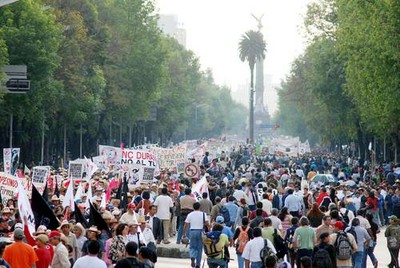
A CNC (Confederacion Nacional de Campesinas, the Farmers’ Union) sponsored megamarch brought out 50,000 (by government estimates) to 130,000 (by CNC estimates) protesters into the streets. The 10-lane (with a center mall and two pedestrian walkways on either side) Paseo de la Reforma was completely blocked off by protesters, who also torched a tractor at Monumento de la Revolucíon.
The farmers — some of whom walked to Mexico City from as far away as northern Chihuahua and Sonora — are protesting the end of tarriffs on Canadian and U.S. imports, especially of corn and milk.
Sugar tariffs also ended January 1 under the NAFTA agreement.
The 5-million member CNC is looking for renegotiations to NAFTA, claiming that “government subsidies their counterparts in Canada and United States receive are unfair. CNC said farmers get some 20,000 dollars in annual subsidies in the United States compared to only 700 dollars in Mexico.”
Watch their language
Anti-immigrant paranoid, conspiracy mongering lonewacko.com tipped me off to this compliation of the greatest hits of the … uh… usual gang of idiots.
War… what’s it good for?
The White House will ask Congress next week for another $70 billion for the wars in Iraq and Afghanistan, an amount that would help cover operational costs only until early next year when the next administration takes over.
According to how estimates are done, somewhere between 21 and 51 percent of the United States Federal Budget ($2,387 billion)is for defense and military spending (the high estimate – $1,228 billion includes military pensions, veterans benefits and debt services for previous military expenditures).
The Mexican military budget (as a percentage of the National Budget) has been falling since World War II (even during the war, the budget was rduced — a rather neat trick I cover in my soon to be published book) and the Mexican military actually returns a small profit to the government (natural resource protection is a military mission, and planting fruit trees to protect watersheds — and selling fruit — is a legitimate military activity; the soldiers’ and sailors’ bank is a mortgage lender; and Mexican military sales to foreign countries — mostly trucks and uniforms — bring in the dough).
Given the creeping militarization of police (and political repression) and raises for soldiers is up this year, the Mexican military budget is up… a whopping 0.44% of the Mexican Gross National Product is spent on defense… 34,861,500,900 pesos (3.2 billion dollars) is the estimate for FY2008 …mostly salaries for the 245,000 men and women (the highest percentage of women soldiers in Latin America)
Per capita, Mexico’s military is about the same size as Ecuadors, and in numbers is equal to Chile’s… both much smaller nations. On the other hand, who has Mexico ever invaded. Other than U.S. gun runners (and their customers, the U.S. financed drug dealers), Mexico doesn’t have any foreign enemies, and hasn’t pissed anyone off recently. Like, say, Iraqis, Afghans, Pakistanis, Cubans, Venezualans ….
“No nookie for you” and other signs of the times
I don’t think you could ever print something like this in a U.S. “family newspaper”. And, I have to admit, my translation had to play fast-and-loose with some phrases… a few of which I’d never heard before.
The original (Prohibido cachondear frente a la virgen) was published in the 21 January 2007 Milenio, written by Juan Pablo Becerra-Acosta M.
The best translation I can come up with for the sign in the photo (and the original title) is “No horniness in front of the Virgin.” A sign you won’t see in the U.S. either!
The little parish church of Saint Bartholomew theApostle, in the Naucalpan suburbs, has a pocket park in front where an enormous sign warns:
“The vestibule and the congregation deserve respect. We prohibit loving couples. Please go elsewhere.”
The spend the lunch hour here: Secondary school kids who usually only travel in packs come here in pairs looking for a shady, discrete place. After a few minutes of whispers and giggles, the pubesce nt lovebirds gaze in each others eyes… their lips graze … and their adolescent bodies come together. Some, sitting near us, are discrete, but others are bold in their caresses: a boy takes his ease on a bench, his girlfriend hikes her leg on the bench, exposing firm young flesh. The peach-fuzzed badboy tremblingly slides a hand up the leg, arriving in the vicinity of white, fresh panies, where the exploratory finders of the youth remain for several seconds. Suddenly, the girl turns away, but settles on the lap of the now delirious youngster. And there they are, for several long minutes. He an amazon, he a rampant stud … until a passing patrol car lets loose with a howling siren, and the gasping couple untwines themselves and make a hasty departure.
[… wooo! I need a cigarette! Back to the translation…]
Rodolfo, the little man who takes care of the church for its pastor, Father Gabriel, is sweeping up the leaves that have fallen in the park. Yes, he saiys, they do call the police about the youngsters.
“They are like little dogs after other little dogs in the street. Next thing, they’ll be laying down on the grass. It is a horrible and frightening thing, gentlemen. For that reason, the Father will be closing the gates to our little park. This kids come here and it gets ugly. These are things not meant to be seen by priests. They should be in a porno movie, gentlemen.”

The photograph was taken outside Metro Indios Verdes. “What gives,” I ask a vendor near an altar.
“Oh, the usual thing,” she says. “Its not the kids coming to buy breakfast, but the kids that are horny- We tell them to go find some other place, but they say they’re not doing anything wrong… and that a little kiss in front of the Virgin is a sign of respect, nothing more.
***
In Chapultepec park, near the lake and the El Sope running track, Pro Bosque [a “friends of the park” charity] has posted a confusing sign: “Adding graffitti? Want to erase it? Throw trash? Damage Trees?” Perhaps it means you should mark the trees, so they can be scraped. Or you should trow your trash around, and kill the trees.
The intent was to remind people to just walk in the park, but here, like the area around the Cafetería Las Ninfa, where the lights are low, people act out – throwing trash, or themselves in pairs upon the lawn. Or, well … in the parking lot (there’s two now)… in the parking lot. The laid back, elderly lot attendant, Don Alfonso, said that almost every day, police patrols “give the fuckers a ticket,” or at least tell them “get a blanket.”
“Of course, that’s an exaggeration,” Don Alfonso points out. “Until they get down, there’s not much going one but holding hands and kisses… hard and heavy kisses, to be sure.”
A well-dressed young woman, in fashionable sports clothes, who arrived in a Seat [a fairly-high priced auto] is warming up for her run. Marina, from Los Lomas, comments: “Of course, people do things. But they need to get a hotel room. Puleeze!”
In Parque México. Hipódromo-Condesa, the sign reads “Please use park benches appropriately.” .
“Dude,” says the maintenance man, “we need the cops down here to at least write tickets. Look (indicating two couples in different parts of the park, wrapped up in themselves): drinking beer, smoking joints and bouncing the benches til they’re ready to break. Seriously, man… go down by the duck pond, and guys are getting naked. And those guys… you’d think they were in their own kitchen.
Two Condessa girls, listening to their Ipods on a bench, protest. “He’s dense. There have to be places to go. Who cares who is kissing whom… it’s nobody’s business. If we start banning everything in this city, it’s no longer “el Deyeffe”…”
The logo at Reforma 222 — a commercial and luxury apartment complex (featuring three-bedroom apartments, a virtual concierge, gym, pool, handball court, indoor jogging track, video room and events center), located at the corner of Insurgentes and Nápoles – reads “Another way of life”. But, the private security force are regularly escort out gay couples for doing nothing more than holding hands. Their improbable defense: “We’re not an assault squad, and we’re not homophobic. But we can’t permit these kinds of excesses. We’ve caught guys in the back (where is still construction and there are storage rooms) with their pants down, going at it. This isn’t anything against gays. There are men and women who get carried away in the fast food court, too.”
In El D.F., if you are suddenly overcome by desire, read all appropriate warnings before proceding.
“The shadowy bastard child of NAFTA”
“Grits For Breakfast“, which covers (and covers very well) what passes in Texas as “justice” expands his horizons a bit to look at one key player in Mexican drug cartel violence — money launderers.
It’s not something I’ve followed closely, but Grits (aka Scott Henson) has been keeping tabs on… as has WFAA-TV’s Byron Harris, who has “followed the money.” Last month, Harris reported on Ex-Im Bank loans tothe Juarez and Sinaloa cartels. Which means you and I — the taxpayers of the United States — are loaning money to gangsters.
The U.S. government is underwriting corruption and murder in Mexico quite openly… no need for some big secret CIA plot needed. .
Grits reports that Ex-Im is claiming it’s cleaned up its act. OK, sure. And we don’t waterboard suspected “terrorists” either.
Oh well… I guess this blows the idea that there are “pure” capitalists. Even drug dealers need government handouts to do business.
Economy heads south… maybe literally
The Mexican new housing market is booming and the Bolsa rebounded, “closing up by 6.36 percent, the largest surge since June 2006, reaching 26,892.74 points.”
Ana Maria Salazar writes that the “stock exchange increase was a positive reaction in response to the U.S. Federal Reserve announcement cutting the benchmark lending rate by 0.75 points, three-quarters of a percentage point.”
Normally, when the U.S. economy catches a cold, Mexico develops pneumonia. While Guillermo Ortiz (the Bank of Mexico’s Governor… more or less like the Chairman of the Federal Reserve in the United States) warns that a U.S. recession will affect Latin America, and experts at the Davos Forum think the U.S. is already in a recession, he is hopeful Mexico can weather the storm. Felipe Calderón is also saying the Mexican economy is prepared to withstand a downturn north of the border.
I am not an economist and I don’t pretend to have inside information on … almost anything… but there seem to be a few things working in Mexico’s favor right now.
Mexican exports to the U.S. — oil, automotive parts and narcotics — are not going to be affected much. Even if the U.S. cuts oil imports, it will be OPEC that’s affected. Mexico oil (already somewhat underpriced) will still be needed… and the U.S. needs the business PEMEX provides.
If new car sales are down, the market for auto parts is going to go up. Gringos aren’t going to give up their cars.
Narcotics are not a luxury item for their users. And, something that I always found amusing (and remember from a statistics class as an warning about being careful to draw conclusions from statistical data): church attendance and narcotics use increases in a bad economy. I suppose Mexico may be able to also export Catholic priests.
Another upside: I’ve thought for years (and it’s one reason I think the Mexican left, over the long run had the better economic prescriptions) that Mexico depends too much on the U.S. for exports, and needs to diversify. Less sales to the U.S. — and the need to find financing elsewhere — will increase trade with the rest of Latin America, and maybe convince Mexico to forge closer ties with the Banco del Sur/Mercosur countries.
Agriculture is already in the dumper, but with less exports, there may be a better domestic market for Mexican vegetables and fruits (and maybe we’ll finally start getting decent Mexican coffee in Mexico)
Downside: I suspect remittances have been a huge factor in the Mexican building boom… and have been invested in the domestic market. With less work in the U.S., Mexican remittances are going to drop… and there will be attempts to “blame” the recession on Mexican workers sending money home (even though all data shows remittances are good for both the employing and employee-providing countries) .
Tourism will probably take a hit, but with retirees having to scale back, more will probably consider Mexico a viable option. And, if people aren’t spending as much on travel, they will be spending more on books… GOOD! However, in the short run, I’ve already become a victim of the recession we don’t have. I make my living driving a van for the railroad, but — and I don’t think the press has noticed — there aren’t as many trains passing through lately. Hopefully, that’s not a sign of anything, but my income is about half what it normally is, during the usual bad times. I still need to pay off two large loans, buy tires and have some mechanical work done on the old Volvo before I go south myself…

There will (not) be blood
Lynn Brezosky in the San Antonio Express-News (via Houston Chronicle)
LA GLORIA — The bleachers were full, the air rich with the aroma of fajitas, the matadors resplendent as the sixth season of corridas, or bullfights, at Texas’ only exhibition bullring got under way.
After the opening act — Guapo, the dancing horse, pranced sideways and backward, lifted its hooves, and curtsied to ranchera music — a tractor combed the dirt.
Announcer Lyn Sherwood prepped the crowd. Many were white-haired retirees from Northern states, “Winter Texans” taking in part of the tapestry of the Mexican border. Others were families from surrounding miles of lonely ranchland. Most had never seen a bullfight.
What they saw last week at the Santa Maria bullring wasn’t a classic bullfight, with a half-ton animal weakened by lances and barbs but still capable of killing the matador with each pass at his cape before being killed himself.
By U.S. law, there can be no blood and no kill, only a final swipe by the matador to remove a rose attached to the back of the bull. Without the lancing during the picador phase, known as the Tercio de Varas, the bulls must be smaller.
But the essence of the bullfight is retained, owner Fred Renk said, and spectators are able to experience the dance of man against beast, which he said is as ancient as the walls of Crete.
Renk, 71, inaugurated the 30-foot ring at his ranch 60 miles northwest of McAllen in 2002. He named it for his patron saint and installed a small prayer chapel for the matadors under the stands.
It was the realization of a dream dating back to his own days in Mexico City, when he abandoned plans to become a priest in favor of becoming a bullfighter. He fought as a novillero, or novice bullfighter below the rank of matador, from 1958 to 1967.
His son, 44-year-old David, made full matador in 1981 and earned respect even in the most snobbish of bullfighting circles as El Texano. He was the sixth U.S. matador in history and the only American to confirm that status in Mexico City’s La Plaza Mexico, the largest bullring in the world.
[…]
I have yet to write on two Texas-born bullfighters who particularly fascinate me: Patricia Hayes, who threw up her music studies at North Texas State College in the early 1950s to move to Mexico City and take up a respectable career as a”the Grace Kelly of the Bullring” and Patricia McCormick of Big Springs, Texas.
Bullfighting is not nearly the elitist sport we think. There have been women bullfighters (including the two Texans), gay bullfighters (see Ernest Hemingway’s “The Mother of a Queen” — incidentally Hemingway’s only story with a Mexican protagonist, or the somewhat NSFW gay Turkish site, Casual in Istanbul — gay Turkish bullfight fans… who knew?) and tauromachia has been racially integrated as long as “race” has been a factor in our thinking.
While tauromachia has roots going back to ancient Crete, the modern bullfight celebrates the common man (never mind the fancy suits). In the 18th century, the sport radically changed: before that it was meant as a ritual glorifying stratified social classes. The picadors – representing the nobility – were protecting the unarmed peasant from the forces of nature. When the matador first took up the sword in the ring, the commoners came into their own. And, became demi-gods. In their traje de luz, the matador – a common man (or woman) – takes on an almost mythic status. Unlike other “mythic” creatures like rock stars or pro athletes, the matador in a very real sense is putting his (or her) humanity on the line. A “bloodless” bullfight misses that “point” … Becoming one with nature is not risk free.
Hemingway’s story (which is somewhat difficult to find) is less about bullfighting (or gays) than about accepting our place in nature, and our own mortality. The greatest of twentieth century matadors, Silverio Perez, (who lived to be over 90 by the way) spoke and wrote of his art almost as if he were writing Buddhist precepts. “Only by becoming one with our fear, and the bull’s fear, and becoming one with our own mortality, are we alive,” he wrote.
And, consider this. In Texas, you can’t stab a bull, but you can shoot your neighbor. ¿Qué barbaro?
On MLK Day
It is a sad fact that because of comfort, complacency, a morbid fear of communism, and our proneness to adjust to injustice, the Western nations that initiated so much of the revolutionary spirit of the modern world have now become the arch anti- revolution – aries…. If we will make the right choice, we will be able to trans- form the jangling discords of our world into a beautiful symphony of brotherhood.
Martin Luther King, 04-April-1967

Yes, things have changed for the better since 1967, but we’re still destroying ourselves with our comfort and complacency. For the sake of midwesterners who can’t get around having to listen to a short telephone message in Spanish, we’re taking land and civil rights from people along the border (and how far from the border do we need to live to have our rights as American citizens?). For our comfort and complaency, rather than deal with our overdependence on foreign oil (or maybe look at a different mode of transit than huge SUVs), we attack other countries, and subvert our neighbors. We HAVE given up our “morbid fear of communism”, only to replace it with a morbid fear of populism and/or “terrorists”. We adjust to injustice — expecting working people to hold down two or three jobs just to afford to be able to see a dentist.
Mexico is not a perfect society, not by a long-shot. But at least I’m going back to someplace where “the revolutionary spirit of the modern world” still lingers… where no one would think of starting a foreign war… for the comfort and complacency of the people, or out of a morbid fear of anyone. Someplace where “adjusting to injustice” means having to stand in line to see the dentist… where there is still greed and abuse, but at least it’s nakedly presented, and openly challenged.
It’s my birthday too… all I want to to pay off my bills before I leave the country (and a new set of tires would be nice!):
Be careful what you wish for
Latina Lista, writing about the woes of Oklahomans faced with strict anti-immigrant laws, ran across this gem in the Daily Oklahoman:
I live here in Arizona where the infamous sheriff of Maricopa county has the” Immigration Fever” and his politics is beginning to hurt in the county pocketbook.
The illegals that were trying to get a work release and come here to work in the low paying sector has been run away. Now the Unions are sending people in to get these jobs, but they want two thirds of a higher salary. Maricopa county is now in financial trouble.
Well, doh! Non-documented laborers had to work for lower wages, and drove down incomes. Or so we were told. So, documented laborers, earning a real wage, are worse?.
The only “respectable” anti-immigration argument that was around was that somehow being an undocumented immigrant was costing the taxpayers money. I guess folks will just have to go back to their old nativist bleatings, and give up on attempts to sound like anything other than the idiots and racists they are.
Another one bites the dust
In case anyone is keeping score, since George W. Bush was “elected” in 2000, Argentina, Bolivia, Brazil, Chile, Ecuador, Nicaragua, Panama, Suriname, Uruguary, and Venezuela have all elected leftist or social-democratic leaders. Add Guatemala to the list.
Alvaro Colom, a social-democrat, was elected on the UNE ticket, seems to offer a program similar to that offered by Mexico’s not-elected (by 0.05 percent) Andres Manuel López Obradór: expanded social spending and integration with Latin America, and attacking crime by going after the root causes — poverty and corruption — rather than the approach favored by both Colom and AMLO’s main rivals — the hard hand.
Colom is an intriguing figure. His uncle was the martyred mayor of Guatamala City, Manuel Colom, who was one of a spate of left-leaning democrats murdered after Guatelemala supposedly returned to Democracy. The new president’s background as a business executive and social services administrator (the big scandal in the election involved supposedly diverted funds from his campaign going to social services — even if true better than the other way around) is about what you’d expect for the president of a small country. One other interesting piece of trivia: those a “ladino” (a Guatemalan of non-indigenous ancestry) he is a Mayan priest.
Other than bananas (and workers) Guatemala doesn’t have much in the way of resources — no oil to make the election caputure the attention of the U.S. It has already signed on to CAFTA (the Central American Free Trade Agreement) which hopes to repeat the mistakes of NAFTA over a wider area.
Under the Spanish, Guatemala was a “vice-viceroyalty” of Nueva España, and until the 1820s, its history is Mexican history. Chiapas was once part of Guatemala and is a slightly better-off version of conditions in Guatemala. The Revolution never having reached Guatemala, it’s indigenous population has never had the advantages of legal equality.
Though, both in Mexico and Guatemala, Mayans have been treated as less than human, and often denied their civil rights, Mexican Mayans could at least get an education, vote and a wider economic and social sphere than their relations across the border. In 1954, Jacabo Arbenz, a rare democratically elected president, was overthrown in a bloody coup. His “crime” was attempting to nationalize the banana industry, and reform agriculture, modeled on Lazaro Cardenás’ nationalizations in 1930s Mexico. Unfortunately, the foreign entity controlling Guatemalan bananas was the United Fruit Company. One of the directors of United Fruit was Alan Dulles, the director of the CIA.
Arbenz was painted as a “Communist” (much as Venezuela’s elected left-wing leader, Hugo Chavez, is) and overthrown in a not-very-covert — though very bloody — coup. Guatemala remained under military dictatorships until the 1980s, democracy sacrificed for bananas . The bat-shit crazy Guatemalan dictator of the 80s, Efríam Rios Montt, was …well… bananas.
With no legitimate route to change, Guatemala had been in the middle of an on-and-off civil war since Arbenz was tossed out. Rios Montt launched a “scorched earth” campaign against his own people — or rather, the Mayans. Allegedly putting down Communists, Rios Montt was of the theory that he should “kill em all and let the Lord sort ’em out.” Like Colom, Rios Montt was also a minister… though in his case, it was a California-based Fundamentalist Christian sect that won his allegiance.
A Mexican brokered peace agreement ended the “official” civil war in 1996. While largely a forgotten step-child of Mexico, foreign reaction to Guatemalan events influences Mexican actions. After the 1954 CIA-sponsored coup, Mexico foreign policy turned conservative and did not seek to challenge the United States. The “socialist” PRI began repressing leftist challenges where before Mexican leaders coopted them, or made space for them within the system.
Rios Montt and the odious right-wing dictatorships that were only slightly better sent waves of Guatemalan refugees into Mexico… When the United States began withdrawing its support for the Guatemalan dictators, Mexico began making space within the system for indigenous groups and paying more attention to indigenous affairs. In many ways the latest in a long string of Mayan uprisings (the Zapatista movement) was a indirect result of the Guatemalan situation. The Mexican Army would not have been in a confrontation with the Mayans had it not been for the refugees, nor would there have been a push to identify Mayan dissent with the left if it hadn’t been for the U.S.-backed regimes in Guatemala.
And, while you are already starting to hear rumbles on the right that Guatemala may be “going left” (well, it is… but “going commie” has lost its cachet and now countries “fall under the sphere of influence of Hugo Chavez”) I’d expect Mexico is going to recognize that the U.S. is losing its hegonomy in the region, or — at least — is starting to recognize that social democrats are not a threat.
( A bit off topic, but I don’t know how to insert a footnote when writing directly on “wordpress”: Paraguay is also likely to join the left-list — and, there too, it is likely to elect a clergyman as president. Though Fernando Lugo Méndez is more what you expect a Latin American clergyman/leader to be: he is — or was — a Roman Catholic bishop).
Note to Mobile/Exxon stockholders…
… don’t start drooling over the prospect of PEMEX being open to foreign investments. With the continued push by the Calderón administration to open Mexican oil production to foreigners, the assumption in the U.S. press is that somehow this means more business for OUR oil giants. There are other players, much more likely to work with a national oil company.
TEHRAN, Jan. 20 (MNA) – There is a fertile ground for more cooperation between the Islamic Republic and Mexico, Iran’s First Deputy Foreign Minister Alireza Sheikh-Attar said in a meeting with his Mexican counterpart Lourdes Aranda on Sunday in Mexico.
Iran and Mexico plan to hold the third joint economic committee meeting in Tehran.
Sheikh-Attar said the meeting will be an important step in fueling the economic cooperation between the two countries, the Foreign Ministry press department said in a press release.
Extending ties with Latin American states is a foreign policy priority for Iran, he pointed out.
Aranda said that the two countries can cooperate in various fields and called for sharing Iran’s experiences in oil sector.
“Oh, grow up”
Call it “opposition research” or call it masochism, but I regularly look at the crazy right-wing websites. Even the not-so-crazy ones are clueless about the border economy.
I’m not sure its even worth trying to respond to people who have already made up their mine, and don’t want confused with the facts. When I point on (on this site) that there are serious economic and other concerns about a border fence, the best anyone can come up with is “well, you should want your local economy destroyed, put up with federal agents and environmental degradation.”
Ignorant comments like this (from this site) are common enough:
I would think that every true re-blooded American citizen would have no problem, or even appreciate the fact, that the federal government has finally gotten off their collective asses and are doing something to secure our southern border. But, that’s only the feeling of one true red-blooded American citizen.
The poster “thinks” without knowing a damn thing about the people who live here, their lives … or much of anything apparently. And, what really amazes me is that even in “mainstream” media, people are so willing to eschew their usual reasoning to twist their minds around the concept of a Mexican border fence. The same people who were arguing for local control, or who back environmental preservation… or who believe in the free flow of goods and services… suddenly concoct an exception to the rule to justify denying us the same rights and expectations they have for themselves.
As a “thought experiment” I used to point out that if “terrorists” (and they usually mean foreign ones, not our homegrown ones, that are never spoken of) we’d be stopping British and Canadians from crossing the border, not Mexican farmers. At best, you hear that there is a “potential” threat (in which case, you’d think the government would seal off the known threat first).
Even people who should know better will ultimately resort to bigotry: “PressOne for English” is “immoral” or “they” aren’t like us. So — neither were my German-speaking ancestors, nor the masses of immigrants who came into the United States AFTER the Mexican-American War.
It’s not the “terrorist” threat at all, but local economic worries in a few places about “illegal immigrants” (and it’s dubious whether “illegal immigrants” are screwing up the economy even in those few sectors like home construction or restaurant services). Of course, people are going to look at their own pocketbook issues (and so are we).
Is it too much to ask better from our government officials? Yup:
Our Department of Homeland Security is an example of the federal government’s ignorance about what’s really going on along the Mexican border.
It’s just the latest example.
When we contact Washington and say, “Knock, knock,” Homeland Security doesn’t say, “Who’s there?”
No, Homeland Security Secretary Michael Chertoff says, “Grow up!”
This is in connection with new security measures that go into effect at U.S. ports of entry. That has to happen; we must secure our borders, and real proof of citizenship when entering the U.S. is a necessary step.
Meanwhile, even before the new rules, wait times on bridges have become too long. In El Paso, that hurts the flow of commerce, thus is a negative hit on the economy.
But when concerns about even longer wait times were aired, Chertoff told us to, “Grow up.”
Mayor John Cook had a good retort. “I take that personally, when he says we need to grow up. I think I understand the border and I understand border security.”
Said Monica Weisberg-Stewart of the Texas Border Coalition’s immigration committee: “It comes across as a bullying, hard-handed insensitive way of dealing with a very serious problem.”
Beginning Jan. 31, and we’ve known this for a long time, we will be required to present either a passport or a photo ID along with proof of citizenship (usually a birth certificate) to cross back into the U.S. on foot or in a vehicle.
This, we all understand, means that more “paperwork” will be involved, and that Customs and Border Protection will have even more to do.
However, from Chertoff’s statement, it doesn’t appear Homeland Security is very far along with implementing ways to check those documents without causing even more bridge glut. Instead of saying, “Grow up,” he could have at least said the government was working hard on ways to get the lines moving faster.
We just don’t think either Chertoff or Congress has much of an idea what really goes on at the borders. El Paso is a major import city. If commerce is forced to idle on a bridge for up to three hours, goods do not move effectively to their destinations.
At least twice now, U.S. Congressman Silvestre Reyes has invited fellow lawmakers to come see border crossing in operation. He hosted a recent seminar at the Chamizal, where a handful of lawmakers heard concerns.
But when it comes to addressing our major concern — we rely on commerce from Mexico — we’re told to “grow up.”
We have a message, too. In fact, it’s a message we’ve sent all along to Washington, D.C. — get educated on border concerns.


