Nothing’ better for Thanksgiving
My best Thanksgiving dinner was at “el Rey de Pavo” on calle Simon Bolivar (or is it Motolinía?) — a little semi-hole in the wall joint serving nothing but turkey, 7 days a week — turkey tacos, turkey tortas, turkey soup, turkey mole… With limited seating, I had thanksgiving dinner with a bunch of jolly Quechans from Ecuador who’d come up to Mexico City to sell silk scarves on the streets.
OK, so we had to watch futbol, and not football. And the half-time show was a skinny old guy with a 12-string guitar. I had jamaica, which is the closest thing to cranberry you’re going to find in Mexico (it’s at least a pretty red color, and kind of tart)… but the basics were there. A peaceable dinner of corn and turkey with a bunch of Indians.
I don’t think the custom started with our Puritan Fathers, by the way… though the Plymouth Colonists and Squanto obviously got along a tad better than the folks at America’s first “inter-racial encounter” and dinner-party
Cortés had incredible luck off Cozumel. His ships were separated, and Pedro de Alvarado had arrived first. Alvarado, who turned out to be one of the greediest of the conquistadors, was stealing turkeys from the local villages when Cortés arrived. More importantly for Cortés, his crew had found two Spaniards. They were the last survivors of a shipwreck eight years earlier—the others had been sacrificed and eaten. Gonzalo Guerrero, a sailor, had married the local chief’s daughter. He had three children (these little Guerreros are probably the first modern Mexicans, mestizos – mixed bloods – part European and part indigenous), a responsible job as an advisor to his father-in-law and no intention of becoming a common sailor again.
The other Spaniard, Gerónimo de Aguilar, was a priest and carpenter. It was his carpentry skills that kept him alive; they made him a valuable slave. Father Aguilar was more than happy to be rescued. Slavery was bad and the human sacrifice worse,1 but what terrified Father Aguilar were women. As a priest, he had taken a vow of celibacy and the indigenous people simply couldn’t comprehend a healthy young man refusing to take a wife. Eight years of temptation was enough. He considered his rescuers God-sent. He spoke fluent Mayan and was more talkative than Melchor.
Father Aguilar preached a sermon in Mayan, pouring out eight years of built-up frustration and anger. Though the people had treated their visitors kindly and fed them, the Spaniards insulted their hosts, destroyed the local temple and sailed north. Landing at the mouth of the Usumacinta river (near modern Frontera, Tabasco), they found much warier Mayans—they had evacuated their women and children and cautiously approached the Spaniards, sprinkling incense. The Spaniards thought it was a compliment, but the truth is that Europeans didn’t bathe, and the indigenous people were extremely cleanly. The Spaniards smelled terrible, but the Mayans were much too polite to say anything about it.2
These extremely polite people fed the Spaniards a turkey dinner and then nicely told them to go home, otherwise, regrettably, they would have to kill them. The smelly Spaniards asked to visit the Mayans’ houses. The Mayans, still polite, suggested the Spaniards had missed something in the translation. Cortés trotted out his lawyers, read the official document and turned his cannons against the Mayan stone clubs and obsidian swords. It was only a test to see if cannons, horses and war-dogs were effective weapons. The cannons scared people as much as killed them. Horses were unknown in the Americas, and the only dogs were small animals (ancestors of today’s Chihuahua) that were used both for food and for pets. Melchor, the grumpy old cross-eyed fisherman, took this as his cue to exit history.
1 When she learned of her son’s shipwreck and his probable fate, Aguilar’s mother became a vegetarian.
2Americans, north and south, generally bathe daily—one of the few indigenous customs adopted throughout the hemisphere. In Mexico City, the custom is so well ingrained that “bath houses” are just that—places to clean up when there’s no water at home. This confuses some gay visitors, for whom a “bath house” has a different purpose, though such institutions also exist.
You can understand then, why Thanksgiving never quite caught on in Mexico… though they have their own turkey customs…
Now that you’ve digested your meal… time to watch a little turkey-related sports action: El Globo de Manteca contra el Pipilo… may be best gobbler win!


A tip of mi sombrero to Guanabee.com (and “viento” at tu.tv).
With friends like these…
For the last month, a Chamber of Deputies sub-committee has been looking into the finances of ex-president Vicente Fox. There are allegations that Fox benefited personally from influence pedaling and may have diverted Federal property to his own farm for his personal use (a Humvee that he likes to drive around the spread is always mentioned… Fox claims it’s for his security people).
Don Chente got a little testy the other day, when he was interviewed by the Spanish radio network, SER. He claimed he was the first Mexican Preisdent to give an accounting of his personal assets (not true: Juan Alvarado back in the 19th century was proud to still be a poor man when he resigned the presidency and grumpy 1950s president Adolfo Ruíz Cortones accounted for all his assets, right down to his wife’s second-hand Buick). Whatever, Vince…
If we don’t believe him — he’s got character witnesses: Colin Powell and George W. Bush. Colin Powell wouldn’t lie would he? And as to George W. Bush,… Mission Accomplished! An unimpeachable witness! 
Sieg Heil…
uh…
¡Juramos!
Did Mexico cause the war in Iraq?
It never crossed my mind before. Jose de la Isla on immigrants providing the funding Americans can’t…
A lingering question has surfaced: Did Mexico and the undocumented traffic that crosses its northern border into the United States cause the war in Iraq?
If “illegal immigration” is becoming a presidential-campaign issue, you should ask each and every candidate about his or her position on this.
The issue might have stayed in the closet had it not been for a recent essay and a round of commentaries in the highbrow tabloid New York Review of Books. It started this way. Christopher Jencks, in the Sept. 27 issue, presented one of the best summaries in print in the English language about immigration-policy issues. He was reviewing Patrick Buchanan’s ridiculous book, “State of Emergency.”
In his essay, Jencks argued that about half of the undocumented immigrant men and women hold regular jobs. The other half works off the books. The regular half provides employers with a Social Security number. The Social Security Administration credits their retirement accounts with both workers’ and employers’ contributions. But what if the account doesn’t belong to anyone? What if no one claims it at retirement time?
Jencks says State University of New York political scientist Peter Salins estimates that “no match” accounts hold more than $586 billion. Most “no matches” come from fake numbers that migrants use to get work when they don’t have legal papers.
There are two outstanding facts about U.S. immigration to take further into consideration. One is that migrants from Mexico make up 60 percent to 65 percent of this total (depending on the place, time and circumstances). And those who use fake, or other people’s, or made-up Social Security numbers may never claim the money they and employers contributed.
Basically, after the Treasury collects the money, it allows the Social Security Administration to carry the amount as a receivable for bookkeeping purposes. And Treasury uses the funds to pay other government expenses. The biggest one is the war in Iraq. Right now it is running, coincidentally, at $500 billion, according to the National Priorities Project.
If no one claims this Social Security windfall, it’s free money to pay for the war.
Some may claim the funds do not automatically go to cover war expenses. True. So let’s say it goes to Medicare and Medicaid and we launder it that way. That means undocumented migrants are actually huge contributors to the U.S. fiscal wellbeing.
Since Mexicans and “illegal immigrants” cannot be heroes in this scenario, would there have been an Iraq war unless they caused it? You know we would not pay for it in our right minds. Forget about the alleged falsified CIA-intelligence information, the invented “weapons of mass destruction” and the later argument about punishing Saddam Hussein for torturing his own people.
Couldn’t U.S. foreign-policy leaders now claim the war was really an immigration sweep to prevent “no-match” dollars from causing inflationary pressures inside the government? The war in Iraq was the fastest way to spend the money.
This has a perverse logic to it. By more tightly regulating our fluid borders immediately after 9/11, we forced millions of undocumented visitors from Mexico to stay here in order to pay for what they started.
So it makes sense then to have them pay. As a suspicious class of people, their illicit activities — like renting, seeking work, driving, having families, going to college, getting sick — is just like what terrorists would do. So it’s not demented to say these immigrants are not unlike terrorists. And it is not shameful for this nation to apply the unclaimed money to fight terrorism.
Nancy Conroy, at the Gringo Gazette, is the only person I’ve seen who is paying attention to this:
The United States and Mexico recently unveiled a new $1.4 billion anti-drug aid package that aims to help Mexico fight the drug cartels. Although most commentators have applauded the goals of the program, one troubling aspect of the aid package seems to have escaped public notice. Apparently, the appropriation program calls for the use of private contractors to help Mexico fight drug dealers.
…With private contractors as part of the deal, the $1.4 billion dollar aid package could begin to look like a Trojan Horse strategy. Under the guise of a generous gift to Mexico, whoever controls the private contractors could be cleverly inserting their shady operatives into key anti-drug enforcement positions. The Gringo drug dealers operating in Mexico used to be corrupt elements of the CIA and the DEA, but now maybe the mercenaries are the new kids in town.
Los Zetas… Blackwater… what’s the diff?
This could get ugly
Even Argentines know Argentines are arrogant jerks, but once in a while they have to broadcast it to the world…
 The pPasty-looking bald guy with the scraggly beard at left is Jorge Lafauci. He’s a judge on one of those witless “Dancing for Dinero” shows that TV networks sell when they run out of creative ideas. For what it’s worth, the Argentine network must have run out of ideas for names of shows too… “el show” is called “Esta el show”.
Lafauci was overheard on Argentine national television saying “Mexicans are the ugliest people in the world, and they don’t know how to dress.”
On the second point, I have to sometimes agree.
It pays to advertise…
While today is the official holiday, tomorrow (20 November) is Revolution Day, commemorating Francisco I. Madero’s “invasion” of Juarez…
Madero was a bit of an odd duck (he dabbled in spiritualism and wrote pseudo-Hindu philosophical essays) and would have made a fine character out of a 19th century novel… but, in staging his revolt, relied on post-modern techniques like “media spin” and corporate sponsorship.
A friend at ThornTree wanted a “sample” of what I’m putting in Gods, Gachupines and Gringos … and so… here’s a sample.
The wonderful photos are from the University of Texas at San Antonio Institute of Texas Cultures collection. I don’t have a web copy of the photo of Madero’s headquarters with the Bell Telephone logo, but there is one in the collections of the El Paso County Historical Society, reproduced on page 87 of David Dorado Romo’s absolutely wonderful “Ringside Seat to a Revolution (2005, Cinco Puntos Press, El Paso).
The railroads had been Díaz’ most important contribution to pulling México into the modern age. While the trains were designed to take products out of the country and still left one region isolated from another, most parts of the country were—for the first time—within a day or two of Mexico City. The viceroys had been able to “hear, but not obey” the king of Spain. With trains able to carry soldiers even to isolated state capitals, governors heard and obeyed Porfirio Díaz. But Porfirio needed the railway workers. They were essential to the Mexican economy, and they knew it. Even if the foreign workers were better paid than Mexicans, the Mexican railway worker was still better paid than most other workers. The railways attracted the skilled and ambitious. Most could read. Brakemen, engineers, baggage handlers and tracklayers knew each other and had contacts throughout the republic. Even without a union, they had been able to obtain some benefits. And they weren’t shy about sharing their organizing skills and insights with other workers.
The railway workers knew México—and often a good part of the United States, as well. Díaz might have an army, but the army couldn’t go anywhere without the railroad. Francisco I. Madero—the little rich boy with the squeaky voice—had the railroad men.
Díaz canceled the elections and for the first time in many years ignored the democratic facade he had so carefully maintained. Madero, operating from relative safety in the United States, continued writing. The railway workers—helped by the railway unions in the United States—smuggled in Madero’s articles, along with other revolutionary propaganda and guns. México was set for another rebellion. Madero took out advertisements in Spanish-language newspapers along the border, announcing that the Revolution would start 20 November 1910. The railway workers sent the information south (amazingly, Mexican newspapers reported on this strange advertising campaign—and even reprinted the advertisements—as news, of course). And…much as it goes against the Mexican stereotype, the Revolution started on schedule.
On the appointed day, Madero—who with his wife had spent a busy week attending parties in El Paso while arranging for press coverage for the revolution and telephone service for his “Provisional Capital” (a storage shed sitting on the Mexican side of the border, behind an El Paso smelting plant)—crossed the border and posed for the cameras. He’d managed to talk the Bell Telephone Company into running a line across the border in return for hanging up a sign on the “Provisional Capital” that advertised the phone company and would be seen in the news photos.
Madero was by no means the first revolutionary to seek corporate sponsors but was probably the first to trade off advertising for technical support. The reporters asked their questions and took their photos, and the Revolution was on.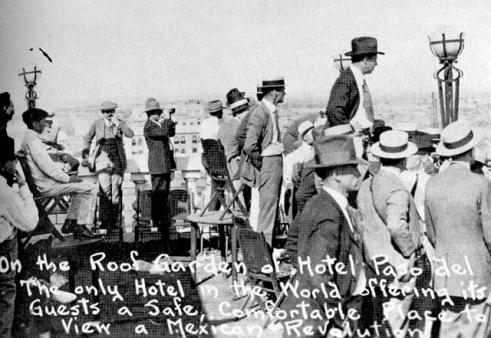
The reporters did the job Madero expected. Other than a short battle in Ciudad Juárez (there were a few casualties in El Paso, Texas—people don’t get to watch a foreign revolution from their rooftops every day, and a few stray bullets crossed the border) With advance publicity, enterprising photographers had stationed themselves throughout Juárez. Colliers’ Magazine—at great expense—hired an airplane hoping to scoop the competition.)

Madero didn’t have much of a revolution. There were “spontaneous” uprisings throughout México on 20 November, but they went nowhere. However, the news photographs of the Battle of Juárez, made it look important — and, sometimes looking good (or bad) is more important than being good (or bad). Porfirio, seeing the photos, knew his time was up, and made arrangements to sail into exile. Interim president de la Barra’s first official act was to schedule new elections. He spent the rest of his six-month term cutting ribbons and dedicating monuments (with the Centennial celebration still under way, there were a lot of new monuments to dedicate) and filling key bureaucratic positions with Porfirio die-hards. Naturally, Francisco I. Madero won the election. José Pino Suarez, a newspaper editor, was vice president.
¿Por qué no te callas?
The second ever post on MexFiles was about my (accidental) meeting with Juan-Carlos II of Spain. His Most Catholic Majesty does have a tendency to act in rather unregal ways (which makes the guy human, not a jerk). Asking Hugo Chavez “why don’t you shut up?” probably was taken out of context, but c’mon… Hugo is one of the windier politicos around, and he does tend to go on... and on… and on… about almost anything.
Mexican politicos too are being told to shut up, though in Mexico, which isn’t such a bad thing at all. A new election law prohibits paid political advertising... which means Mexican political journalists, unlike those in the U.S. will actually have to talk about what the politicos are proposing, and stop farting around wasting everyone’s time talking about who has how much money to spend. In Mexico, where they’re a little more realistic about things, that kind of money is called by it’s proper name — bribes.
Our political writers will also have a hard time with another reform… no political campaigning until 90 days before the election (which has been the law for some time now… just that the rules have been strengthened). This means avoiding all those meaningless “debates” between 7 or 8 party pre-candidates and endless agonizing over which of several people who won’t be running for president to support (er… bribe).
And, in a really radical reform, it looks like Mexican politicans are going to have to hire people who do work, not “spin” their accomplishments. No more burying facts in some hagiography of your local politician. In the U.S., you get used to letters from your local congressman saying “Congressman Bilgewater announced today that he is in favor of mom, apple pie and homeland security…” After you read all about Congressman Bilgewater, you learn that a congressional committee considered a proposal to add funds to some obscure budget line item to fund more hay for Border Patrol horses.
Official propaganda (and that is the correct word for information from the State) can no longer even suggest being presented for the benefit of any individual or political party. WOW! Maybe these congressional aides, city assistant liaisons and so on and so forth will have to find real jobs. One can only hope they’ll be replaced by people who actually do stuff.
The people speak…

Do as we say, not as we do
The … federal prison system is plagued by overcrowding, limited alternatives to incarceration, and is facing challenges created by prisoners involved in narco-trafficking.
No, that isn’t Scott Hensen talking, though it could be any expert on incarceration in the United States. It’s from an unidentified document “obtained by the Washington Post” outlining U.S. strategies for Un-Plan Mexico (i.e., “Plan Merida”, aka — “throw money at the Mexicans, and hope they stop us from buying narcotics”). The only difference I can see is that the U.S. prisons are overcrowded with narco-buyers, and Mexican prisons with narco-sellers…
SO… what do our great minds in Washington propose. For starters…
…the document states that Mexico’s military, known by its Spanish-language initials SEDENA, is better suited to interdict drug shipments, especially those in remote areas, than the Mexican federal police or the customs agency.
In other words, don’t fund crime-fighters (i.e., police), but make this a “national security issue” and turn it over to the military, which the report also wants funding for — to improve their human rights record (or at least sell advertising about their human rights record…
It sounds like a sop to all those “political consultants” (spin doctors) who will be out of a job now that Mexico reformed (once mor) its electoral process and banned outright all paid political advertising. Guys like Dick Morris and Rob Allyn are going to need some way of receiving funding from the Mexican government for their work on behalf of the Republican Party…. but more on that later).
Out here in West Texas, we have not exactly enjoyed peace and tranquility when the military has come in to act as policemen. I wonder how many people outside THIS area ever have had to tolerate being under occupation — but, what the hey, the Mexicans won’t complain, right?
OOPS…
The U.S. effort to sell the plan in Mexico, where there is an ongoing debate about whether the military should be involved in drug campaigns, has been hampered by inaccurate reports in Mexican media that 60 percent of the package would go to the Mexican army and navy.
Those silly Mexicans… only 40% is going to the military: a measly 200 million dollars of your tax money. The rest we expect to spend convincing the Mexicans to change their legal system to fit our need to prosecute their people who sell the drugs we want to buy. And to stop the flow of guns — and money — from us to our suppliers.
OK, why don’t we stop the gun and money smuggling, and just keep our $500 million at home… and maybe clean up our own prisons.
NAH… too simple.
Photo of the week

Well, why not? Oysters are aphrodisiacs!
Burro Hall managed to uncover this from the hilarious “Mi blog es tu blog”, big time financial reporter Laura Martinez’ twisted look at her native country.
It isn’t supposed to work this way…
Nov. 16 (Bloomberg) — Mexico’s economic growth accelerated in the third quarter, spurred by construction projects and U.S. demand for manufactured exports such as automobiles.Gross domestic product, the broadest measure of a country’s output of goods and services, grew 3.7 percent from a year earlier, the fastest pace this year, after expanding 2.8 percent in the second quarter, the government said. Mexico’s growth has quickened for two straight quarters, reversing a slowdown that began last year.“Mexico’s economy is strong,” Omar Borla, a senior Latin America economist with Dresdner Kleinwort in New York, said in an interview. “The third quarter shows a good recovery led by manufacturing and construction.”
Normally, “when the U.S. catches a cold, Mexico gets pneumonia,” but the Mexican economy has been developing an immunity to U.S. downturns over the last few years — becoming less dependent on U.S. trade.
Mexico’s economy is better positioned to withstand a slowing U.S. economy in part because of rising sales to Europe and Latin America, said Gray Newman, senior Latin America economist at Morgan Stanley.
Mexico’s sales to the U.S. as a percentage of total exports peaked at about 90 percent in 2001 and since have fallen to about 80 percent, according to the statistics ministry.
According to a Morgan Stanley report published Oct. 22, the U.S. accounted for 41 percent of Mexico’s total export growth in the first eight months of the year. Europe and Latin America accounted for 43 percent. In 2000, before the U.S. and Mexico went into recession, the U.S. accounted for more than 90 percent of Mexico’s export growth, according to the report.
“There has been a decoupling of sorts if you look at the rate of growth of Mexican exports to non-us destinations, Newman said. “It’s pretty striking.”
Growth in U.S. consumer spending and more domestic infrastructure spending also accounts for the relatively good Mexican economy. Mexican economic growth is still lagging behind other Latin America nations — specifically those that have turned their backs on “neo-liberalism” — Brazil, Argentina, Ecuador, Uruguay — all considered “leftist-populist” governments, with policies similar to the PRD’s.
Neither Calderón, nor Finance Secretary Augustín Carstens are stupid. They recognize, like every other Latin American leader, that the present “Free Trade Agreements” aren’t “free trade” and don’t lead to growth. With a falling U.S. dollar and less sales (outside of Mexican made “American” automobiles) to the U.S., there isn’t much for the Bush administration to sell except rhetoric:
Politicians find it exceedingly difficult to explain free trade’s virtues without drowning the listener in a torrent of common coinage. For a recent example of this, take President Bush’s speech in Miami, designed to shore up flagging congressional support for pending free-trade agreements (FTAs) with Colombia and Panama. Echoing those all-too-familiar Bush bromides, he insisted that approving these FTAs would fortify “freedom,” strengthen “democracy,” and increase “prosperity” in Latin America.
As I’ve said before, PAN sort of won the Presidency, but the left won the election (after all, 2/3rds of Mexican voters chose socialist or social-democratic parties in 2006). With a string on PRI and PRD victories of late in state elections, and more cooperation between the two “revolutionary” parties (on a symbolic issue — secularism — PRI is supporting a PRD initiative, which is something of a change), I expect there will even less reliance on U.S. based policies in the future, and even under Felipe Calderón, an economic policy more in line with the other Latin countries.
This COULD (at the outside) include changes to NAFTA, if Mexico seeks closer ties to Mercosur. Both in the U.S. and in Latin America there is less and less support for the U.S. based “free trade agreements” and development funds… and more support for the regional economic blocs. Even the die-hard neo-liberals know a dollar ain’t a dollar any more.
Compare and contrast
Dr. Eugene “Gus” Newport appealed to the Episcopal Church’s House of Bishops to and tell the story of New Orleans, “how two years after the hurricane, the majority of people are still not back in their homes. Why isn’t the national media here, covering this story?” he asked.
New Orleans’ public school system entered receivership after the hurricane… while in Tabasco, where ONE MILLION people lost their homes on the second of this month, the state Education Secretariat announced that next Monday school classes will start up again in Villahermosa.
- I take it that means Monday, 26 November. 19 November is one of the new “Monday” holidays, the old 20 November Revolution Day. Wanna bet the “incompetent” Mexican Army even manages to get together a half-way decent parade in Villahermosa?
Médecins Sans Frontieres (Doctors Without Borders) has an update on recovery efforts on their site:
- While the water levels are dropping all over Villahermosa, certain areas of the town center are still under more than two metres of water. The district of Gaviota is among the most seriously affected. It is practically deserted, with the exception of a few families taking refuge on the first floor of their homes, living off their reserves and the assistance provided by the Mexican army. The vast majority of the inhabitants have taken refuge in temporary shelters in the vicinity, and the MSF teams have set up a reservoir of 10,000 liters of drinking water for them.
- In Frontera, a coastal town where the water levels have yet to drop and certain communities remain cut off, an MSF medical team has visited the area to evaluate the situation and participate in a distribution of drinking water set up by the municipality.
- Given the large-scale mobilization of the Mexican authorities and the progressive drop in water levels, the situation should revert to normal before too long. The country’s health authorities are undertaking epidemiological surveillance and starting a vaccination campaign against hepatitis A, measles and tetanus.
By the way… those of us in the Big Bend can make direct relief contributions to “Ayuda Tabasco 2007” at the Fort Davis State Bank — account # 893943.
Round, round get around — that damn fence
Unimpressed by claims that a border fence will do anything to curtail illegal immigration, the McAllen Chamber of Commerce has informally compiled a list of ways to defeat rhe barrier. Among our favorites:
- Employ the Jedi mind trick. “These are not the illegals you are looking for.
- Walk around with a cell phone saying, ”Can you hear me now?“
- Put on a hard hat, grab a clipboard and say you’re inspecting the wall.
- Wear a George Bush mask. No one will be surprised if you can’t speak English.
- Pretend you’re a Canadian–eh?
- Ask who ordered the pepperoni pizza.
- Build a Trojan Burro and mail it to Washington, DC.
- Walk backwards and say you’re leaving.
- Boat across the Gulf of Mexico to another state where there are no walls. Yet.
- Walk around it.
(Mary Jo McConahay in the Texas Observer, 7-Sept-2007)


