The Reuters-AP post below does not make this clear:
OAXACA, Mexico (Reuters) – Gunmen opened fire on protesters in Mexico’s colonial city of Oaxaca on Friday, killing a U.S. journalist and wounding several people at road blocks set up by leftists pushing to topple a state governor.Will Bradley Roland, a cameraman working with Indymedia New York, was shot in the chest and died before reaching the hospital, the independent news group said on its Web site.
Emergency services said the journalist died after being shot in the torso in one of two shootouts in the city.
Nine people, mostly protesters, have been killed in a conflict that began in Oaxaca state five months ago, when striking teachers and leftist activists occupied much of the state capital, a popular tourist destination.
Red Cross officials said several people were wounded in the shootings on Friday.
A Reuters photographer said protesters came under fire near barricades on the edge of the city, famous for its colonial architecture, thriving arts scene and indigenous culture.
This week, striking teachers voted to return to classes but many protesters say they will not back down until state Gov. Ulises Ruiz is ousted.
Critics accuse Ruiz of corruption and repressive tactics against dissenters, whose roadblocks have driven tourism from the city and hurt business.
President Vicente Fox has vowed to end the conflict before he leaves office on December 1. but negotiations to find a peaceful way out have so far failed.
A Milenio reporter, Oswaldo Ramírez, was also wounded. Milenio is NOT a leftist paper… if anything, it’s considered independent conservative. Milenio reports that the shots came from supporters of Ulises Ruiz, or from the State Police.
Jornada quotes APPO spokesman Flavio Sosa, as calling for immediate Federal intervention after the attack. The reporters were filming APPO barricades in the City, and were allegedly attacked by gunmen working for the PRI-ista alcade. “We only have stones against their firearms,” Sosa was quoted as saying.
While the “usual suspects” on the right are trying to spin this as more evidence of “anarchy,” a sensible Oxacan resident points out that in the last 5 months, with no functional police department, there have been very few deaths. The AP shows the death toll at 9, but by my count, there have been only 4 (including Will Roland) tied to the protests — and only one death can be possibly laid to APPO supporters.
Another Oaxacan points out that “porros” (not football fan clubs, but bands of either plainclothes police or hired thugs in the pay of the authorities) have been active, and are acting as “agentes provacateurs.” Most Oaxacans remain calm, and … as everyone who lives there has told me… this was no where near any tourist activities.
And, this is terrible to say, but I though of “Under Fire,” the 1983 Hollywood film about foreign jorunalists in the Nicaraguan Civil War. The film gives the impression that the murder of a U.S. journalist by government forces, witnessed — and photographed by a U.S. journalist, is what ended the Somoza dictatorship. As the foreign reporters are watching the newscast about the shooting… and the collapse of the dictatorship, a Nicaraguan woman says, “Thirty years of civil war for what? Maybe we should have shot a gringo years ago.”
I don’t know. Oaxaca was Benito Juarez’ hometown… and Benito’s great contribution to world affairs was the very simple idea that countries should stay out of each other’s business, unless they are asked. The U.S. has no reason, or rationale, to be involved here. On the other hand, we are supposedly supporting democracy in places like Ukraine or Lebanon… or — according to some — Iraq. But, when our next-door neighbors are demanding democracy, we ignore it, preferring to see it as an affront to our right to be tourists, to see a colorful, dirt-poor state.
I happen to think democracy is important… and we should pay attention when the people rebel against incompetent, corrupt, and dubiously elected leaders, such as Ulises Ruiz… Perhaps that’s too close to home. I just wish it wasn’t necessary to have “one of ours” die before we get the message.
The Mennonites in Mexico
 Someone on Lonely Planet brought up the subject of the Mennonites living in Mexico. Since one of my favorite uncles used to be a practicing Mennonite in Northern Indiana, and since I’m always interested in the subcultures who have settled in Mex, I’ve decided to write a bit about them.
Menonas (Mennonites) are a conservative Christian religious group which originally chose to live in communities which shun secular life. After being pushed out of Europe and Russia, they scattered to Northern Africa, U.S., Canada, Brazil, Paraguay, Mexico, and to Belize, etc. seeking religious freedom. The Mennonites pledge their allegiance to a higher power (God) and steadfastly refuse to pledge allegiance to a nation. They are pacifists and will not fight in wars. They still speak in low German (Plautdeitsch), which is an old unwritten language. It is the issue of refusal to join the military that often causes the most friction in the countries they reside in.  Migration map from 1500’s to present
When Canadian laws changed, Mennonites, who refused to send their children to government schools, faced imprisonment. Mononas insist on educating the children in their own private schools. The strict rules of the Mennonite community prohibited conscription into the Canadian armies and the teaching of English. The believers didn’t want to interact with “outsiders” and rejected modern technology (electricity, automobiles, telephones, etc).
So in 1921, six elders left Manitoba and Saskatchewan, Canada for Mexico. Long story short, the exodus began in 1922 for many Mennonites to found two main communities near Chihuahua, Mexico. The government of Mexico signed an agreement with them allowing for religious freedom that complied with the groups needs. Today, there are approximately 65,000 Menonas residing in these two communities.
They dress in stark contrast to their fellow Mexicans. The men wear denim overalls or jeans with suspenders and flannel shirts, and straw hats with brims. Some of the women wear white mesh bonnets, full, modest blouses, and full pleated skirts. Inter-marriages are rare, so the Mennonites still retain their European appearance. Women spend most of their time inside the community, and most do not even speak Spanish…. men have more interaction with “outsiders”, and most do speak some Spanish… but little or no English. It’s a patriarchal society with work duties divided along gender lines. Bet I can guess who has diaper duty.
Today, you can spot differences between the two Mennonite communities which are a mere 40 miles apart near the town of Cuauhtemoc (west of Chihuahua). Both are located in the vast arid desert. El Sabinal maintains strict and pious lives in accordance with Biblical teachings. Radio, television, music, autos and electricity are taboo. In the eyes of these Mennonites, they represent the worldly consumer society. Tractors may be used to plow the fields, but they may not use rubber tires on them as they aren’t allowed for transportation.
The second community of El Capulin has recently opened itself up to the outside world and has begun to embrace technical innovations. Teenaged boys wear baseball caps and Levis. The group may use cars, listen to the radio, ect. The use/abuse of alcohol is creeping into community and has caused a rise in crime and is of great concern to members.
When I’ve spent time in Juarez, Mexico, I’ve seen groups of these Cuauhtemoc Mennonites selling their popular cheese to restaurants and to the public. That didn’t surprise me, but what did, was that I witnessed them being picked up around 4:00pm by ‘brothers’ driving shiny new passenger vans. No more horse and buggy for the more “opened ones”.
The Cuauhtemoc based Mennonites still stay connected with their Canadian groups and often make treks back to their origins. Although some men take menial jobs outside their communities, most families support themselves by farming the land. During periods of droughts, the Canadian brethren give their Mexican brothers financial help to get their families through the rough periods. It seems that the people are getting more exposure to the outside in the larger Mexican cities and it’s bringing in problems that the Mennonites have not faced in the past.
For US police forces, the entry point into the labyrinth of today’s Mennonite drug network came via a grandfather named Cornelius Banman. It was November 23, 1989, and the Old Colony Mennonite sat in an aging pickup truck that inched towards a busy US border crossing in El Paso, Texas. Banman had pocketed several thousand dollars to deliver a load of Mennonite-made furniture from Cuauhtemoc to Winkler, Man. He had made the long, monotonous journey often. This time, however, he was in for a surprise.
A drug-sniffing dog was in another lineup when it suddenly charged towards Banman’s vehicle, barking hysterically and furiously pawing the ground beneath his truck. When startled agents tore into the furniture, they discovered over 100 kilograms of marijuana ‘bricks’ hidden in the false bottoms of a few couches. The estimated street value of the haul was $1.5 million. A 52-year old farmer who attended church regularly with his wife and children in Winkler, Banman was a ‘mule’ paid to courier drugs.
Soon, a trickle of Mennonite mules holding dual Canadian-Mexican citizenship would be detained by US border agents who realized they were encountering an unlikely new breed of drug smuggler.

By the late 1990’s, a fifth of the marijuana sold on the streets of Canada could be traced back to Mennonite drug kingpins holed up in Mexico. The slew of arrests did little to deter a steady strean of willing new recruits from teenagers to the elderly. And as confidence in the smuggling apparatus grew, so did the quantity and size of shipments. Source: Mexico Symposium
What can I say???
There are other Mennonite communities established near the town of Hopelchen in the state of Campeche, some outside Merida, in Chiapas, and in the suburbs of Mexico, City. As far as I know the group in Hopelchen is just farming. I drove down the dirt roads to their community a few years ago while on my way to the city of Campeche. The farmhouses and barns looked just like the ones I’d seen in Northern Indiana…. white, large and well-kempt.
It’s saddens me to think that some of the groups are breaking down because of the same addictions and greed that afflict the rest of society, but it’s probably inevitable. I don’t know where these other communities came from before settling in Mexico or when they arrived. I do know that each has their own rules regarding acceptance of the things in the secular world. Some groups are stricter/ more traditional than others.
I have seen some Mennonite “tourists” in Merida who were taking in the city sites with their families. They did dress in their Prussian-influenced duds and were speaking in low-German, but I didn’t follow them around to see if they rode back home in a horse drawn wagon or in a Ford stationwagon.
I’ve spoken with indigenous Mayan mothers in the Yucatan who have lamented to me that their young teens insist on dressing in trendy clothes rather than traditional clothing and that they are concerned about losing their kids to big city ways, too. With the constant blurring of cultural boundaries happening at such a rapid pace, it’s nearly impossible to hold onto old traditional ways of living. Once the people, who maintained an isolated existance, began interacting with the “outsiders” their lifestyles are at risk of being forever altered in positive and negative ways.
This is why one Mennonite community has sequestered itself deep into the jungle in Brazil.
Don’t fence me in!
From “Think Progress“:

Bowing to anti-immigration hardliners in the House, President Bush today held a White House ceremony celebrating the signing of the “Secure Fence Act.” Bush told reporters, “The bill authorizes the construction of hundreds of miles of additional fencing along our southern border.”Bush is right, the bill does “authorize” the constrution of a new fence. But that doesn’t mean the bill pays for it.
Bender’s Immigration Daily has several articles on the (not so) Great Wall of Texas… from American Jurist, the Houston Chronicle and elsewhere.
I had hoped that the President’s time in Texas and experience with Mexicans would lead to more meaningful and comprehensive immigration reform, not just the jingoistic resort to this bandaid. When permanent residents have more than a decade-long wait to reunite with their families, as Mexicans, Filipinos, and others do (due to the per-country limitations and the backlogs), and when federal laws have squeezed out virtually all the ways that Mexicans can legally come to the US, it is little wonder that so many enter without inspection. Reinstating the hated bracero “guest-worker” program will hardly scratch the surface, and such initiatives could only work if they were coupled fairly with more nuanced naturalization and legalization efforts.

Don Quixote: Mexican crime fighter… for real!
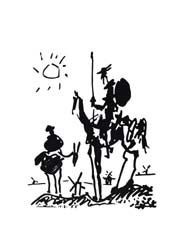 The ingenious hidalgo fought giants, demons and Moors in 17th century Spain without much success, but the Man of La Mancha is back … and enjoying more success fighting car thieves, narcos and public attitudes in Mexico.
No Mexican policeman’s lot is a happy one — a garbage man gets more respect. During the Revolution Day Parade in Mexico City, the crowd claps and cheers for the garbage trucks. The police cars sailed past with sirens blaring… to drown out the boos from the crowd. They couldn’t do anything about the propensity of parade-watchers to give them the finger… or “moon” them.
Mexican cops are low paid, seen as a necessary evil at best. Where the Mexican solider at least gets three hots and a cot (and a uniform, and some education) in return for taking on a thankless job, “los Esmurfs” (as Mexico City cops were called behind their back, in honor of their blue uniforms) received a salary too low to appeal to anyone capable of better work, and not enough to support a family.
What you got were either the “ethically challenged” who could supplement their income, people without families, or alienated from social norms (I’ve always half-suspected that William S. Burroughs’ claims in the 40s of seducing Mexican cops with drugs and sex he talked about in Queer were based in Borroughs’ ignorance of Mexico — gay cops and drug-suing cops were the norm… and they were taking advantage of him, not the other way around). Or, you got bullies who wanted an excuse to carry a gun and exercize some power. Naturally, no one trusts the cops. Mexicans often say, “don’t call the police, or the real theives will show up,” after a robbery.
The situtation has started to change. Mexico City started providing arms and uniforms to the officers, paying them a livable wage and giving them training. And raising the standards. I used to see the results around the the old 1968 Olympics Veleodromo where I used to teach a few mornings a week. The “NEW” cops were younger, healthier and … wonder of wonders … were doing their morning workout in the parking lot. Coupled with higher entry requirments, various attempts to foster “esprit de corps” (decent uniforms made a difference… a well-dressed officer isn’t going to be sitting around with taco fixin’s dripping down his big belly) and some changes making it harder to offer bribes (traffic citations are bank deposit slips and the fines were lowered to reduce the incentive to offer a bribe) were genuine accomplishments during the Lopez Obrador years. The biggest change I saw in Mexico City’s police was that the cops got younger and buffer… and it wasn’t rare to see well-dressed pretty girls flirt with policemen.
Nezahualcóyotl, across the state line from the Federal District (If Mexico is Manhattan, Neza is Jersey City) always had the worst of Metro Mexico. That included city services and, por supuesto, city cops. They had a police chief sentenced to 25 years for narcotics violations, and a random drug test of their department turned up more drug users than upstanding citizens. The city could only do so much to raise salaries and buy uniforms. They were still faced with the lower-qualified police officers. And no respect.
In a fascinating experiment, Neza has been creating better cops. Low eduction (many officers don’t have more than a secondary school education, and a spotty one at that) suggested sending the officers to school. Besides just giving the officers the equivalent of a GED, the idea is that a better citizen is a better cop. And a better cop will be treated as a citizen.
So… besides basic schooling, the officers in Neza are … reading Quixote as part of their regular shift. Every Spanish speaking person of any accomplishment has read Quixote at least once. Of course they also read Agatha Christie and Ignacio Taibo II (Mexicos one and only socialist detective novelist) and… a lot of things. The Neza cops are reading a book a month on city time. And writing poetry in creative writing classes. And attending art appreciation lectures. And, once in a while, some dance lessons.
It sounds bizarre, but apparently it works According to the Herald measurable crime is down. Sociolgists studying the Neza experiment are using auto theft records (something people report, just because their insurance agent requires a police report) show a drop and calls to the police are up. Anecodotal evidence suggests people call the cops because they expect them to respond — and not steal something.
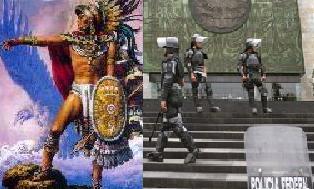
Not an impossible dream …
Tlatelolco — yes, it was the CIA
This has always been known — two and a half years ago, I bought a CD from an ambulante on the Mexcio City Metro for five pesos detailing much of what’s just “officially” coming to light now. The Jornada program didn’t quite say the CIA had suborned President Diaz Ordaz, but hinted at it. The semi-official line was that Luis Echiverria was responsible for the massacre, but when Diaz Ordaz left office, he took the blame himself, shortly afterwards leaving the country as Ambassador to Spain.
I don’t know how this is going to pan out. Some older Mexican I know fondly remember Diaz Ordaz as the last “good” PRI president. They overlooked the authoritarian facets of his presidency, noting the economic successes and stability of the country. Echiverria, who had a schitzophrenic policy of repressing the left while trying to build a populist image (and rewarding leftists who worked with the administration) destabilized the entire economic and political structure — leading to the “12 years of misery” that followed. It was only with Cuauhtemoc Cardenas’ stolen victory in 1988 (engineered by the CIA?) that the system began to change. The 1994 murder of Luis Donaldo Colosio (backed by ???) finally forced PRI to open up the system, though there’s no doubt the system was tilted (with the help of ???) towards PAN, not the left (which tended to meet with an incredible number of fatal accidents in those days, though you only heard in the U.S. about anti-PAN actions from the U.S. sources).
Of course… the U.S. couldn’t be involved today. Could it?
The National Security Archives Project is here.
Documents link past presidents to CIA
El Universal
October 20, 2006
WASHINGTON – Mexico´s president and interior secretary at the time of the 1968 massacre of protesters in Mexico City were both CIA informants and the intelligence they provided had the effect of misleading Washington policymakers about who was responsible for the repression, declassified U.S. documents show.
The revelations appeared Wednesday on the web site of the National Security Archive, a Washington-based independent research organization.The group posted more than two dozen declassified documents detailing the CIA´s recruitment of senior Mexican officials over the 1956-1969 period.
The highest-placed CIA sources were Gustavo Díaz Ordaz, who served as president of Mexico from 1964-1970, and his eventual successor, Luis Echeverría, who was interior secretary.
“Never before had there been official verification, via declassified documents, that the CIA relied on high-level Mexican government officials to provide intelligence reports on political events in that country,” Kate Doyle, director of the Archive´s Mexico Project, told EFE.
…
The documents shed light on what the CIA knew and did not know about the events of Oct. 2, 1968, in Mexico City, where a student protest ended with a massacre in Tlatelolco Plaza.
…
While Mexican authorities put the number killed in Tlatelolco at 39, hundreds are believed to have been slain in the square by members of a government-run paramilitary squad known as the Falcons, which also played a role in other acts of repression during the PRI´s “Dirty War” against leftists, which went on until about 1980.
…
In February, the National Security Archive published on its web site a copy of a draft report on the Mexican “Dirty War” that the country´s current conservative government has yet to publish.
The initial draft accuses the administrations of Presidents Díaz Ordaz, Echeverría and José López Portillo of committing “crimes against humanity that culminated in massacres, forced disappearances, systematic torture and genocide.”
Under Mexican law, the term “genocide” can refer to instances of mass murder that fall short of the attempted extermination of an ethnic, racial, religious or other group.
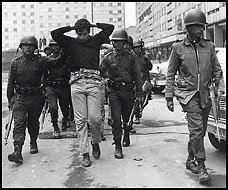
Et tu, Tabasco? More shady vote counts…
Rene Alberto Lopez, Jornada (my translation)
Villahermosa, Tab(October 18) Reinfoced by riot police, and guarded by 17 PREP police officers, the Citizen’s Particiation and Electorial Institute (IEPC in Spanish) of this Gulf state began officially counting votes for the election of governor, municipal presidents and local deputies.
As on election day, anti-riot police from the Public Security Secretariat (SSP) surrounded the facility.
As a result of a lawsuit filed by the “Coalition for Everyone’s Benefit” (PRD-PT-Convergencia), votes for the Centro Municipio, which includes the city of Villahermosa, electoral packets from that district were opened today.
The Coaltion expects the eventual triumph of Fernando Mayans Canabal, but numbers the Preliminary Electoral Results Program (PREP) count shows Mayans trailing PRI candidate Evaristo Hernandez, by more than two thousand votes.
Mayans Canabal’s supporters congregated early this morning outside electorial headquarters demanding the vote by vote count, claiming fraud in the PREP results. Police stood by, but there were no distrurbances at the gathering.
The problem was noted when actas (precinct totals) in district 248 failed to tally with the number of votes cast. Coalition representative, Carlos Canabal Ruiz asked for that that package was opened and each vote was counted, against the wishes of the elections officials.
Candidate Mayans Canabal, who was prevented from entering the building this morning by the police, alleged that “there are more votes in our favor. We won the election, and are already demonstrating agreeing in advance that the calculations will clear away any doubts.”
In the municipalities of Cunduacán, Paradise and Centla, where PREP results gave the PRI a narrow advantage over its rivals, coalition candidates are also convinced they won.
Nidia Naranjo Cobián, candidate of the coalition, assured that she won, said “I won’t let them rob me” of my victory.
In the municipality of Jonuta, vote counts confimed that Coalition candidates did win the delegation and mayoral elections.
Juan Manuel Focil, PRD state chair, said the coalation candidates will defend their wins, and sue where the losses are extremely close.
On the other hand, PRI chair Pedro Gabriel Hidalgo, informed reporters that his party will be opposing narrow defeats in Balancán, Huimanguillo and Centla.
“Tear down that wall…” or don’t build it — from a guy who knows what he’s talking about
Bob Campbell, Midland (TX) Reporter-Telegram
Former Soviet President Mikhail Gorbachev compared the United States’ proposed 700-mile wall on the U.S.-Mexico border to the Berlin Wall during a Tuesday visit to Midland.
… “You remember President Reagan standing in Berlin and saying, ‘This wall should be torn down,'” said the 1990 Nobel Peace Prize winner. “Now the Unite d States seems to be building almost the Wall of China between itself and this other nation with which it has been associated for many decades and has had cooperation and interaction with.
“I think what is really needed are ideas and proposals about how to improve that cooperation and work out all of those issues regarding immigration flows. I don’t think the U.S. is so weak and so much lacks confidence as not to be able to find a different solution.
On a clear day… WOW
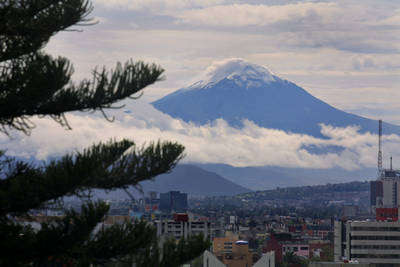
This was Mexico City this morning. Jornada photo.
Good news or not? I donno
President-elect Felipe Calderón named Agustín Carstens, a deputy managing director of the International Monetary Fund, to head his economic transition team
Hard to say if this is good or bad. I have the usual “knee-jerk” distrust of the IMF, and expect a conservative adminstation is going to continue the same economic policies as the previous conservative administration — which haven’t been all bad, though they failed to deal with equality and opportunity as well as they should. Inflation is low, investments are up, but there is concern that too many of the investments (and the jobs for younger and unskilled workers) are headed north. And agricultural policy has been a semi-disaster for the small farmer.
At worst, Carstens would continue the old policies, but with more confidence from outside investors. Not bad in itself. What struck me though, were some of his statements, which indicate he may be willing to take measures that are decidedly outside the neo-liberal orthodoxy… the same ones recommended by Carlos Slim and Andres Manuel Lopez Obrador during his campaign.
From today’s Herald:
“The market by itself is not sufficient to create an economy that is truly human,” Calderón said. “The sensibility and guidance of the state is needed to correct the terrible inequality that exists in our society – Dr. Carstens knows this.”The appointment makes Carstens a likely candidate to become finance secretary under Calderón, Chappell Lawson, a political science professor at the Massachusetts Institute of Technology in Cambridge, said in a telephone interview.
“He´s clearly a frontrunner, but these appointments don´t make it a sealed deal,” Lawson said. “His name is good for the markets because people know him and trust him.”
Carstens holds a doctorate in economics from the University of Chicago. From 2000 to 2003, he served as deputy finance secretary under Francisco Gil Díaz before taking the third-highest position at the IMF. He has worked as an economist for Mexico´s central bank.
…Carstens, speaking beside Calderón today, said his experience working with underdeveloped economies in Africa, Asia and Central America gave him insight into solving Mexico´s problems.
“What Mexico needs is to foment economic growth and alleviate poverty,” he said. “These should not be seen as separate goals.”
© 2006 Copyright El Universal Online México, S.A. de C.V.
La Raza and THE RACE…
In light of the passing of one of the border’s greats (posted below), I thought this editorial by R. Daniel Cavazos, publisher of The Brownsville Herald and El Nuevo Heraldo was worth noting — MEXICANS prefer Formula One races, but hey, in the United States, everybody adjusts…
…
The entertainment industry, like nearly every other part of the American private sector, is grooving programs and products that focus on growing Latino populations in this country.Wal-Mart, Target, Ford Motor Company, General Motors, Coke, and all the cell phone companies employ legions of advertising and marketing agencies to help them reach a Hispanic market that now touches every corner of this country.Even NASCAR (NASCAR!), the epitome of white Southern culture, is anxious to reach out to Latino audiences. A story in USA Today last week detailed how NASCAR officials hope to market and promote driver Juan Pablo Montoya to expand its fan base.“Short term, you’ll have more Hispanic fans tuning in and becoming fans,” NASCAR spokesman Ramsey Poston said in USA Today. “Long term, we’ll have many wanting to get involved in the sport, and we want lots of drivers from lots of backgrounds.”How ironic, verdad, that during a time when xenophobic politicians in Washington are voting to build a border fence as part of their desperate efforts to stem Latino influences in this nation, the powerful U.S. private sector in all of its capitalistic glory has already decided this issue.There’s no anti-Hispanic walls being built by U.S. capitalists. What they want to know is how we can get “La Fea Mas Bella” on American television. Meanwhile, the nation’s fastest-growing sport, NASCAR, wants to rev up and diversity its fan base, with a special focus on the Latino market.
Baldemar Huerta: “The Mexican Elvis”
I was never a fan, but back in the mid seventies, you couldn’t avoid hearing (and knowing), Baldemar Huerta’s pop classics. Who?
Tejano music — and Tejano culture — is easy to make fun of. The music is sometimes described as “German oom-paa-paa played by Mexicans on instruments stolen from Gringos” and its an acquired taste. Tejano culture is unique in that it blends two blended cultures (U.S. and Mexico) into a third. Balemar Huerta understood this.
And, while some of us deplore the creeping gringo-ization of Mexican culture, we’ve overlooked the Mexicanization of U.S. culture. For years it was limited to South Texas. UNTIL.. Baldemar Huerta, mixed Tejano with Blues, R&B, Rock-n-roll and Country-Western. Before him, Latin music was “exotic” (think of Dezi Arnez in the 50s) and after him… just part of the American musical scene.
Born in the Rio Grande Valley (his parents were migrant workers), Baldemar took the tradtional path of ambitious valley kids, joining the Marines. When he got out, he returned to the Valley, where he enjoyed some local success as “El Bebop Kid” (pronounced “keyed”) in local bars. He did Spanish-language covers for Elvis and Harry Belfonte and perfected his art.
His friend Augie Meyers called him “a Mexican Elvis” but in the late 50s, stars with names like Baldemar Huerta had a limited audience. So, taking the name of his guitar’s manufacturer, he reached a new audience as “Freddy Fender“.
His “Wasted Days and Wasted Nights”, released in 1960, was a regional hit… and a little closer to the truth than most knew. Busted for marijuana possession, Huerta did three years in a Louisiana prison before he was pardoned by that state’s own musically inclined governor, Jimmie Davis (Gov. Davis is best known for writing “You Are My Sunshine, My Only Sunshine”. He was a early 20th century country star in his own right, and a fixture on the Grand Ol’ Opry as well as the Lawrence Welk Show in the 50s).
As Freddy Fender, Huerta was a phenonomon. Marketed as a “Country” star — and he was the only Mexican-American country star — his style and sound made him a cross-over hit. It was impossible in the 70s NOT to hear “Until The Last Teardrop Falls” or “Behind Closed Doors” … and an updated version of “Wasted Days”.
Though he hasn’t been a national star since the 70s, Fender opened the door for other border musicians (Los Lobos, for example) — and his fellow Texans, Willie Nelson and Waylon Jennings — to enter our musical consciousness. Nelson, especially, is open to Mexican and border influence. (If you don’t believe me, walk around suburban Monterrey some day… every geezer around looks like Willie.)
Fender had been working mostly in the Spanish-speaking market until a combination of diabetes and hepititis slowed him down. Lung cancer finally got him last week. He was 69, and will be buried in San Benito Texas.
If he brings you happiness
Then I wish you all the best
It’s your happiness that matters most of all
But if he ever breaks your heart
If the teardrops ever start
I’ll be there before the next teardrop falls
Si te quire de verdad
Y te da felicidad
Te deseo lo mas bueno pa’los dos
Pero si te hace llorar
A mime puedes hablar
Y estare contigo cuando treste estas
Give me some space!
Mexico City has more than 25,000 streets and 2,150 colonias. Anyone who has driven in the city knows what a jungle it is. You share the streets with thousands of green VW taxis, belching buses, delivery trucks, pedi-cabs, hawkers, numerous pedestrians as well as hundreds of thousands of cars. Parking in the commercial districts is a nightmare.
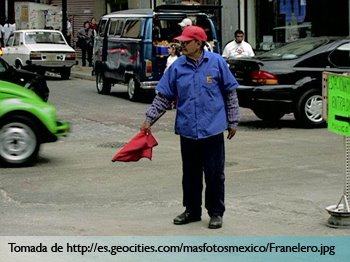
The following is a story from El Universal (May 29, 2006) which describes the turmoil and stress you’ll find on any given day in the downtown areas of Mexico’s greatest city. The story focuses on some of the city’s most colorful hard working people…. the franeleros. They’re really the ones who ultimately “hold the power” midst all the chaos.
It is 10:30 a.m. Grimy green Volkswagen taxis grind forward, arms punching from drivers´ windows to wave away pedestrians
It is 10:30 a.m. Grimy green Volkswagen taxis grind forward,
arms punching from drivers´ windows to wave away pedestrians.
Horns screech. Somebody screams, “Muévete!” – Move it!A man jumps frantically out of an ancient, exhausted Toyota and tries to edge it to the side of the road. Behind him, handcarts piled high with stringy green onions seem to lurch and stop on
their own, levitating amid the chaos, the drenched men who push them hidden by mountains of produce.Gridlock.
Nothing moves.
At the edge of El Mercado de la Merced, Mexico City´s sensory feast of a downtown market, the
tangle is getting ridiculously tangly. But somehow, above it all, two magic words ring out: “Viene, viene!”The meaning, in Spanish, falls somewhere between “Come on!” and “He´s coming!” But everyone in this spectacular morass knows what it means: A parking spot has opened.
Juventino Villegas Alvarez, 65, his jacket slung cavalierly over his shoulder, blows his whistle and shouts again, raspy and loud: “Viene, viene!”
Somehow, im
possibly, order is restored. Villegas sternly halts one of the edgy taxis with his outstretched arm, pulls away an old crate and waves a brown sedan into a parking space. The
driver steps out, greeted by Villegas´ outstretched palm, and dutifully hands over 10 pesos, roughly about US$1.Villegas is a “viene, viene” man, one of thousands in Mexico City. It is nearly impossible to park on public streets here without sliding a few pesos to one of his brethren or their counterparts, the “hombres del trapo rojo” – red rag men, so named because they draw parkers by waving a red rag.INFORMAL ECONOMY
Their work is not officially sanctioned. No government entity grants them domain over their
street corners. But they are universally accepted. Some get by on their charm, their rapid-fire shtick. But there also is a sinister undercurrent to their street-level economy: People who don´t pay often return to find their windshield smashed.Villegas runs his stretch of asphalt – 100 feet of prime parking space across from a guy who sells scorching guajillo chilies by the kilo – with restless, mesmerizing efficiency. At 10:45, a lumbering delivery truck tries to sneak in without his permission. Villegas is apoplectic. “Para!” he blares. Stop!
His cheeks puff out, expelling a series of gusts through his whistle. A woman standing nearby covers her ears. For a split second, all is still. Vendors turn to Villegas. The truck driver pounds his brakes.
Eyes ablaze, Villegas points to his left. There, wedged next to a pole, is a baby stroller. Two tiny brown eyes are all that is visible amid the mass of blankets. “Somebody get that baby out of here,” Villegas yowls. “We´re going to have a tragedy.”
No one, including the truck driver, hesitates to follow his instructions. This is Villegas´ realm, and while he is not menacing, he is clearly in charge. He has worked this chunk of Mexico City for 15 years. When he leaves in the afternoon, a nephew of his takes over.
Villegas´ voice catches as he looks around his little empire, waxing about the generations he´s
rolled into parking spaces – fathers growing old and giving way to sons. “Everything that begins in life has to end,” he says, his eyes becoming red. “I´ll be here as long as God´s willing.”A shrill horn shakes him out of his reflection. Villegas looks up and beams. Juan Zamora, a squat taxi driver, idles a few steps away. Zamora is an old pal, a customer from way back. He gets
special treatment.Zamora tosses Villegas his keys. He´s not just handing over a car, he´s handing over his livelihood. “Eh, I just trust the guy,” Zamora says before dipping out of the sun and into the cool, dark market. Villegas double-parks Zamora´s green taxi. But within minutes someone wants
to get out from behind it. Villegas jumps into the taxi´s driver seat and turns the ignition. A weak, rattling sound stirs in the engine. He tries again. And again. Nothing.Rubén Domínguez García appears. Domínguez works the streets by the market, too, carrying a bag of tools that he uses to hammer out dents on the spot. He is a busy man in this zone of constant fender benders. Two other guys run up. They lean into Zamora´s car, shoving it out of the way, giving it just enough momentum to coax the engine to life.EARNINGS
Villegas glows. He has 130 tax-free pesos in his pocket, more than twice the minimum daily wage of 48 pesos. It is only 11:30, but his day is almost done. He claps Domínguez on the shoulder and the two break out in song. They croon “Marta,” a melodramatic bolero, gloriously off-key. But their celebration is interrupted by a tooting horn. A man in a fat truck wants a place to park. http://www.mexiconews.com.mx/18507.html


