Probably no one but the worriers at freerepublic (the yahoo brigade think it’s to invade Arizona) and military hardware enthuiasts would have noticed this, but it’s worth passing on for a couple of reasons:
Mexico is not depending on the U.S. for its military hardware (Mexican tanks are Polish, by the way). The big economic problem for Mexico has always been dependency on imports. Porfirio Diaz, back in the late 19th century, started the trend of using different foreign suppliers to avoid being dependent on any one foreign country (which is one reason the phone system was so screwed up for so long — German switches and U.S. switches weren’t compatible, and Mexico had both). After WWII, the trend in consumer goods was to create Mexican industries that could at least provide equivalents of the things people wanted (if people couldn’t buy Fords, Chevys, Cadillacs, and DeSotos, they could buy Mexican Volkswagens…).Hard to do with big ticket military items, and hard to say no to your next-door neighbors, especially when it has a huge “military-industrial complex” — and nukes. Here, Mexico selected between the Swedish and the Russians.And, consider the weirdness of this purchase. The old commies (the Russians) are selling to the “oh-my-god, they’re turning leftist again!” Mexicans surveillance planes to watch… Stalinists in Cuba! Really, other than stopping drug smugglers and finding lost yachtsmen and guarding the oil wells (ok, the latter is of real strategic significance), that’s about all the Mexican Navy can expect for the next few years.
When Comrade Fidel finally goes to the big Guantanamo in the Sky, it’s gonna be a mess. Between the crazies invading from Miami, and the folks looking to leave for Mexico and/or the U.S., there’s going to be a traffic jam out in the Carribean. Somebody’s gotta be the “eye in the sky”.
Mexico selects Sukhoi Su-27 for strategic surveillance
 The Mexican navy has selected Sukhoi’s Su-27 over the Saab/BAE Systems Gripen to equip its first air defence unit.
Head of the service Adm Armando Sánchez Moreno says the new fleet of 10 fighters will enable the navy to carry out “strategic surveillance” over key areas of Mexico’s coastline.
Preliminary selection work was initiated in early 2005, and the navy is now entering into contract negotiations with Russia’s Rosboronexport agency for the purchase of eight single-seat Su-27s and two Su-27UB two-seat trainers. Local sources indicate that the entire package – which also includes spare parts, tools and personnel training – is worth slightly over $410 million.
What Would Brigham Young Do?
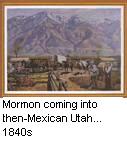
Wow! Who haven’t we heard from? This, from the Central Utah Daily Herald.
Book of Mormon prophecies bear weight in respect to the current immigration debate.
1 Nephi chapters 13, 21, 22: The Lord permitted the Gentiles to take control of this land so we (their descendants) could aid Lehi’s descendants to become spiritually enlightened and economically prosperous, for the building up of New Jerusalem, whose inhabitants will be largely Lamanites. (3 Nephi 21:23-24.)
1 Nephi 21:22 and 2 Nephi 6:6-7: The Lord admonishes Latter-day Saints of Gentile (European) ancestry living in this land to carry Lehi’s descendants upon our shoulders. We will be severely punished if we don’t. (3 Nephi 20:15-16.)
D&C 42:39: We are commanded to financially aid the Lamanite people.
Most of the immigrants Americans want to deport are future church members. Spencer W. Kimball, citing 2 Nephi 3:24, said a future prophet of the church will be Lamanite and will do great miracles, to the bringing of the Lamanites into the gospel fold.
George W. Scott,
Orem
How you gonna keep em down on the farm …
… unless they can make a living?
From Cattle Network:
Addressing a group of farmers and agricultural associations, Mexican President Vicente Fox promised to elevate the National Agreement on Agriculture to a decree, which would make the objectives set by the agreement obligatory for government officials to enforce. Fox announced that there is a serious effort to negotiate with the United States and Canada to exclude corn and beans from complete liberalization in 2008. According to President Fox, the Ministries of Agriculture (SAGARPA) and Economy (SE) will negotiate Mexico’s interests in this matter. In a related action, Rep. Rafael Galindo stated that the GOM sent a formal request to the USTR to exclude corn and beans from NAFTA in 2008. A number of Mexican agricultural associations also demanded that SE carry out detailed investigations on the impact of NAFTA on sensitive products.
Wanna bet we start hearing screams from Archer-Daniels-Midland (“controlling the food of the world”) about how Mexico is “refusing to play by the rules”?
The anti-immigration folks in the U.S. have a simple choice — let Mexican family farms compete against corporate (and tax subsidized) U.S. agribusiness, or hire Mexican farmers to work as peons.
Ridin’ that (subway) train…

photo by Jesús Villaseca, Jornada
These are Mexico City’s newest subway cars — gives a whole new dimension to art in public places.
Writing on drugs… on drugs, apparently…
From the usually half-way sane Huffingtonpost.com
…First of all, who knew Mexico had a congress? I always thought that by constitutional mandate the country was run by the richest guy with a mustache….
So what does this have to do with the immigration debate, you may ask? Well, if all that good-time space candy becomes legal south of the border, then at least a few hundred of those Mexicans who are so miserable living there on sub Wal-Mart wages will at least be able to get stoned every day, leaving them slightly less bummed-out about their plight. Meanwhile, unimaginable numbers of American college students will immediately head south in search of a hassle-free good time. The whole country will look like Tijuana on the first Friday of spring break — every night of the year! All those Americans streaming into Mexico will more than offset the tidal wave of illegal immigrants heading north.
According to his biography,
Hayes Jackson lives in Los Angeles. He writes for film and television, mostly because he’s not qualified to do anything else.
I can’t find an email suitable for sending photos of non-mustachioed Mexican presidents, and the 500 Mexican congressional representatives and 128 (or is it 96 — I always forget) Senators, but you can always send your comments to info@huffingtonpost.com
Iran prepare for ‘Mexican Voodoo’
The Star on-line (Malaysia)
TEHRAN: Iran will prepare themselves for the “Mexican Voodoo” during the World Cup in Germany, an official of the Iranian Football Federation (FFI) told the news agency ISNA on Sunday.
“The Mexicans are masters of psychological wars and might use magicians (for voodooing),” said Ali Pour, the cultural deputy of the Iranian Football Federation.
“This issue (Voodoo) has to some extent affected our players and some of them link it to the injuries of (Ali) Karimi (Bayern Munich) and (Vahid) Hashemian and (Mehdi) Mahdavikia in the Bundesliga,” said Ali.
Many Iranians are superstitious and for example believe in the “evil eye” or “salty eye”, meaning that if someone deeply wished something bad for somebody, then the bad thing would eventually happen.
Therefore many keep a small and usually blue stone with an eye on it – some even hang it inside their cars – to confront ill-wishers.
“We have already planned appropriate measures against such tricks and generally believe that real believers cannot be affected by such magic and as the Iranian team have a deep religious belief, it will resists like an unconquerable castle,” he said. – dpa
The myth of the gringo immigrant…
One of the more popular diatribes going around the internet right now is the tale of the “Director for SW Bell in Mexico” Besides wondering why SW Bell has such crappy attorneys (and wondering where the corporation’s relo specialists are) I’m wondering if this “director” isn’t some freeper’s imaginary little friend.
His story is in italics. It MAY not be a bald-faced lie, but the BOLD-FACED truth is by David Bodwell, who has lived in Mexico since 1997, and owns the Mazatlan Book and Coffee Company, in bold-face. This kind of nonsense calls for a blue-streak from me.
I spent five years working in Mexico.
I worked under a tourist visa for three months and could legally renew it for three more months. After that you were working illegally. I was technically illegal for three weeks waiting on the FM3 approval.
If he worked at all on a tourist visa, he was working illegally! Although, the period between applying for the FM-3 and getting it approved is a gray area. Working during this time is usually ignored. As the right wing would ask, “what part of illegal don’t they understand?” What’s the difference between “technically illegal” and “illegal” (oh, it’s only a crime if it’s a foreigner in the U.S.)
During that six months our Mexican and US Attorneys were working to secure a permanent work visa called a FM3. It was in addition to my US passport that I had to show each time I entered and left the country. Barbara’s was the same except hers did not permit her to work.
It sure doesn’t take a bunch of attorneys to get a working FM-3, especially not if you’re working for an American company. The longest I’ve ever heard of is 3 to 4 weeks, and that’s unusual. And how is showing his work permit any different than a foreigner in the U.S. having a “green card”?
To apply for the FM3 I needed to submit the following notarized originals (not copies) of my:
1. Birth certificates for Barbara and me. They needed these to get their tourist visas, why should it be such a hardship? Besides, passports work better.
2. Marriage certificate. If the wife was coming in as a dependent on his FM-3 (or a foreign spouse into the U.S. as a dependent), this would be required.
3. High school transcripts and proof of graduation. Not true.
4. College transcripts for every college I attended and proof of graduation. Not true.
5. Two letters of recommendation from supervisors I had worked for at least one year. Not true.
6. A letter from The ST. Louis Chief of Police indicating I had no arrest record in the US and no outstanding warrants and was “a citizen in good standing.” Some consulates still require this, but I don’t know of any Migración office in México that does. Or, maybe they want to keep out “criminal aliens”?
7. Finally; I had to write a letter about myself that clearly stated why there was no Mexican citizen with my skills and why my skills were important to Mexico. We called it our “I am the greatest person on earth” letter. It was fun to write.
Actually, something similar to this is required, but only in Spanish for a working FM-3. Where this diatribe is wrong is that it is a letter from the EMPLOYER to Migración stating why they want to hire this person and what the pay is going to be, NOT a letter from the FM-3 applicant. The only type of FM-3 that requires a letter from the applicant is the category “actividades lucrativas” meaning that you want to open a business in México, and it doesn’t need to be nearly as detailed as the writer describes.
All of the above were in English that had to be translated into Spanish and be certified as legal translations and our signatures notarized. It produced a folder about 1.5 inches thick with English on the left side and Spanish on the right.
Not true, UNLESS everything is in English. It’s normal to have to produce required documents in the language of the country. Any documents that the immigration folks in the U.S. require for a U.S. visa must be translated to English. My problem with this whole line is that most of the documents he mentions just are NOT required for a working FM-3.
Once they were completed Barbara and I spent about five hours accompanied by a Mexican attorney touring Mexican government office locations and being photographed and fingerprinted at least three times. At each location (and we remember at least four locations) we were instructed on Mexican tax, labor, housing, and criminal law and that we were required to obey their laws or face the consequences.We could not protest any of the government’s actions or we would be committing a felony. We paid out four thousand dollars in fees and bribes to complete the process.
You do have to affix your thumbprint to the FM-3 once it is issued, but the rest of this, especially the part about fees and ¿BRIBES? is ridiculous. If even partially true, then SWB stockholders should demand an audit. Or, they should start demanding that their “directors” have an IQ above room temperature. I’ve done a fair share of legal translating in Mexico, but outside of dubious website, and more dubious reporters like Lou Dobbs, I’ve never heard of a “felony” in Mexico, and have never found any legal translation for that Anglo-Saxon legal concept.
When this was done we could legally bring in our household goods that were held by US customs in Loredo Texas. This meant we rented furniture in Mexico while awaiting our goods. There were extensive fees involved here that the company paid.
Sounds like a normal menaje de casa to me. I don’t know where he got that extensive fees involved unless he was using a moving company and a customs broker and that has nothing to do with the Mexican government.
We could not buy a home and were required to rent at very high rates and under contract and compliance with Mexican law. Not true. If they chose to rent something pricey, I sure hope they had a contract. Did they expect it to comply with some other country’s laws? This guy sounds more and more like a spoiled brat and less and less like a director of … anything, let alone a Fortune 500 company.
We were required to get a Mexican drivers license. Not true.
This was an amazing process. The company arranged for the licensing agency to come to our headquarters location with their photography and finger print equipment and the laminating machine. We showed our US license, were photographed and fingerprinted again and issued the license instantly after paying out a six dollar fee. We did not take a written or driving test and never received instructions on the rules of the road.
It’s normal in most countries that if they recognize the other countries driver’s license, they will issue one without a test. The only time I’ve ever had to take a test anywhere was when I didn’t have the necessary endorsement on my U.S. license for the type of license I was applying for.
Our only instruction was never give a policeman your license if stopped and asked. We were instructed to hold it against the inside window away from his grasp. If he got his hands on it you would have to pay ransom to get it back. Not true.
We then had to pay and file Mexican income tax annually using the number of our FM3 as our ID number. The companies Mexican accountants did this for us and we just signed what they prepared. I was about twenty legal
size pages annually.
True, but where he gets twenty pages from I sure don’t know. I don’t know of ANY country where you can work legally without filing a tax return. And you certainly don’t use your FM-3 number as your tax ID. You have to get an RFC from Hacienda, a one day, painless, free process.
If this “director” exists, he sounds like a hapless moron who couldn’t find his ass with both hands. The only thing I can think of is that he was completely clueless, and THOUGHT whatever the notario was handing him (probably their bill, various legal papers, etc.) were his tax forms. What a maroon!
The FM 3 was good for three years and renewable for two more after paying more fees.
Not true. A FM-3 is good for only one year. It can be renewed 4 times (5 yrs. total), then you must get a new one (which is only a little more difficult than getting a renewal). The fees are approximately the same every year (They go up by the same percentage that the minimum wage goes up annually). This alone makes me dubious as to the authenticity of the tale. Either that, or SWB has some real incompetents running their operations.
Leaving the country meant turning in the FM# and certifying we were leaving no debts behind and no outstanding legal affairs (warrants, tickets or liens) before our household goods were released to customs. Not true. Not within even the realm of the credible — espcially when you recall that the usual whine is that the Mexicans don’t check what’s leaving their country very carefully (if at all).
It was a real adventure and If any of our senators or congressmen went through it once they would have a different attitude toward Mexico.
If any of our senators or congressmen went through the process of getting a U.S. visa, they would certainly have a different attitude about the whole immigration thing. That’s a NIGHTMARE!
The Mexican Government uses its vast military and police forces to keep its citizens intimidated and compliant. They never protest at their White House or government offices but do protest daily in front of the United States Embassy. The US embassy looks like a strongly reinforced fortress and during most protests the Mexican Military surround the block with their men standing shoulder to shoulder in full riot gear to protect the Embassy. These protests are never shown on US or Mexican TV. There is a large public park across the street where they do their protesting. Anything can cause a protest such as proposed law changes in California or Texas.
I watch Mexican news, and the protests are always covered. They do, indeed protest outside government offices and their “White House” (and outside union and political headquarters as well — damn democracy!) . As a matter of fact, the morning traffic report usually includes the routes and hours that streets are likely to be blocked by protesters of one type or another. Why is this “director” surprised that people protest in their nation’s capital. And, I’m wondering if he prefers the U.S. Embassy be left unguarded during demonstrations? Has he ever seen a demonstration in the U.S.?
As I said before, just another anti-México diatribe. For those who might doubt my bona-fides, I’ve lived, worked, and owned a business in México for almost nine years now. I’m very familiar with what is and isn’t required for a working FM-3. I fully realize that different Migración offices work differently and that the México, D.F. office is possibly the worst one for getting the working FM-3, but I also think that the writer of this diatribe probably was doing it sometime long before computerization. It’s not just different now, it’s a LOT different. (David is being kind — I think the guy was either lying through his teeth, or a fuckin’ moron!)
Please feel free to share this with everyone who thinks we are being hard on illegal immigrants.
Please feel free to call South Western Bell in Mexico City, and see if this guy ever existed.
South Western Bell
Parque Via No. 190
Col. Cuauhtemoc, C.P. 06500
DISTRITO FEDERAL
Tel.(55)5254-2149
Between a Rock and a Hard Place
On Lonely Planet’s “Thorn Tree” there’s a discussion about whether an American on disability (about 1000 USD per month) can live in Mexico. I suppose it depends a lot on the nature of the disability, but a lday of a certain age who found herself stuck in Chicago “between a rock and a hard place” when her minimal social security payment was not nearly enough to survive, has been living contentedly in Mexico City on substantially less than that.
Oprah Winfrey’s O Magazine was interested in short articles by older women on how they overcame hardships. This, apparently, isn’t what Ophrah had in mind … but well worth publishing as it was originally written:
When you are between a rock and a hard place.
by “Ann O’Nomous”
The Plans
Behind the window of my small downtown apartment, I used to watch the snow falling – layer upon layer and think – it is going to be a rough commute tomorrow morning for the workers. It turns out that I was right. As the newscaster on the morning program said “today is another ‘character-building day’ in Chicago.”Since I am in my late seventies, and no longer working, I spent much time reading in preparation for a summer flight to someplace warmer, cheaper and not to far away… Mexico City.
My husband of 53 years had died after a 33-year illness that had eaten away at our savings, and now I found myself alone, no savings left. My social security check was 800 dollars, but with a $736 rent, I was left with 64 dollars for telephone, food and electricity. Something had to be done!
I had left England as the bride of an American paratrooper who I met when he was stationed in England, awaiting the Normandy invasion. Then, on to Germany for two years in the American Sector of the Army of Occupation, we came to Chicago, where we lived and worked until a massive stroke in 1966 left my husband paralyzed on one side of his body and unable even to speak. I nursed him faithfully for 33 years and became a widow in 1999. When the year 2000 came in I had two alternatives – end it all, or go to a place where the Social Security Check would stretch from month to month. Purchasing a book from the neighboring bookstore for $25 (The Fodor Guide to Mexico) provided both facts and entertainment during the Chicago Winter.
I studied as one would study for a final exam: in fact many people living here in Mexico have remarked that I knew facts of which they were not aware… so be it!
Realizing that my baggage allowance would be two suitcases full meant that clothes and other necessities to tide me over. Everything else had to be left behind.
I wanted to keep my leaving a secret for many reasons. Four people knew about my leaving , one by accident: I went for a passport to City Hall, and another tenant of my apartment building worked in that particular office as Probate and Passports are in the same room. Fortunately, this person was a devout Christian and kept my secret. In fact, her church’s weekly prayer meetings were a supportive influence while I was waiting to leave.
In the prayer group were two ladies who had been stewardesses on the Chicago to Mexico City flight. A friend in Chicago had a connection in Mexico City and although I could not count on this contact, at least there was one person, English-speaking, who had lived in Mexico City for 30 years. A lovely couple gave me emotional support – invited me to social events and paid for my passport. The other friend helped me put my two cases of clothing together and suggested which items to take and which to leave behind.
On July 5th I left O’Hare for Mexico City and have been there ever since. Being the Capital of all the Government and other facilities are right here but the cost is more than it would b in a rural town. With about one dozen words of Spanish in my vocabulary, I as afraid to be adventurous and go to a more remote place. Many people here have some English, and which what I have learned, get along quite well.
It was sad that despite belonging to the most powerful and wealthy country in the world, I should have to leave it all behind and find a place where I could manage financially. I did not feel British anymore, as I had left there at 21 and had become an American citizen and had lived in the United States for 54 years.
Since Chicago has about a million Latinos, I had quit a good idea of the culture, and encountered quite a few Mexicans in my day to day life.
My final decision was made when I read that the climate varied from 60° Farenheit to 80°. That sounded good after 52 years of hard winters which I never got used to, and hot summers, which required air conditioning, and here, you just pt on more clothes and close the windows when it is cold, or dress lighter and open windows when it’s warm.
Please don’t get the idea that I have come to a Paradise. Lake ever other places, it has its warts and bumps. The pollution is horrid, though you learn to tolerate it. You are on your own for Medical benefits (you can, however, buy medicine without a prescription – except narcotics – and a doctors visit to their Generic brand of medicine is two dollars (Farmacias Similares). Medicine is much cheaper than in the U.S.A. Strangely enough, Medicare, which was free for me in the U.S., because my Social Security income as under $900, I have to pay for here, where I cannot use it. Go figure: they deduct 80 dollars a month from my Social Security check. I pay it however, as if I develop a major illness and return to the U.S. for treatment I will have to keep my benefits intact.
Now this escape is not recommended for everyone. Immigrants used to return to their native lands from America (back to Italy, Poland, Greece and many more countries). Now with the European Common Market and the Euro – I hear that Hungary is one of the few places left affordable. My advice to anyone contemplating the move would be to come here on a vacation, learn Spanish and if you have a major illness, stay in the U.S.A.
At least if you live in Mexico with a limited income you are not the bottom of the economic scale – a place where I found myself in Chicago. You are in the middle class, and if you get a higher rate than me, you can well find yourself in the upper class. The cost of being an alien in Mexico is about a hundred dollars a year. You can own a car and a house. Also, if you have savings and a generous Social Security income, you can go back and forth to the U.S.A.
The American Embassy is so helpful. One visit to the Embassy with documentation, social security card, medicare card, birth certificate and passport and in about six weeks you can receive payment – direct deposit to any A.T.M here (though the Bank of California. Every 3rd of the month, the payment is credited to your bank card and the charge for the service is $5 a month. The interbank rate on the 3rd is what you receive in pesos. They do ask you to chose direct deposit as the Mexican mail is horrendous, and those who chose a check (which often fails to arrive) wind up at the Embassy – trying to replace the lost check (which can take up to two months). And, it is costly and difficult to cash checks. Once a year you take your Social Security statement to the Embassy. Report any change of address or marital status and the money flows to 12 months (you can mail the statement in, but it’s risky).
Packages to and from the U.S. are expensive, often lost or stolen. A friend sent me a parcel and two years later I received it – I was lucky – I had given up hope. Most people are warm – friendly and polite and although there is crime here – at the side of Chicago, I fell much safer and the little green cabs are cheap and in the four years I’ve never had a problem. Just know which direction you are going – your destination and keep to the main streets. Most places I go the fare is about a dollar and I usually walk back. Being a senior citizen, I usually go out in the day time and have yet to be openly accosted, but do watch myself and use precautions and move around if I feel threatened.
It took me quite a while to locate certain items, but after four years – almost everything I need – I either know where to get it, or a reasonable substitute.
The rate of exchange is in our favor and transportation is cheap. Subway is free for seniors, although it is not convenient for me (stairs, and too many people). Buses are 25 cents (no transfers) but on the subway you can travel 30 miles on one ticket, costing 15 cents. Deluxe buses are cheap to cities North, South, East or West (1/2 price for seniors) and you can visit all the towns and cities in Mexico without the hassle of passports. Airfare is not cheap here. I am going to list the good features and the set-backs to help you decide if this change of country would benefit you, or caution you about things that might make you want to “stay put”. I did everything by “trial and error” but I’m most willing to share my experiences with you.
On the negative side…
If you admire promptness, efficiency and the truth, Mexico will fall short! Mexicans arrive late – very late. Services are often delayed and dry-cleaning, etc., late, work promised – not delivered and the truth – rather than say no, they say “si” to be agreeable, bu of course, it doesn’t happen.
Although age is usually respected here, women can expect “overtures”, “approaches”, “flirtations” but sadly it is for the wrong reasons – free English lessons, and you have a reliable income: they don’t. Or a marriage could mean entrance to the U.S.A. It bothers me how critical the T.V. and newspapers are of America where there is such a long line to get into the States, and so many American Dollares are being sent by Mexicans in the U.S.A. to support their families back here – at least be fair!
After the bounty of American tables, I find the food here lacking in quality – it is cheap and the fruits and vegetables plentiful. I especially enjoy the mangos and figs, but the best apples arrive from America and also the large peaches. There is a beautiful supply of kiwis from New Zealand. Most vegetables are not served as such, but as “salsas” (sauces) and after being accustomed to a serving of meat, potatoes and a vegetable at most dinners in America, it is difficult to find potatoes served (except as French Fries in fast food places). Cars park bumper-to-bumper and Mexican families move around in groups and seldom “break rank” on a sidewalk – so give in – move around them. There is hardly a sidewalk which is even – so stiletto and high heels are difficult and hazardous to maneuver, but Mexican Senoritas do wear them, and sprained ankles and broken heels are the result.
On the positive side…
After a winter of approximately six weeks the trees are starting to bud and flower and April is the hottest month of the year, June starts rain, which you can usually time – 5 or 6 PM, and it seldom lasts long. You do not miss the snow and ice and biting winds, layers and layers of clothing, the heating bills in winter and the high electric bills in the summer for air conditioning.
People have less here, so you don’t feel underprivideged if you are not wearing the latest clothes. Also, if you pockets are less than full – welcome to the club – you probably have more than people you come in contact with. They think my monthly income (without working for it) is “Manna from Heaven”. Pensions here are much less. A ten dollar a month check for an elderly lady is not unusual. A retired executive or business man $700 or $1000 a month is about as good as it gets.
My final “nudge” out the door came when I read Oprah’s Magazine – a monthly feature “What I know for sure” explained how we carry around so much emotional baggage that it cripples us and prevents us from doing what we can and should do.
You can begin again! Make a fresh start, take a chance! A least with an American Passport, you have what 9 out of 10 people in the Third World would like to own and believe me, it is my most cherished possession. I love my adopted country, America, but cannot afford to live there.
Mexicans Taking Mexican Jobs!! OH NO!!!
When 31-year-old illegal Arizona resident Ignacio Jimenez sought employment at an American plant in Mexico, he was shot at by Mexican border guards as he attempted to illegally enter the country of his citizenship, pursued by U.S. immigration officials who thought he might be entering the country illegally, and fired upon again by a second group of U.S. Border Patrol agents charged with keeping valuable table-busing and food-delivery personnel inside American borders.
“It was a nightmare,” Jimenez said. “Many became disoriented and panicked, and some were mixed in with immigrants going the other way across the Rio Grande and ended up swimming to the wrong country.”
He added: “My cousin almost drowned. They fished him out and sent him back to wash dishes at T.G.I. Friday’s.”
Ok, it’s from a respectable satiric site, The Onion, not from one of those unfair and unbalanced comedians slightly less funny than freerepublic.com
You can sum up American immigration law this way: There’s us, and there’s them. They’re different, and we’re better. It’s an old, old story, older than Servs vs. Croats, older than Hatfields vs. McCoys, older than Capulets vs. Montagues. It goes back to the biblical scapegoat, to the sacrificial vestal virgins, and the like: Let'[s take our fears and put them on someone or something else, and then kill it or run it out of town. Then we’ll be safe.
(Dan Kowalski, “The Moral Physics of Immigration” in the May 5, 2006 Texas Observer.
The Texas Observer, by the way, is sort of an all-War on Immigrants issue. On-line, Forrest Wilder (“South Texas Hold-em”) reports on one Texas industry’s profits from the “illegal immigrants are bad” craze — the private prisons (… oops, “detention centers”) the rest of the world seems content to ignore.
Buy the magazine for the Dan Kowalki’s article and Beatrice Edward’s long review of “Lockout: Why America Keeps Getting Immigration Wrong When Our Prosperity Depends on Getting it Right (Michele Wucker, Public Affairs, 288 pp., 25.95 USD)
Besides, the Texas Observer is the best damn magazine in Texas, featuring REAL TEXANS like Mollie Ivans and Jim Hightower and Erasmo Guerra (and financed by Waco’s only Jewish, Socialist multi-millionaire, Bernie Rappaport), not wannabe Texans like that drunken coke-head preppies from Midland…

MEXICO LEGALIZES DRUGS… (OH MY GOD!!!!)
A touch of madness??? NAH!
Everyone from the normally sane Huffingtonpost.com to the right-wing alternative universe of freerepublic.com is reacting as if — well — stoned!. Lawrence Iliff provides some, uhhh… sober perspective on the new Mexican drug bill, alas buried on page 10A, of today’s Dallas Morning-News.
Before you book your flight on the Don Juan tour special, a couple  of points
The new drug laws are much stricter in a lot of ways:
Under the old law, “addicts” could avoid prison time by providing a doctor’s certificate claiming whatever they had in their possession was necessary for treating their disease. Naturally, there are doctors willing and able (for a considerable consideration) to provide these certificates. There’s an apocryphial story about the trucker, caught smuggling a load of Acapulco Gold who claimed ten tons was for his personal use… and got away with it.
- The new law restricts such claims to very small amounts of specific drugs.
- Under the old law, drug offenses (“Offenses against Health” — note that Mexico has always seen drug addiction as a public health issue, not a strictly law-n-order one) were investigated by Federal Police, and charges brought in Federal Courts. Under the new law, local and state police and courts can also bring charges. Springbreakers of the more than normally stupid variety now have the option of being shaken down by both Federal and Local cops. .
- Mexicans do not much tolerate drug-users. Gossip is the Mexican vice — the local hood hanging out on the corner smoking a joint is cruisin’ for a bruisin’ when his grandma, uncle Jose and older sister find out. And they will.
This isn’t a particularly radical law — Colombia’s possession laws are much more lenient. And for much the same reason. Drug users are a public health problem and a public nuisance. Drug trafficers are unfettered capitalists at their worst. They weren’t much of a problem when they stuck to bumping each other off. It’s their nasty habit of tossing hand grenades at reporters and cops that make them obnoxious. As in horse-shows, “close” is too damn close when it comes to grenades.
With their brother capitalists, the gun runners, on the other side of the border, and with 50% of the world’s narcotics buyers on that side, maybe the Mexicans have decided their not going to die in the U.S. War on Drugs.
For those who argue that Mexico shouldn’t export narcotics — ok, GROW YOUR OWN.
(04 May 2006)

10:13 PM (Mexico City time)… oh well, NEVER MIND!
Into the Spin Cycle…
Under U.S. Pressure, Mexico President Seeks Review of Drug Law
By JAMES C. McKINLEY Jr. and JOHN BRODER
Published: May 4, 2006
MEXICO CITY, May 3 — After intense pressure from the United States, President Vicente Fox has asked Congress to reconsider a law it passed last week that would decriminalize the possession of small amounts of drugs as part of a larger effort to crack down on street-level dealing.
In a statement issued late Wednesday, Mr. Fox said the law should be changed “to make it absolutely clear that in our country the possession of drugs and their consumption are and continue to be crimes.”
Officials from the State Department and the White House’s drug control office met with the Mexican ambassador in Washington Monday and expressed grave reservations about the law, saying it would draw tourists to Mexico who want to take drugs and would lead to more consumption, said Tom Riley, a spokesman for the Office of National Drug Control Policy.
Later in the day, Mexico’s chief of the Federal Police, Eduardo Medina Mora, tried to clarify the law’s intent, saying its main purpose was to enlist help from the state and local police forces. Until now, selling drugs has been solely a federal offense, and the agents charged with investigating traffickers are stretched thin, he said.
Mr. Medina Mora, the main architect of the first measure, which Mr. Fox sent to Congress in January, said it was true the law would make it a misdemeanor to possess small quantities of illegal drugs, but he added that people caught with those drugs would still have to go before a judge and would face a range of penalties. “Mexico is not, has not been and will not be a refuge for anyone who wants to consume drugs,” Mr. Medina Mora said.
The current law has a provision allowing people arrested on charges of possessing drugs to argue they are addicts and that the drugs were for personal use. The new law sets an upper limit on how much of each drug one could possess and still claim to be using it to support a habit, Mr. Medina Mora said, and stiffens penalties for people possessing larger amounts of drugs.
But the law drew a firestorm of criticism from American officials on the border and among American drug enforcement officials in Mexico, who argue any move toward decriminalization would encourage drug tourism. Some municipal officials on the border have worried that cities like Tijuana and Ciudad Juárez would become the Mexican equivalent of Amsterdam, where marijuana is legal in some bars. Mayor Jerry Sanders of San Diego, a former police chief, called the bill “appallingly reckless and incredibly dangerous.”
Judith Bryan, a spokeswoman for the American Embassy here, said the officials in Washington had urged Mexico “to review the legislation and to avoid the perception that drug use would be tolerated in Mexico and to prevent drug tourism.”
It is unusual for American officials to try to influence internal Mexican legislation.James C. McKinley Jr. reported from Mexico City for this article, and John Broder from Los Angeles.
It is unusual for American officials to try to influence internal Mexican legislation? In a pig’s eye!
Into the rinse cycle
(Bush is pushing socialism in Latin America, again…)
Drug czar John Walters was shown saying that “if we are talking about legalizing
drugs, that’s bad for everybody.” (That suggests Walters had doubts that the new
law was legalization, but if so he wasn’t shown expressing them.) His
predecessor Barry McCaffrey skipped the “if,” and opined lugubriously about the
risk of “cross-border drug tourism out of the United States, to include college
students.” A drug counselor from San Diego talked of the risk that San Diegans
could “go across the border and buy heroin out in the open.” (How people were
going to openly buy a drug it would remain a serious crime to sell wasn’t made
clear.) Alexander talked of counsellors’ fears of being “swamped by a new
audience of addicts.”A lone Mexican official was shown denying that the
law legalized drugs, and the view that the new law would help focus attention on
traffickers was attributed to the Mexican government, but those were left as
bare assertions, discredited by everything else said and shown.This evening, under what appears to have been intense pressure from the U.S., Vicente
Fox capitulated, saying that he would not sign the bill his own appointee as
head of the Federales had shepherded through the Mexican Congress. It’s
hard to guess whether this rather public humiliation of Fox will damage
Calderon’s chances of beating Lopez Obrador; what seems certain is that none of
the American drug warriors whipping up the furore had bothered to think about
that question.
From: “More Absurdity” by Mark Kleinman (Professor of Policy Studies at the UCLA School of Public Policy and Social Research, and Chairman of BOTEC Analysis Corporation, a Cambridge, Massachusetts firm that conducts policy analysis and contract research on illicit drugs, crime, and health care. Love it when I find somebody with credibility who agrees with me)
AND ME AGAIN (writing on CINCO DE MAYO):
HELL NO, WE WON’T GO… along with your futile war on Mexican farmers (er… drugs)
More fallout on the latest intervention (as opposed to those in 1848, 1911, 1914, 1916, 1968, 1985…)
Michael O’Hare, of the Reality Based Community carps about Mexican court procedure — though why he thinks a public health law change was designed to reform the federal judicial rules of evidence is beyond me. Yup, there were problems with enforcing the new law, but I’m also confused as to whether that has anything to do with the U.S. government pressuing the Mexican president to veto this bill.
Our tax payer dollars made this idiotic, puritan statement from the U.S. Mexican embassy possible: “We [– the USA –] urged them to review the legislation to avoid the perception that drug use would be tolerated, and to prevent drug tourism.”
One aviso to Frei — this bill would let Mexicans get high… quite the opposite, it made it easier to bring drug dealers to court (in theory anyway). Besides, as the CIA has told us… it’s not Mexico that’s full of junkies.

I haven’t seen many figures on the boycott, but one I did see was that retail sales jumped 75% in Juarez (well, it was a holiday), but dropped 50% in El Paso. I expect it’s the same in other border towns. I wonder what the retail figures were where this picture was taken… Kodiak, Alaska.


