Hey Jude … cops, robbers, saints and sinners
28 October is El Día de San Judas Tadeo. Rolly Brooks’ always excellent website is up to its usual standards, covering El Día de San Judas Tadeo down in his neck of Oxaca.
Jude, perhaps because he’s easily confused with Judas (Jude was a mere bench-warming disciple, til the Apostles lost one of their starters), is the patron saint of hopeless cases and lost causes. The perfect saint for Mexico: statistically Mexicans are some of the happiest people on the planet , maybe because they embrace lost causes and just expect things to be hopeless. And Mexicans, with their good-natured black humor, make Saint Judas Tadeo the patron saint of both cops and robbers (and prostitutes, for good measure). Basically, he’s the generic patron saint of disreputable activities. Given that Mexico City has more than its share of disreputable professionals, El Día de San Judas Tadeo is an important holiday you’d never know about from reading the tourist books. His biggest – and most important shrine – is one of my favorite churches, Iglesia de San Hipólito (Paseo de la Reforma at Puente d’Alvarado).San Hipólito is one of the best preserved Colonial churches. It’s a damn shame more people don’t know about it.
Among other things, it was the world’s first alcoholic rehab. Vasco de Quiroga, who came to Mexico when he was well over 60 was the first in a long line of foreign retirees who found a new life, and surprising second career here in Mexico. Vasco was planning to retire to a monastery after his long career as a criminal court judge in Spain. Like so many retirees to follow, he reasoned his money would go further here, and he agreed to sail to Mexico to work one more year. Mostly, who came before him were formerly reputable Aztecs who got drunk and got into trouble. Vasco, did two amazing things – he became one of the first people in history to realize that alcoholism was a disease, and – absolutely mind-boggling for a scholarly gentleman of his time – sprang into action. Having blown his savings on a hospital and church meant the old guy needed a job. So… having saved a few Aztecs, he took on the Tarascans. He had himself ordained and consecrated as Bishop of Michoacán. THEN… just to prove he wasn’t any run of the mill early colonial archbishop… he and the Tarascans worked out a “master plan” for the people’s survival. They adapted Thomas More’s Utopia to the local situation (hey, it was the New World and it was the Renaissance… people were willing to experiment). The Tarascans organized communal villages (some still surviving) where everyone had a job. The Archbishop included: Vasco de Quiroga spent the next 35 years of his life (no one is quite sure when he was born, but he was somewhere around 100 when he died) writing contracts. Age and experience must count for something – those 16th century contracts are still valid.But enough about a colonial good-guy. Let’s get back to Jude’s bad boys (and girls). Given it’s parishioners, San Hipólito isn’t included on most tours. I’ve only been in there once, and yes I did watch my wallet! It’s hard to get into… given Saint Jude’s popularity, when it’s not locked up, it’s packed. Even on normal Sundays, the crowd spills out into the street and the Clarentian Fathers who preach to the unruly, resort to bullhorns and a huge PA system to get their message across.The brave — or foolhearty — photographers at el Universal covered San Judas’ festivities. You can take a look for yourself at: http://photos.eluniversal.com.mx/fotogaleria/ol_fotogaleria_despfoto.php?idfoto=36366&gal=3
“Thou Shalt Not Steal” probably wouldn’t go over well with that crowd, but the Fathers are continually sermonizing against Santa Muerte, the Afro-Brazilian(?)-Cuban(?)-Mexican voodoo protector of those with dangerous occupations (… like, cops, robbers and prostitutes). While the ecumenical council of icon vendors just outside the church gates sell both, they defer to tradition and stick Santa Muerte under the counter on San Judeo Day.Día de los Muertos is November 2 – She’ll be back…. Whhhhoooooooo!
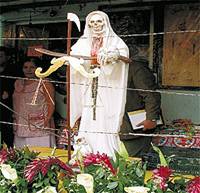
SANTA MUERTE — Guardian of … Abbott Laboratories and other gangsters
Jammin’ for Jesus — or “Shut up and pray!”
By: OLGA R. RODRIGUEZ – Associated Press
MONTERREY, Mexico — Some Mexican priests, tired of Mass being interrupted by ringing cell phones, are using counterintelligence technology made in Israel to silence the devices.
In four Monterrey churches, cell phone blockers the size of a hand-held radio have been tucked among the paintings of the Madonna and clay statues of saints to bring peace back to Mass.
“There are still many people who don’t understand that being at Mass is sharing a moment with God,” said Juan Jose Martinez, a priest and spokesman for the Monterrey Archdiocese. “Sadly, we had no other choice but to use these little gadgets.”
The churches began using the cell phone blockers, made by the Tel Aviv-based Netline Communications Technologies, after Rodrigo de la Mora, an insurance salesman, imported them as a personal favor for a priest.
The wall-mounted jammers were developed by former Israeli military and defense officers to avert eavesdropping on security-sensitive conversations and to prevent bombs from being detonated by a mobile phone.The devices, purchased for about US$2,000 (euro1,600) each, can be turned on by remote control. They emit low-level radio frequencies that thwart cell phone signals within a 100-foot radius.Users get a “no service” or “signal not available” message on their cell phones and incoming calls do not get through.
In Mexico, mobile phones have outnumbered fixed lines, and one in every four Mexicans now has a cell phone, according to Mexico’s Federal Telecommunications Commission.
But as mobile phones are becoming part of daily life, so are their nuisances, including users chattering away in movie theaters, restaurants and churches.The frequent use of mobile phones at Sacred Heart church in downtown Monterrey, a baroque temple favored for weddings by the rich and famous, prompted church officials to acquire the blockers two years ago.
For months, the devices went unnoticed until reporters covering the weddings noticed their cell phones never worked at that church. Since they wrote about the jammers, priests from around Mexico have been calling to find out how to get them, said Bulmaro Carranza, a parish clerk at Sacred Heart.Now priests in Mexico City and Guadalajara are also requesting the jammers, De la Mora said.Whether the use of cell phone blockers in Catholic churches has become common is unclear.
The Vatican doesn’t track how many churches around the world are using the devices but it does acknowledge cell phone use during Mass has become a headache.Netline did not return a call asking for comment, but company officials have said they are selling thousands of devices a year via the Internet and expanding their business all over the world.
At Sacred Heart, a device at the entrance to the church and another by the altar are turned on right before every Mass. Still, priests remind parishioners to turn off their phones before beginning the services, hoping good cell phone etiquette will eventually catch on.”Whenever there was a wedding, cell phones would ring every five minutes,” Carranza said. “It was a real problem because there were times when even the groom would forget to turn his cell phone off.”
The Rosario, San Juan Bosco and Our Lady Queen of the Angels churches have also followed suit. There are more than 200 churches in Monterrey, many of them with few resources, and priests still hope they can avoid the jammers and trust that politeness will prevail.
The four churches with the devices are frequented by mainly wealthier parishioners, Martinez said.”For a lot of them, the cell phone is a necessity. But that shouldn’t prevent them from having good manners and remembering that one must respect sacred places,” Martinez said.
Blocking cell phone signals in the United States is illegal, but Mexico does not yet have a regulation against it, according to an official with Mexico’s Federal Telecommunications Commission who spoke on condition of anonymity.
Margarita Escobedo, a Catholic who goes to church at least twice a week and volunteers at the San Genaro church, says she would welcome the jammers at her church, where cell phones are becoming an irritating nuisance.
“Those who bring cell phones to church are not committed to God,” Escobedo said. “It’s very distracting to be praying and suddenly hear birds chirping or techno music.”
Coke smugglers… but not what you think
From the 7 October Philadelphia Inquirer
A thirst for imported Coke
The Mexican version’s retro recipe is simply better-tasting, fans say.
By Gaiutra Bahadur
Inquirer Staff Writer
It’s nostalgia in a slender-necked, curvy glass bottle.
But this is no throwback to a Rockwellian era of white picket fences and apple pie. In fact, this Coca-Cola signals an edgy new America: one inscribed, like the green-tinted bottle, with the words Hecho en Mexico.
Made in Mexico.
And for sale on Federal Street in Camden – or at almost any of the bodegas and taquerias shooting up across the region and country.
The customers at the city’s San Lucas Restaurant, many of them from the region of Puebla in Mexico, wash down their enchiladas de mole with Cokes made and bottled in their native country rather than the local brew.
“It has a different taste,” owner Adela M. Trinidad, 30, explained in Spanish.
It’s common for immigrants to seek out and buy products shipped from their homelands. For them, brand names such as Chandrika or Jarritos re-create Bombay in a bar of soap or Oaxaca in a fizzy tamarind drink.
But the attachment to Coke, Mexican-style, is another story.
The company is, after all, based in Atlanta. It is so symbolic of Uncle Sam that writer Salman Rushdie famously coaxed its consonants into a word for America’s global dominance in economics and culture: Coca-Colonization.
What’s more, cans and plastic bottles of the soda are a dime a dozen in the United States – or, actually, $7 a dozen. The Mexican Coca-Cola sold by Philadelphia-area distributors costs $10 to $12 a dozen.
Why bother with an import that will cost customers more?
“Because they’re looking for it,” said Camden shopkeeper Juan Medina. “They come and they ask for it.”
The cooler in his corner grocery contains both plastic bottles of Coke, 20-ouncers for $1 each, and the Mexican incarnation, 12-ouncers for $1.35 each.
“They know which tastes better,” Medina said, without swagger, in the same matter-of-fact tone he might use to say:
Mexicans drink more Coke, 487 servings per capita a year, than people in any other nation.
- Their president, Vicente Fox, was a Coca-Cola executive.
- The beverage giant began bottling in Mexico in 1927, one of its first global forays.
- Its bottler there is the second-largest worldwide and has captured 70 percent of the soft-drink market there.
Medina, brand-conscious in his white Tommy Hilfiger T-shirt, leaned against his store counter to say the two versions are just flat-out – diferente.
“The other people, they don’t care. For them, it’s the same brand,” he said. “But the American Coke has more gas inside. It doesn’t taste right.”
That feeling has fueled ever more business for distributor Carlos Romero, owner of Philadelphia’s La Tienda Wholesale. Every week, he trucks about 1,000 bottles of Coca-Cola – twice as many as when he started in 1998 – to retailers in Norristown, Center City, North Philadelphia and elsewhere in Pennsylvania. And his is not a monopoly.
Coca-Cola responds to the trade across the turf lines it has drawn for its bottlers with some head-scratching: “It’s essentially the same product going into the bottle or can,” said spokeswoman Racquel White.
Still, there’s more to favoring the imports than the glow of a flashback to another time and place. Mexican Coke does, usually, have a retro recipe. It uses sucrose made from sugar cane or sugar beets, as Coke once did in the United States and still does now in other parts of Latin America.
This is less and less the case, however. The North American Free Trade Agreement has meant that cans of Coke are cropping up south of the border, and the caffeinated concoction made in Mexico sometimes contains cheaper corn syrup just like its American counterparts.
Even if it uses the same sweetener, the bottled Coca-Cola still hooks believers, including foodies not from Mexico who have discovered it at restaurants.
“Most of them ask for the glass bottles,” said Martin Herrera, owner of Taqueria Veracruzana in South Philadelphia. “They say it’s like the old times in the U.S.”
Contact Gaiutra Bahadur at bahadug@phillynews.com or 856-779-3923. Inquirer staff writer Joseph A. Gambardello contributed to this article.
W! Bush for President … of Mexico
Bill Arbon, who lives in the OTHER Nafta partner, passes this along from TomDispatch.com “An alternative to the regular media”
© El Fisgón
El Fisgón, aka Rafael Barajas, is one of Mexico’s leading political cartoonists.
Free-trade globalization has produced some exceedingly strange phenomena: China, the last socialist power, is glad to provide slave labor to multinationals; a firm in India fills the tax forms of an American corporation that produces vodka in Peru and then sells it to Polish immigrants who are constructing a British-financed building in Madrid; an enterprise which specializes in biotechnology tries to copyright the DNA of an isolated tribe from the Amazon, and George Bush has become the worst Mexican president ever.
Mexican political culture has very defined features and the President of the United States has absorbed them all: The classical Mexican political boss usually inherits his power from his father. The typical Mexican cacique has a love for guns as well as an inclination toward violence and cruelty; he despises legality and intellectual activity, has a personal history of alcoholism and dissipation, lies systematically, and declares himself a faithful servant of God. (Did we miss anything?)
According to Mexican tradition, politicians always reach their positions thanks to a fraudulent electoral process and then surround themselves with a clique which uses its power to conduct “business” on a staggering scale while in office. The Florida electoral thievery and Halliburton’s Iraq contract are classic examples of Mexican corruption.
Based on a complex pyramid of political bosses, a totalitarian presidential regime flourished in Mexico. It was organized around a political party whose name remains a monument to paradox: the Revolutionary Institutional Party (PRI). Names aside, the PRI model was so efficient (for the PRI, of course) that the party was able to hold power for more than seventy years. The Peruvian writer Mario Vargas Llosa called it “the perfect dictatorship.”

From Here to Hell to Eternity…
I disagree that Bush would make a good, bad Mexican president though. None of them were ever quite that stupid. Maximiliano comes close, but Mad Max was Emperor… and we haven’t had an emperor, yet…
They may be wacko Libertarians (rudundant, redundant), but Hit & Run finds more interesting stuff about Mexico than most political websites.
OFAC You
Smoke a cigar containing Cuban tobacco in Mexico, go to American jail.
That’s the new rule handed down by the odiously-but-accurately named Office of Foreign Assets Control, the freedom-abroad-limiting wing of the Treasury Department. The clarification [PDF], issued Sept. 30, explains that the previous $100 limit on Americans’ importation of Cuban merchandise (I should say, licensed Americans’ importation, since buying a Cuban tortilla is illegal without Treasury Dept. permission), has now been reduced to $0. And don’t think you’re free from Uncle Sam if a buddy gives you a Cohiba in Cancun, or even if you’re not an American citizen.
This prohibition extends to such products acquired in Cuba, irrespective of whether a traveler is licensed by OFAC to engage in Cuba travel related transactions, and to such products acquired in third countries by any U.S. traveler, including purchases at duty free shops. Importation of these Cuban goods is prohibited whether the goods are purchased directly by the importer or given to the importer as a gift. […]
The question is often asked whether United States citizens or permanent resident aliens of the United States may legally purchase Cuban origin goods, including tobacco and alcohol products, in a third country for personal use outside the United States. The answer is no. […] [T]he prohibition extends to cigars manufactured in Cuba and sold in a third country and to cigars manufactured in a third country from tobacco grown in Cuba. […]
Criminal penalties for violation of the Regulations range up to $1,000,000 in fines for corporations, $250,000 for individuals and up to 10 years in prison. Civil penalties of up to $65,000 per violation may be imposed by OFAC.
Remind me again why we need the Patriot Act…
The Dallas Morning News ( http://www.dallasnews.com/) is one of the few U.S. papers with decent coverage of their large southern neighbor (and major oil — and narcotics, and agricultural products, and labor — supplier). Lawrence Iliff had an excellent article on Mexico’s Ley de transparencia, which is an interesting commentary on the U.S. Patriot Act.
Mexico’s done keeping secrets from citizensNation making more information available to public than ever06:48 PM CDT on Saturday, October 2, 2004By LAURENCE ILIFF / The Dallas Morning News
MEXICO CITY – A decade ago, Sergio Aguayo asked a simple question. How much does the Mexican president make? The answer he got was equally simple: none of your business.
So Mr. Aguayo, a writer and democracy activist, pressured President Ernesto Zedillo through the courts and the media. Eventually, the president’s office released the number – about $200,000 in base salary per year.
Still, nothing had really changed. The president’s salary remained technically classified, as was a legal “secret fund” that had contained hundreds of millions of dollars under earlier presidents, Mr. Aguayo said. Where that money went, no one knows.
What a difference a decade makes.
A dynamic mix of greater democracy, Internet access and a new federal freedom of information law is causing a huge shift in how Mexicans police a government that until recently coveted even trivial information with the jealousy of a Soviet-style dictatorship, analysts and officials said.
“For the general public, it’s impressive what you can get now,” Mr. Aguayo said. “We are very advanced in relation to the past.”
Today, the salaries of President Vicente Fox and his support staff are posted at http://www.presidencia .gob.mx. Each purchase made by the federal government can be found on distinct Web sites. Nearly 220 federal agencies are required to post detailed information about their operations. And the president’s “secret fund” has been empty since the end of the Zedillo government.
Moreover, reporters and civic groups are quickly learning how to dig into bureaucracies and square off with the president’s office. Results include a funding scandal involving a charitable group and details on the pricey wardrobes of Mr. Fox and his wife.
Journalists, who often had to rely on an occasional leak to get their hands on revealing documents, now ask for them directly.
“It’s now possible to know things that have been off limits to us,” said Daniel Lizárraga, a reporter for the weekly magazine La Revista , who nonetheless complained that government agencies continue to fight the information opening.
The Federal Institute for Information Access, or IFAI (for its initials in Spanish, has been operating for about a year, and it’s been less than four years since Mr. Fox ended 71 years of uninterrupted presidential rule by the Institutional Revolutionary Party.
More than 45,000 information requests have been made, and 40,000 have been answered, according to IFAI. Of the 5,000 remaining requests, some are being processed, others are being appealed, and still others have been dropped.
Ninety percent of the requests were made through the IFAI Internet portal, which has become critical to the flow of government information. Without it, officials said, requests have to be made personally at government offices located mostly in Mexico City.
While Mexican households lag significantly in Internet access, Mexico is awash in Internet cafes that serve even the smallest of communities.
“One of the successes of the law in Mexico is that you don’t have to prove your identity or legal interest” when seeking information, said María Marván, commissioner and president of IFAI. “Once you have the exact information, you are in better condition to defend yourself.”
Through IFAI information requests, people have sought medical records from government hospitals to pursue malpractice cases, questioned their government pensions and plunged into the National Archives to find loved ones “disappeared” by the government during the 1960s and 1970s.
Curbing corruption
Business people analyze government public works projects in an attempt to get a piece of the action and prevent fraud.
If a government agency refuses to provide the information requested, the denials can be appealed to a five-person IFAI commission. In the majority of cases, the commission has sided with citizens.
Still, only the federal government is covered by the new law, and freedom of information advocates say that states have a long way to go to match the feds with their own laws.
Likewise, there are critics of IFAI who say it is too cozy with the Fox administration, which nominates commissioners who then must be ratified by the legislature.
But even the current administration and Mr. Fox, whom Mr. Aguayo considers an honest man, have had their knuckles rapped.
When a group of reporters requested copies of receipts from clothes purchased by Mr. Fox and his stylish wife, Marta Sahagún de Fox, for official functions, the president’s office balked. It argued that general information on purchases was open to the public but not the receipts, because they contained personal facts such as clothing sizes.
After months of wrangling, technical arguments and appeals, the IFAI commission ruled against the president, and the receipts were released.
In a recent article in the Mexico City newspaper El Universal (http://eluniversal.com.mx/noticiash.html), those receipts showed that Mr. Fox had bought $1,000 suits and $100 ties for state functions. Likewise, his wife spent up to $1,000 on dresses. Some critics said it was an extravagant use of public money in a nation with a 50 percent poverty rate.
‘Pro-Vidagate’
When nongovernmental organizations requested receipts from an anti-abortion group that had been given $3 million in government funds to help pregnant women last year, they found purchases of men’s suits and Cartier pens and a slew of poorly documented receipts. Much of the money went to upstart companies that had the same address and phone number as the conservative group, Pro-Vida.
As a result, the nongovernmental groups have asked that the money be returned, and the media has dubbed the scandal “Pro-Vidagate.” The government has cut off Pro-Vida’s funding for this year.
“We never thought that we could have access to all of these expenditures and that they would show the poor spending of public resources,” said Lucía Peréz Fragoso, coordinator of the group Equality and Gender, one of the nongovernmental groups.
Pro-Vida has said that some receipts were included by accident and will be replaced with others. “There could be accounting errors, as in any company, but not acts of corruption,” the group said in a written statement.
Fighting for citizens
Jacqueline Castillo Posada, 36, is a modern-day gatekeeper for the federal government. But rather than thwarting every citizen request for information with mountains of paperwork, Ms. Castillo is on the side of the citizen.
Ms. Castillo works at IFAI’s walk-in center in a southern Mexico City neighborhood where the uninitiated can learn the tricks of the trade.
She has helped a university researcher locate and view a telegram sent to the Mexican president in 1962. She continues to help an elderly man trying to determine why his government pension has been reduced. Ms. Castillo has worked with disabled citizens pursuing malpractice cases against government hospitals.
“Sometimes we are also their psychologists,” Ms. Castillo said.
Simply having access to the system, being able to ask questions and receive answers, even if they do not ultimately satisfy their original goals, often alleviates the anger of those who feel wronged by government institutions, she said.
“People calm down over time while using the system.”
E-mail liliff@dallasnews.com
Chinese Chincanery and whatall this week…
Well, hello Dalai…

The People’s Republic of China mounted a photo exhibit here last week on exploitation in Tibet. New openness, letting, as Chairman Mao once said, “a thousand flowers bloom, a thousand thoughts contend”? Not on your life! These are old, old photos showing how crappy things were in Tibet before their “liberation”.
Nobody went. While Mexicans are no slouches when it comes to lousy wages, hours and working conditions, they still have pesky things like a minimum wage and unions that really cut into the cheap exports and (Wal)market. Nobody north of the border is going to worry too much about it, so the Mexicans are appealing to a higher authority. The Dalai Lama is making a State Visit later this week. If nothing else, the Chinese are really, really pissed off… which is probably the whole point.
Speaking of governments that like to shoot unarmed student protesters… yesterday was the 36th anniversary of the Tlatelolco Massacre. Despite the commie rhetoric (The PRD, and Cuauhtémoc Cardenas are the good guys, not the villains – they’re just not commie enough for the author), http://www.mexconnect.com/mex_/history/tlatelolco/tlatelolco1e.html is readable overview of what happened.
The kids are all right…

Even people who knew about this event somehow forget how young some of these protesters were… it was high school kids protesting police repression (the coppers started busting heads when a pickup soccer game between two prepas got a little rough) that led to general protests by college students, workers, housewives, campesinos and civil servants… you know – what Time and Newsweek and CBS and the New York Times all called “Communist Inspired” types. Read “educated people”… a whole generation of them. Even those 14-year old “commies” are getting a little long in the tooth. The poor has always distrusted the cops… ever middle-class person my age or older fears them. It’s a good thing people are self-reliant… or neighborhood-reliant… here. The last thing you want to do is call a bunch of yahoos who had trouble getting through 6th grade to handle a problem. The cops are starting to get a little better – they have to be 7th grade graduates now, and the younger ones can actually run a few blocks if they have to. There were 3500 of them lined up down Insurgentes this afternoon waiting for the protesters.
Maybe Mexican kids have more respect for their elders… or tradition. They’re still the bulk of the 2 October protesters. I watched the cops patting down a few punkers. Two years ago, when a few of the “usual suspects” (Kentucky Fried Chicken and the foreign owned banks) had their windows smashed, the powers that be blamed the “darkeos” for the trouble. The “darkies” are the weird kids who like morose music, read Edgar Alan Poe and wear lots and lots of black. They’re just smart, weird teenagers – and lucky for them they live in a big enough city to find other smart, weird teenagers (besides not having guns, you’re more likely to find a Mexican who likes George W. Bush than a potential high school shooter in a city where even morose loners have a huge peer group). Like I said, our police are not known for their smarts. This year’s flavor of “potential trouble maker” are the punks. Excelsior said a few were arrested for carrying explosives (i.e., firecrackers), but then, the punks stand out even more than the darkeos – they both wear a lot of black, but the darkeos have long hair and the punks have spiked hairdos. I guess next year, it’ll be the skaterboarders the coppers go after.
 President Gustavo Diaz Ordaz died and went to Hell before he could be prosecuted for Tlatelolco, but Luis Echiverria is still among the living. Echiverria was the Sec. de Gobernacion (sort of Homeland Security chief) in 1968… with a second job as a C.I.A. agent (like our friends Manuel Noreiga, Saddam Hussain and Osama bin Ladin). Maybe they’ll get him into a courtroom before he goes to his reward.
Another Mex-File mystery, semi-solved…
Thanks to Jeff A. Taylor at Reason Magazine’s Hit and Run website for this one. (http://www.reason.com/hitandrun/2004/09/26-week/index.shtml) . The Las Vegas Journal Review, covering a store about Judge Marrero’s ruling that the Patriot Act was unconstitutional gives me a clue to solving one Mex-File…
The Journal-Review (http://www.reviewjournal.com/lvrj_home/2004/Sep-30-Thu-2004/news/24881864.html) reports
… late last year Vegas casinos, hotels, and airlines were subject to a massive FBI data mining exercise the true extent of which remains unknown. Some 350,000 people had their personal info sucked up without their consent or even knowledge. Indeed, the PATRIOT Act forbade companies from even disclosing the federal request for info to anyone.
Last January, our City Comptroller was videotaped in Las Vegas playing blackjack with MY TAX MONEY. Ok, the guy’s a scumbag (present whereabouts unknown – Interpol is guessing Brazil or Cuba. I’m betting he’s at the bottom of Lake Powell with his feet sitting in cement). We have a lot of scumbags in city government. But, just when it started to become obvious that our Socialist Jefe de Gobernacion was the overwhelming favorite for President in 2006, all sorts of Socialist corruption (a refreshing change from the usual PRI and Foxista corruption) started to pop up. Our Jefe (who drives a Tsuru and lives with his three sons in a middle-class apartment) always said there was a right-wing (read “gringo”) plot to discredit him. How did Vegas casino security tapes (supposedly not available to anyone without a court order) end up on a morning talk show, in the possession of a right-wing congressman. Do you really believe the F.B.I. was looking for terrorists at the blackjack table?
And… yes, I do have a life…
Things were getting a little too normal. I’m STILL waiting for one client to pay a very large bill (They’ve promised to pay this week, but then, they’ve promised to pay in 15 days, 5 months ago too. And we’re not talking about some fly-by-night company, or a mom-and-pop operation here. I won’t mention any names, but the only way I’d do business with that unnamed international pharmaceutical company listed as ABT on the New York Stock Exchange is if they pay up-front). So, my “emergency” U.S. bank account is running very, very low. Not exactly an emergency, true… but then, after buying household appliances and paying little incidentals like rent, the phone bill, and silly things like that, I’ve developed this weird habit of eating every day.
And, I have another mouth to feed. I know, I know… I said I really wanted to live alone. But, what are you going to do… an orphan with questionable parentage, though a real charmer and knows it… and a Latin American blonde. What else can you call the pup but Eva Perra? I’m guessing she’s about 10 months old… probably a Christmas puppy some asshole abandoned when they went on vacation. Small – 6 Kilos and, best guess, some sort of collie and terrier and maybe Cocker Spaniel in the family tree. I notice the serious political bloggers always post a picture of their cat on Fridays. But, I’m not serious, and I don’t have a cat… and I don’t have a regular posting schedule. Still, I’ll post a pooch picture when I find my camera.
Here’s the big difference between Mexico City and Houston. I’m absolutely comfortable walking Eva at 1 AM through a park and around the hood here. I don’t think I’d have walked Hippie (or Stella, or Bubba) outside my semi-suburban neighborhood at that hour. Even the guys hanging in doorways smoking mota and dinking coronas say “Buenos dias”.
And that’s all the news from Lake Tezcoco-be-gone, where all the men are good looking, the women are strong, and the children are suspects.
U.S. – Mexican Relations for Dummies…

Gentlemen and Scoundrels — American and English writers in Mexico… and a strange German
(edited to fix formatting errors, 23 Aug 2010)
I’ve been reading the English and American writers who lived and worked here. Most of them were completely nuts.
Some, like William S. Burroughs had almost nothing to do with Mexicans, but just wanted someplace c heap to live, and, most importantly, out of US jurisdiction. Burroughs, who spoke no Spanish, liked to brag about seducing policemen and giving them narcotics. I half suspect that the policemen were using the rich gringo. I tracked down the various apartments where the author lived (one is now the Federal Prosecutor’s office – alas not the drug police, which would be all too fitting). Burroughs was out on bail after shooting his wife, when Jack Kerouac showed up on his doorstep. Kerouac (who couldn’t speak Spanish either) was a terrible houseguest: he never cleaned up after himself, holed up in Burrough’s apartment smoking marijuana, never replaced what he ate out of the fridge, drank up the liquor (whatever was left after the late Mrs. Burroughs ill-fated attempt to balance a bottle of mescal on her head – Bill claimed he was playing “William Tell” and dropped the gun) – oh, and wrote On the Road.
D.H. Lawrence holed up in the Hotel Monte Carlo to complain about the plumbing (I’ve stayed there, and it still has noisy pipes) and write The Plumed Serpent in the hotel lobby. Lawrence already had his crackpot theories about race, and –after his wealthy wife rented a limousine and hired a chauffeur – went looking for local color to make his nonsensical tale of tragic miscegenation read a little less like something written by … oh, Josef Göbbels. At least he also wrote a semi-readable travel book as well. I’m not sure of Lawrence’s academic reputation these days – still high, I imagine, but then, academics have a soft spot for pretentious caca. It’s ironic: for Lawrence, the Indians, being closer to nature, are superior to “white” people. In The Plumed Serpent , it’s the debasement of mixing with “white” people that leads to tragedy. The only excuse for this was that the author was dying of tuberculosis (which can cause mental disturbances) and he had the good grace to die before Hitler and friends joined his fan club. The book is still popular with Nazis, old and neo-.
Graham Greene set out to trash the country (he was working for a Catholic paper covering anti-clericism), and was a very bad undercover reporter. He got one hilarious travel book (The Lawless Roads) and a great novel (The Power and the Glory) out of it anyway. By the way, Greene’s novels are nearly impossible to find here, either in Spanish or English (except for The Third Man, El tercer hombre, #59 of las 100 joyas del millenio – a common list of 100 books of the last millennium available in low priced editions from any number of Spanish-language publishers). Next time anyone’s coming this way, they might want to stop at their local second hand bookshop and look for paperback Greene novels for me.
Katherine Anne Porter’s knowledge of Mexico was more intimate. She arrived in 1920, ready to join the Revolution, but instead, joined the staff at a Catholic girl’s school where she taught English and dance (“Violetta the Virgin” is based on her students). It was her dancing – or rather her shapely dancer’s legs – that brought her into the Mexican avant-garde. Roberto Turnball’s 1927 Mitad y mitad was a shocking film for the time. It’s a psychological thriller in the expressionist style about sexual obsession. In the film, a young man living  in a basement apartment falls in love not with the woman who passes by his window, but with her legs. Porter, who was a sometime journalist “explained the Revolution” to the readers of intellectual magazines (she socialized with Revolutionary leaders and Mexican artists and intellectuals) and tried to mount one of the first Diego Rivera shows in the United States. The artwork was seized by customs authorities on the grounds that Rivera was a Communist – which he was, of course (which didn’t prevent him from later working for the Rockefellers and the Wall Street investment banker and U.S. Ambassador to Mexico, Dwight Morrow. Morrow was another of Porter’s wide circle of acquaintances). Until the end of her life, Porter wrote stories, poems and essays on Mexico – and, in 1964, a novel, Ship of Fools. It was not only a best-selling “Book of the Month Club” novel, but also a successful Hollywood film. This is apparently a disgrace in academic circles, and her reputation has never recovered.
Katherine Anne Porter seems to be the only English-language writer who hung out with Mexicans, and Mexican writers. B. Traven – who became a Mexican citizen – didn’t hang out with anybody.
I’m not sure Traven even counts as an English-language writer. He was born in Chicago, which makes him a gringo, but he grew up in Germany. He wrote in German, and translated himself into English. Bruno Traven Thorvald (if that was his real name) was the bastard son of either the Kaiser or the Kaiser’s brother (mamma was a Norwegian with … uh, monarchist tastes). The Imperial Family provided Travel a pension until he died in 1969.  The pension gave him the independence to do what he wanted. In his case, it was a rejecting his family ties, becoming involved with socialist and revolutionary activities in Germany. In 1933, he suddenly decided to become a Mexican author (Hitler had a lot to do with it – but then, Hitler had a lot to do with a lot of Mexican art and German immigration). Hitler made Traven’s career: banning his books (specifically, a pro-anarchist seafaring yarn, The Ship of Death – writers planning to live in Mexico should never use the word “Ship” in their titles) as “un-Aryan” and publicly burning them made the minor German anarchist and socialist writer an internationally known author.
In Mexico, Traven wrote not only adventure stories like The Treasure of the Sierra Madre, but also novels about the effects of industrialization and the Revolution on traditional Mexico (The White Rose is both the story of a ruthless American oilman and a traditional hacienda owner). Mexicans particularly praise A Bridge in the Jungle: it’s a simple tale – an immigrant worker in the U.S., back to visit his family, gives his little brother a new pair of shoes. The little boy, not used to wearing shoes, slips crossing a foot-bridge, drowns and is buried. Traven milks the village tragedy for all its ironic worth, and, say the Mexicans, has written the best description in any language of indigenous life and customs.
Traven hated being famous. He wanted to be left alone, and would play little games like pretending he was the German translator of novels written by President Adolfo Lopez Mateos under the pseudonym “B. Traven”. What gave the story a slightly plausible ring was that everyone knew Mateos’ sister was “B. Traven’s” Spanish translator. (Intellectual presidents, by the way, used to be the norm in Mexico. Vincente Fox is unusual for having no literary or intellectual pretensions. He once referred to “the famous Mexican author, Jose Borges.” Like other Argentineans, Jorge Luis Borges had a low opinion of Mexicans).
Hollywood – in the form of John Huston – made Traven a very rich anarcho-socialist. After he married his agent, he spent the rest of his life hiding from his fans and the press. There’s a memorial plaque in Tampico, commemorating the spot where Traven (under his real name, which was his best deception) met with Humphrey Bogart. Traven may not have been the greatest of prose stylists, but “We don’t need no stinkin’ badges” (from Treasure of the Sierra Madre) ranks right up there with “To be or not to be, that is the question” for quotability.
Anti-Americanism… it ain’t that bad
“Poor Mexico! So far from God, so close to the United States”
Porfirio Diaz
Despite interruptions (family emergencies, financial obligations… life), I’m finishing up my “Gringo’s Guide to Mexican History”. There was an interesting post on “anti-Americanism” a few weeks ago, which disappeared before I had thought about the issue. The tourists concerned about possible anti-Americanism should relax. There is some, but it’s normal and isn’t a major problem here.
Once or twice, I’ve met people who had a bad experience in the U.S., and wanted to tell me about it – followed by a request for money. It’s probably the closest most tourists will ever get to anti-Americanism, but it doesn’t really signify anything.
Personal experiences aside, Mexicans have a keen sense of history. In Oaxaca, I once heard anti-French muttering from a postcard vendor. It took me a while to realize she wasn’t talking about the passing tour group, but about the 1863 French occupation.
Going back to the first United States Ambassador, Joel Roberts Poinsett, there have been numerous attempts by the United States government to gain control of Mexican resources and property (and, in what Ulysses S. Grant called “the worst injustice one nation has ever done to another”, we did take half the country). The Mexican Revolution was spurred, in large part, by reaction against the mostly U.S. control of economic resources. Henry Lane Wilson, Taft’s ambassador, organized a military coup against the democratic Revolutionary government of Franciso I. Madero. He is still a very real villain in Mexico. Woodrow Wilson, given his comments about Venustiano Carrenza (“We will teach them to elect good me”) his invasion of Veracruz and Pershing’s “Punitive Expedition” ranks a close second in Mexican villain-hood. Poinsett, the 1848 invaders, the Wilsons and a host of lesser villains, are still real presences here.
Given our government’s history of meddling in Mexican internal affairs, even somewhat helpful suggestions are resented. Right now, there are discussions of changes in Mexican oil and utility laws. Official, and semi-official statements from the United States have been received with great suspicion, and even public anger. The United States’ invasion of a major oil producing country with a second rate army was despised, if not feared … in this oil-producing, second-rate military power next-door. There was – and is — some rancor here over the war, but not nearly as ugly as the way French tourists were treated in the U.S. during the Bush and Chirac government’s public disagreements.
There are a few on-going differences between the Mexican and U.S. governments — over agricultural policy, the death penalty, the seeming tolerance for neo-fascist groups on the border, the 100-dollar visa fee, and on and on. People complain when they think they’ve been screwed. Mexican friends of mine heard an earful from Texans over Mexico’s water policies. Those Mexicans no more had Vincente Fox’s ear than the gringo tourist has George W. Bush’s. None of which stops people from taking out their very real frustrations on an inadequate stand-in.
History aside, Envy is the favorite of the 7 deadly sins here (I’d say pride is the gringo’s). People always make snide comments about the (supposedly ill-got) gains of others. Gringos come (willingly) to Mexico to play. Mexicans go (reluctantly) to the United States to work. A guy working a 14-hour day who depends on remittances from his brother in Atlanta to help support his diabetic grandmother sometimes gets a little testy talking to someone with the money and leisure to just hang out.
Finally, our knowledge of Mexico tends to be superficial. At home, some people get downright rude to foreign visitors who don’t speak the language well, or think Hollywood movies reflect our culture. And some visitors to Mexico say — or do — some pretty bone-headed things. And people react.
Mexicans are human. The way I nod, or roll my head, probably tips people off that I’m not a supporter of the Bush administration and its policies (basically, my feelings about the war against Iraq are the same as General Grant’s regarding the war against Mexico). So I’m more likely to hear anti-Bush (and, by extension, anti-U.S.) comments than most. People are not stupid, nor do they normally look for arguments (and, regarding Iraq, I’m not – I’m merely illustrating a point). Certainly, anti-gringo feelings exist, and are real. But it’s rare a tourist will be confronted. With visitors, Mexicans are, as Spaniards used to describe people with exquisite manners, “polite as a Mexican”.
mexico
We were in line to buy tickets at Monte Alban in Oaxaca. At the front of the line there was an incredibly loud and rude college kid screaming repeatedly at the ticket taker in English: “I’M AN AMERICAN STUDENT! I GET A DISCOUNT!” The ticket taker just kept looking at him saying “No entiendo.” This guy shouted at her for 10 minutes or so, until he finally gave up. When it was my turn, I spoke to the lady in Spanish. She gave me my tickets then pointed to the guy walking away and said, in English, “What a jerk.”
Fun Facts from the C.I.A.
(and you can look them up at “The World Factbook” Central Intelligence Agency, Washington DC, 2004.
http://cia.gov/cia/publications/factbook/index.html )
HIV/AIDS – adult prevalence rate:
- USA 0.6% (2003 est.)
- MEXICO: 0.3% (2003 est.)
To quote our friends at the CIA, “The US has the largest and most technologically powerful economy in the world, with a per capita GDP of $37,800.” In Mexico, “per capita income is one-fourth that of the US”. Ok, so why does a country with a quarter of the GNP of the U.S. have half the rate of infection by a preventable viral infection considered by both the Central Intelligence Agency and the National Intelligence Council to be a major destabilizing force in international security? - We’re always told the United States has the best medical care in the world. You mean people are supposed to pay for the right to stay alive? If you don’t have medical insurance, you don’t get treatment? Those poor, backwards Mexicans … free health clinics, public hospitals, free condoms, and junkies can buy syringes in any pharmacy. Why, that’s… un-American! Healthy Mexicans? Must be part of the secret plot to regain California (where a good number of Mexicans who do have AIDS acquired it, by the way).
Public debt:
- USA: 62.4% of GDP (2003)
- Mexico: 23.1% of GDP (2003)
Well, gosh… the Mexicans owe a lot of money to a lot of folks. So does the U.S. And this doesn’t count the Iraq expenditures… US – billions and billions… Mexico – about a million dollars to train Iraqi election officials. The Mexican debt would drop about 20% if they were paid the same price for oil that OPEC nations are. The U.S. debt though, would be much, much higher.
Military expenditures – percent of GDP:
- USA: 3.3% (FY03 est.) (February 2004)
- MEXICO: 0.9% (2003)
The figures don’t count that little dust-up in Iraq.Look at it this way. One rocket launched against Bagdad cost one million dollars. One neo-natal hospital in Chiapas costs… one million dollars. Healthy babies or cheap gasoline?Mexico hasn’t been in a foreign war since 1945. It’s the only country in the world to have cut its military budget during wartime (WWII was a great excuse to professionalize the army, and get rid of political generals left over from the 1910-20 Revolution). Mexico’s military is – I believe – the only one anywhere on the planet that turns a profit. Watershed protection is a military mission. Planting avocados is a military objective. Harvesting avocados is whatever the opposite of “collateral damage” might be.
Illicit drugs: US: consumer of cocaine (my emphasis) shipped from Colombia through Mexico and the Caribbean; consumer of heroin, marijuana, and increasingly methamphetamine from Mexico; consumer of high-quality Southeast Asian heroin; illicit producer of cannabis, marijuana, depressants, stimulants, hallucinogens, and methamphetamine; money-laundering center .
Mexico: illicit cultivation (my emphasis) of opium poppy (cultivation in 2001 – 4,400 hectares; potential heroin production – 7 metric tons) and of cannabis (in 2001 – 4,100 hectares); government eradication efforts have been key in keeping illicit crop levels low; major supplier of heroin and largest foreign supplier of marijuana and methamphetamine to the US market; continues as the primary transshipment country for US-bound cocaine from South America, accounting for about 70 percent of estimated annual cocaine movement to the US; major drug syndicates control majority of drug trafficking throughout the country; producer and distributor of ecstasy; significant money-laundering center.
So, if I have it right, the U.S. IMPORTS cheap Mexican oil and cheap Mexican drugs (and cheap Mexican labor) and has a public debt of more than 60% of GDP. Mexico EXPORTS oil, drugs and labor below market cost and still only has a debt less than a quarter of GPD.