AMLO and the PRI
Translated from “AMLO-PRIÍSTA” (La Cabaza de Villa, 8 January 2018) with the permission of author Pedro Salmerón.
“The director of the National Indian Institute has became a bit of a mythical figure in the region. Everyone knows that he can only be found in his office between seven and eight in the morning. After that, he’s out supervising field projects. I had the opportunity to observe his working method. He was sitting in his office in the middle of a crowd presenting him with written complaints. The director is 26 years old and acts as if there was no time to lose. The complaints were resolved with the greatest attention and the greatest possible respect. Efficiently, in a word “.
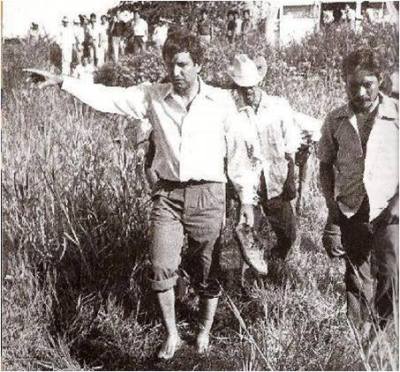
AMLO, ca. 1980
So wrote Polish anthropologist Irena Majchrzak in 1988 about her experience in Tabasco in 1979-1980, when Andrés Manuel López Obrador was a newly emerging regional leader of a nascent opposition movement that Majchrzak was apparently not aware of. The anthropologist talked about his work when there was not particular reason to make him look good, or praise the young bureaucrat. It is a disinterested and moving portrait.
The enemies of Andrés Manuel, who often resort to gross exaggerations, or simply repeat the cliché that he “was with PRI” ignore what type of PRI-ista the 23 year old was. Fresh out of the University, he joined the 1976 electoral campaign of the poet Carlos Pellicer [then running as an “external candidate for the Senate] , and from 1977 to 1982 served as regional director of the INI [National Indigenous Institute, for its initials in Spanish], working in the manner the Polish writer described. To simply say that AMLO was “with the PRI” also omits to mention that during this era (1946-1988) many of the best Mexicans, from scientists, artists and intellectuals to honest politicians (there were some), were PRI or worked for the PRI.
AMLO’s enemies also omit the reason he broke with the PRI, after serving as the Tabasco, state party president (1982-1983) at the beginning of the governorship of his former professor, Enrique González Pedrero. When a documented attempt to democratize the PRI was blocked by the “machine”, González Pedrero relocated him to a less political position, “officio mayor” [basically civil service director] in which AMLO served exactly one day (August 15 to 16, 1983) before sending a resignation letter outlining his principles.
He focused on self-searching and finishing outstanding tasks, only nominally a PRI member until he joined with Cuauhtémoc Cárdenas in 1987-1988.
That is history. You can look it up: Héctor Alejandro Quintanar, “Las raíces del movimiento regeneración nacional”, Ítaca, 2017. Originally masters’ thesis, FCPyS-UNAM.
The Russians are coming… ho-hum
Coming from the country that has never been exactly subtle when it comes to trying to “influence” elections here, this is rich. Regeneración, 6 January 2018 (my translation)
Once again accusations are being leveled against Russia, said to be attempting to influence yet another foreign election.
This time the accusations come from General H.R. McMaster, White House National Security Adviser , who claims that Moscow will intervene in this year’s Mexican elections, but does not give any details to support his statement.
In mid-December, Aristegui Noticias reported that McMaster said the United States had “perceived” that Russia would seek to intervene in the Mexican elections.
The counselor said that the objective of this alleged intervention is to “polarize societies and cause a crisis of confidence,” adding that this “can be seen already in the campaigns in Mexico,” but did not provide any details.
“With Russia we are increasingly concerned about these sophisticated campaigns of subversion, disinformation and propaganda. Theyn have the cyber tools to do it,” McMaster said at a Jamestown Foundation conference.
Along with these US accusations, some political commentators in Mexico also suggested that “Russian hackers” could influence the results of elections here. For some reason, RT (the Russian news service) responded that similar accusations have been raised over other elections, wth claims that “Russian hackers were responsible for the victory of Donald Trump in 2016,; that they also caused Brexit that same year; they started the independence movement in Catalonia; they intervened in the Netherlands; they influenced the elections in Germany and France … ”
REGENERACIÓN noted at the time that types of statements, despite not being based on evidence, have become a kind of wildcard that political actors use to evade responsibility for electoral results not matching their expectations.
On the other hand, the media expert Jenaro Villamil, has said the real “ghost” that various politicians call “Russian influence” is “the failure of a generation of politicians who after the 2008-2009 financial crisis either could not, or did not want to read the messages sent by Greeks and Spaniards caught by the collapase, or by the denizens of the suburban London and Paris who know themselves excluded from the “European utopia”.
It might e worth noting that the Jamestown Foundation was set up to provide a sinecure for Soviet Bloc defectors, and to pitch their various memoirs to major publishers. It has close ties to both the CIA and to known Russophobes in the foreign policy “establishment”.
That said, and accepting that Russians might have actually sent out various tweets and facebook messages during various recent political campaigns, one has to ask… so what? I don’t see that there’s any evidence that Russian hackers had any real influence on any elections elsewhere. And, while Mexico’s recent administrations have bent over backwards to support US policy, Russian relations are … so far… a non-issue here. The US is somewhat concerned about one of our presidential candidates (and we know which one that is) who has more to worry about US intervention than a few tweets and posts from Moscow. And, as it is, given the candidate’s overwhelming led in the polls right now, Russian interference with the other candidates would be counterproductive
But, as an excuse for the probable outcome of the election… blaming the Ruskies is a natural for those US politicians who want to ask “who lost Mexico” (which was never theirs to lose in the first place, natch).
Raw deal
Via EFE:
Washington, January 5 (EFE) .- The US Department of State today approved the sale of an arms package valued at 98.4 million dollars to strengthen its security by supporting a “strategic partner”.
The package, which must still be approved by the United States Congress, includes the sale of 6 Harpoon Block II surface missiles, 23 Block II Rolling Airframe tactical missiles, and 6 lightweight torpedoes.
“The proposed sale will strengthen our foreign policy, as well as the national security of the United States, by supporting a strategic partner,” the State Department said in a statement today.
The State Department release said that Mexico could use this weaponry to fight against drug trafficking organizations by strengthening the capacity of its Navy.
According to the latest official data released by the United States government, in 2016, Congress approved the sale of weapons to Mexico worth 686.08 million dollars. That same year, Washington granted its neighbor of the south 100 million dollars of aid to fight against drug trafficking.
I’m not sure buying missiles manufactured by the only country that is a potential military threat to Mexico is all that good an idea. The missiles mentioned are for taking out enemy warships, and there’s only one navy (on either of the Mexican seacoasts) that’s in any position to attack here.
Oh… but we can use it for “drug trafficking”, which I guess means blowing up our own ships bound for eager consumers of some of our products which will just go by sea if the great wall of Trump ever goes up… or are we expected to start a war with some third country, blowing a merchant ship from, say Colombia, out of the water? Predator drones, capable of targeting gun dealers in Arizona and New Mexico might be more useful to us right now
What I really question is that last paragraph. Gee, we’re given 100 million bucks to buy close to 700 million bucks in new hardware (installation and maintenance not included). What a deal… NOT!
“And bad mistakes ‒ I’ve made a few”
With no time for losing… the PRI will keep fighting… to ridiculous ends.
Local PRI candidate for Benito Juarez delegate(CDMX), Esteban Ruiz, like other political candidates, revels in celebrity endorsements. Like…uh…Freddy Mercury, who being both dead and British, really isn’t likely to be all that much help to the PRI.
Neither is Michael Jackson.

Raising Hell outside the Cathedral (Oaxaca)
Father Miguel Ángel Morelos García died last week in San Francisco Telixtlahuaca on the 43rd anniversary of his ordination. Nothing particularly newsworthy, but this is Oaxaca, where anything can set off a protest… even the death of a elderly country pastor.
Since January 2004, when José Luis Chávez Botello became Archbishop, 39 priests have died. Considering that they were elderly men, that shouldn’t surprise anyone, but… the old priests were overwhelmingly clerics in indigenous communities, while not necessarily “liberation theologians”, out of tune with Chávez Botello’s intended return to a more traditional clergy. With conservative bishops having controlled the diocese since 1999 (Chávez Botello, one of Pope John-Paul II’s “traditionalist” appointments has made it his mission to wipe out the influence of Liberationist bishop Bartolomé Carrasco Briseño,who had died in 1999. Carrasco’s replacement,the extremely conservative Hector Gonzales Martinez, later transferred to Durango, never had the time or inclination to remove the liberationists from their pulpits or to recruit replacement priests more to his taste). While the liberationist priests were able to hold on, they were getting older. And, in stepped Chávez Botello… who not only has been systematically removing priests who offend his theological sensibilities, but those who dare speak of the flagrant pedophilia scandals that have particularly plagued indigenous communities. The most egregious and public of which was when the dean of the Cathedral was caught in flagrante delecto molesting an altar boy. But the scandal that gives the dissidents some leverage is the Bishop’s refusal to comply with Vatican requests for information about Fr. Gerardo Silvestre Hernández. Silvestre was imprisoned for raping a nine-year old, and he is suspected in over 100 other cases of child abuse (mostly of indigenous children). Chávez Botello is said to have known about the abuse, but continued to simply transfer Silvestre from one parish to another.
When parish priests began openly calling for Chávez Botello to retire and even petitioning the Vatican for his removal, the Bishop has responded by transferring dissident priests to remote parishes. That some of the dissidents, like the late Fr. Morelos García were already serving… and long serving at that… in those remote parishes meant tearing away traditional community leaders (and men who had integrated themselves into their local community… sometimes on the quiet also having families of their own, accepted by their communities).
Fr. Morelos García, one of those priests who had called for the Bishop’s removal, and had been a long time supporter of various social movements in Oaxaca, was said to have died of a broken heart when he heard he would be transferred from his home and replaced by the Bishop’s choice for the pastorate, Fr. Leonel García.
Fr. García may be perfectly fine priest… but the parishioners of San Francisco Telixtlahuaca are not about to accept him with open arms. Well… one hopes without arms at all, as they’ve occupied the local church properties. While they held an impressive funeral for their late pastor (with six priests and a band), they’ve also taken to picketing the cathedral in Oaxaca City, demanding not just a new pastor more to their liking, but the immediate removal of the Bishop.
It’s a Oaxacan thing.
Pedro Matías, “Católicos de Oaxaca exigen destitución de arzobispo de Antequera por encubrir pederastas“, Proceso 3 January 2018
“Oaxaca archbishop accused of cover-up“, Mexico News Daily, 27 January 2016
Stan Gotlieb, “Hard Times Ahead for Liberation Theologists“, Real Oaxaca, Volume 8, No. 20: December 15, 2003
Un soldado en cada hijo te dio?
María García Pérez, a PAN deputy for Queretaro, has introduced a bill that would end the draft. Well, that seems fair…though what she would like to replace it with would be universal military service for all 18 year olds. Being well past draft age, and not having kids, I suppose it’s not all that bad an idea. It would make the military a more democratic force … funny that most kids who get drafted are the poor kids and very seldom the middle or upper class ones (though I did have a friend from a family of academics and Communist Party leaders who was drafted, though his military assignment was finishing his doctoral dissertation research on sex and gender studies).
I don’t know much about the bill, and it may be one of those bills fated to die a quiet death in committee, but it appears to be much less radical that one might suppose. Mexicans are already supposed to do a public service job, and the overwhelming majority of the 18 year olds would be reservists, merely trained for disaster relief and emergency assistance. Then again, do I want to give guns to a bunch of teenagers?
I hate to ask…
THANKS, ALL. I won’t be able to get banks straightened out until later this week, and hadn’t noticed that my site would have otherwise gone off line on Tuesday. Was able to renew, and problem resolved (for the next 12 months, anyway).
… but having spent the last six months recovering from a serious accident (DO NOT USE YOUR RIGHT LEG AS A BICYCLE BRAKE!), I haven’t always been as up on keeping track of recurring expenses that were automatically paid as I should have. And, obviously, being in a wheelchair the last six months… besides the medical bills (which we were able to cover), but minor expenses that add up… having to take a taxi instead of the subway to my rehabilitation therapist, paying an out-of-work Bulgarian actor (long story) to fetch and carry for a few days when there was no one at home to help out and even heading to the bathroom required some assistance, a few delivered meals, etc. Dumb, but not having made a bank deposit in several months (and the neighborhood branch with a handicapped entry having been closed by the September earthquake), my paypal account is down to about ten US dollars, split between pesos and dollars.
I don’t need much… but the yearly charges for this domain and website maintenance are due this week. The “paypal” donate button is at the right.
The general in his labyrinth … at Christmas
With our politicians suddenly aghast at the mere mention of using a general amnesty as a means out of a violent, and increasingly pointless “war on drugs”… a bit of Mexican history on how amnesty … while not ending violence… has been used to reduce violence and allow for political and social reform.
His forced decimated in the Bajío during the spring and summer of 1915, Pancho Villa had retreated north. Driven out of Sonora that fall, he returned to his native Chihuahua in December. Between the cold and a wave of executions along the trail, he lost still more of his forces before arriving home to address a crowd … described about equally as apprehensive and enthusiastic … ten days before Christmas.
 Still powerful enough to impose forced loans and order retail stores to open, he also commissioned his chief civilian adviser, Silvestre Terrazas and general Cruz Domínguez to negotiate with the Carrancistas for the peaceful surrender of the city.
The Constitutionalist had 10 thousand soldiers of the Army of the Northeast under the command of Jacinto B. Treviño advancing from Torreón in Camargo, waiting for orders to attack. Villa saw off the families of his top generals, along with his official wife, Luz Corral and his children on the train to El Paso (and eventual, and as it turned out, temporary, Cuban exile) on the 18th.
On the 19th, General Cruz Domínguez entered Chihuahua with a force of 500 mounted soldiers. Villa’s generals, along with what remained of his civil administration met at his home. Villa ordered the evacuation of the city of Chihuahua, ordering his remaining forces to gather in Bustillos, to discuss to approve plans for continuing his campaign. He warned them that no matter what his subordinates decided, he would continue to oppose Carranza, and, if necessary, die in the attempt.
It began to snow when Villa appeared on the balcony of his municipal palace. Through tears, in the bitter cold, he harangued the crowd with invective against Constitutionalist leader Venustiano Carranza for selling out the revolution to the gringos (despite Villa’s own overt attempts to curry U.S. support) and assured that he would continue the fight in the mountains. Then left for Bustillos. Carranza decreed an amnesty for those who would lay down their weapons.
Villa conferred in Bustillos with 27 generals; 23 of them made it clear that they did not want to continue a struggle that had no hope or future and that they were thinking of accepting Carranza’s amnesty or taking refuge in the United States. On Christmas Day 21 generals and 7000 men surrendered. In the following weeks, another another 20 would surrender, along with over 5000 officers and civil servants, and 11,000 soldiers.
What was left of the once powerful Division of the North, and the Villista government, was reduced to a guerilla force, of little strategic importance, his raid on Columbus, New Mexico the following year being the “last hurrah” of the legendary commander, both feared and favored by the Wilson Administration, and once seen as the most important of the Revolutionary war-lords.
Although the violence would continue on a smaller scale, and small scale rebellions would continue up into the 1930s, the Revolution effectively ended with a Christmas amnesty. But, with Villa no longer a threat, the Constitutionalists were able to consolidate their hold on the country, call a constitutional convention the following year, and begin the process of reform.
(source: Pedro Salmerón Sanginés, Navidades y amnistías: fin de la División del Norte, Jornada, 26 December 2017)
Left, right, left, right

It’s probably dangerous to slap labels… especially those labels coming from European and other global northerners… on the political movements here. Still, for simplicity (and for foreign media consumption), the formula has been PRD = “leftist”; PRI = “centerist”; and PAN = “conservative”. The other seven national parties are usually forgotten, or mentioned only as an afterthought, but this year, with one of the “others” possibly crushing the big three, and ideologically incongruent coalitions between parties in the race for the Presidency, the simplistic formulas beloved by the media are going by the wayside.
PRD claims to be a Democratic Socialist party, so calling it a “leftist” party makes sense. Until one realizes that PRI… which follows a neo-liberal economic policy, as well as the PRD, are both member parties of Socialist International.
But, I suppose a lot of “Socialist” parties have more or less acquiesced to neo-liberalism and the “Washington consensus” over the last 25 years or so. And, Mexico having always been seen as further “left” than the United States, I suppose a party Socialist in theory, but not much in practice, is “centerist”.
And PAN? Although its roots were in both Fascism and in conservative Catholic movements, the Partido Acción Nacional” considers itself neutral on economic policies. In reality, it is a neo-liberal party, a bit further to the right (especially in cultural and social policy) than PRI. So, I suppose it is the right party to call the “right”.
Right?
Several new parties, with different ideological positions have sprung up in the last three years, complicating the neat divisions between the parties, and no doubt ruining the simplified political shorthand of “left, center, right”.
Morena (Movimiento Regeneración Nacional), led by With Andres Manuel López Obrador –“AMLO”, the PRD’s presidential candidate in 2006 and 2012 — knocked his old political home from its position as the third largest party. Unable to hold its own against the two larger parties (between them, PRI and PAN can count on about 60 to 65% of all voters in any election) and having driven López Obrador out of the party (and, consequently, a good portion of PRD voters defecting to Morena), it has been desperately trying to maintain its relevance by providing an alternative to PRI.
However, an alternative has always existed (or at least a viable one since the 1990s) in PAN. So… the socialist PRD started running in coalition with the neo-liberal PAN for state offices a few years back… and, finding that it was usually left out of power… seems to be of the theory that if it hasn’t worked out yet, maybe it will if we do it again. In short, they’ve formed a coalition, with one of the new parties, Citizen’s Movement (which, outside the State of Jalisco, has almost no presence) to form a anti-PRI, anti-López Obrador coalition.
For the ideologically pure PRD members, this leaves Morena or Citizen’s Movement. The latter was a re-boot of the mortibund “Convergence” Party, which was briefly López Obrador’s political home after leaving the PRD. At the time, its appeal was mostly to middle-class leftists, barely holding on to its registration (which requires winning at least two percent of the national vote). López Obrador brought new blood into the party, “frenimies” like Marcelo Ebrard –his sucessor as “mayor” of Mexico City, and a rival for leadership of the Mexican left. Although López Obrador, with his support mostly from the working class, has moved on to the new Morena Party, as a home for the “liberal” left (with their commitment more to social reforms than economic ones), the Citizens’ Movement has established itself in a few places, notably in the State of Jalisco. There, where PAN was identified with the more reactionary elements in the Catholic hierachy, and PRI’s unsavory reputation for corruption was always a factor, and PRD infighting was tearing the leftist alternative apart, the Citizens’ Movement made substantial gains, even capturing Guadalajara’s municipal government its first time out.
Perhaps sensibly, the Citizens’ Movement … at least hoping to preserve its position in Jalisco, joined the PAN-PRD coalition, moderately demanding the two major parties support its own candidates in that state, in return for their support for the PAN selected Presidential candidate. Meaning, socialists supporting a neo-liberal nationally, in return for neo-liberals supporting socialists locally.
The Mexican Green Party… often sneered at as the “Show me the green” Party… has survived as an appendage of the PRI since leaving the coalition that elected Vicente Fox, who denied the Greens control of the Secretariat for the Environment. That was back when the “Ecological Green Party of Mexico” was actually interested in ecological issues. Since then, while it pushes a “green” bill in the legislature every now and again, it’s become just the PRI for “juniors”…If anything, the best analogy is the Greens are to the PRI as the U.S. Libertarian Party is to the Republicans. In other words, a party for those who generally agree with the power elite, but consider themselves too sophisticated to consort with the rabble.
For all that, the PRI — saddled with corruption scandal after corruption scandal, and desperate to show a new face — has chosen as its candidate a PAN politician! Unable to find an acceptable candidate among the party leadership (one with a chance of winning, anyway), they changed the party rules to allow for an “external candidate”, and turned to Calderon and Peña Nieto cabinet minister, José Antonio Meade. While a rather bland figure, he doesn’t upset anyone, but doesn’t seem to excite them either. Economic issues have never played a major role in Mexican presidential elections (except for gaining or losing the tacit support of the United States) but as Secretary of the Treasury, he may be able to gain the support of important business leaders, especially those made nervous by AMLO’s leftist discourse, and worried about the future of NAFTA.
Who knows what the Alliance will do? Founded by long time teachers’ union boss Ester Elba Gordillo when she was thrown out of PRI for her cozying up with the Fox Administration, the Alliance has been a stalking horse for the two biggest parties, sometimes in coalition with PRI or PAN, and in others, fielding its own candidates for the purpose of draining off votes from other parties. Notably, in 2006, the Alliance mounted a serious campaign in Oaxaca, not to win, but to pull votes from the PRD, which would have won the presidency had there not been a (suspiciously high number of) votes for the Alliance candidate.
That PRD candidate, by the way, was Andres Manuel López Obrador, whose near capture of the Presidency, and the fallout from that election, led to the break-up of the neat divisions on the political playing field.
Morena, having grown overnight into one of the big three, is the “new” left. With PRD having turned against it’s former leader, it has to find its coalition partners where it can. That the Workers’ Party (PT), the rump of the old Communist Party, is joining with Morena, makes perfect sense. What makes no sense is the announcement that the Social Encounter is also joining in.
Social Encounter claims “Christian Humanism” as its ideology, though it appears more “Christian” in the sense that right-wing U.S. Fundamentalists are “Christian” than in the usual sense of applying the principals of Catholic social teachings and the philosophical tradition based on the writings of Thomas Aquinas to politics and ethics. Founded in Baja California, where it used the “fish logo” as its own logo (something a little too obvious to use nationally), Social Encounter’s platform… outlawing abortion and same-sex marriage prominently mentioned… have roiled Morena, which included the country’s most prominent feminists among its more loyal members, and … in unveiling its intended presidential cabinet included eight highly qualified women among the 16 prospective posts… including a woman as Secretary of Goverance, the de facto Vice-President and “Home Secretary”.
With intellectuals able to make or break a candidate (at least on the left), when people like Elena Poniatowska kick up a public fuss (she was photographed holding a sign saying “NO Social Encounter” at the same press conference where the proposed cabinet members were announced) and the actress/feminist/political organizer Jesusa Rodriguez walked out, there could be real trouble for a candidate who seemed unbeatable going into the election.
López Obrador, for all his populism, is socially conservative, so I’m not surprised he would consider taking in the small Social Encounter party. Same-sex marriage and liberalized abortion laws only came to Mexico City after his tenure as head of the government ended. Its widely acknowledged there was the political will and support to pass both measures, but during his tenure, they weren’t brought forward for fear of a backlash by conservatives that would interfere with his own presidential ambitions (and those of the then powerful PRD) as well as AMLO’s own personal reluctance to support the measures.
This is a strange election. With the left joining the right to fight the centerists (who turned to the right to find a centerist who will stay in the center) on one hand, while fending off the left on the other, and the left is courting the far right, perhaps we need to stop talking about where anyone is in the outfield, and start asking “who’s on first? And what’s on second?”
Will Canada have to subsidize the cartels?
So, Canada is gonna sell it’s own marijuana next year, at what they say are below-market prices. Although the rationale is undercutting the black market, and ending smuggling, Canadian consumption far outstrips production … only about 30% of domestic consumption is domestically grown. So where is the other 70% to come from?
Eppur se mueve… or the Primate directive
It’s official. Norberto Rivera, Primate of Mexico is finally going. He is, to no one’s surprise, being replaced by Carlos Aguilar Retes, Bishop of Tlalnepantla , who only received his red hat 14 months ago. Aguilar’s surprise elevation was widely seen as a sign of Pope Francis’ dissatisfaction with Rivera’s elitist style and his too-chummy relationship with Carlos Salinas and the political class… what the political left here refers to as the “mafia of power”.
 While the new Primate is said to be personally close to Enrique Peña Nieto (he assisted Peña Nieto in untangling the impediments to his second marriage), he doesn’t carry the baggage that Rivera brought in with him when he first came to the Metropolitan Cathedral in 1995. As Elena Reina reported for El País [Madrid] on Aguilar’s elevation to the Cardinalate:
Aguilar has been an important religious actor in the country. He was president of both the Mexican and Latin American Episcopate. “When he was president of the episcopate his relations with Rivera were very bad. Rivera comes from a crudely triumphalist Church , which wants to aggressively influence public debate, resorting to strong statements and even blackmail. [Aguilar] Retes is more sophisticated in political terms, is not [he and Rivera] are so different ideologically, but that he is more audacious in the use of politics, “says Bernardo Barranco, the Mexican sociologist specializing in religious matters.
It’s impossible not to see the Primate as a political player, especially with a watershed election coming up. While Rivera and the “old guard” churchmen were bending the laws on clerical participation in politics to back conservative and neo-liberal candidates, and it can be expected tha Aguilar’s own politics veers towards the rights, he is known as a consensus builder, which would be to the Church’s advantage in a time of social and political transformation. As de facto head of the Mexican Church, his elevation to the Metropolitan Archdiocese signals Rome’s support for a more pluralistic and flexible Church, responsive to the people and not the elites… but one more willing to engage in the political and social arena.
Plato, Bertrand Russell, Pablo Escobar, Jesus, and AMLO
Mexican political commentators just love to splash around their erudition. Defending AMLO’s remarks about possibly considering an amnesty for those involved in the narcotics export trade, Federico Arreola

How did I get dragged into all this?
(SDPNoticias.com) manages to drag in Plato, Karl Popper, and Bertrand Russell to build his defense of the Morena candidate. You can read the whole thing here, but what it comes down to is guys like Plato (as explained by Popper and Russell) are raising issues not so much because they see their suggestion as the one and only means to an end, but because they are opening a dialog.
And, given the responses from the usual suspects to that “dialog opening” suggestion on who to proceed with the “drug and violence” issue, it doesn’t sound like too many political figures outside AMLO’s camp want to even consider alternatives. PAN chair Ricardo Anaya dismissed AMLO’s talk of amnesty as “loco”. He expanded just a bit, referring to Colombia’s “amnesty” for Pablo Escobar as proof that it wouldn’t work… although one badly considered plan, under other circumstances, hardly counts as proof no plan would work. Lord Russell would dismiss that bit of illogic with a sneer.

OK, so prison wasn’t so bad for me…
Margarita Zavala (Mrs. Felipe “indicted by the world court for genocide” Calderón) said she preferred criminals to go to jail. Okey dokie. I suppose building prisons to house the estimated 400,000 Mexicans directly tied to the narcotics industry in one way or another is a public works initiative. Points for thinking outside the box, an finally coming up with some kind of policy initiative in her lackluster campaign for the Presidency.
Mexico City’s mayor (and possible Citizens’ Front candidate for President), Miguel Angel Mancera, frets that an amnesty means that one has sanctioned the whole business, and would effectively legalize organized crime:
Amnesty means a law of oblivion, a law of forgiveness, and the truth is that this would sanction behavior related to drug trafficking… it would stop being a crime.
I donno. Mancera states the obvious, that amnesty means a law of oblivion (at least as far as the state is concerned), but I don’t see that it sanctions the actions by any means. José López Portillo was in no way sanctioning guerilla uprisings when he sent an amnesty bill to Congress in 1978, nor was Carlos Salinas justifying the Zapatistas in his January 1994 amnesty decree.
And, naturally, the heads of the various military branches all poo-pooed the idea… even when pointed out that some of them might be eligible for amnesty.

I’m no Benito Juarez, but so what?
But, my favorite objection came from PRD’s Ángel Ávila Romero. Ávila Romero rejects the idea, not because it might not be legal (although it apparently would, and apparently does have precedent) but because it is … for lack of a better term… too Jesusy.
…forgiveness comes from a religious concept that is applied to the state. Mexico is a secular state. Juarez separated religion from politics because mixing the two can cause social polarization.
Not a bad argument really, though I recall Juarez (a former seminarian) forgiving and forgetting a lot of French soldiers and imperial hangers-on after Maximiliano was taken care of. Did he slip and think of Jesus? Or maybe Maimonides (“Better 99 guilty go free, than an innocent man wrongly suffer)? Or Carlos Salinas?


 mexfiles.net