Cristina Pacheco, DEP
A combinaton of Oprah and Studs Terkel, Cristina Pacheco chronicled the lives of Mexico City’s denizens for over 50 years, both in her long-running weekly “Mar de Historias” in La Jornada, and her television program, “Aqui nos tocó vivir“, and in an interview chat show that always surprised me.. in which she’d interview, in depth, figures as unlikely to be found in the same program as Nobel Laurate Gabriel Garcia Marquez and workers in a sweatshop turing out the clothes for Barbie dolls, giving equal respect to both, In 2010, she was honored by UNESCO for her contributions to memorializing the Mexican cultural identity.
Born in 1941, Pacheco was a working reporter and mother. Her husband, José Emilio Pacheco — a poet, essayist and “public intellectual” — died in 2014, and she is survived by her two daughters. A workaholic of sorts, she only gave up her television work a few weeks ago, and her newpaper column a week ago, never mentioning her terminal cancer.
One of my favorite segments was her search for, and discovery of, the source of that most enduring (though not always endearing) melodies that everyone in the city (and in large parts of Latin America) has come to know by heart: ”Colchones! Tambores!…” and finding dignity and worth in those plying even the must humble of trades.
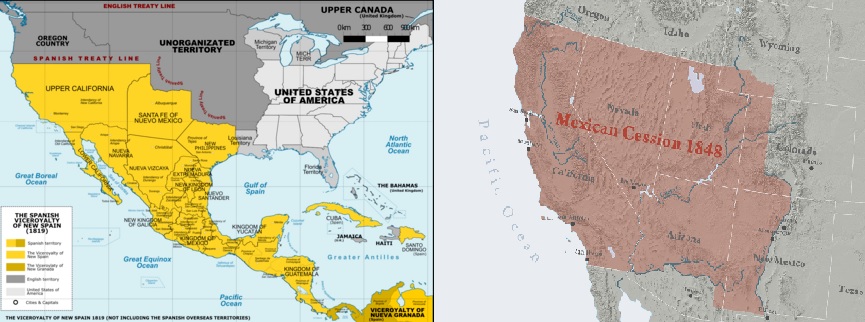
Chronicle of an Annexation Foretold?
Luis de Onis… of the Adams-Onis treaty that set the boundries between the new United States and New Spain, during the early deliberations that would lead to the 1819 treaty setting the boundaries of the United States and New Spain, wrote to Viceroy Vengas in April 1812:
“Every day the ambitious ideas of this republic are developing more and more, and its hostile views against Spain are confirmed… this government It has been proposed nothing less than to set its limits at the mouth of the Río Norte or Bravo, following its course up to the 31st degree and from there drawing a straight line to the Pacific Sea, consequently taking the provinces of Texas, Nuevo Santander, Coahuila, New Mexico and part of the province of Nueva Vizcaya, and Sonora. This project may seem like a delirium… but a plan exists and has been expressly drawn up for these provinces by order of the government, also including the island of Cuba in said limits…
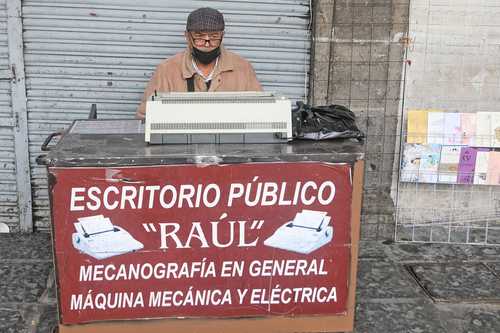
Matthew, Mark, Luke, John.. and Raúl
One of the last of a dying breed… the public writer, or…. “evangalista”. In the days before mass literacy, and even 20 years ago, you’d find “evangalistas” around Plaza Santo Domingo (along with print shops and booksellers) ready to help you prepare anything from a CV to a love letter to a plea for mom back in the campo to send you rent money.
Photo in Jornada by José Antonio López.
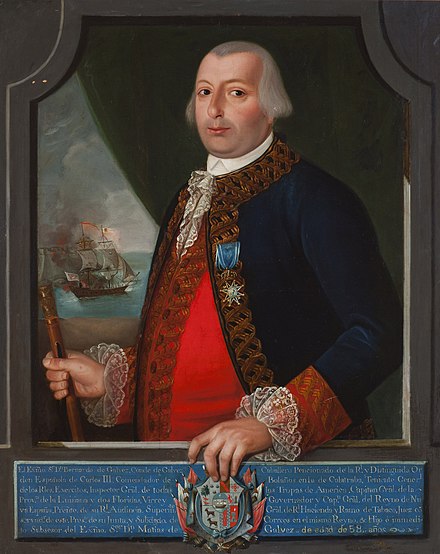
Bernardo de Galvéz: the enemy of my enemy …
There is no doubt Bernardo de Gañvéz was a key — and until recently, overlooked — figure in the American Revolution, and he well deserves the honor bestowed upon him postumously (of the United States,Perhaps it was a combination of nepotism and geopolitics that led Bernado de Galvéz to be (long) postumously made an “honorary citizen” of the United States (a mere 228 years after his death). But one shouldn’t forget that his importance to the cause of US independence was precipitated more by his loyalty to the Crown of Spain than any love for the “American Way of Life”.
A professional soldier, Galvéz had fought Portuguese, Moroccans and even Apaches by the time he was in his early 20s. A bit of nepotism (his dad was Viceroy of New Spain) certainly didn’t hinder his colonial career, being appointed miliary commander of Nuevo Viscaya (today’s Sonora, Chihuahua, and Durango) at 24, then sent to serve in a joint Spanish-French unit where he picked up fluent French (useful later).
In 1777 (when he was 31) he got another career boost, as Governor of
Florida… not just today’s US state, but Alabama, Mississipi and parts
of Lousiana, and.. later as Governor of Spanish Luisiana — that massive
chunk of real estate in the center of North America, gifted to Spain by
the departing French in 1762 although it would largely remain French in
language and culture. In all his posts, he enjoyed excellent relations
with the colonial subects, attentive to their needs, even when they
conflicted with those of the “Metropol”.
In his dual role, and politically well connected, Galvéz (and his father in Mexico City) were paying close attention to the rebellion in British North America. How better to stick it to perfidious Albion than — like the royal family’s cousins in France, with its own reasons to weaken England — than to offer aid and assistance to the rebels? And not just token support.
Whereas in Mexico City, dad was raising funds to keep George Wasington’s army paid and fed (the only quid pro quo being Washington have his soldiers innoculated against smallpox, as Spanish soldiers were), though a “back door” from Luisiana, and from Florida into Georgia, Bernado was anxious to keep the rebellion supplied and avoiding British naval blockades.
Moreover, he served as overall commander in the first US overseas operation… a joint Spanish-US seizure of the Bahamas (a useful bargaining chip once independence was achieved), With the Spanish navy busy harrassing the British Navy around the world (an overlooked Spanish contribution to US independence, although of course the Spanish objective was to regain control of the Mallorcas –which they did — and Gibralter — which they didn’t), Galvez was also able to arrange for the Havana gold shipments to be diverted to Washington. just in time to keep his troops on the offensive as they closed in for the final showdown with Conwallis. (September 1781)
AND… a few months earlier (May 18, 1781), Galvéz personally commanded the Spanish attack on Pensacola, the center of British control over the Floridas. This eliminated any threat from the south (and given the strong military presense of the British in the Caribbean, as opposed to their weaker presence in Canada) was the final nail in the coffin for the British forces still in the field.
However, how committed he was to the Ameican cause, and its rather limited definition of the right to “life, liberty, and the pursuit of happiness” and how much his actions were just those of a good soldieer, or as a geopolitical thinker we’ll never know. He would become Viceroy of New Spain at 40.. in 1785, at only 39 (succeding his dad), but died of typhus the next year. Had he lived into Mexico’s independence here, he would have only been in his early 60s, and whether his duty to his sovereign, or his support for criollos would have swayed him, we’ll never know.
We do know, however, what he thought of his suport for the enemies of his enemies. The way following his defeat of the British at Pensacola, he told us what he really thought:
The Yankee is a hypocritical, false and truly rapacious being. The ideas of popular government, of democracy and free trade that it proclaims, have no other purpose than to ignore the rights of others, deceive the world with false promises and obtain personal advantage.
Mammon is the God of the New Phoenicia or New Carthage of America, a motley mixture of hypocritical puritans, lawless adventurers, audacious demagogues and merchants without conscience” (May 9, 1781).
Selser, “Cronología de las intervenciones extranjeras en América Latina. Tomo I (1776-1848)” Mexico: Cema, page 45 (2010).
Yanez, “The Role of Spain in the American Revolution” (Masters’ Thesis, United States Marine Corp Command and Staff College)
This Christmas remember the Alamo

Just a reminder
A new political post… about what will at some point maybe be another “historic” election in Mexico… is up at mexfiles.substack.com.
It’s free to subscribe (and donations are always accepted through this page’s paypal button.. yeah, I know, paypal is evil, but the only option I have right now for these kinds of transfers… an issue having to do with my bank card that hasn’t been straighted out).

Nuevo Irelandia? Californy was the place it was meant to be… but…
If it wasn’t for British historian John Fox’x “El Proyecto MacNamara” (Irish Academic Press/Merrion, 2014), one of the great “whatifs” of North America… might have disppeared forever. More than a great story of a spectular failed effort at ethnic cleansing, it is largely the story of a single man who was caught up in international intrigue, one war, one near war, and is largely (if unwittingly) at least partially responsible for the founding of the state of California. Quite the career for a guy, who if you run a “google search” for his name only turns up Fox’s book, buried among references to an American academic and poet of the same name, and — despite being in his time, a person of concern to Popes, Presidents, and Parliaments, is so obscure a figure, we don’t even know what he looked like.
About all we can say about Eugene MacNamara is he was an Irish priest, born in 1814 and somehow educated in Paris. Whether he was properly ordained is still unknown, but by the 1830s, was a member of the Jesuit order. Or at least assumed to be.
Given the growing oppression in Catholic Ireland by the British in the last 1830s and 40s — even before the great hunger — the Papacy had been “creative” in its Irish policies. A request, appeal,demand made to the French, or Spanish, or Austrian powers wasn’t going to work in Ireland (where the Chuch didn’t even have Bishops, but only “apostolic visitors”… clerics with a brief to report on conditions in their region, and temporary admistrative functions… and little control over the activities of the clergy, or the faithful.
MacNamara… educated in France, although his record appears to include being tossed out of the seminary at some point (even that is obscure)… also seems to (again, for obscure reasons) have had contacts withiin the British establishment, that (again, under murky circumstances) brought him to the Vatican’s attention.
And, given the repression of the Irish, and the growing demand for a irish homeland… a CATHOLIC homeland … MacNamara was not alone in turning his thoughts to mass emigration. His unhappy experience as Apostolic Visitor to British Guiana (modern Guyana), given the tropical climate … not to mention having made himself persona non grata with the local clergy (whom he complained were incorribly corrupt and lazy), he began to turn his attentions to Mexico.
Or, rather, the then growing interest in the Pacific trade among Europeans. Mexico had inherited claims to massive amounts of the North American west, although very few Mexicans lived there, and … having recognized by the 1830s that the westward expansion of the United States, as well as European designs on controlling the China trade were were a growing threat to its own interests, what better than bringing in Catholics (Catholism the state religion up until 1857) with presumably no love for, or support for, Britain (which — like the United States — was already making known their desire for warm water ports on the North American Pacific coast).
Move the Irish to California… simple, right? Mexico’s recent unhappy experience with immgration to Texas, aside, California is a massive chunk or real estate, and where exactly to put those several thousand (to being with) Irish had to be determined… nobody having ever mapped much more than the coasts. Some vague claims to the San Joaquin Valley having been ok-ed by the Mexicans, the British (who would have had to oversee the “voluntary”(?) emigration thought more in terms of setting up a new colonial possession to extend their claims on what was then Oregon (US states of Oregon and Washinton, the Canadian province of British Colombia) then subject to testy competing claims with the United States –who also had interests in acquiring the territory.
Meaning… a otherwise unknown Irish priest had the Mexicans expecting him to serve their interests, the British to serve theirs, and the Americans… well, they didn’t want to British OR the Mexicans to be running things there. And certainly not the Papists.
This is where the story gets even murkier. Whether MacNamara was a British agent (as the Americans suspected), would be seeking to create an independent Irish republic (as the Mexicans suspected), or simply over his head in an honest effort to assist Irish farmers isn’t clear. Any one, or all of the claims have incomplete evidence to support them.
Even worse, just as MacNamara finally got approval from Mexico to begin, the United States invaded Mexico… and Frémont.. who JUST HAPPENED to be on a mapping expedition of the west, showed up to assert US claims. If he was working on behalf of Mexico, he was a traitor to Britian. If on the behalf of Britain or Mexico, to the United States. If on the behalf of the Pope… well… any way you look at it, he found himself a wanted man.
One can only assume that all he set out to do was find a place to resettle displaced Irish peasants, though given the “power games” of the 1840s, his options were limited. He escaped California, first going to Chile … which had no interest in his scheme … and was lost at sea heading for yet another possible refuge, in the Kingom of Hawaii.
Would there have been a “Nuevo Irelandia” in northern Mexico, a British Hiberia, a Celtic Republic… or… ?
¡Viva la revolucíon!
I wouldn’t say “little known”, but this facebook post (by Judit Megal) captures the essentials quite nicely:
A little know fact about the Mexican Revolution:
It started because of conditions similar to what you see around the world today:
-A President who gave too much of the Country’s National Resources away,
-Foreign corporations exploited the national workforce and took the profits out of the country,
– Most of the rural folk didn’t own the land they lived and worked on, only less than 0.10% of The Indigenous People owned any land at all, instead 1,000 Families owned most of the Gran country of Mexico.
– The Government ruled by a strongarm and forced dictatorship on the country.
– Taxes were high, profits were taken out of the country, the Rich Elit enjoyed all the cream while the country’s workmen were kept under.
It all changed in 1908 after the situation reached a boiling point.
Fransico I. Madero, a young educated son of a Rich Farmers family openly opposed the President and ran against him in the Elections.
– The Elections were forged, Madero was imprisoned, and the old ruler stayed in power.
– Madero escaped across the border and started planning the Political change needed in Mexico.
-On 20 of November, 1910, Madero announced his political program; to overthrow Diaz, to organize a Democracy, and return to the Indigenous Communities the Land that was stolen from them.
That announcement ignited the fires of the revolution.
Although on the 6th of November 1911, Madero was elected and the old president was exiled, that was only the first chapter.
For the next 20 years, there were many internal conflicts and disagreements about the road ahead between all parts of Mexican society. Although these years are considered part of The Mexican Revolution they also qualify as Civil War.
The last internal armed conflict happened in 1926 and was resolved a year later.
¡Viva México! ¡Viva México!
¡Que Viva México!

Felix Parras, 17 Nov 1845 – 9 Feb 1919
Born in Michoacán, Felix Parras was a “transitional” artist, still in the academic style favored throughout the 19th century, but with a twist, less a mentor than an inspiration to the great 20th century Mexican painters. Diego Rivera was just one of his several pupils (although one he particularly mentored) during his stint as director of the Academia San Carlos
Although still in the accepted European style, Parras was a pioneer in his subject matter. Unlike the colonial and early 19th century painters, his paintings reflected purely Mexican… not the glories of Spanish colonial history, nor Catholic themes (although both are reflected in his work), nor were they depictions of the “colorful” and “exotic” Mexican landscape and peoples, but of triumph and tragedy that created the Mexican identity.

Fray Bartolome de las Casas, 1876

Una escena de la Conquista, 1877
Stray cat
Mexico can still be weird. Much news today about a stray cat wandering around the forested coastal municipality of La Huerta, Jalisco. Poor kitty… uh….
How a Bengal tiger –who so far has managed to kill a cow (he was hungry) and knock down a horse, ended up in coastal Mexico nobody seems to have said. I don’t think his name is Richard Parker, though life sometimes imitates fiction down this way.
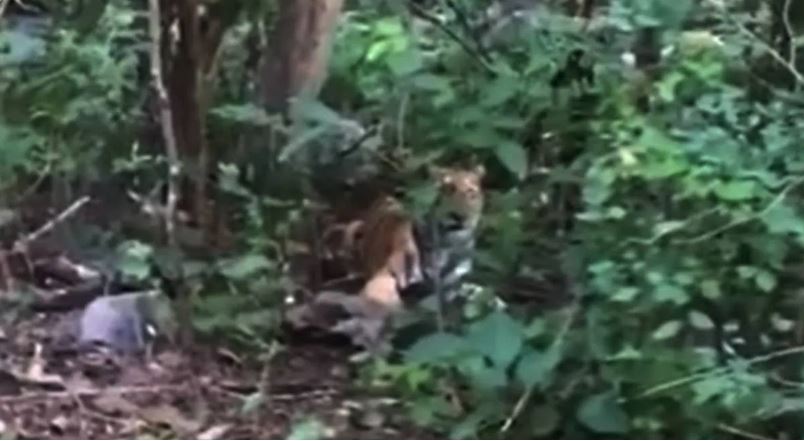
(Video clip from just about every TV news report)
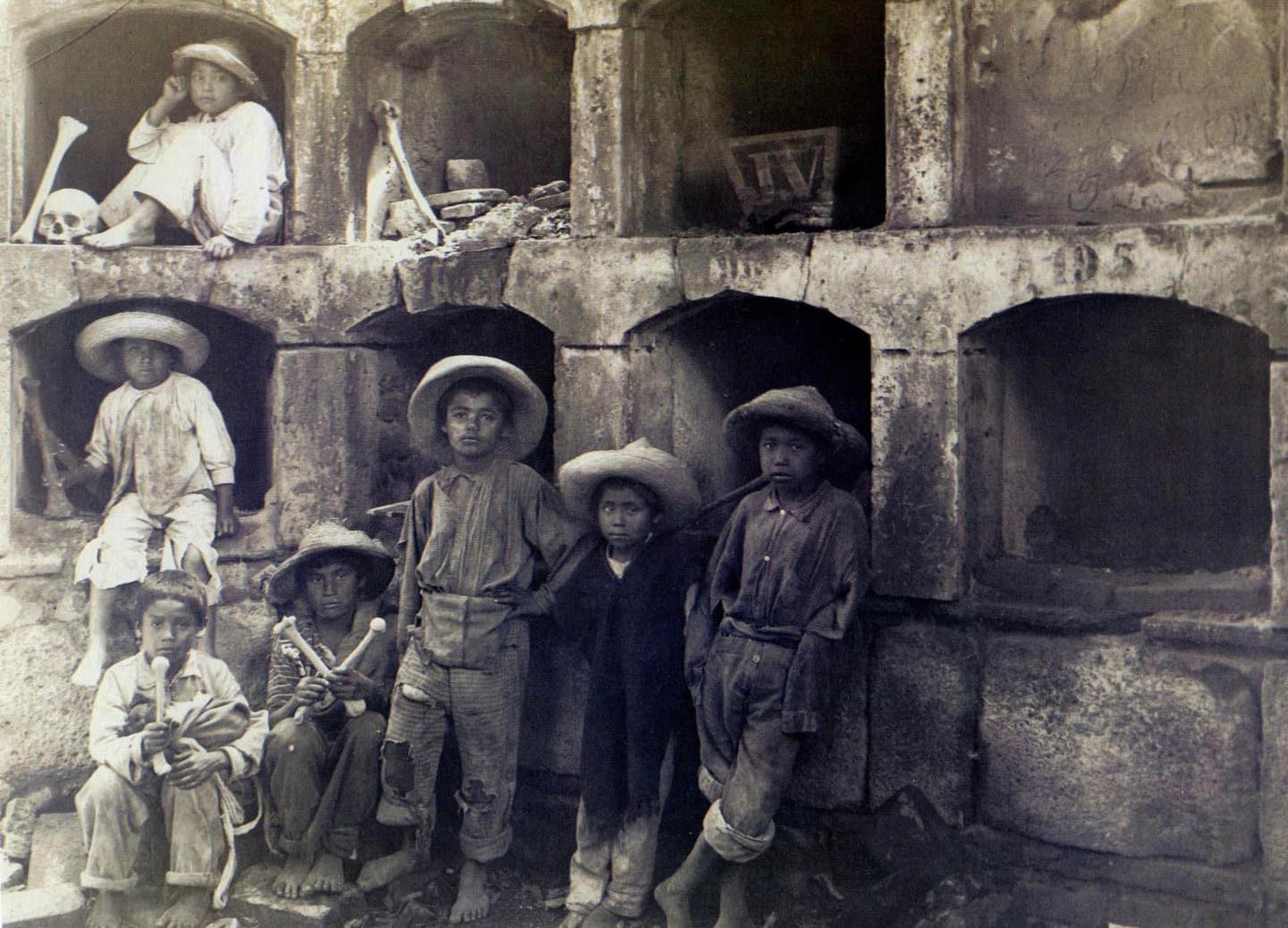
Hey Mom! Look what I found!
The little rascals are playing in an abandoned 18th century cemetery here in Mexico City. Photo about 1910 by Hugo Brehme.


 mexfiles.net