Quid pro quo… or expats beware.
Three members of the Mexican Congress have an answer to U.S. President Donald Trump’s funding plan for his wall on the southern U.S. border.
If Trump applies taxes to Mexican imports to the U.S. or to remittances sent home by Mexicans living in the U.S., the congressmen say they will introduce legislation to confiscate property owned by U.S. citizens in Mexico. A less draconian option, they say, is to attach liens to the property to repay the government for losses from the Trump taxes.
U.S. citizens — not counting U.S.-based corporations — own an estimated $20 billion in Mexican real estate.
(From Cuenca Highlife… an on-line publication specifically for expats in Ecuador, but recommended reading for those interested in expat issues in Latin America in general).
I tend to think that while there will be some overt “anti-gringoism” as a result of Trump, I’d expect official response to be more in the nature of shorter visitor visas, probably higher visa fees, and perhaps a tightening of requirements for hiring foreign workers, as well as applying as a foreigner for some government programs like Seguro Popular and IMSS. And more reluctance on the part of local authorities to give in to demands by foreign residents for public improvements that benefit their own neighborhoods as opposed to less serviced areas: things like street lighting and pothole repair.
Any violence would be more likely directed at US branded properties (even if Mexican owned franchises, McDonald’s or Walmart, for example) than at individuals. Unless they’re doing something stupid like LOUDLY praising Cheeto Benito, or being drunk and disorderly with the expectation that they are entitled to special treatment because of their nationality and racial identification.
MAD… mutually assured deflection
Neither Trump nor Peña Nieto are popular presidents. Laura Carlsen speculate on Democracy Now that ratcheting up the rhetorical war between the United States and Mexico may have political benefits for both weak presidents:
LAURA CARLSEN: […] as political analysts, as people who analyze international relations, I know that we’ve had to start thinking in different ways with this Trump presidency, because there’s this psychological factor, you know, this macho, bullying personality that indicates that they’re not always rational considerations that come into play, such as provoking an international crisis with a close ally, a neighbor and the third-largest trade partner.
So, here he comes in, polls showing from 32 percent to maybe the 40s, lowest approval rating of an incoming president in recent history. What does a weak president do in that situation? He picks a fight, and especially if his name is Donald Trump and he is who he is. So, picking a fight with Mexico, though, is what is probably the bizarre factor, of course, for us who analyze this relationship, because, again, it is an ally. However, it mobilizes his base. It’s been his wedge issue since the beginning of his campaign. It increases this racist environment. And it makes him look strong.
Now, he’s also picked a fight with one of the weakest presidents in the world. President Enrique Peña Nieto has an approval rating now of 12 percent, according to some polls. So he’s between a rock and a hard place. He has his entire population saying, “You have to stand up to the United States,” and a huge opposition movement. There are people calling for his resignation in the streets of Mexico, a news item that’s—that doesn’t come out, with everything else that’s happening in the Trump administration. And then he has this necessity among the Mexican elite, his own group, really, to maintain a relationship almost at any cost with the United States. So, the situation, with all these factors coming into play, and especially the unstable actions and personality of Donald Trump thrown into the mix, has created a very uncertain environment, in which we’re already feeling the impact with the drop in the peso, and a lot of uncertainty regarding investment and other economic and political factors here in Mexico.
Not since 1914
I want to let it sink in for a day or so before I comment at any length, but given the topsy-turvy, on-again-off again, Trump threats towards Mexico (and migrants), I’ve never seen a situation like this where every political party in Congress, the cabinet, the state governors, and the business establishment were meeting today to work out a united response to US economic threats.
Additionally, the Catholic Bishops and peasant groups were also considering their positions, while UNASUR has offered its assistance and “solidarity” with Mexico. Presidents from across the political spectrum in Latin America, from Brazil’s extreme neo-liberal Temer, to Bolivia’s Evo Morales, are condemning the United States and, in Morales’ case, making the same argument as much of the business establishment here in Mexico, that it’s time to reconfigure the export economy: 80% of Mexican exports going to the United States having proven “problematic” and a situation that needs changed.
Why I don’t live at the beach now
(Apologies to Emma Lazarus)
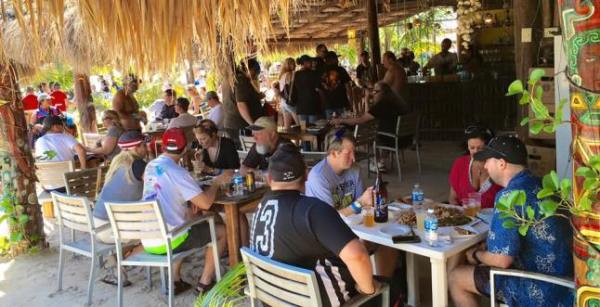
Not like the bronzed beauties of tour brochures,
With well-knits limbs emerging from the sea to land;
Here at our sea-washed, sunset gates are planned
A host of bars, sea-food joints and tourist stands.
In the twilight, the sun-burnt tourists waddle ashore
to eat and drink, eat and drink… and drink some more
We bid them welcome; our mild servers withstand
The raucous gringo accents, as the beer they pour.
“Keep your loud ways, your foreign tongue!” we sneer
With silent lips. “Give me retirees, snow-birds
With humongous asses, yearning for cheap beer,
Wretches who refuse to use our words.
Send these, the clueless toss-pots to me,
We pad the tab: “For you, gringo, almost free!”
Trump’s partner in crime?
According to John Ackerman, it wasn’t Vladimir Putin who has made Donald Trump Mexico Public Enemy #1. It was Enrique Peña Nieto:
Indeed, the foreign government that made the greatest contribution to Donald Trump’s victory was not Russia. It was Mexico. Vladimir Putin’s alleged covert meddling in the presidential election pales in comparison to Peña Nieto’s overt, public support for Trump. The Mexican leader is expected to cash in on that support on Tuesday, January 31st as he becomes the first Latin American head of state to meet with the new U.S. president in the White House.
Peña Nieto will speak publicly about protecting his people, but his real agenda is to negotiate impunity for his government as his administration winds to an end.
[…]
Trump and Peña Nieto have a great deal in common. The Mexican president already applies mass deportation policies, of the kind Trump promised, against Central Americans trying to cross Mexico towards the United States. Peña Nieto has also already begun construction, with U.S. help, of a high-technology equivalent of a “wall” on Mexico’s southern border with Guatemala.
Like Trump, Peña Nieto has placed the corporate agenda front and center. He began his administration with a blitz of “structural reforms” that privatized the oil and electricity industries, rolled back protections for labor, and attacked public education. Freedom of expression and protest have also come under heavy fire. Marches are systematically repressed, social and political leaders jailed or assassinated, and journalists censored, fired or murdered. Federal security forces have also committed a series of heinous massacres. An extreme equivalent of the America’s Patriot Act, allowing for the permanent use of the military for law enforcement and the generalized suspension of habeas corpus, freedom of assembly, and other fundamental rights, is presently being discussed in the Mexican Congress.
Darkness at noon (Eastern Standard Time, 20 January 2017)
Laura Carlsen, writing in yesterday (19 January) in Counterpunch says “Bringing Mexico to its knees will not ‘make American great again´.”
Trump’s punish-Mexico proposals are unprecedented: build a wall the entire length of the U.S. southern border; prevent or tax remittances to force Mexico to pay for the wall; deport the estimated 11 million undocumented immigrants, among them some 5 million Mexicans; slap a 35% tariff on products made in Mexico and sold in the U.S.; increase aerial surveillance and triple the number of Immigration and Customs Enforcement (ICE) officers on the southern border; imprison immigrants through the use of private detention centers; eliminate President Obama’s DACA program that allows students brought to the country as children to remain with renewable visas; end birthright citizenship for children of undocumented workers; expand e-verify and employer sanctions; and renegotiate NAFTA with the threat of withdrawing altogether.
These measures, even if only partially implemented, would have a devastating and almost immediate effect on Mexico. Since the election, far from backing off, Trump has knuckled down on his extreme anti-Mexico campaign promises.
Posted today, Carlsen is skeptical that the Mexican government’s responses will be adequate to the very real threat of (by design or incompetence) setting off an ” economic crisis and social instability in a nation already wracked by poverty and drug war violence” next door to the United States.
The Mexican government has responded to these dire scenarios with empty promises to expand U.S. consulate services, offer limited private-sector jobs for returnees and seek to cozy up to Trump. Instead of challenging Trump on proposals that violate international human rights and trade laws, Peña Nieto vows to engage in a friendly dialogue with Trump while battening down the hatches at home. Anticipating a hole in the 2017 budget due to lower investment, interruptions in remittances and loss of US markets, the Peña administration has announced austerity programs that affect the average Mexicans but ignore the vast resources lost in corruption, waste and propping up Peña’s image. In this context, the nearly 20% hike in gas prices this January that sparked massive protests is a hedge against Trump effects.
Mexicans want to see a much stronger reaction—that doesn’t involve making the people pay.
It does seem, though, that the government is being forced to respond, both to Trump’s proposals and to internal demands for immediate reform. Making Mexico “Great Again” is less on the agenda, than surviving … and perhaps a painful transition from a satrapy of the United States to an independent state within the larger community of nations.
Chapo’s Extradition:
The surprise extradition of Chapo Guzmán… the last full day of the Obama Administration seems suspiciously timed. Some are claiming it was meant to curry favor with the incoming Trump administration and others to prevent Trump from taking credit for it (and both US spinsters ignoring that the courts had turned down Chapo’s amparo [request for an injunction] against extradition earlier in the day, and — while more a political decision than one based in absolute justice — the immediate extradition was timed to prevent Chapo’s lawyers from filing another amparo.
My sense is that if the spinners that see this as kowtowing to Trump “win”, the Peña Nieto administration will look weaker than ever. I doubt the few Chapo supporters have much clout politically, but given the absolute contempt for the Trump Administration in Mexico, any sign that Mexico is not defending its citizens against the U.S. “justice” system will be ripe for exploitation. The gangster bands called “cartels” to make them sound scarier than they are, are probably too stupid to re-brand themselves as patriotic exporters exploiting a foreign market, but Chapo’s extradition does bring back into the news the “drug war” and the high price Mexicans are paying for the US sponsored war on their own consumption habits. The push in Congress here to legalize the use of military forces in domestic law enforcement might be slowed, especially given the likely response to anti-Mexican moves by the Trump Administration, in favor of the older “don’t ask, don’t tell” attitude towards drug lords that existed before “Plan Merida” and the Calderón Administration’s genocidal attempt to legitimize itself.
On the other hand, a renewed focus on “cartels” might be seen by the present government as a means of deflecting criticism from other unpopular measures like the “gasolinazo” and associated price jumps in commodities.
The Gasolinazo
Trump is rather peripheral to this… the 20% jump in gasoline prices, but coming as it does, just as concern over the future of US-Mexican relations has led to a YUUUUUGE drop in the value of the Peso, has angered Mexicans like I have never seen before. Naturally, the left… which has had its proposals for reforming PEMEX and reducing dependence on foreign refineries for several years… is the beneficiary. Never mind if their proposals are good, bad, or indifferent: they’re the only one’s out there. Maybe it makes sense that gasoline prices reflect world prices, but try telling a farmer in Chihuahua who can’t get enough gasoline to get his tractor running that some day, some how, this is for his own good.
The incredible shrinking peso
THAT, Trump does get blamed for. But despite the best efforts of the money gurus to make it all-Trump, all-the-time, the economy has been … ah… less robust than hoped… and major budget cuts are in the offing. With the whole country already pissed off about the gasolinazo, and even the government’s usual apologists unable to justify huge overheads in various departments and state governments for salaries and perks, people are falling all over themselves to protect their parties and maybe avoid a lynching by cutting their own salaries (the Governor of Sinaloa took a 50% salary cut) and that of their top officials. Chihuahua’s governor is selling the Governor’s mansion, along with state owned aircraft and autos. How economically valuable that is, I can’t say, but it looks good and might help keep his state in his party’s column.
A few months ago, we all were laughing (cynically) at the Senate for announcing with great pride that they were giving up the free cookies and other snacks provided by the taxpayers. Morena’s Senate faction upped the ante, by donating half their “dieta” (per diem allowances) to Morena’s own (non-accredited) universities. Not that it hurt them much (the per diem is beyond generous) but that it started a bidding war, one that the major parties couldn’t win. A few hold-outs, trying to justify their benefits, come off looking like out-of-touch, clueless elitists, and their party is going to pay for it.
And… when it comes to misspent public funds, there’s the always popular rabble-rousing cause of …
Corruption
Again, nothing specifically related to Trump, and no way once can deflect blame to Trump for the millions in missing pesos that various now-former governors made off with. Parties making a show of purging a “few bad apples” raises the question of how far they fell from the tree. The new parties — not having been around long enough to have any particularly juicy scandals — benefit. Those parties (Morena, Social Encounter, Citizen Movement) are leftist or nationalist. The old parties, seen as willing to cooperate with the US, and with their more flamboyant “corruptos” turning out to have invested large amounts of their ill-got gains in US real estate, it’s going to have some effect.
Possibly, as damage control, the parties might crack down on US investments, and they could make it a “patriotic” move by saying it was a way of repudiating Trump-ism, but that would be a stretch. A more practical (and, I have to admit, smart) more by the Peña Nieto administration is to announce a tax break for investments repatriated from the United States. Crooked governors and over-paid civil servants buying properties at home instead of abroad might not look good, but less bad than buying a condo or four in Miami.
Speaking of repatriation, where Trumpism is an existential problem, is when we talk about…
Migration
Even if Trump and Co. don’t carry through on their “promises” to deport millions of people (and I don’t see more than cosmetic action here, at least in the very near future), the toxic waste coming out of Trump’s mouth during his campaign has had an immediate effect. The present Mexican stance seems to be that the negative effects on the US economy, with the loss of workers in agriculture, hospitality, and health care is likely to stay the Trump Administration from its more radical promises. But there is no guarantee and Mexicans in the United States aren’t going to count on the new US administration acting in a logical way, and … depending on how threatened they feel as individuals, may be joining the relatively modest number of Mexicans who have been returning in recent years, overwhelming what limited services there are now, just as the budgets are being cut.
I read in Thursday’s papers that ten (US) million pesos was being transferred from the elections commission budget to immigration services… a drop in the bucket, but a start. A very good bill was rammed through Congress in anticipation of a repatriation flood. Passed Thursday, changes to the general education law will allow students to that will allow students to be enrolled in school, even if they lack the documentation (old school records and certifications, as well as things like their birth certificates) that are likely to be missing among deportees. For families with US citizen children, this should make the transition not easier, but at least a tiny bit less stressful.
How Mexico is going to react to its own “immigrant crisis” (Haitians, Central Americans, Africans, and now Cubans who were trying to beat the end of the “wet foot-dry foot” policies the US had in place until last week) depends on how Trump’s Administration proceeds on Mexican migration. Should the US start pushing people out, Mexico is quite prepared to push “our migrants” north. That is, stop cooperating with the US on controlling our own southern border, and assisting (overtly or otherwise), the migrant’s pass-through to the United States.
Economic reprisals
… are getting the most attention however, and, depending on how they are handled, the most likely to either save, or sink the present political system.
There are those within Mexico who, while not supporting Trump, sense that his threats to tear up NAFTA is not a bad thing at all. Farmers especially have been hurt by the accords, and would like to see changes that protect them from cheap food imports. With the present budget calling for cuts in foreign commodities (especially yellow corn), it probably hasn’t sunk in yet in the US corn belt, but Trump’s election has already cost them a sizable part of their state’s GNP.
Renegotiating NAFTA… even if Trump backs off.. isn’t an unpopular stand in either Mexico or Canada. Just making noises in that direction might be enough to prevent outright rejection of the government, but it would pit the “winners” (the export manufacturers, the mining sector, and foreign chain owners) against the “losers”. The farmers, the indigenous communities affected by mining operations, the factory workers, and consumer groups are either going to be at each others’ throats, or… what will damage the US more than them… demand a treaty more favorable to their own needs, not to that of the foreign investors.
Which could mean outright cancellation, and Mexico turning to other markets, China in particular. How likely that is, I can’t say, given Mexico’s traditional distrust of China and the Chinese.
With Trump just entering the White House, what will happen is anyone’s guess. He may surprise us, and only screw up the United States, maybe making car parts more expensive and trying to get a wall built (which still leaves an opportunity for Mexican nationalists to attack the government for not doing enough to counter the gringos), and not much else. Or, he may, as the joke going around has it, just make Peña Nieto only the second stupidest head of state on the planet.
If necessary, Mexico could even turn back to “product substitution”… using the existing plant capabilities to manufacture those goods that it now depends on US imports to fill. It’s probably a small number, and even then, there are Canadian, Brazilian, or European substitutes for high-tech products like MRI machines or robotics.
Or… as I strongly suspect… whatever happens… Mexico in a bind, where it has to chose between the status quo, and the three major parties, or opt for radical change. I’m expecting radical change: a new dawn after the darkeness? That, we’ll have to wait and see.
The Obama Administration record in Mexico
From Latino Rebels:
The Merida Initiative is a diplomatic and military aid package designed to “disrupt organized criminal groups, institutionalize reforms to sustain the rule of law and support for human rights,” and has shaped the most significant financial aspects of our shared relationship with México. In 2009, the 111th Congress approved significant aid that helped the Obama administration continue counter-narcotics policies of administrations past.
Felipe Calderón (2006-2012), whose hands remain stained with the blood of tens of thousands of innocent Mexicans, obliged, accepted the assistance, and continued a self-initiated conflict. México has amassed a treacherous human rights record, where increased instances of torture, disappearances and extrajudicial killings, have defined México’s international image. The Obama administration accepted the human rights abuses, the State Department pushed for the extension of the Mérida Initiative, despite the obvious human rights violations.
The Clinton State Department had a sordid legacy in México, as depicted in a piece from Foreign Policy in Focus (FPIF). Multiple cables from officials provide examples of official corruption, even as officials boasted of sophisticated intelligence cooperation (Cables from 2009 and 2010, as cited in FPIF). State officials were aware of the rampant violence. Tt was communicated by officials, yet, the State Department refused to confront the abuses committed by Calderón.
The Obama administration ignored human rights abuses committed as the New York Times reported in 2011, by Mexico’s armed forces. Human rights groups openly criticized the involvement of the Mexican military in drug cases, a valid criticism, the Obama administration has done nothing, but cut $5 million dollars in aid to México. The government of Mexico has defended these actions, and has continued to use the military force, even under the administration of Enrique Peña Nieto.
Under Peña Nieto, the extrajudicial killings committed by the Mexican army continued, as overall violence has increased alongside it. The United States (and by obvious extension, the Obama administration) reacted in a minimal fashion, providing nothing but security assistance. Human rights organizations in July 2016 wrote a letter to Secretary of State John Kerry (2013-2017) asking for the State Department to assess the human rights requirements of the Merida Initiative, citing numerous examples of violations for consideration.
The United States has funded, and contributed through association, to the rise in corruption and violence. The Obama administration has, in effect, propped up Mexico’s corrupt drug war. It has forced Peña Nieto to govern México as a servile U.S. client state. It has frustrated countless people, the needless violence and corruption, created from a blank check from Washington, to appeal to the interests of the United States. As was written in Foreign Policy, “the blank check that top Mexican officials receive from the U.S. government against the scrutiny of civil society on both sides of the border has allowed the situation to spin entirely out of control.”
Bad timing, or… Clueless in Naucalpan

Not that there’s anything wrong with being an “illegal alien” and being in no position to wax (too) judgemental about the white people who did pretty much what I did (though I had a job… which proved terrible… waiting and changed employers without going through the then much more restrictive measures required for a working visa) I still wonder about people who move here with only the vaguest of notions of what they’re getting into.
Whether the poster is coming from the UK — which not too long ago had a referendum that includes making it much more difficult for foreigners to work or stay in that country — or the US — where a major issue in the recent Presidential election openly called for deporting foreign workers (especially Mexicans) — I’m not sure. But either way, not the best timing to be posting a request for assistance in working illegally.
If the Facebook poster stays, she can look forward to the usual experience of any undocumented alien: labor exploitation, low wages (and likely wage theft), some housing discrimination, and difficulty in obtaining public services (like ordering a telephone line). Still, for some of us, it was worth it.
I don’t use the term “successful migrant” for those who are able to make a long-term transition to living here comfortably, since I don’t know whether just being adjusted to the country and living a modest life counts as “success” for everyone, but those who do stay with some comfort are those who get over the idea that a foreign degree, or simply speaking another language is enough to make them welcome. Perhaps a “Masters in International Child Development” is a respected UK degree… whether it is here or not I have no idea, and what the market is for social workers or child development workers might have been something the Facebook poster might have considered first.
What seems to mark those migrants who transition is that they weren’t expecting a permanent vacation (although — with the financial resources to do so, have no illusions about their work and financial prospects (expect to be poor, maybe very poor by the standards of the global north) and aware of both the history and the contemporary culture is in your target country.
Mexicans are obsessed with their history, and whether one likes it or not, the undercurrent of xenophobia and mistrust one sometimes encounters, is there for a reason. Assume what you learn in your own country is based on the perspective and biases of your home culture, not that of the Mexicans.
The daily concerns of Mexicans may not be the concerns of your own country. Right now, gasoline and tortilla price rises are more important to us than what some home politician said about some other figure unknown here. At least know the names of the people that show up in the news (and that includes the entertainment news), whether it really interests you or not. Despite the historic mistrust of foreigners (especially those who come as “missionaries or mercenaries”), whether one is all that interested in the issues of the day isn’t the point. That things like a price rise or a major demonstration is likely to affect you is.
And… while it’s probably unlikely… immigration officials might start reading facebook pages where people advertise their intention to break immigration laws.
Mahatma Gandhi in Chihuahua

Chihuahua is better known for Pancho Villa than Mahatma Gandhi, but who says your can’t teach old revolutionaries new tricks?
Around 11 A.M. this morning (6 January), around a thousand citizens who had blockaded the Carmargo (Chihuahua) tool booth were met by 30 Federal Police officers and ordered to disburse. The demonstrators refused to leave their positions, and the police sent for back-up.
Shortly after 11 AM, an additional 200 officers, in full riot gear, arrived at the scene. With the citizens holding their position, the police prepared to dislodge the protesters and began to move in beating their shields with their riot batons. At which point…
The citizens knelt on the roadway, raised their hands in the air and began singing in unison, the Himno Nacional!
The Federal officer commanding the operation, identified as Teófilo Gutiérrez, ordered the police to fall back, and after meeting with community leaders Arturo Rey, Francisco Barajas, Jorge González, René Flores and Guillermo Briseño, called off the operation, with the citizens allowing traffic to continue on the toll-way, although the booths were closed and the demonstration continued.
Día histórico para Camargo … brilliante reacción frente antimotines. Onze TV Carmago.
On the eve of destruction?
José Gil Olmos in Proceso (translation by Rachel Alexander) on the growing protests triggered by the gas price hikes:
…it is the reaction fueled by a series of abuses of power, corruption scandals, impunity and injustice on the part of the government and the political class in general.
That is why the angry response of the people demands attention, since no reaction of this magnitude has been seen with other transcendent events, such as, for example, the tragedy of thousands of deaths, disappearances and displacements of families from the violence generated through the war on drug trafficking declared a decade ago by PAN leader Felipe Calderón and later PRI member Enrique Peña Nieto.
This protest is of people who are angry because they feel cheated by the cascade of lies the government of Enrique Peña Nieto and the legislators from all over told when they approved the energy reforms [in 2013 and 2014]: that gasoline, gas and electricity prices would not rise. They are angry when they see congressional deputies and senators giving themselves millionaire bonuses [for Christmas] and spending stratospheric amounts on luxury products [e.g. iPhones] while approving measures that affect the entire economy.
And also when the acts of corruption by public servants and the relationships between governors and other officials with drug trafficking become well-known.
People are the country are angry, fed-up, and taking to the streets more than usual… that much is certain. Less certain (I don’t have the resources to get around everywhere in this very large country, let along everywhere in the Capital, and… yeah… I do have a life, too) is whether the protests are a “mile wide and an inch deep” — likely to dissipate once people get it out of their system and sink into apathy — or something momentous. And, perhaps something we’ll see shortly and not have to wait for historical analysis to sift through is how the government and the elites respond.
Having been around some today… a government office, a trip to the mercado, out for coffee at my favored “people watching” place… I really didn’t notice anything out of the ordinary. And my people-watching cafe is a prime locale for catching any major protest (it’s the access street between a major Metro station and the Angel of Independence). While writing this, I took the trash out and walked the dog… the reports that all C-stores in the city were closed is obviously not true, nor that people are just afraid to go out: the taxi stands and all-night taco and snack bars don’t appear any differently tonight than any other week-night. But, like I said, I’m not everywhere. So, am, as are we all, “low information consumers”… that is, all we know is what we see on TV, hear on the radio, read in the print media or on-line.
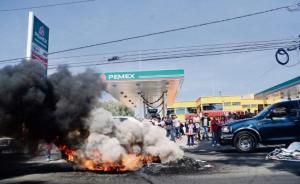
Is PEMEX burning? Nope… but there are burning tires out in the road. (“El Universal” photo by Hugo García)
And, I suspect the government takes advantage of that. While unlike 1968, when conditions were similar to now — rising middle class expectations bumping up against lowered opportunities and a growing consciousness of the income gap between the haves and have nots; international political dissatisfaction with the political classes; deteriorating confidence in the state; and earlier protests against human rights violations having led to massive protests — the State is less in a position to control the narrative. Not that it doesn’t try.
The methodology was cruder in 1968, but the process is the same. Provocateurs spread stories of widespread criminality and ungovernability to justify state repression and the forced acceptance of state policy. Reports are already circulating of “bots” spreading stories of looters in the city (not that there weren’t a few robberies here and there, especially in the new rich-people friendly shopping malls that have sprung up lately), but this is not Mexico City 1968, nor Oaxaca 2006… for the State, it’s a bit more difficult to control the narrative with nation-wide protests.
I lived through the surreal “drug war” in Sinaloa, and it’s deja vu all over again: in the foreign media, and on the English-language social media forums, there are long threads claiming the situation couldn’t be better for tourism (or retiring here), while at the same time, there are over-the-top reports of mass violence, and endless discussions of safety (though right now, it seems to be more “how do I get my Uber cab if ´they´ block a highway?” type things) , while the Mexican social media (and mass media) seem to be spinning the stories to fit a pre-conceived meaning.
Maybe it’s a problem of being more attuned to History (with a capital “H”) than “current events”. Damned if I know what it all will mean. All I can say is right now a lot of people are angry and many are looking for change. Whether it is just gasoline prices, or “corruption”, or a president who plays golf when he should be handing crises, they have a lot to be angry about. I want to read in my hopes (for a sea-change in political power) and have my fears (of a Tlatloloco-style massacre), but I just don’t know what will happen. None of us do, and even those of us who know a bit about something should be taken with some skepticism.
RATS!
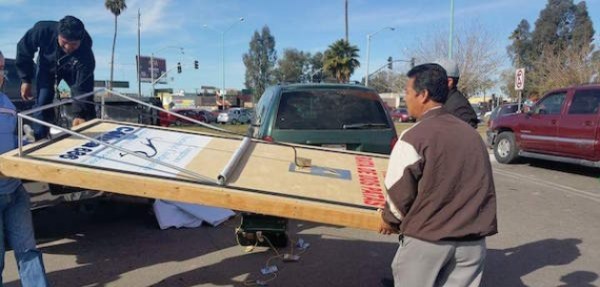
Want to catch a politican? Build a better rat-trap.
In Mexicali, citizens outraged by recent federal tax “reforms” that return nothing in the way of public services, to say nothing of the generous “bonuses” the Chamber of Deputies and Senate voted for themselves, installed giant rat traps outside the homes of their local representatives.
One thing I love about this country is we know how to do political theater right!
Now is the winter of our (gas-powered) discontent
From Dutch journalist Jan-Albert Hootsen:
The issue with the gasolinazo (and I’m purely talking politics here, not economics) is not that the price hike isn’t logical or that it doesn’t make sense to stop subsidizing petrol in this country. It’s that people perceive the government as doing, yet again, the exact opposite of what was promised, and now it has a direct and severe effect on everyone’s personal finances.
Mexicans were promised a new PRI, they got a president mired in scandal, fugitive governors wanted for corruption, transparency and anti-corruption legislation that stalls in Congress and is then neutered into a caricature.
Mexicans were promised lower electricity prices, they got higher electricity prices.
Mexicans were told austerity was needed, they got a congress that showers itself with bonuses.
Mexicans were promised more security and a fairer justice state, they got homicide rates back at the level of 2012, the Ayotzinapa massacre and its botched investigation, etc.
They were promised an energy reform that would put an end to petrol scarcity and price hikes, they got the biggest gasolinazo in 25 years and scarcity in 15 states.
Even if economists argue that the energy reform will be beneficial in the long run, politically it doesn’t matter. The PERCEPTION among Mexicans is that they’ve been lied to and cheated worse than they have been for a very long time, and in electoral politics that’s the only thing that counts.
And remember: Estado de México is at stake this year. The PRI simply cannot lose that state, but they should start getting worried.
If you say one thing and are then time and time again perceived to do the exact opposite, what starts off as irritation among the public at some point will simply boil over.


 mexfiles.net