Cutting through the weed
An interesting footnote to the much hyped ruling by the Mexican Supreme Court that allowed a few individuals to grow and use marijuana if they so wished. They don’t want to, and don’t intend to do so.
I don’t think the position taken by those four people, whose rationale for the suit was an interest in public health and personal rights, is particularly out of the Mexican mainstream. As Pablo Giralt, one of the four, said:
… I have no desire to use cannabis. The point was to reaffirm the liberal state and to approach drugs from a health and not a criminal perspective.
Gerald and the others could have easily made the same argument for the (re)legalization of heroin — and maybe should have — rather than marijuana. In theory, heroin possession (up to 50 mg) and other drugs, including a very small amount of marijuana (40 grams) is not a criminal offense, and hasn’t been since 2009.
All of which makes it less than likely that the “National Debate on the Use of Marijuana” is going to be much more than an academic and political exercise of more interest to foreigners than to Mexicans themselves.
Jan-Albert Hootsen lays out the main arguments of those opposing further legalization in “Vice News“…. all based on the presumption that marijuana legalization will do nothing to lessen the problems of organized crime. What is troubling is that the court’s ruling had nothing to do with the effects on organized crime. While the effect of legalization on organized crime is an issue — the claims that legalization is meant to weaken the reach of criminals were ones more likely to be raised in consumer nations (above all in the United States) than in producer nations.
As I’ve pointed out before, marijuana usage in Mexico is extremely low. Despite the anecdotal “evidence” (usually by foreigners living in “expat” enclaves) to the contrary, the best estimate of cannabis consumption in Mexico is about 1.2 percent of the population (compared to 14.8 percent in the United States). While I suppose it is possible that personal consumption rates would rise with legality, it certainly would have little or no effect on the marijuana trade: there just aren’t enough consumers — and, given the court’s ruling, the consumers would be growers themselves — to mean anything at all. What is done in Netherlands (consumption rate estimate 7.0 percent) or Uruguay (8.3 percent, and — like the United States, next door to a major producer, Paraguay) is completely irrelevant to Mexico.
Even if one assumes that this “opens to door” to full legalization, I see more problems than solutions. Perhaps the so-called cartels would get out of the marijuana business (and into the human trafficking, opium and heroin production, meth lab, and extortion trade instead), but so what? Despite the best arguments from marijuana enthusiasts in the United States and Canada, that their “good weed” will drive “Mexican ditchweed” off the market, basic economics tells me that cheap (even inferior) products drive higher priced (although superior) sell better.
We’ve seen a few “mega-plantations” of marijuana — in water scarce areas like Durango and Baja California — even while the cultivation is illegal. One fears for our water tables if marijuana was to be a commercial product. And, while what returns to the rural community from the illegal trade is only a pittance, the gangsters have to win the “hearts and minds” of their suppliers if they are to do business at all. While the “cartels” might be terrible people, they are locals, and some sense of noblesse oblige — or at least a paternal attitude towards employees and their community. After all, they live there. What will be the effect on rural economies and on rural workers should the industry be controlled by foreign corporations?
I’m sure legalization will generate a lot of excitement in some quarters, but don’t expect it to give birth to … anything. Or, as Edgardo Buscaglia puts it, absent a decent regulatory system for business and industry, any talk about legalization is just “legal masturbation.”
Sources:
Enciso, Froylan. When Drugs Were Legal in Mexico (Points: The Blog of the Alcohol & Drugs History Society, 20 February, 2012)
The Four Mexicans who don’t smoke marijuana but wanted freedom of choice (El Universal English, 5 November 2015).
Hootsen, Jan-Albert. Opposition to Weed Legalization Unites Mexico’s President With One of His Harshest Critics (Vice News, 1 January, 2016)
Malkin, Elizabeth and Azam Ahmad. Ruling in Mexico Sets Into Motion Legal Marijuana (New York Times, 4 November 1015)
United Nations Office on Drugs and Crime. World Drug Report 2014
Usborne, David. Heroin and cocaine now legal in Mexico — in small doses (The Independent, 14 August 2009)
Drinking in the knowledge
A library built on booze… literally!

Santa Catarina Minas, Oaxaca, like so many rural communities in Mexico is a village of women and children left behind. The men emigrate to find more remunerative work, and the best and the brightest leave for better educational opportunity. If only it had, at the very least, a library and community resource center… something to give the youngsters a chance to further their education at home, and perhaps, a reason to stay.
Now, they will, thanks to Graciela Ángeles Carreño, and the other women of the community, who have taken over the traditional male perogative of producing mezcal. With the help of Sabrá Dios — a distributor of “artisanal mezcal”, the village’s “minero” mezcal is providing the very bricks from which a new 4000 square meter public library and community resource center.
Mezcal is produced from the heart of the maguay, reduced to mash which is then fermented. The residue of the maguay is the perfect binder for a fine durable adobe known as guarape.
8000 guarape bricks later, the municipality’s first public library is nearing completion.
Apologies to Woody Guthrie
The cops all come in to the condo in PV
To check out the visas of Ethan and mom;
They’re flying ’em back to the American border
To pay off the judges, and start killin´ again.
Goodbye to young Ethan, goodbye to his mommy,
Adios pendenjos, and good-riddance too;
You won’t have your names when you ride the big airplane,
All they will call you will be “affluenza boy”
Spoiled by daddy, and coddled by mommie,
In justice, the court should take all the money you have;
For killing the people who were moving a car,
And the kids in your truck thrown around til they died.
Yeah, it wasn’t legal, and you are not wanted,
You screwed your probation and that’s all there is to it;
Six hundred miles to that Mexican border,
You made yourself outlaws, and now you are screwed.
Turning the tables
(22 December: Although a legitimate part of the story — publicizing it was a factor in capturing him — I’ve removed torture-boy’s surnames from this post. I think his family values (or lack thereof) should be public information, but Adel is a minor. While I’m not any sort of official media guy, I’ll err on the side of caution, and follow the practice — and law — here in not giving out the name publicly).
In the last week we’ve had at least two instances of individuals who humiliated, abused (and in one of these instances, tortured) indigents on the street, tracked down through social media and now facing legal penalties.
In downtown Tepic, local journalist Heriberto Villela happened by a Coppel department store where the manager, and two employees, had turned a water hose on a woman sitting outside on the sidewalk. The woman had been told to move along, and despite it being pointed out by Villela that she was on a public sidewalk, not on Coppel’s property, the store manager said “pointed out that the woman was not on Coppel’s property, the manager told he gave the orders, and could do what he wanted.
With the publication of Villela’s photos, it seems that it is the State’s governor and attorney general, not the store manager, who “give the orders”.
Governor Roberto Sandoval Castañeda said on Twitter he had ordered an investigation and that the store or those responsible would be punished for the “regrettable humiliation” suffered by the woman who, he also noted, was indigenous.
The state Attorney General’s office acted this morning, detaining the manager and two employees, ordering the remaining staff out of the store and sealing the doors. Signs were hung announcing the store had been shut.
As of yesterday morning, the state attorney general’s office prepared a preliminary investigation (averiguación previa) into assault charges against the store employees and the manager.
A potentially rougher justice may have been avoided when 17-year old Adel M. turned himself in to the Public Minister in Tijuana this morning. The teenager had accosted a homeless man in Tijuana with a taser-pistol, forced him to kneel in the street while repeating some obscenities (the usual teenage giggles about sucking dicks and the like), before he was forced to strip naked and burned with a cigarette. Which was recorded on a cell phone camera by one of Adel’s “charming” cohorts, and posted on youtube.
These guns for hire… against migrants
After the Summer 2014 “Central American Migrant Crisis”, the Obama Administration crowed about the 86 million dollar “Southern Border Plan” … which basically is paying Mexico to do the dirty work of preventing Central American migrants from crossing Mexican territory to the United States (which is the ultimate source of that “crisis” in the first place). According to Centro PRODH (a Catholic Church affiliated legal aid and civil rights organization in Mexico), the “strategy” appears to include outsourcing a terrorist campaign against migrants to private companies. Eliana Gilet reported in Wednesday’s on-line Disinformemos on the Legal Center’s press conference announcing legal action against at least three of these companies. My translation (edited more or less to U.S. news style):
At least three private companies are implicated in the arrests, beatings, attacks and murders of migrants , according to public denunciations filed this morning (16 December) by several prominent human rights workers. In all, eight formal complaints have been filed with the Federal Prosecutor (PRG) against three private security firms: Cusaem, Cuerpo Especial Valle de Toluca, and Sepromex (Servicios Especiales de protección México).
Fathers Alejandro Solalinde (director of the Casa del Migrante in Ixtepec, Oaxaca) and Heyman Vazquez Medina (Casa del Albergue de la Misericordia in Chiapas), as well as Ramón Verdugo (director of the “Todo por ellos” shelter), Martin Martinez Rios (Association Civil Estancia del Migrante) and Sister Leticia Gutierrez Valderrama of the Scalabrinas Mission for Migrants and Refugees, laid out information received by their respective organizations.
Sister Leticia said, “As organizations, we are joining in the denunciation of eight homocides: in Coatzacoalcos (Veracruz); in Celaya (Guanajuato); and in Chiapas. Three were comitted by Cusaem and the rest, according to the testimony of witnesses, were committed by police, but we have failed to further identify [the culprits]”.
Cusaem is the main offender. Sister Leticia explained that “after implementing the Southern Border Plan, the Mexican government subcontracted security firms to implement anti-migrant action. It’s a private security company, which to our knowledge, has jurisdiction only in the state of Mexico, but has seen action in Queretaro, Jalisco, Guanajuato and Tlaxacala.”
Appeals have also been made to the National Commission on Human Rights, demanding action in the documented case against Cusaem. However, as Sister Leticia said, “The CNDH said: ‘Sister, can not make any recommendation because we do not know who the security firm is working for — whether it is under the aegis of the army, the Federal Police. We’re just seeing violence by this private company.
“It’s called that [a private company], because it answers the description of one given in international treaties, and if we use that name is because they are working under some authority, but until now nobody has been able to tell us who authorized these companies to use heavy weapons reserved only to the military, to go migrant hunting.
Journalists at the conference insisting on full details and complete numbers of complaints were told by Martin Martinez Rios that “migrants have already realized that the Mexican justice system is useless. They’re not going to complain. Three people we serve in Hidalgo told us they would rather die than go to a doctor. Much less go to the Mexican justice “
“Violence against migrants in Queretaro have increased since April, including the deaths of two people that went unreported because we do not know where their bodies are,” Martinez said. He added that the guards working for Cuerpo de Seguridad Valle Toluca have no specific training, “let alone know about respecting human rights. They are trained to kill and have told us themselves: ‘Our motto is to shoot everything that moves around the train’. “
Martinez recounted two episodes in which he saw or heard the bullets hitting “La Bestia” [the freight train on which the migrants travel north] “They were all armed with heavy caliber weapons. They had held 80 migrants who had left the train, rifling throught their backpacks, and taking what was in them. There were women among the [migrants being held] about which we know nothing, where they are, or what has happened to them.”
Father Elias Espinoza D’Avila recounted a meeting with the Mothers of Disappeared Migrants Caravan at a migrant shelter in Tlaxcala, where he was told of 14 migrants taken off a train in nearby Tocatlán, by a truckload of men wearing black hoods who began shooting at the migrants. One man died after being struck in the chest, and another was hospitalized.
According to the testimony of another migrant on the train, migrants were forced to lay face down in the bed of the truck, while the men in black hoods interrogated them. A boy who raised his head was shot, as was another man. The witness said he was very afraid, and thought he was going to die. The bodies were taken away in trucks, and to this day no one knows what has happened to them.
Heyman Vazquez, the priest from Chiapas, said he has seen the bodies of five migrants. “We have no private security forces on the Chiapas coast, but common criminals are creating insecurity and killing migrants. He added he needed to perform a “mea culpa” for his inability to report in more detail on the problems in his region. But, he added, that “Since the implementation Plan Frontera Sur especially in Chiapas, there has been a need for more people willing for work with and for migrants. “We are so few that we can not follow up on complaints. We just notify the specialized state prosecutor for migrants and if we know the nationality of the deceased, notify that country’s consulate.”
Ramón Verdugo, who works at a shelter for migrant children and youth and Mexican street children in Tapachula, complained about corruption in the municipal solid waste management program. 97 Guatemalan families are eking out a living from picking out PET plastic and aluminum from the city dump, “but are forced to sell to a municipal council member at ridiculous prices, while being paid 30 or 60 pesos per 11-hour days. He also mentioned that in 2013 his group had denounced 11 municipal police officers for sexual exploitation of minors. Seven officers were imprisoned for a short period, and are now free. “Whenever I make a complaint we are persecuted,” he said.
Meet los Jetsons…
Not exactly sci-fi, our experimental new addition to public transit… individual pods over the city. And I thought the Metrobus (I rode it the very first day it went into service) was cool.
How can we know the dancer from the dance?
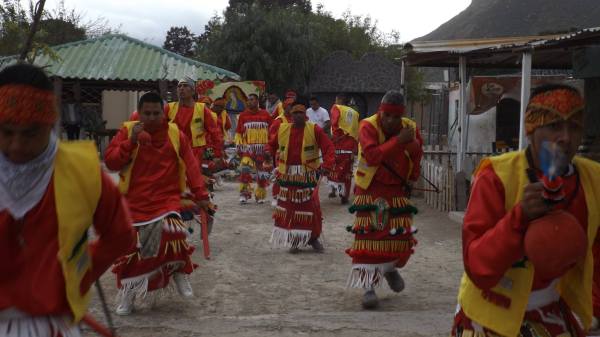
With the Conquest, the mass conversions of the natives to Christianity was made much easier by those clerics who were willing to accept native practices when given a “Christian” meaning. Sacred dance, having always been part of indigenous worship, was tolerated. However, under the supervision of Franciscan friars such practices were reduced to lessons, perhaps suitable to children, or to the “childish” natives. From the Spanish word “matachin”, meaning antics performed in silly costumes, the Mattachines were meant as stylized tales of the reconquista… the centuries of warfare on the Iberian peninsula between the Islamic south of the Moors, and the Christian north of the Goths. More meaningful to the conquerors than to the conquered, however, the “childish antics” took on a deeper meaning, less so for the observer than for the participant.
While, as Father Robert Coogan, of the Diocese of Saltillo, wrote me, “”In Western culture there are very few forms of prayer that do not involve words, and the sacred dance is one of them,” uniting the physical and the spiritual does have a tradition within western culture, although one largely forgotten or only embarrassingly admitted. It is largely preserved in words, but there is the erotic tradition of the Baroque poets and the sexual metaphors used to describe union with God by mystics like St. Theresa of Avila. Or Bernini’s famous attempt to convey that mystic experience, although in stone, and not in actual flesh.
Although northern Europeans were less than comfortable with the idea, and the offshoots of north European Christianity has been less receptive to physical manifestations of the sacred, the African-American churches (adopting African styles to western culture) and some Pentecostals and Evangelicals have been more receptive. Those manifestations, however, are seen as “outsider” practices, with their participants called “holy rollers”, or treated with humor, as in The Blues Brothers:
.
The native people were the ultimate outsiders of western Christianity, so perhaps analogies to the African-American religious tradition, presented through a parody (but an affectionate one) of that tradition are not amiss here. Jake and Elwood’s “mission from God” may have been delivered by a Roman Catholic nun, but it is though James Brown’s service — and the physical ecstasy of the dance — that they obtain their spiritual awakening. Within the Catholic tradition, outside of the outsiders, that tradition, and the fusing of the physical and spiritual, has been largely lost outside the native community.
Although, as Fr. Coogan notes, with a defeated and degraded people, there are some deformities of the original custom, beyond it’s change in focus toward the Christian faith:
It is a male tradition, except where it is no longer understood, and seen as folklore, where it is frequently carried on by mixed groups and women because the ancient male heritage has died out.
Different from the African-American tradition, where new musical styles and instruments are easily incorporated into the worship, the Mattachines seek to preserve their own culture:
The dance is done to a drum beat, which is understood to be the voice of God. A drum beat has no beginning and no end. the drummer enters into something that is always there waiting to be channeled, and it is there even when the drummer stops. The dance is hours long, and the contact through the body transforms the dancer. A “runner’s high” is a way of understanding what happens, but that is only part, because the runner is not pushing through that to a communion with God. The drum, the rhythm, the body, the pattern of the dance, the body of dancers, all merge into a transcendent unity of a high mystical order…
Despite the folkloric aspects of this mattichine group , this clip (from the 2013 Pilgrimage to Guadalupe) shows how that mystical experience is created. The mattachines are still several kilometers from the Basilica, and are already near the point of physical exhaustion. By the time they arrive, what remains is not the dancer, but the dance … a mystic communion, in common union with the others.
If the authorities really knew what the dance is, instead of thinking of it as a quaint folk custom, they would probably prohibit it.
Especially in Father Coogan’s “parish”. Coogan, like many modern Mexican priests, is quite open to accepting that the style of worship of his congregants is to be honored and accepted: but the “authorities” to which his congregants answer have near complete control over not just their lives, but every expression of their thoughts. Coogan is the chaplain at the Federal Maximum Security Prison in Saltillo (among too many other duties), the matachines in his community, not only the sons of the outcast native peoples, but outcasts of the outcasts:
Some of the guys are from Saltillo, some are from Torreon, and the gang rivalry between the two cities is violent and bloody. The prison has had to create separate areas for the Torreon guys, but the Dance is greater than any other loyalty. The Saltillo dancers made me get a special permission so that the Torreon dancers could practice with them. If you played high school sports, you know how a former high school football player, for example, feels an instant link to someone they meet who also played high school football.
When I first corresponded with Father Coogan, the mattachines had just had their kits for an important festival taken away by prison authorities. The particular religious feast was that of San Judas Tadeo, patron of hopeless causes, but the mattchines made the best of what they had:
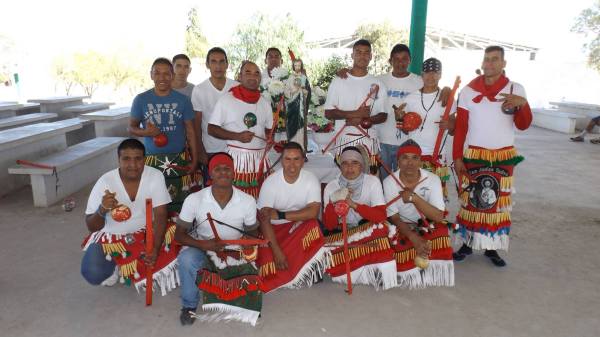
For the then upcoming Feast of la Virgen, Coogan and the men both were on a mission:
Some of the guys have worked in the auto industry making car seats, and as good upholsterers, are good tailors and will be making their new blouses. The headdresses are very complicated affairs, but they also will miraculously have them ready in time. I will be running here and there gathering feathers, jingle bells, carrizo and other stuff they need.
Because English is his first language, Coogan is one of the better known working priests here in Mexico, often quoted by foreign media. Like many other foreigners planning only a temporary stint in-country, the sense of community so often missing in our own individualist culture kept him here:
Coogan did not come to Mexico to save anyone. He first arrived in Coahuila in 1988 through a job with the campus ministry of his alma mater, Fordham University. The second oldest of 14 children born to a corporate lawyer with a degree from Harvard Law School, Coogan spoke no Spanish and had never traveled outside the United States. But he appreciated the sense of community he found in Mexico and the effort to survive collectively. “It was like the Brooklyn I grew up in, with people out in the street,” he said. “You go for a walk and you see your neighbors. You talk. I found that incredibly appealing.”
It may have been the sense of community, but Coogan’s Bishop, Raul Vera, has been assigning him to work with the outsiders within our larger Mexican community… gays and lesbians (which made him and his bishop targets of the reactionary Catholic publication, Lifesite News); drug addicts; migrants; and prisoners. Not an easy job, and between having to occasionally pay bribes to the Zetas to protect his incarcerated parishioners, there are those beads, feathers, and jingle bells to consider. I had originally planned to beg for a few bucks to cover those beads and feathers, which had to come out of the small salary Mexican priests receive. He ” really haven’t done much about fundraising except accept what falls from heaven.”
What doesn’t fall from Heaven will have to come through paypal. Donations sent to montezumabooks@hotmail.com (use the “donate” button below) marked “Coogan” or “prisoners” will be forwarded to Father Coogan, if not for beads and feathers and jingle bells, then for soap and toothpaste and candy bars and whatever else the migrants and prisoners might need. I wouldn’t expect donations of more than five or ten dollars from anyone, but for $50 or more, I’ll send a (not entirely inappropriate) copy of either the advance copies of Mezcalero or Comandate Ibarra, Montezuma Books first two releases, both novels dealing with “outcasts” among the Mexican community.

Photos: Robert Coogan
The Mother of American Education
With the present government here trying to impose educational “reforms” by force, sending in federal police to prevent teachers from making a mockery of “testing” programs designed not to highlight weaknesses in the educational system, but to force public school teachers out, and pave the way for more privatization; and with teacher training having become potentially fatal (remember the 43?), a little bit on the history of education in Mexico. A bit from the draft of my revised “Gods, Gachupines, and Gringos” (maybe Gods and Gringos Reloaded?).
The “apostles” I mention were the twelve Franciscan monks sent by Carlos of Castille and Aragón (aka, Holy Roman Emperor Charles V) with a mission to convert the Aztecs.
Although the first Conquistadores were followed by more than its share of profiteers, rogues and outright psycopaths (like Nuño de Guzmán), the “apostles” were not the only Spaniards who found a higher calling in the New World.
Catalina Bustamante, one of the first European women in the Americas, had emigrated to Santo Domingo (Haiti and the Dominican Republic) was secure enough in her position as a “lady of quality” to bombard King Carlos with letters demanding justice… and a better education… for the indigenous survivors of the Conquest in the Carribean. Widowed young, with several children, she used the one sure skill she had, literacy in an era when it was rare for even a wealthy woman to read and write, to support her family as a teacher. Cortés hired her to educate his own children, brining her to Mexico.
 While teaching the children of the elite was renumerative, Catalina became friendly with Motolinia, who had been teaching the sons of the former Aztec elites. With no one educating their daughters, Catalina took on the task, and opened her school to any indigenous girl. As a condition of receiving support from the Church, she of course had to add religious instruction to her curriculum, but daringly, began instructing the girls in Spanish law, and encouraging them to speak up for their rights. As one might expect, this wasn’t exactly what the “founding fathers” of the Colony had in mind, but… backed by Isabella of Portugal (Queen of Spain and Empress of the Holy Roman Empire) she was not only able to find funding for her school, but returned with the backing and money needed to expand her programs, and to start start training her girls to become teachers themselves. The only restriction ever put on “The Mother of Mexican Education” was that the Crown expected education to be controlled by the Church. Becoming a member of the “Third Order of Franciscans”, which bound her to follow the religious precepts of her superiors… the monks running the boy’s schools… she remained free to live independently of a religious community, to manage her own personal affairs, and to claim her school (and, later, schools) were officially religious institutions.
The Custom of the Country
William S. Burroughs noted in the 1940s, “It would not occur to a Mexican to expect criticism from a stranger, nor to criticize the behavior of others,” it is as strangers that we do not criticize, nor expect criticism. But a stranger is — by definition — “not one of us”, and to our community, irrelevant. And, ironically enough, the quote is from a book written about a community … of “expat outcasts” in — but not really OF — México.
The community, even if it is of outcast expats, is however, essential to Mexicans and Mexico … even in the most ephemeral of communities. Riding the Metro, I am a member of the fourth car on the blue line between Chilpancingo and Chabacano village. In our village, there are a set of rules (no different really than those of any other Metro car) that we live by, if only for those three or four minutes, and a sense that we are all in it together. My building, my street, my neighborhood, has its own unwritten rules by which we all live… more or less in harmony.
As a foreign migrant, in some ways I am free to chose my community. I am not born into the traditional community of the extended family, nor are there expectations of adhering to certain economic and cultural values simply because they conform to those of the community and family in which I find myself. I can see the strength in those bonds (unchosen though they are) in equipping the community (and, on a larger scale, “la raza”) to weather difficulties and to thrive even under the worst of conditions.
Much as I may accept that I live in a much more communal culture, I was programmed to accept another more individualist one, with all its advantages and faults. What if you don’t find yourself outside your culture, even if it is not by choice, or though any fault of your own? It is part of one’s being, and one’s sense of one’s self, and cannot simply be rejected, even if it rejects you.
Miguel Ángel Léon Carmona, in the Veracruz-based Blog Expediente MX, meets NOT a stranger who is immune to criticism, but one cast out by his own community… and his family… NOT for breaking the rules by his own volition, but for not fitting the pre-ordained unwritten rules by which the rest of the community believes it lives.
“A punta de madrazos te quitaré lo puto” (my translation)
In Tlanecpaquila, Veracruz, set in the central mountainous Zongolica region, the word has come down. Not one is to speak to Eduardo Xóchitl, the only homosexual in the community of 236 inhabitants. The elders warn their offspring to stay away, less they contract a horrible disease.
“I am not welcome in my own home. My own mother wants to run me out, and I’ve been told to live somewhere else. I’m afraid to go out, and have been kicked in the balls, told the the bruises were to keep me from turning into a faggot.”
Eduardo, 32 years old, is alone and depressed. He agreed to an interview, held at the only clinic in the community, visibly nervous about being recognized. His hands shook as he began to discuss a life suffering under homophobia.
A campesino, he leaves every moring at six to till his fields. He waves at his neighbors out of good manners. No one waves back. He spends entire days never saying a word to anyone.
He discovered his preference for his own sex when he was sixteeen — the worst of it being he was in a school room at the time. “The other kids jumped me, one pulled my hair, another stabbed me with a pencil in my ass. As soon as we were outside, they beat me.”
It was not easy for him to understand, let alone accept his penchant for me. The rules of life in Tlanecpaquila are simple and clear, learned if necessary, by the application of the sole of a huarache1. One lives as God intended.
Finish secondaria2. Dedicate your life to wheat and hay. Harvest coffee from November to February. Find a woman or two. Have children in abundance. Drink pulque. Wear a hat. Obey your mother. Beat your enemies to the ground. Believe in God.
The rules are simple enough for the 127 men in the community. All but Eduardo Xóchitl. He cannot look another man in the eye, or shake his hand, or hold a conversation. Love between men is punishable by exile or absolute rejection.
He has heard of other homosexuals in the Zonoglia, in San Sebasian, a two hour walk. But a relationship seems out of the question. “My mother told me she wants to die in peace, and not see me doing ‘dirty things´.”
Two years ago, Eduardo invited a gay friend from Emilio Zapata3. The visit had to be secret, timed to occur at eight in the evening while his family would be out at a festival honoring the Virgin of Guadalupe.
The friends held hands, commiserating on their situation.
— “We need to go to another city, Lalo. Far from this god-forsaken town.”
Eduardo trembled in fear. The dogs began to bark, and the door opened.
— Who the fuck is this guy, son?
“My father started hitting me. It was December, and my friend was chased out into the night. My mother was screaming at me to move out as soon as possible.”
His brother, doing what he could, bought him five square meters of land for 6000 pesos. “’There, you can do what you want,´ he told me. I felt horrified that my family had thrown me out, and screamed all night. I thought of killing myself, but I’m not capable of that.”
So, he lives in a secluded hamlet. His house of four brick walls, with a dirt floor, without electricty or running water sitting on hill is a morbid local attraction. The sinful leper of the Bible according to Tlanecpaquila, has only the rocks for neighbors, the desolation of his room relieved only by with four religious prints, an old serape, a teddy bear, and a sharp machete.
Eduardo Xóchitl was destined to do field work, and its the only work he knows. Doing seasonal contract labor he says “The contractors don’t know I’m gay, but I have to keep quiet and just do my job.”
“On the big farms, during harvest season, when I have to work with the others, they don’t work next to me, saying ´Don’t stand near the faggot, it’ll rub off on you.’ I never talk to anyone, but when I get home, I just want to scream.”
Field work is natural tor Eduardo, with his hands rough and his feet calloused. He tops his father’s quota, picking 70 kilos of coffee a day, earning 140 pesos. Half he gives to his mother, in return for allowing him to eat in her house.
Work days end at four in the afternoon. Eduardo is the last to leave. People speed up to avoid walking with him, not wanting to be mocked. Sometimes, they throw stones at him.
Going to his mother’s is the bitterest part of the day. The family will not eat with him, nor will his mother, as she does with his brothers, serve dinner and heat up hot water for their baths. “They just give me food, and let me take a bath there.”
“We always have tamales with mole for her birthday. I brought 20, but they had the party without me. Niether a hug, nor a gift. I spend my time here in the hills. I’m not afraid of being alone, nobody bothers me here.”
In a small community, hidden in the mountains, there is not only hunger and a lack of basic services. The customs passed down through the generations deprive people of the ability to think freely, to be different, like Eduardo.
“I’d like to go to a place where no one would stare at me, or see me as an animal. But I don’t know how to use a telephone or a computer, and I can barely read or write. And, I’m afraid to talk to people. The furthest I’ve ever been is Cordoba and Oriziba, about three hours by bus.”
The interview comes to an end. The time is passing, and people might notice. Leaving the doctor’s office, Eduardo Xóchitl comments, “I would like to know what I can offer to men. I wish my family would accept me, but I know that will never happen.”
The men in the waiting room, look down at the muddy boots with glassy stares. The women, cover the eyes of the children with bloated bellies, lest they absorb the evil in their midst.
1Beating children with a shoe.
2About 9th or 10th grade in the U.S. System.
3Another community in the Zonoglia, with a population about twice that of Tlanecpaquila. The Zongolica, has among the highest illiteracy and poverty rates in the Republic, and is mostly indigenous.
The story is heart-breaking, though it’s hopeful that several commentators stepped up to assist in any way they can, leaving e-mail addresses and telephone numbers.
But, as Eduardo said, he doesn’t know how to use a telephone or computer. I would love to send him a laptop, then realized he doesn’t have electricity, and would need to learn how to use it. And it would likely be stolen, or his electric service cut off, just as he has been cut off from contact with his own family and culture. And, much as foreigners (or even outsiders who have by their own choice “turned Mexican”) think we can … or maybe should… be the ones to try to alleviate his situation, I don’t think we are. Much as we care, and much as we think we “know better”, any intrusion is going to be seen as not just an intervention on behalf of Eduardo, but an intrusion into the community. For the better, we’d hope, but how we’d do that without uprooting the entire cultural framework is something I don’t know, and it’s not up to me to decide what needs to be changed, and what doesn’t. And how to go about it.
This one I’ll leave to those Mexicans who have been through the same situation, and who might have a workable solution. But, if I do find “those Mexicans” can use a bit of practical gringo assistance, you’ll be the first to hear about it.
Injun givers… French fashionistas and Coca-cola
Isabel Marant, a French designer, and the clothing line Antiquité Vatic claim they have intellectual rights to their new winter designs, which somehow bear a striking resemblance to those worn by the Mixe-speaking residents of Santa María Tlahuitoltepec, Oaxaca for … oh… forever. Marant has fessed up to “borrowing” the design that she is passing off as her own work, but Antiquité Vatic is seeking to obtain a patent to the design.
 The municipality, and its inhabitants, are quickly discovering, legal protections for indigenous rights including ownership of intellectual and artistic work, basically doesn’t exist. Our “civilized” legal system, it appears, gives no rights to human beings as collective owners of non-material goods, but apparently does when the collective is based not on human existence, but on being collective financial resources.
….
At least the French fashionistas… greedy pigs that they are… don’t pretend they’re doing some sort of public service, and are open about stealing from the Mixes.
Unlike one of the tackier… if not the tackiest… Christmas season ads of all times, based on a “colonial fairy tale” of the white savior… and a
… clear demonstration of the presence of transnationals in the Indigenous territories of Oaxaca. In the last years, these companies have increasingly been taking over natural, economic and now cultural resources from the communities…
Also targeting Mixe-speaking communities, Coca-Cola is not stealing Mixte creative work outright, but instead is trying to sell itself as some sort of savior of the community, by way of selling the community on buying their products. Presented as a weird “public service project” in which obviously European-descended Mexicans bring a Christmas Tree (itself an odd cultural appropriation by north European Christians of Germanic Yule celebrations) made of wooden slats painted “Coke Red” (Pantone 484, which Coca-Cola did attempt to patent) with the words “Tökmuk n´ìjttumtat” (“Merry Christmas” in Mixte) tacked on to the Mixe.
Apparently, the “white man’s burden” is not only to steal the culture of the Mixe for the greater glory of French corporate interests, but to seduce the downtrodden Mixe into accepting the non-Mexican U.S. symbols of Christmas and … in so doing… buy foreign corporate products.
Coca-colonialism, 2015:
Sources:
Bonilla, Isadora, “La propaganda del descaro de Coca-cola utilizando a indigena” (Regeneración, 25 November 2015)
“Coca Cola Navidad comunidad Mixe Totontepec 2015” (Youtube)… was taken private by Coca-Cola. Copy via Latino Rebels (Youtube)
“Empresa francesa reclama los derechos del diseño de blusa oaxaqueña” (Mientras tanto en México)
Franceses pelean diseño de blusa de Tlahuitoltepec (Oaxaca Pólitica)
“This New Coca Cola Ad Shows Mexico’s White Savior Problem” (Telesur TV)
Trashy behavior?
“Lord” or “Lady” -whatever has taken on a specific meaning in Mexico City… people who become instant celebrities for some anti-social act which they then follow up with a self-justification or entitlement. The latest to receive the “dishonorific” is “LadyBasura”, “Lady Trash”, who was charged with throwing trash in the street and causing a public disturbance. Had she picked up her trash, there wouldn’t have been any newsworthy story here, and she earned her title for her behavior towards the officers who tried to reason with her, and with the subsequent story that although she apparently has a job with her delegacion, her penalty for throwing trash in the street (defined in the Federal District Code as a fine ranging from 1,345 to 13,458 pesos, and/or 13 to 24 days in jail) was reduced to 69 pesos (about US$4.20) on the argument that she was without an income.
Although there’s no question that LadyBasura was acting like a self-entitled jerk, I think most of us in Chilangolandia are in something of a bind when it comes to dumping our trash. While I suppose it is possible to be home, or have someone home, when the trash collectors come by (around 10… or 11 … or whenever) during the day, and hear them ringing their bell, and run down the stairs, unlock the gate, get around the cars blocking the driveway, out to the street and hand it to the collector, ain’t gonna happen.
Even in an advantaged neighborhood like mine (Roma Sur) good luck finding a public trash bin. We are fortunate that up on the corner, there is enough of a berm for people to pile trash the night before. Whether we can be fined for that I can’t say, but with the trash from everyone within two or three blocks piling up on one corner, of course, its going to end up in the street. And even with most of us in the neighborhood boxing or bagging the trash accidents happen, the collectors don’t get everything, or animals and recyclers pick through the bags and … well, the situation is far from ideal.
I’m all in favor of reduce, recycle and reuse, and I’ve long supported reforms in trash collection here. I try to keep our own trash to a minimum, and with recyclables not being easily disposed of, I bag them separately so the”freelancers” aren’t just ripping through bags of dog poop and orange peels and burnt dinners looking for the good stuff. Still, it’s a mess. The District Assembly, as it has too often, wrote a good law, with no way for citizens to easily comply. There just aren’t any trash cans or dumpsters for us to use, and no one seems to have considered the issue.
It’s not the sexiest urban design project, but couldn’t someone come up with neighborhood dumpsters that are esthetic enough to sit on street corners in our neighborhoods? Then, when self-entitled jerks DO break the rules, we can all mock them with a bit less hypocrisy.
Sending the turkey to damnation
There have been the usual parleyings about the brandy for the turkey — the guajolote, the Indians sitll call him — the ancestral bird of Mexico. The Aztecs ate, and continure ot eat, him; and good cooks have the habit of giving him the following happy death: on the morning of the day on which you are to eat him, you generally hear him gobbling about. Then, there is the demand for whisky or brandy “por el guajolote, pobrecito.” The unfortunate (or fortunate) bird is then allowed to drink himself to death. This is the effective way of rendering him chable, it being impossible to hang meats at this altitude. The flesh becomes soft and white and juicy. But try a gravel-fed guajolote that has not gone to damnation!
Edith O’Shaughnessy, “A Diplomat’s Wife in Mexico” (Harper and Row, 1916)
O’Shaughnessy was not just a diplomatic spouse who wrote on “safe” subjects like Mexican cuisine (and how to kill turkeys). “A Diplomat’s Wife..” and “Intimate Pages of Mexican History” (1920) attacked Woodrow Wilson and argued for a “strong hand” in Latin American affairs. One of the first women to write on political affairs for a popular press, she was a pioneering right-wing pundit who would have been at home today on Fox News.


 mexfiles.net