Two threats: Anarchism and Peña Nieto
So… are the “anarchists” who disrupt peaceful protests “infiltrators” or are they a legitimate threat. Well, yes… maybe.
Gibrán Ramírez Reyes, Emeeques (21 November 2014)… my translation:
The “anarchist” violence during protests comes from infiltratrators say those in the streets. The “anarchist” violence is an orchestrated attempt to destabilize the country, foolishly writes [Journalist and PRI “cultural affairs” official] Beatriz Pagés on behalf of Enrique Peña Nieto; scorching the doors of the National Palace door bears the signature of Andrés Manuel López Obrador and, according to the PRI cultural czar, so do protests in Guerrero, and guerrilla actions there as well. For the citizens, doubt and prejudice are at least understandable: the PRI are old hands when it comes to infiltrating and disrupting social movements. Therefore, the opposition has a knee-jerk reaction, suspecting infiltration based on minimum evidence, and seen as working for the benefit of those in power. But, on the other hand, the press has not done much in the way of reporting on the anarchists (sometimes simply out of the assumption that these groups are organized by the federal government).
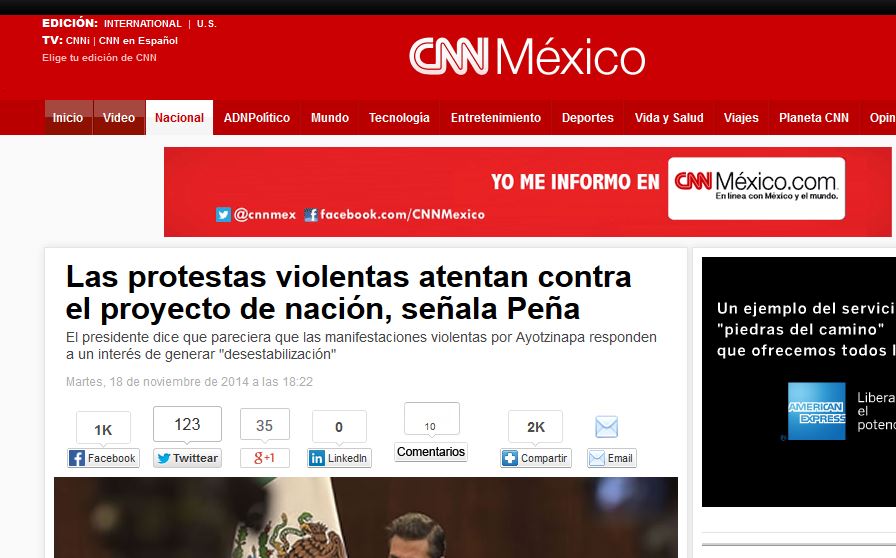
When it comes to our dismissal of anarchist violence, the government discourse is by far the most dangerous. Witness Peña, really angry, suggesting Carmen Aristegui is probably complicit in a conspiracy to destabilize not only his government but, according to him, something much more worth defending… a cause: the “national project”.
In varying degrees the Federal Administration, the PRI (including the lamentable Pagés claims), the Mexico City government, the business community, the conservative press and Coparmex [the National Chamber of Commerce], which is demanding a return to “order” – seeks to shift the discourse for two reasons. First, violent anarchism is a real concern that the Mexican government now shares with the US government; and secondly, the discourse itself – visually shocking as it is — is a useful tool in forging a strategy to recover the smokescreen of Peña Nieto’s leadership.
The claims of Peña and Pagés, and those that echo them, appeal to that part of the middle class that is frightened by more radical forms of protest, and speaking of them instills in them the fear of an uncertain future. Demands for political change challenge the conservative instinct to preserve what one has: family, possessions, life itself. The key is to make people frightened that “our Mexico” – that of the middle-class majority – is going to change when the thinking is “well, at least WE’RE alive, and living quiet lives”.
The scheme aspires to govern with the complicity of a silent majority, which would sooner avoid “destabilizing” the national project —and a life of “normality”, even if the assumptions of normality are based on inequality and death. The historian Ariel Rodríguez Kuri documented that there was a broad social support for suppression in 1968, when the official discourse was of anticommunism, so irrational and violent at the time, that columnists reflexively referred to protesters as “assholes” for trying to dampen the national spirit.
Certianly, right now Peña is facing the worst of all worlds. What brought him to power was the claim that force was needed to maintain order. But public outrage over the use of force required a change in national policy. Nobody is happy and everyone’s viewpoint has shifted. However, it appears that imposing authoritarian political solutions in his DNA, at least in the first part of his term. The simplest strategy for him, is to apply a real problem (violent anarchism) to an imaginary threat (instability and the derailment of the national project), which requires national unity and, consequently, scares Mexico into chosing a side: that of destabilizing the country, or going on with the national project
To say that there is orchestrated effort to destabilize suggests that there are one or more villains ready to make the attempt. Perhaps there’s an iota of intelligence that could serve as the basis for a telenovela to the taste of that silent majority. Peña and company are quite capable of it, but more likely are the outbursts of a stagnant regime that hasn’t a clue how to react.
On the other hand there is a real concern about violent anarchist cells. So far, the Federal District’s investigations and prosecutions have been, to say the least, ineffective. Intelligence work has been predictable and awkward and, as the lack of results has been alarming.
This type of anarchism first broke on the scene in the United States in 2004, but came to Mexico in 2006 during the Oaxacan conflict, when local activists exchanged methods of agitation with foreign “revolutionary tourists”, and spread to other states in Mexico. Since then, there have been sporadic actions reported on the inside pages of popular newspapers and in the nota rojas [crime pages], while intellectuals, sociologists and political scientists have ignored them, or assumed anarchist actions were infiltrators or agentes provacateurs, without any empirical support for their assumption.
In the Federal District, although little is known about such groups, there have been attacks, the largest being the firebombing of a car agency in Tlapan, as well as attacks on ATMs as well as letter bombs sent to academics by those opposing scientific research or technological innovations based on their supposed potential for enslaving the people. These cells had their greatest growth during Marcelo Ebrard term as Governor of Mexico City. The prosecutor in charge of the investigation at the time was Miguel Mancera – who received a letter-bomb – and one of his top aides, not Secretary of Public Security, Jesus Rodriguez Almeida. Both saw the groups not as a political problem, but as a police matter, one that could be solved by infiltrating a few cells, and making arrests “in flagrante delicto”. Today we see the results.
Along with everything else going on
Volcán Colima is active… spewing up a three-kilometer high plume yesterday a little past noon.
The Magna-marcha
Beyond a “mega-marcha” presumably. While too early to say this is a “historic” event, or to read any long term meanings into it, it’s safe to say that the impact of videos like this are going to reverberate socially and politically. Filmed from the Terrace atop the Hotel Majestic, facing the Palacio Nacional across the Zocalo, 20 November 2014
Friday Nite Video: Mika Agematsu
Proof, if any is needed, that you don’t even have to be Mexican to get Mexican… Japanese harpist Mika Agematsu with the Hermanos Durarte performs Moliendo Café:
(from a concert at The Roppongi, recorded in Tokyo in November 2002)
A hunger for justice…
… does not mean going without tacos
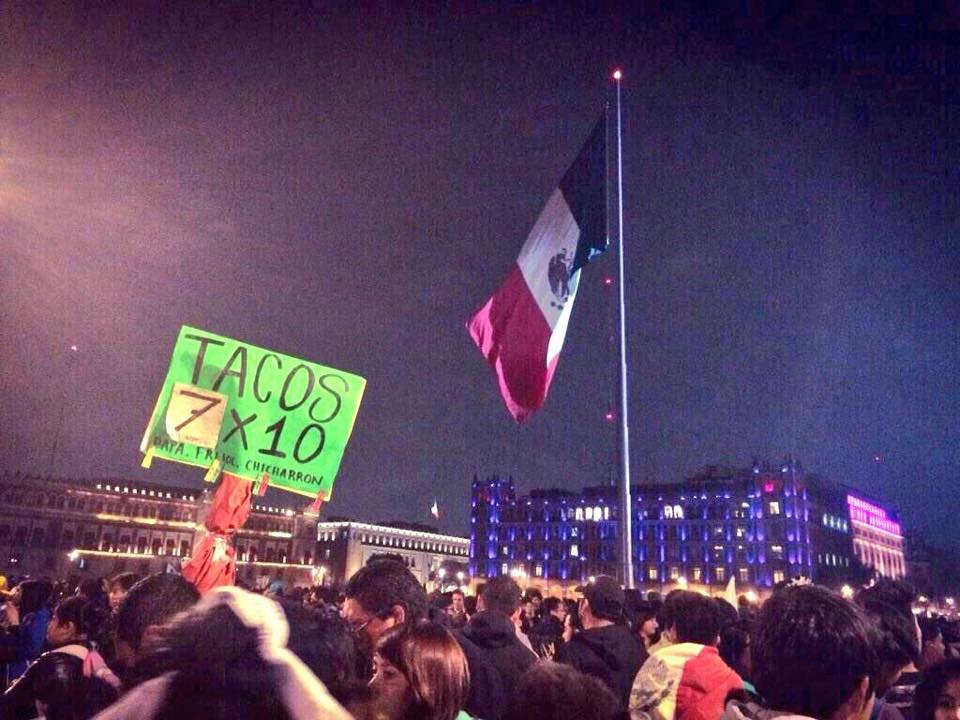
(photo: Ophelia Pastrana)
Ashes of the day
1910
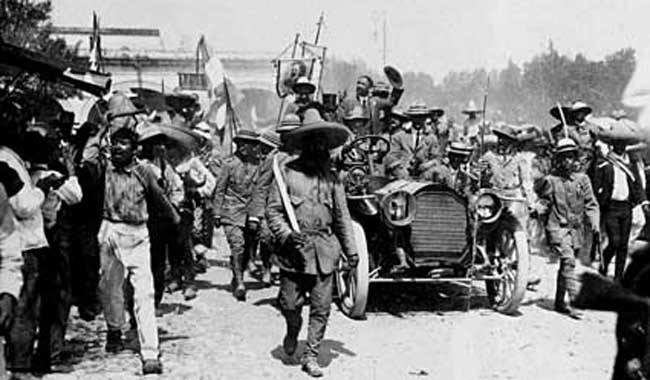
Slouching towards the Zocalo
As you might expect, there are certainly those who are not at all supportive of the mass demonstrations today. The comments section on stories in Milenio has been full of “kill them all, the stupid Indians” type remarks, and those that echo conservative columnist Ricardo Alemán, who argues that the government can restore credibility through some selective violence against dissidents. And.. once in a while, something worth considering. On a story appearing five days ago in Milenio on the groups planning to participate in today’s demonstration (Más de 50 organizaciones marcharán este jueves por normalistas, 15 November 2014) “Deore Danone” wrote:
The saddest thing is that all this has nothing to do with demands for justice.
Why are they not protesting the fifty people killed in the Monterrey Casino; the 60 students in Salvárcar Villas; the 72 migrants killed in Tamaulipas; why are they not marching for the 49 children who died in the ABC nursery … so many innocent .. truly, they never did receive justice.
But for most, it’s those 43 vandals they value. Worth more simply because they have political connection. Their unhappy parents question the authorities but why not challenge the normal school leaders who used their children as cannon fodder?
Behind all this “solidarity” with the normal school parents is hidden political interest. And not so hidden. Many organizations are shamelessly using the pretext of the 43 as grist for the mill. For them, the worst that could happen to them is [for the missing students] to appear alive.
Of course, there were indeed protests after middle-class housewives were killed in the Monterrey fire (and, as I recall, a crackdown on irregularly licensed casinos), and after the ABC nursery fire … the former a gangster shakedown gone terribly wrong, the latter the kind of tragedy that can happen anywhere, though it exposed bureaucratic ineptitude (fire inspections not done) made worse by the indifference of the owners (who included powerful political figures and their families) to public safety. And, various protests of the others, explained away as governmental inability to fight gangsterism.
“Deore Danone” is correct in that the Normal School students are encouraged to take political action, and that they are often the “shock troops” in leftist political actions. It’s not a huge stretch to consider the student actions that day in September as “vandalism” (and Milenio commentators tend to be of the “shoot em all and let the Lord sort em out” philosophy of property crime prevention), nor to see that political capital has been made of the disappearances (and presumed murder) of these students.
BUT…
Consider that the Iguala incident had all the elements of the previous tragedies … gangsterism and indifference to public safety… compounded by legitimate political protest (over school funding and curriculum design issues), and exposed not only the nexus between power and privilege, but came at a time when economic and social issues only peripherally related to the actual incident itself were also central to public discourse. I don’t think the Normal School students were more “valuable” than the children killed in the Hermosillo fire, nor the housewives in Monterrey, but — yes — they are a political symbol, and one easily grasped, of what so many Mexicans see as their own victimization by a state that is not meeting their demands. That other citizens … thoughtful or otherwise… are going to resist those demands can only be expected.
And what rough beast, its hour come round at last,
Slouches towards Bethlehem to be born.
I have nothing to hide
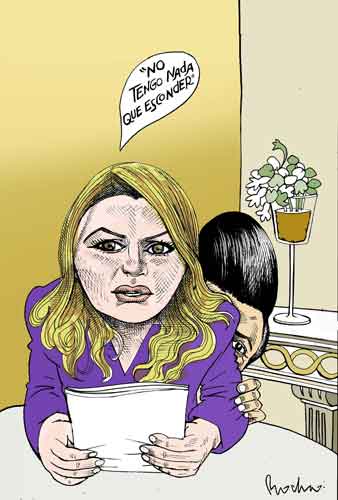
The primara dama’s explaination of the source of income for her 90-odd million mansion is that the money came from her earnings as an actress. As a performance piece, it has nowhere near the credibility Richard M. Nixon brought to his 1952 “Checkers Speech”. In supporting roles, Pat Nixon and her “Republican cloth coat”, and Julie and Tricia’s little cocker spaniel, Checkers, worked much better than claims that this was for the benefit of her own children, none of whom anyone seems to like very much.
The people, yes!
I love a parade… and I always enjoyed the Revolution Day parade. Although Vicente Fox started labeling the event a “Celebration of Sports” as a way of demilitarizing the event, and it had always included civilian units (including the under-appreciated, but wildly cheered one day of the year, garbage men) the Revolution Day parade was always meant as a celebration of the State’s power.

This year, the citizens will NOT be cheering the sports heroes, marching basketball teams and garbage trucks… nor the all important symbols of state power… soldiers, sailors, airmen, their weapons and equipment. Wednesday (yesterday), without prior notice, the reviewing stands and massive array of bleachers where removed from the Zocalo, with notice coming later that the yearly event was being cancelled.
 Not that there is no parade, but it is one celebrating NOT the State’s power, but the people’s power. It is not, as perhaps some have hoped, that the state has withered away, so much as the State has become isolated, and — it seems — out of touch with its citizens. The people are marching … not from the Zocalo, but upon it. From Tlatelolco, from the Monument to the Revolution, and from the Angel of Independence, the people will descend on the Palacio Nacional to demand the state put its power in the service of its people. In 110 cities and towns around the Republic, other marches are planned. Even in Mazatlan, which almost never sees demonstrations, there will be people in the streets.
We have had mega-marches before, notably the “million Mexican March” during the Calderón adminstration, which had been endlessly pumped by Televisa, and chambers of commerce, not to mention the political parties). But those marches were meant to signal to the outside world acceptance of the “war on criminality”… the state — and the supporters of the state (the multinationals, Televisa, the political parties) — in suppressing criminal violence. With the growing recognition that the state (and its supporters) are themselves tied into that nexus of criminal violence only became clear to many with the disappearance of the 43 students. And, although the State, the “official” media, the public image makers, have done everything possible to dissuade the people, or persuade them that the 43 “disappearances” were an anomaly, it just isn’t going to work this time.
 Students, their families, teachers, the unions, church groups, peasants, the middle class, will be marching demanding not only justice for the disappeared and murdered in Ayotzinga, but much, much more. A change in the political system, an end to the economic policies that invite state (and nonstate) repression, the rights of the rural and indigenous people to live without fear. The Mexican people are celebrating the Revolution in the best possible way… demanding from their government effective suffrage, no re-election (of the same old, same old parties), land, peace, education, and national independence.
No shit!
I wonder if it’s crossed anyone’s mind in the administration that there is widespread opposition to their “national projects”.
IF
With talk of a presidential resignation (forced or otherwise) making the rounds, it’s time for a review of the process.
IF a president resigns or dies or becomes incapacitated within the first two years of his or her six year term… and Congress is in session… then Congress (both the Deputies and Senate), with a two thirds quorom, act as an electoral college and appoint a “presidente interno”, who will within ten days schedule elections for a new president whose term of office will be the remainder of the former president’s scheduled term.
IF Congress is NOT in session, then the Permanent Commission names a “presidente provisional” to serve until Congress appoints a “presidente interno” . The “Permanent Commission” came out of the attempts in the 19th century to keep a democratic state functioning during the French occupation. Unable to meet with Maximiliano’s troops hunting for them, the Deputies and Senators appointed members to act on their behalf, subject to approval when.. and under the circumstances, IF, they were able to get together at some future date.

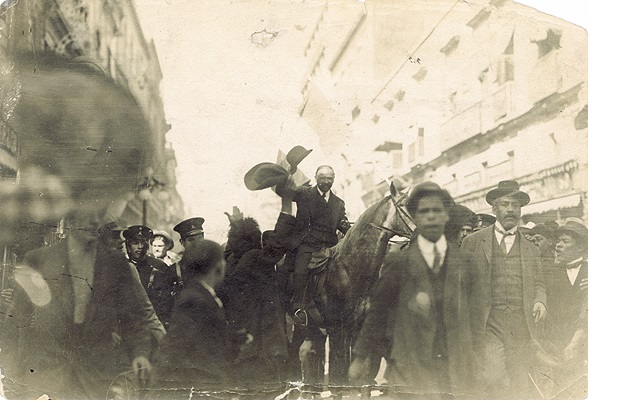
Portes Gil
In the post-revolutionary era (post 1920), there has been one time a “presidente intero” was elected by Congress. In 1929, Alvaro Obregon was assassinated a few weeks before he was to be sworn in. The Constitution never covering what to do if the president-elect was unable to perform his duties (rather difficult, being dead), Congress appointed Emilio Portes Gil, who I think did an excellent job under the circumstances. Coming into office in 1928, he had the Cristero Rebellion to deal with, and after scheduling elections that would keep him in office until February 1930, faced the unexpected crisis caused by the world-wide financial collapse of October 1929… just as the federal budget was being prepared. Expecting political troubles as a result of the election, Portes Gil cut the military budget to the bone (simultanously working out an agreement with the Vatican and the United States to put an end to the Cristero Rebellion) while wisely throwing every centavo he could find into job creation projects like roads and bridge construction, and into education.

Ortiz Rubio

Rodriquez
Portes Gil was suceeded by Pascal Ortiz Rubio … as “substitute president”… BUT: Ortiz Rubio — besides having been seriously wounded on his way to his inaugural ball (like Obregon, he was shot by a reactionary Catholic terrorist, though unlike Obregón, he lived) — just didn’t live up to the expectations of Plutaro Elias Calles (who in reality, following Obregón’s assassination, was the real power in the Republic) and was forced to resign. Which triggered another Congressional meeting, and rather than go through the whole process of a special election … again… called on Abelardo Rodriguez to serve out the remaining two years and a few days as the interim president (of the substitute president), without resorting to a special election.
Mexican then returned to its regularly scheduled elections… until???????.


 mexfiles.net