An honest politician… sort of
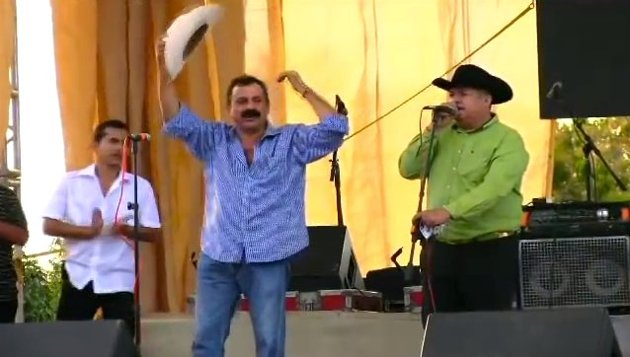
The voters in San Blas (Nayarit) appear to appreciate moderate leadership in municipal government.
Hilario Rodriguez Villanueva, former municipal president of San Blas (PAN… the conservative party) has been re-elected in today’s state elections.
During the campaign Rodriquez admitted to robbed the municipal treasury. But, he added “I didn’t steal very much”.
With 100 percent of precincts reporting, Rodriquez (running as an independent) has received 40% of the vote, beating second place finisher, Candy Yessica Blancas (PRI-Green-PANAL) by at least five percentage points.
Volverá a gobernar San Blas alcalde que robó “poquito” (Milenio)
Candidato que dijo que “robaba poquito” gana las elecciones de San Blas, Nayarit (SPD Noticias)
Gana de nuevo exalcalde de San Blas, Nayarit, que admitió haber robado “poquito” (Crónica de Hoy)
¡Ahora sí! ¡México premia la honestidad! (el Deforma)
Mirales arrest…
I haven’t written anything about the arrest of Dr. Mirales, the rural physician and best-known leader of the “autodefencas” (militias or self-created police forces… depending on one’s point of view) that sprang up in Michoacán in response to so-called narco violence. I’ve somewhat avoided writing about it because it seems too simplistic to lay the blame for violence solely on narcotics dealers … agricultural interests (especially cattle raisers) as well as timber and mining groups sometimes claim to be victims of the narcos, but are also said to be cooperating with them out of their own interests. As it is, the “Knights Templars” did have local quasi-official support when they were the “Familia Michaocána” and — although exporting meth to the United States — were enforcing “traditonal values” locally.
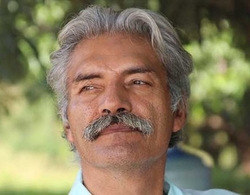
Daily Kos photo
And, I’ve always wondered if these self-created militias might not operate as covers for death squads, eliminating not just “narcos” but dissidents or social disrupters (by which I mean petty criminals or simply those who don’t “fit in” and cause problems) within their own communities… something all too common when the law is in the hands of self-proclaimed protectors.
Mirales has, however, become an international hero for fighting back against the narcos and he makes a good case for the need for these militias. His arrest, on 27 June, did indeed appear to be “convenient” for the government and the charges do appear bogus (supposedly, after being given weapons by the military that were taken from gangsters, he was arrested for carrying illegal weapons)… and there’s never been any suggestion that Mirales was involved in marijuana smuggling, though he was also charged with possession outside the legal limit.
While it’s not a site I normally look at, Daily Kos has a good overview with links here.
(Sombrero tip Robert Broughton)
Downloads for Garcia Marquez
Via Regeneracion:
1- “CIEN AÑOS DE SOLEDAD”
2- “DEL AMOR Y OTROS DEMONIOS”
3- “EL AMOR EN LOS TIEMPOS DEL CÓLERA”
http://www.instituto127.com.ar/Bibliodigital/GarciaMarquez-ElAmorenlosTiemposdelColera.pdf
4- “LA HOJARASCA”
http://www.instituto127.com.ar/Bibliodigital/GarciaMarquez-LaHojarasca.pdf
5- “EL GENERAL EN SU LABERINTO”
http://hectorucsar.files.wordpress.com/2013/02/el-general-en-su-laberinto.pdf
6- “EL CORONEL NO TIENE QUIEN LE ESCRIBA”
http://biblio3.url.edu.gt/Libros/el_coro.pdf
7- “EL OTOÑO DEL PATRIARCA”
http://www.instituto127.com.ar/Bibliodigital/GarciaMarquez-Elotoniodelpatriarca.pdf
8- “MEMORIA DE MIS PUTAS TRISTES”
http://biblio3.url.edu.gt/Libros/put_tris.pdf
9- “NOTICIA DE UN SECUESTRO”
http://www.auladecastellano.com/pdf/a%20Noticia%20de%20un%20secuestro.pdf
10- “VIVIR PARA CONTARLA”
The battle of Battle of Angostura.. or Buena Vista as it’s better known in the United States (22-23 February 1847), was militarily inconclusive: depending on how you look at it, either the United States won, or it lost… ditto Mexico. The U.S. advance was halted, and — with their supply lines already stretched to the breaking point — on top of heavy casualties, it was seen as pyrric victory at the time: one that would break the invasion and force a withdrawal. The U.S. was forced to retreat and regroup. However, as Heriberto Frías, whose popular history of the U.S. war I’ve been editing, writes, any Mexican success (which faced the same problem with over-stretched supply lines and had much high casulties, although being on its own turf could more easily overcome those problems) was undone by the inexplicable decision of General Santa Ana to retreat after the battle.
Although the Mexican batteries held their own, their cannons were mostly surplus British equipment, left over from the Napoleonic Wars. What made Buena Vista celebrated in U.S. eyes was the battle’s symbol of U.S. technical superiority. To the people of the United States, the battle was something to celebrate, Yannkee ingenuity being, seen even then, as one of the things that justified the sense of opimism and moral superiority of the United States. New towns and counties in the expanding west (which at that time included places like Iowa and Minnesota) would be christened Buena Vista as a result, and the U.S. commander, Zachary Taylor would be headed for the White House.
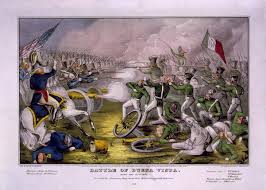 Still, Mexican ingenity created its own heroes, as Heriberto Frias celebrates in his “War Against The Gringos”:
After heavy rain that afternoon forced a temporary truce in the battle, both sides formed up again to continue fighting with more bloodshed. The Mexicans had not even returned to the charge and only the occasional cannon blasts could be heard, which the right-hand North American battery exchanged fire with our left, and one could see coming out of one of the dales, toward the road, a man on horseback, in peasant clothing, who rode at full gallop toward the enemy positions, making his way toward the battery which was firing at ours.
At first they believed that he must be some enemy scout who was returning to join his camp. He was seen coming up to their cannons and there, quickly, throwing into the air his lasso, which whirled, its loop reaching toward the center of the battery; but not having caught, he pulled it back and returned at full speed to the Mexican line, under a rain of bullets from the enemy marksmen, who had been stupefied by such daring.
Our side witnessed that act with great admiration. Who was that man?
Right away they knew, when he returned to the lines. It was an old insurgent named Villareal, who in his time had lent his services to the artillery, says a witness of his heroism, in the role of a conductor of munitions, with the rank of second sergeant.
Old Villareal, a good rider who in the war of independence had lassoed Spaniards, said that he had wanted to catch a Yankee in the loop of his rope, in order to not go without having done something on that great day.
Oh do not ask us why…
… Salvadorians are having to flee their country. As if criminality (courtesty of U.S. prison gang MS-13) and the narcotics trade (serving U.S. consumer demand) isn’t enough for that poor country, there is a continuing agricultural crisis, with independent farmers unable to compete with U.S. grain exports. So, what does the U.S. do to slow down the refugees pouring into the United States?
This!
US leans on El Salvador to open up its seed market
El Salvador has been awarded a $277m (£161m) grant to improve its “competitiveness and productivity in international markets” on condition that the country opens its markets to competition, which would undermine the current system.
The previous Farabundo Martí National Liberation Front (FMLN) government, El Salvador’s first leftwing rulers, introduced a seed scheme as a poverty reduction policy. Under the initiative, the poorest 375,000 subsistence farmers are given packets of maize and bean seeds every year. The seeds are locally produced and bought from farmers, providing them with economic opportunities.
The US ambassador to the country, Mari Carmen Aponte, has denounced El Salvador’s failure to comply with the conditions attached to the new tranche of money, which led to the protests. Environmentalists and public health experts have also expressed concerned over the conditions.
Nina Lakhani in The Guardian (4 July 2014). Full article here.
Public trans(*)portation

As I have said before, there are “many Mexicos” and one can’t make assumptions about the whole country… but the pace of change and the tolerance for change I sometimes see just amazes me. New public service announcements on Metro cars like this one, show different trans* people (including one with a couple) just doing “normal” things and … perhaps most importantly, that they are happy.
I don’t know what surprises me more… that the federal district government is making a push for trans* acceptance, or that trans* people like Marck — an engineering student — are willing to share what was until quite recently something considered shameful with a few million strangers every day.
This land was made for you and me…
… a la “Las Cafeterias”
Sombrero tip to Latino Rebels
Well worth reading
“Children on the Run” (United Nations High Commissioner on Refugees). This situation is neither new, nor unexpected (nor unprecedented) and while it is not going to be resolved without looking at the reasons for what the U.S. media calls a “surge” (suggesting a military invasion), those advocating some quick fix (like”send em back”) need to have some understanding of the reason the refugees cannot just go home without major changes in the region. And that the refugees are not simply a U.S. “problem” but that other nations have stood up and done what they reasonably can. Not enough, but something.
From the Executive Summary:
Since 2009, UNHCR has registered an increased number of asylum-seekers – both children and adults – from El Salvador, Honduras and Guatemala lodging claims in the Americas region. The United States recorded the largest number of new asylum applications out of all countries of asylum, having receiving 85% of the total of new applications brought by individuals from these three countries in 2012. The number of requests for asylum has likewise increased in countries other than the U.S. Combined, Mexico, Panama, Nicaragua, Costa Rica and Belize documented a 432% increase in the number of asylum applications lodged by individuals from El Salvador, Honduras and Guatemala. In the United States, the number of adults claiming fear of return to their countries of origin to government officials upon arriving at a port of entry or apprehension at the southern border increased sharply from 5,369 in fiscal year (FY ) 2009 to 36,174 in FY 2013.
Individuals from El Salvador, Honduras, Guatemala and Mexico account for 70% of this increase. Beginning in October 2011, the U.S. Government recorded a dramatic rise – commonly referred to in the United States as “the surge” – in the number of unaccompanied and separated children arriving to the United States from these same three countries – El Salvador, Guatemala and Honduras. The total number of apprehensions of unaccompanied and separated children from these countries by U.S. Customs and Border Protection (CBP) jumped from 4,059 in FY 2011 to 10,443 in FY 2012 and then more than doubled again, to 21,537, in FY 2013. At the same time, a tremendous number of children from Mexico have been arriving to the U.S. over a longer period of time, and although the gap is narrowing as of FY 2013, the number of children from Mexico has far outpaced the number of children from any one of the three Central American countries. For example, in FY 2011, the number of Mexican children apprehended was 13,000, rising to 15,709 in FY 2012 and reaching 18,754 in FY 2013. Unlike the unaccompanied and separated children arriving to the U.S. from other countries, including El Salvador, Guatemala and Honduras, most of these children were promptly returned to Mexico after no more than a day or two in the custody of the U.S. authorities, making it even more difficult to obtain a full picture of who these children were and why they were coming to the U.S.
A burro, Porfirio Diaz, and a pyramid…
… but not Mexico.

Don Porfirio was in Egypt when Victoriano Huerta overthrew Francisco Madero and had the “apostle of democracy” shot (19 February 1913).
Don Porfirio sent a congratulatory telegram from Cairo :
The consideration you have shown me in my divorcement from public life is of inestimable satisfaction to me, and even more so is the delicate manner and kindly words in which you have been pleased to advise me of your elevation to the presidency ad interim of Mexico.
Accept this as an assurance of my deepest gratitude and as a hope that your self-effacement and patriotism may bring to the conscience of the people the realization that only in the shadow of peace can our country prosper and be happy and respected.
Boy, did he get that wrong.
Don Porfirio died in June 1915 peacefully… of old age it seems… but deeply disillusioned about the long shadow Huerta’s brief, but neither delicate nor kindly, regime had cast over Mexico. Huerta himself would follow Porfirio to the grave eight months later, a prisoner of the United States, his attemps to reinsert himself into the unhappy situation in Mexico neither self-effacing, nor … financed by the Imperial German Army… all that patriotic.
(photo: Mitofago.com.mx; telegram text: San Francisco Call, Volume 113, Number 91, 1 March 1913)
We’ll get over it… eventually
The young lady (who calls herself “dizzymissdc”) says she’s not homophboic, nor anti-Dutch. SHe is, however, a Mexican. Which means she’s going to see the results of the Netherlands-Mexico game in a certain light, and… like any other Mexico… she’s going to swear. A lot.
Some restrictions apply
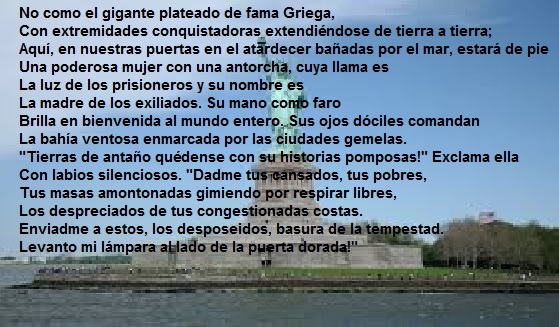
(Translation by Jorge E. Sanint)


 mexfiles.net