Read the review, maybe see the movie, but definitely BUY THE BOOK!
Yeah… this one:
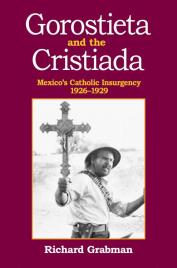
Available as an e-book worldwide (here) and also in a printed version distributed in Mexico.
Catholic News Services’s David Agren provides some balance to the bally-hoo surrounding the Gorostieta movie, released as “Cristiada” in Mexico and “No Greater Glory” in the U.S.
The rebellion saw Catholic clergy and laity taking up arms to oppose government efforts to harshly restrict the influence of the church and defend religious freedom. In the end, the rebellion of the Cristero — soldiers for Christ — was quelled in 1929, leaving the church sidelined for much of the last century and its role limited to a pastoral concerns with no say in the public policy arena.
Ask Mexicans about the rebellion and the answers about what it means today depends on a person’s point of view.
Catholics leaders consider the government’s actions to limit church influence that led to the rebellion an attack on religious freedom. Self-described liberals and many in the Mexican political and intellectual classes consider the suppression of the revolt a triumph of the secular state. Some academics and authors are less passionate, describing the uprising as an agrarian conflict with political and religious overtones.
[…]
“It was a violent era and there were a lot of ambitious generals. Gen. Gorostieta was one of them,” said Richard Grabman, author of “Gorostieta and the Cristiada, Mexico’s Catholic Insurgency 1926-1929.”
“The Cristeros attracted a lot of people that were not necessarily religious, but looking for a military solution to social problems,” he said.
Mexico had emerged from a violent revolution during the 1910s, which was fought mainly to end the enduring rule of then-President Jose de la Cruz Porfirio Diaz and give properties to the landless peasants being exploited by hacienda owners.
[…]
Many of the Cristeros were small landowners, unlike those taking up arms in the revolution.
Haciendas were less common in the main areas of the conflict, which covered an area of west-central Mexican known as the Bajio.
“Cristero were small landowners threatened by social change,” Grabman said. “They feared (agrarian reform) would be collective agriculture.”
The relationship between the Bajio landowners and their workers was different from the exploitation on haciendas suffered by peons taking up arms in the revolution.
“They saw their farm workers as family, instead of peons,” Grabman said.
Gorostieta, the retired general, had experience with attempting to suppress peasant uprisings in Morelos state, fighting the forces of revolutionary leader Emilano Zapata, whose troops were fighting for “land and liberty.” Grabman said it left an impression on Gorostieta when he learned that “farmers without military training could be a formidable force when fighting for a belief.”
Other people are quoted too — as they should be.


 mexfiles.net