Nobody knows my name?
I’ve been haunted by this photo, and am honesty not sure where I found it… or who the lad is. If he is alive, he’d be pushing 100 today, and the photographer is also a mystery to me. 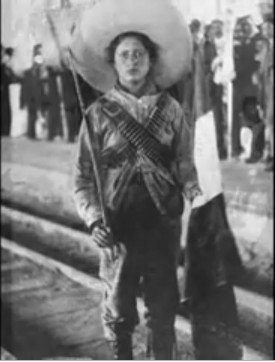
I’m guessing the photo was taken in northern Mexico by one of the several Texas based photographers who worked in El Paso during the Revolution, and made a comfortable living from postcards and photos of the “troubles south of the border.”
Jimmy Hare and Felix Sommerfeld were both pioneering wire service photographers (Hare had combat photography experience, having followed the United States Army into Cuba in 1898 for Colliers‘, who also paid him the then princely sum of $200 a month to stroll across the bridge from El Paso into Juarez for his photos. Of course, Hare insisted on combat pay). Sommerfeld — working for Associated Press — was less well paid, but did a nice sideline selling intelligence on U.S. military operations to both the Maderos and the Kaiser.
Homer Scott — who moved to El Paso for his health — had the lens blown out of his camera while photographing one battle, and wasn’t above shouting orders to whatever unit he was trying to capture on film… hoping for more interesting action shots.
Otis Aultman, who ended up in El Paso to live out his childhood dream of being a cowboy (and figured news photographer was about the same thing) was “the only photographer Pancho Villa trusted”. However, when Villa started to realize how much his photograph was worth in the news market, he began insisting on being photographed by Mexican lensmen — returning at least a small sum to the Mexican economy.
Walter Horne was the guy who really made a killing out of the killing. A pool hustler by trade, Horne realized that the bizarre Victorian attitudes about memento mori hadn’t — uh — completed died out. And, to most people at the time, El Paso and the Mexican frontier was still the “wild west.” Horne´s series of firing squad executions were quite popular souvenirs, and — for a price — he’d pose soldiers from Fort Bliss with a couple dead Mexicans and print up postcards to send back to moms and pops.
None of these gentlemen will be making money off this photo, if we use it, as intended, as cover art for Ray Acosta’s Revolutionary Days: A Chronology of the Mexican Revolution (coming Spring 2010)… but I’d expect those talented scoundrels would still want their cut and I’d be happy to give them credit anyway.


 mexfiles.net
That would be lass, not lad. The photo is also found on the front cover of Elena Poniatowska’s Las Solderas, Women of the Mexican Revolution. All the photos in that book are from the collection of Agustin Victor Casasola found in the Fototeca Nacional of the National Institute of Anthropology and History in Pachuca, Hidalgo, Mexico.
Love your site, by the way, it’s in my top five websites with morning coffee!
Cheers,
Joe Dryden
It is indeed… not on the Mexican version, which I happened to run into today at the Guadalajara Book Fair… I actually wrote the post before I left, and thought it was ironic that I found the photographer (A. Casasolas) and the source today. More on this later.
how can I add to bookrmark your blog? would you like to visit mine? regards!
Very interesting topic. Where would one find a source that substantiates that Hare and Sommerfeld “pioneered” wire service photography? I have never found a picture that Sommerfeld had taken or, for that matter, an article he had written.
I said “pioneering” — as among the first — not that they were the inventors. Sommerfeld, when not working as a spy, worked for Associated Press, but what has happened to his archives I don’t know.
Hello,
This is a very interesting site, would you happen to know a photographer named F. Wray who also potographed the Mexican Revolution?
Hi Ines, has about F. Wray?